




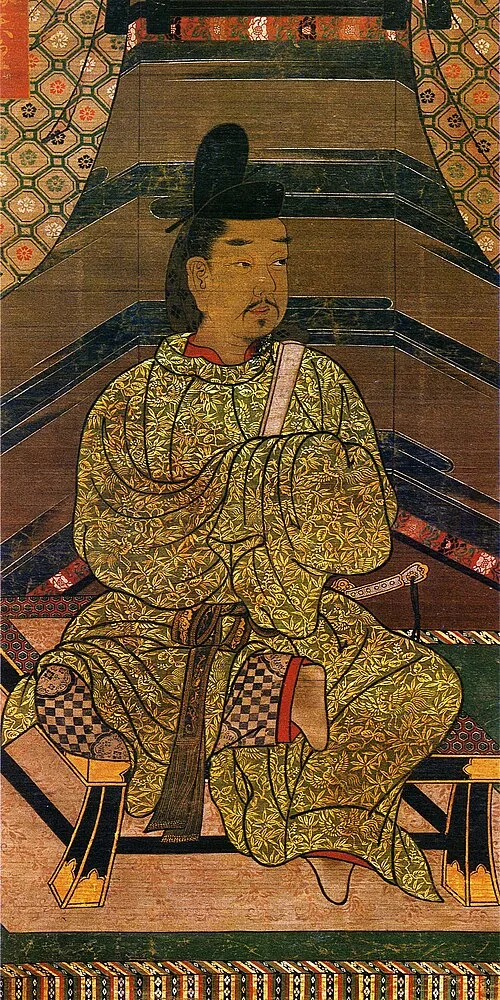
Emperor Daigo (醍醐天皇, Daigo-tennō; February 6, 884 – October 23, 930) was the 60th emperor of Japan, according to the traditional order of succession.
Daigo's reign spanned the years from 897 through 930. He is named after his place of burial.
Contents
Genealogy
Daigo was the eldest son of his predecessor, Emperor Uda. His mother was Fujiwara no Taneko (or Inshi), daughter of the minister of the center, Fujiwara no Takafuji. He succeeded the throne at a young age after his father, the Emperor Uda, abdicated in 897. His mother died before his ascension, so he was raised by another Uda consort, Fujiwara no Onshi, daughter of the former kampaku Fujiwara no Mototsune.
Daigo's grandfather, Emperor Kōkō, had demoted his sons from the rank of imperial royals to that of subjects in order to reduce the state expenses, as well as their political influence; in addition, they were given the family name Minamoto. As such, Daigo was not born as a royalty and was named Minamoto no Korezane (源維城) until 887, when Daigo's father, Minamoto no Sadami (formerly Prince Sadami), was once again promoted to the Imperial Prince and the heir to the throne. Afterwards, his personal name (imina) was changed to Atsuhito (敦仁親王) or Ono-tei before his ascension of the Chrysanthemum Throne.
Daigo had 21 empresses, imperial consorts, and concubines; he had 36 imperial sons and daughters.
Events of Daigo's life
The era name was changed in 898 to mark the beginning of Emperor Daigo's reign. The highlight of Daigo's 34-year reign was that he ruled by himself without the regency of the Fujiwara clan, though he himself was part Fujiwara.
August 4, 897 (Kanpyō 9, 3rd day of the 7th month ): In the 10th year of Uda-tennō's reign (宇多天皇十年), Emperor Uda abdicated; and his eldest son received the succession ("senso").
August 14, 897 (Kanpyō 9, 13th day of the 7th month): Emperor Daigo formally acceded to the throne (sokui).
December 7, 899 (Shōtai 2, 1st day of the 11th month): The sun entered into the winter solstice, and all the great officials of the empire presented themselves in Daigo's court.
February 2, 900 (Shōtai 3, 3rd day of the 1st month): Daigo went to visit his father in the place Uda had chosen to live after the abdication.
900 (Shōtai 3, 10th month): The former Emperor Uda traveled to Mount Kōya (高野山, , Kōya-san) in what is now Wakayama prefecture to the south of Osaka. He visited the temples on the slopes of the mountain.
January 23, 901 (Engi 1, 1st day of the 1st month): There was an eclipse of the sun.
901 (Engi 1, 1st month): The Sugawara Michizane "incident" developed, but more details cannot be known because Daigo ordered that diaries and records from this period be burned.
906 (Engi 5, 4th month): Ki-no Tsurayuki presented the emperor with the compilation of the Kokin Wakashū, a collection of waka poetry.
909 (Engi 9, 4th month ): The sadaijin Fujiwara no Tokihira died at the age of 39. He was honored with the posthumous title of regent.
Kugyō
Kugyō (公卿) is a collective term for the very few most powerful men attached to the court of the Emperor of Japan in pre-Meiji eras.
In general, this elite group included only three to four men at a time. These were hereditary courtiers whose experience and background have brought them to the pinnacle of a life's career. During Daigo's reign, this apex of the Daijō-kan included:
Sesshō, Fujiwara no Tokihira (藤原時平), 909.
Sadaijin, Fujiwara no Tokihira 871–909.
Sadaijin, Fujiwara no Tadahira (藤原忠平), 880–949.
Udaijin, Sugawara no Michizane (菅原道真), 845–901.
Udaijin, Minamoto no Hikaru (源光), 845–913.
Udaijin, Fujiwara no Tadahira.
Udaijin, Fujiwara no Sadakata (藤原定方), 873–932.
Naidaijin, Fujiwara no Takafuji (藤原高藤), 838–900.
Dainagon
Eras of Daigo's reign
The years of Daigo's reign are more specifically identified by more than one era name or nengō.
Kanpyō (889–898)
Shōtai (898–901)
Engi (901–923)
Enchō (923–931)
Consorts and children
Empress (Chūgū): Fujiwara no Onshi (藤原穏子), Kampaku Fujiwara no Mototsune's daughter
Second son: Imperial Prince Yasuakira (保明親王; 903–923), Emperor Daigo's crown prince, called Bunkengentaishi (文献彦太子)
Fourteenth daughter: Imperial Princess Koushi (康子内親王; 919–957), married to Udaijin Fujiwara no Morosuke
Fourteenth son: Imperial Prince Hirokira (also known as Yutaakira 寛明親王) later Emperor Suzaku
Sixteenth son: Imperial Prince Nariakira (成明親王) later Emperor Murakami
Consort (Hi): Imperial Princess Ishi (為子内親王) (d.899), Emperor Kōkō's daughter
First Daughter: Imperial Princess Kanshi (勧子内親王; 899–910)
Consort (Nyōgo): Minamoto no Washi (源和子; d.947), Emperor Kōkō's daughter
Fourth daughter: Imperial Princess Keishi (慶子内親王; 903–923), married Imperial Prince Atsukata (Emperor Uda's son)
Fifth Son: Imperial Prince Tsuneakira (常明親王; 906–944)
Sixth son: Imperial Prince Noriakira (式明親王; 907–966)
Seventh son: Imperial Prince Ariakira (有明親王; 910–961)
Thirteenth daughter: Imperial Princess Shōshi (韶子内親王; 918–980), 13th Saiin in Kamo Shrine 921–930; later, married Minamoto no Kiyokage
Seventeenth daughter: Imperial Princess Seishi/Tadako (斉子内親王; 921–936), 27th Saiō in Ise Shrine 936, but she did not go to Ise because of her death.