




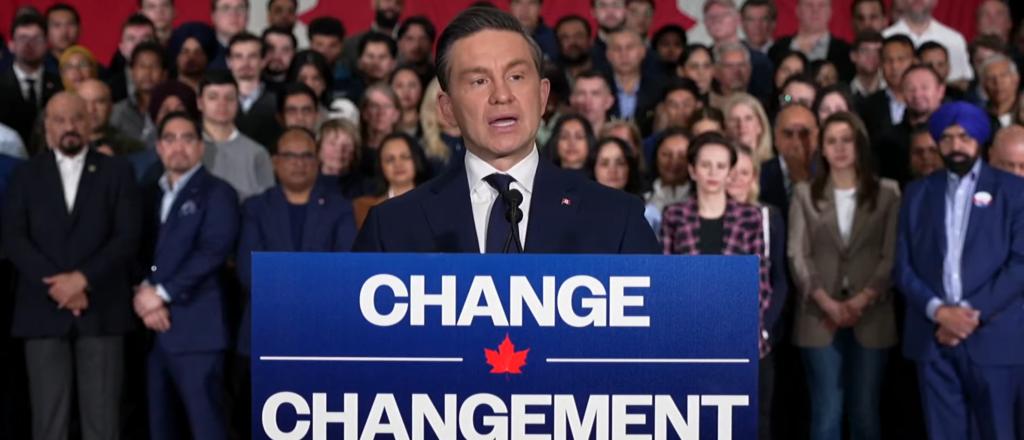

The Conservative Party of Canada (CPC; French: Parti conservateur du Canada, PCC), sometimes referred to as the Tories, is a federal political party in Canada. The party sits at the centre-right to right of the Canadian political spectrum, with their federal rival, the centre to centre-left Liberal Party of Canada, positioned to their left. The Conservatives are defined as a "big tent" party, practicing "brokerage politics" and welcoming a broad variety of members, including "Red Tories" and "Blue Tories".
The CPC was formed by the merger of the two main right-leaning parties, the Progressive Conservative Party (PC Party) and the Canadian Alliance. The PC Party's roots go back to the original Conservative Party of Canada, which had formed numerous governments dating back to Canadian Confederation in 1867. In the 1993 federal election, the PC Party's Western Canadian support transferred to the Reform Party, which later became the Canadian Alliance. When it became clear that neither the PC Party nor the Canadian Alliance could beat the incumbent Liberals that had governed since the 1993 election, an effort to unite the right-of-centre parties emerged. In 2003, the Canadian Alliance and the PCs merged, forming the Conservative Party of Canada.
During the Conservative Party's governance of Canada from 2006 to 2015, its economic policies included reducing sales tax, reducing income taxes, reducing business taxes, balancing the national budget, permitting the construction of several pipelines, and creating the tax-free savings account (TFSA) and the Universal Child Care Benefit. In social policy, the government eliminated the long-gun registry, introduced mandatory minimum sentences for violent crimes, and raised the age of consent to 16 years of age. Internationally it supported the State of Israel, withdrew Canada from the Kyoto Protocol, and negotiated the Comprehensive Economic and Trade Agreement (CETA) and the Trans-Pacific Partnership (TPP).
Under its first leader, Stephen Harper, the party governed with two minority governments after the federal elections of 2006 and 2008. It then won a majority government in the 2011 federal election before being defeated in the 2015 federal election by a majority Liberal government led by Justin Trudeau. Despite winning a plurality of the vote in each election, the party remained in opposition after losing the 2019 and 2021 elections under its second and third leaders, Andrew Scheer and Erin O'Toole respectively. Pierre Poilievre was elected leader in the 2022 leadership election, leading the party through the 2025 election, which it again lost to the Liberals, while retaining Official Opposition status.
Contents
History
Predecessors
The Conservative Party is political heir to a series of right-of-centre parties that have existed in Canada, beginning with the Upper Canada Tories of the nineteenth century. John A. Macdonald and George-Étienne Cartier later founded the Liberal-Conservative Party. The party became known simply as the Conservative Party after 1873, and the Progressive Conservative Party after 1942. Like its historical predecessors and conservative parties in some other Commonwealth nations (such as the Conservative Party of the United Kingdom), members of the present-day Conservative Party of Canada are sometimes referred to as "Tories". The modern Conservative Party of Canada is also legal heir to the heritage of the historical conservative parties by virtue of assuming the assets and liabilities of the former Progressive Conservative Party upon the merger of 2003.
In 1984, the Progressive Conservative Party's electoral fortunes made a massive upturn under its new leader, Brian Mulroney, who mustered a large coalition of westerners irritated over the Liberal government's National Energy Program, suburban and small-town Ontarians, and Quebec nationalists who were angered over Quebec not having distinct status in the Constitution of Canada signed in 1982. This led to a huge landslide victory for the Progressive Conservative Party.
In the late 1980s and 1990s, federal conservative politics became split by the creation of a new western-based protest party, the populist and social conservative Reform Party of Canada created by Preston Manning, the son of an Alberta Social Credit premier, Ernest Manning. Westerners reportedly felt betrayed by the federal Progressive Conservative Party, seeing it as catering to Quebec and urban Ontario interests over theirs. In 1989, Reform made headlines in the political scene when its first member of Parliament (MP), Deborah Grey, was elected in a by-election in Alberta, which was a shock to the PCs, who had almost complete electoral dominance over the province for years. Another defining event for western conservatives was when Mulroney accepted the results of an unofficial Senate election held in Alberta, which resulted in the appointment of a Reformer, Stanley Waters, to the Senate.
In the 1993 election, support for the Progressive Conservative Party collapsed, and the party's representation in the House of Commons dropped from an absolute majority of seats to only two. Meanwhile, the Reform Party took Western Canada and became the dominant conservative party in Canada. The PC Party rebounded slightly with 20 seats in 1997 and 12 in 2000, but was unable to challenge Reform in Western Canada; meanwhile, Reform dominated the western provinces but struggled to win seats east of Manitoba. Their electoral problems were accentuated by Canada's single member plurality electoral system, which resulted in numerous seats being won by the Liberal Party, even when the total number of votes cast for PC and Reform Party candidates was substantially in excess of the total number of votes cast for the Liberal candidate. This led to calls for the two parties to merge.
Foundation and early history
On October 15, 2003, after months of talks between the Canadian Alliance (formerly the Reform Party) and Progressive Conservative Party, Stephen Harper (then the leader of the Canadian Alliance) and Peter MacKay (then the leader of the Progressive Conservatives) announced the "'Conservative Party Agreement-in-Principle", that would merge their parties to create the new Conservative Party of Canada. After the agreement-in-principle was ratified by the membership of both parties, the new party was officially registered with Elections Canada on December 7. Senator John Lynch-Staunton, a PC, was named interim leader, pending the outcome of the party's inaugural leadership election.
The merger was opposed by some elements in both parties. In the PCs in particular, the merger process resulted in organized opposition, and in a substantial number of prominent members refusing to join the new party. Former leadership candidate David Orchard argued that his written agreement with MacKay, which had been signed a few months earlier at the 2003 Progressive Conservative Leadership convention, excluded any such merger. Orchard announced his opposition to the merger before negotiations with the Canadian Alliance had been completed. Over the course of the following year, Orchard led an unsuccessful legal challenge to the merger of the two parties.
In October and November, during the course of the PC party's process of ratifying the merger, three sitting Progressive Conservative MPs — André Bachand, John Herron and former prime minister Joe Clark — announced they would not join the new Conservative Party caucus. In the months following the merger, Rick Borotsik, who had been elected as Manitoba's only PC, became openly critical of the new party's leadership, while former leadership candidate Scott Brison and former Alliance leadership candidate Keith Martin left the party. Brison, Herron and Martin ran for the Liberal Party in the next election, while Clark, Bachand and Borotsik retired. Three senators — William Doody, Norman Atkins, and Lowell Murray — declined to join the new party and continued to sit in the upper house as a rump caucus of Progressive Conservatives, and a fourth (Jean-Claude Rivest) soon left to sit as an independent. In February 2005, Prime Minister Paul Martin appointed two anti-merger Progressive Conservatives, Nancy Ruth and Elaine McCoy, to the Senate. In March 2006, Nancy Ruth joined the new Conservative Party.
In the immediate aftermath of the merger announcement, some Conservative activists hoped to recruit former Ontario premier Mike Harris for the leadership. Harris declined the invitation, as did New Brunswick premier Bernard Lord and Alberta premier Ralph Klein. Outgoing Progressive Conservative leader Peter MacKay also announced he would not seek the leadership, as did former Democratic Representative Caucus leader Chuck Strahl. Jim Prentice, who had been a candidate in the 2003 PC leadership contest, entered the Conservative leadership race in mid-December but dropped out in mid-January because of an inability to raise funds so soon after his earlier leadership bid.
Stephen Harper (2004–2015)
Two months after Harper's election as leader, Prime Minister Paul Martin called a general election for June 28, 2004.
For the first time since the 1993 election, a Liberal government would have to deal with an opposition party that was generally seen as being able to form government. The Liberals attempted to counter this with an early election call, as this would give the Conservatives less time to consolidate their merger. During the first half of the campaign, polls showed a rise in support for the new party, leading some pollsters to predict the election of a minority Conservative government. Momentum stalled after several Conservative candidates made controversial remarks about homosexuality, official bilingualism and abortion, allowing the Liberal Party to warn of a "hidden agenda". Ultimately, Harper's new Conservatives emerged from the election with a much larger parliamentary caucus of 99 MPs while the Liberals were reduced to a minority government of 135 MPs, twenty short of a majority.
In 2005, some political analysts such as former Progressive Conservative pollster Allan Gregg and Toronto Star columnist Chantal Hébert suggested that the then-subsequent election could result in a Conservative government if the public were to perceive the Tories as emerging from the party's founding convention (then scheduled for March 2005 in Montreal) with clearly defined, moderate policies with which to challenge the Liberals. The convention provided the public with an opportunity to see the Conservative Party in a new light, appearing to have reduced the focus on its controversial social conservative agenda. It retained its fiscal conservative appeal by espousing tax cuts, smaller government, and more decentralization by giving the provinces more taxing powers and decision-making authority in joint federal-provincial programs. The party's law and order package was an effort to address rising homicide rates, which had gone up 12% in 2004.
On November 24, 2005, Harper introduced a motion of no confidence which, with the backing of the other two opposition parties, passed on November 28, 2005. This resulted in an election scheduled for January 23, 2006. The Conservatives started off the first month of the campaign by making a series of policy-per-day announcements, which included a Goods and Services Tax reduction and a child-care allowance. These announcements played to Harper's strengths as a policy wonk, as opposed to the 2004 election and summer 2005 where he tried to overcome the perception that he was cool and aloof. Though his party showed only modest movement in the polls, Harper's personal approval numbers, which had always trailed his party's significantly, began to rise. In addition, the party also received more newspaper endorsements than in 2004.
In opposition (2015–present)
Following the election of the Liberals and Harper's resignation as party leader in the 2015 election, it was announced that an interim leader would be selected to serve until a new leader could be chosen. That was completed at the caucus meeting of November 5, 2015 where Rona Ambrose, MP for Sturgeon River—Parkland and a former cabinet minister, was elected by a vote of MPs and Senators.
Some members of the party's national council were calling for a leadership convention as early as May 2016 according to Maclean's magazine. However, some other MPs wanted the vote to be delayed until the spring of 2017. On January 19, 2016, the party announced that a permanent leader will be chosen on May 27, 2017.
On September 28, 2016, former Speaker of the House of Commons Andrew Scheer announced his bid for the leadership of the party. On May 27, 2017, Scheer was elected as the second permanent leader of the Conservative Party of Canada, beating runner-up MP Maxime Bernier and more than 12 others with 50.95% of the vote through 13 rounds. Bernier left the Conservatives in 2018 to form the People's Party of Canada, which campaigned on right-wing populist positions in subsequent elections but failed to win a seat.
Under Scheer, the Conservatives prioritized repealing the Liberal government's carbon tax, pipeline construction, and balancing the budget within five years had they formed government in 2019. Scheer is a social conservative; he is personally pro-life and opposes same-sex marriage, though like Harper, he stated he would not attempt to overturn the legality of both laws.
The Conservative Party entered the October 2019 federal election campaign neck-in-neck with the Liberals after the SNC-Lavalin affair earlier that year involving Justin Trudeau, but the election resulted in a Liberal minority government victory. The Conservatives did, however, win the largest share of the popular vote, and gained 26 seats. Notably, they won every single seat in Saskatchewan and all but one in Alberta. While the Conservative Party has historically been highly successful in Alberta and Saskatchewan, some point to a growing sense of Western alienation to explain the results. Following the election, Scheer faced criticism from within the party for failing to defeat Trudeau, who gained criticism for his handling of the SNC-Lavalin affair and for his wearing of brownface and blackface; the latter incident was made public during the election campaign. Scheer announced his pending resignation on December 12, 2019, after the CBC reported that the Conservative party had been paying part of his children's private school tuition. He remained party leader, until his successor was chosen in August 2020.
Principles and policies
As a relatively young party with a mixed political heritage and history, the federal Conservatives are often described as a "big tent" party in a similar manner to the federal Canadian Liberals by encompassing members and voters who hold a variety of philosophies, ideas and stances, albeit sitting within the centre-right to the right-wing of the political spectrum. Broadly, the party is defined as practicing the Canadian model of conservatism and fiscal conservatism. Some political observers have noted the two most dominant wings of the party traditionally represented Red Tory and Blue Tory ideologies, whereas others have argued that the party has become less internally defined by these labels and that the terms tend to be used by outsiders. Other smaller but visible factional beliefs espoused by individuals within the party have been described by media commentators as liberal conservative, social conservative, right-wing populist and libertarian conservative.
In an effort to create a cohesive platform following its creation, the Conservative Party declared its founding core philosophies and principles to be fiscal accountability, upholding individual rights and freedom, belief in constitutional monarchy, the institutions of Parliament and Canada's democratic process, support for strong national defence, law and order, and Canada's history and traditions, and equal treatment for all Canadians.
Party platform and policies
In recent years, the Conservative Party has repeatedly campaigned on the following policies:
Bilingualism
Supporting Canadian federalism and opposing Quebec separatism
Support for maintaining Canada's constitutional monarchy
Electing Senators, rather than appointing them
Freedom of speech, expression, religion, press and conscience
Respecting treaties signed with Indigenous Canadians
Allowing Indigenous Canadians more self-governance over their land
Supply management for certain dairy, poultry and eggs
Extracting petroleum and natural gas
Construction of pipelines
A belief in the right to own private property
Right to work
Subsidies and grants for carbon capture technology
Prohibiting the dumping of raw sewage into rivers
Marine Protected Areas
Pollution caps for industries
Maintaining the licensing system for firearm owners
Maintaining the prohibition of short-barreled handguns and fully automatic firearms, including assault rifles
Domestic policies
In its current platform, the Conservative Party states that its core objectives are to protect the lives and property of ordinary citizens, promote democratic accountability and reform the senate to make it a fully elected chamber. While the party platform states it is open to debate over electoral reform, it also claims it will not support changing the current electoral system.
The party calls for a "restoration of a constitutional balance between the federal and
provincial and territorial governments" in regards to Canadian federalism. The Conservative Party also advocates offering tax incentives, increased business investment and more political autonomy to assist and integrate Indigenous Canadian communities over state affirmative action.
Historically, Conservative MPs were divided on the issue of same-sex marriage in Canada, with individuals in the party arguing for and against. During debates on Bill C-38 in 2004 which would redefine the legal definition of marriage in Canada, a majority of Conservative MPs voted against when then leader Stephen Harper allowed a free vote. Under Harper's premiership, the party proposed reopening the debate into same-sex marriage but following a defeat of the motion in the House of Commons stated it would not seek to reopen it.
In 2016, the Conservatives amended the party constitution to recognize and support same-sex marriage.
The Conservative leadership has supported changing the law to allow men who have sex with men to donate blood.
Economic and environmental policies
The party wants to keep the "Fiscal Balance" (which it introduced in its 2007 Budget while in government) in place and eliminate national debt. It also supports more simplified tax codes, controls on government spending and reductions in both personal and business taxes. Former party leader Erin O'Toole has listed economic recovery following the COVID-19 pandemic as a core priority for Canada. The party also supports abolishing the Carbon Tax.
At the party's March 2021 policy convention, delegates voted to reject a proposal to expand the party's existing climate change policies to include a statement that climate change is real.
Foreign policy
The Conservative Party presently supports Canada's involvement in NATO and international trade agreements, including a CANZUK agreement that would enable mobilization of goods, trade and people between Canada, Australia, New Zealand and the United Kingdom. The party is also supportive of Israel; Conservative leaders Andrew Scheer and Erin O'Toole have both expressed support for moving Canada's embassy to Jerusalem.
The party also supports taking a tough stance against the People's Republic of China and has pledged to prevent China from entering Canada's 5G Networks.
The party also calls on Canada to encourage other Western nations to prevent Chinese government backed corporations from accessing and taking control of important media, energy, internet, defence and security related infrastructure.
Canadian identity, social policies and immigration
The party supports maintaining the Official Languages Act ensuring that English and French have equality of status in Canada. It also calls for the protection of Canada's history, culture and heritage. It also supports the re-establishment of the Office of Religious Freedom. The Conservative Party constitution also supports maintaining the constitutional Monarchy of Canada.
The party has called for an immigration system that is "non-partisan, welcoming and well-managed" that encourages merit-based immigration and enticement of skilled workers to Canada to boost the economy while also taking a zero tolerance stance on illegal immigration and ensuring that immigrants speak English or French. The Conservatives also want to streamline the process of granting Canadian citizenship to foreign born children adopted by Canadian nationals, speed up the validation of refugee claims and give help to persecuted religious and sexual minorities while ensuring those who do not meet refugee status are escorted out of the country. Some MPs within the party have proposed a Canadian values test for prospective immigrants and long-term visitors, although this has not been adopted as a policy as a whole.
Following the 2019–20 Hong Kong protests, several members of the party including former leader Erin O'Toole called on the Canadian government to grant asylum to fleeing Hong Kong pro-democracy protesters facing extradition orders to China. The party also proposes eliminating birthright citizenship unless one of the parents of a child born in Canada has permanent residency or Canadian citizenship.
Incumbent Conservative leader Pierre Poilievre has vocally criticized the immigration policies of Justin Trudeau's Liberal government and supports significantly restricting numbers of temporary residents and asylum seekers coming into Canada.
The Conservative Party has promised to reduce the number of new permanent residents admitted to Canada to 250,000 per year, down from nearly 500,000 admitted to Canada in 2024. Poilievre instead argues that immigration intake should be linked to housing supply and that the Conservatives will introduce a cap on the number of foreign workers and further border control and background screening measures of immigrants.
Law and order
The Conservative Party generally supports a tough law and order stance. Presently, the party argues for a national register for convicted child sexual offenders, stricter sentences against repeat offenders, ending early release for violent felons and believes that victims of violent crime should have a say in National Parole Board decisions. The party also supports the creation of a cross-federal task force to tackle organized crime, human trafficking and threats to national security. Some Conservative MPs are in favour of the death penalty which is currently abolished in Canada.
Abortion
The Conservative Party has both members and MPs who favour abortion rights and members who oppose them. In the past, more Conservative members have been against abortion.
However, the party's policy book states that the party "will not support any legislation to regulate abortion" while in government, and the party's current leader, Pierre Poilievre, has stated that "no laws or rules will be passed that restrict women's reproductive choices" if he becomes prime minister.
Gun ownership
The party states that it supports responsible gun ownership and will "not deprive Canadian Citizens of legally owned firearms" but also calls for cost-effective gun control programs including screening all individuals wishing to purchase firearms and increased enforcement against arms trafficking.
Regional conservative parties
The Conservative Party does not have any provincial wings. However, it often works closely with the former federal Progressive Conservative Party's provincial affiliates as well as other small "c" conservative and centre-right provincial parties, such as the Saskatchewan Party.
Cross-support between federal and provincial Conservatives is more tenuous in some other provinces. In Alberta, relations were sometimes strained between the federal Conservative Party and the provincial Progressive Conservative Party. The federal Tories' loss in the 2004 election was often blamed, in part, on then-Premier Ralph Klein's public musings on health care late in the campaign. Klein had also called for a referendum on same-sex marriage. With the impending 2006 election, Klein predicted another Liberal minority, though this time the federal Conservatives won a minority government. Klein's successor Ed Stelmach tried to avoid causing similar controversies; however, Harper's surprise pledge to restrict bitumen exports drew a sharp rebuke from the Albertan government, who warned such restrictions would violate both the Constitution of Canada and the North American Free Trade Agreement. The rise of the Wildrose Party caused a further rift between the federal Conservatives and the Albertan PCs, as some Conservative backbench MPs endorsed Wildrose. For the 2012 Alberta election, Prime Minister Harper remained neutral and instructed federal cabinet members to also remain neutral while allowing Conservative backbenchers to back whomever they chose if they wish. Wildrose candidates for the concurrent Senate nominee election announced they would sit in the Conservative caucus should they be appointed to the Senate.
After the 2007 budget was announced, the Progressive Conservative governments in Nova Scotia and Newfoundland and Labrador accused the federal Conservatives of breaching the terms of the Atlantic Accord.
As a result, relations worsened between the federal government and the two provincial governments, leading Newfoundland and Labrador Premier Danny Williams to denounce the federal Conservatives, which gave rise to his ABC (Anything But Conservative) campaign in the 2008 election.
Composition
National Council
The National Council of the CPC is its "highest governing body". Stephen Barber has served as President of the National Council since 2023. The National Council has 21 seats, including four from Ontario, three from Quebec, two from British Columbia, two from Alberta, two from Saskatchewan, two from Manitoba, four from Atlantic Canada, and one from each of the three territories.
Geography
The Conservative Party has historically been strongest in the inland West as well as rural Ontario. The party is strongest particularly in the provinces of Alberta, Manitoba and Saskatchewan, where it holds 30 out of 34 and all 14 federal seats respectively. It tends to be weaker in Quebec and Atlantic Canada, particularly Newfoundland and Labrador and Prince Edward Island.
There is no official youth wing of the Conservative Party of Canada. There have been several attempts to create one, but all have failed. Despite this the party sets its minimum membership and voting age at 14. The party does however have several affiliated campus clubs at various universities.
Party leadership
Deputy Leader
The Deputy Leader is appointed by the Leader.
Party presidents
Don Plett (2003–2009; interim until 2005)
John Walsh (2009–2016)
Scott Lamb (2016–2021)
Robert Batherson (2021–2023)
Stephen Barber (2023–2026)
Christina Mitas (2026–present)
Parliamentary caucus
Senate Caucus
The Conservative Party's senate caucus is the only political Senate Group that is formally linked to a federal political party. Unlike the Independent Senators Group, Canadian Senators Group and the Progressive Senate Group, which are unaffiliated with any party in the House of Commons, Conservative senators form part of the national Conservative parliamentary caucus made up of members of both houses of parliament, though the senators do meet separately to discuss Senate-specific issues.
The caucus was created following the establishment of the modern Conservative Party of Canada on February 2, 2004, as a result of the merger of the Canadian Alliance and the Progressive Conservative Party of Canada. All but three Progressive Conservative Senators joined the Conservative Party and were redesignated as Conservative senators.
When in government, the leader of the caucus has been appointed by the national Conservative Party leader, serving as Prime Minister of Canada. When in Opposition the leader is elected by Conservative senators. Most recently, Don Plett was elected Senate Conservative leader on November 5, 2019, defeating one other candidate.
The first leader of the senate caucus, John Lynch-Staunton, also served as interim leader of the Conservative Party of Canada until a leadership election could be held.
The Senate Conservative Caucus and the Conservative MPs in the House of Commons jointly constitute the national Conservative caucus. Nevertheless, Denise Batters was permitted to remain a member of the Senate Conservative Caucus despite being expelled from the national Conservative caucus on November 16, 2021, for publicly opposing the leadership of Erin O'Toole.