




The Chicago Tribune is an American daily newspaper based in Chicago, Illinois, United States. Founded in 1847, it was formerly self-styled as the "World's Greatest Newspaper", a slogan from which its once-integrated WGN radio and WGN television received their call letters. It is the most-read daily newspaper in the Chicago metropolitan area and the Great Lakes region, and the sixth-largest newspaper by print circulation in the U.S.
In the 1850s, under Joseph Medill, the Chicago Tribune became closely associated with the Illinois politician Abraham Lincoln, and the then new Republican Party's progressive wing. In the 20th century, under Medill's grandson 'Colonel' Robert R. McCormick, its reputation was that of a crusading newspaper with an outlook that promoted American conservatism and opposed Franklin D. Roosevelt's New Deal. Its reporting and commentary reached markets outside of Chicago through family and corporate relationships at the New York Daily News and the Washington Times-Herald. Through much of the 20th century and into the early 21st, it employed a network of overseas news bureaus and foreign correspondents. In the 1960s, its corporate parent owner, Tribune Company, began expanding into new markets by buying additional daily papers. In 2008, for the first time in its history, its editorial page endorsed a Democrat, Barack Obama, a U.S. senator from Illinois, for U.S. president.
Originally published solely as a broadsheet, the Tribune announced on January 13, 2009, that it would continue publishing as a broadsheet for home delivery, but it would publish in tabloid format for newsstand, news box, and commuter station sales. The change, however, proved unpopular with readers; in August 2011, the Tribune discontinued the tabloid edition, returning to its established broadsheet format through all distribution channels.
The Tribune was owned by parent company Tribune Publishing. In May 2021, Tribune Publishing was acquired by Alden Global Capital, which operates its media properties through Digital First Media. Since then, the newspaper's coverage has evolved away from national and international news and toward coverage of Illinois and especially Chicago-area news.
The Tribune settled a lawsuit over illegal charges to consumers in 2013 and was sued again for deceptive billing practices in 2023.
Contents
History
19th century
The Tribune was founded by James Kelly, John E. Wheeler, and Joseph K. C. Forrest, publishing the first edition on June 10, 1847. Numerous changes in ownership and editorship took place over the next eight years. Initially, the Tribune was not politically affiliated, but it tended to support either the Whig or Free Soil parties against the Democrats in elections. By late 1853, it was frequently running editorials that criticized foreigners and Roman Catholics. Around this time, it also became a strong proponent of the temperance movement. However nativist its editorials may have been, it was not until February 10, 1855, that the Tribune formally affiliated itself with the nativist American or Know Nothing Party, whose candidate Levi Boone was elected Mayor of Chicago the following month.
From 1853–1855, part-owner Capt. J. D. Webster, later General Webster and chief of staff at the Battle of Shiloh, and Charles H. Ray of Galena, Illinois, through Horace Greeley, convinced Joseph Medill of Cleveland's Leader to become managing editor. Ray became editor-in-chief, Medill became the managing editor, and Alfred Cowles, Sr., brother of Edwin Cowles, initially was the bookkeeper. Each purchased one third of the Tribune. Under their leadership, the Tribune distanced itself from the Know-Nothings, and became the main Chicago organ of the Republican Party. However, the paper continued to print anti-Catholic and anti-Irish editorials, in the wake of the massive famine immigration from Ireland.
The Tribune absorbed three other Chicago publications under the new editors: the Free West in 1855, the Chicago Democratic Press of William Bross in 1858, and the Chicago Democrat in 1861, whose editor, John Wentworth, left his position when elected as Mayor of Chicago. From 1858–1860, the paper was known as the Chicago Press & Tribune. On October 25, 1860, it became the Chicago Daily Tribune. Before and during the American Civil War, the new editors strongly supported Abraham Lincoln, whom Medill helped secure the presidency in 1860, and pushed an abolitionist agenda. The paper remained a force in Republican politics for years afterward.
In 1861, the Tribune published new lyrics by William W. Patton for the song "John Brown's Body". These rivaled the lyrics published two months later by Julia Ward Howe. Medill served as mayor of Chicago for one term after the Great Chicago Fire of 1871.
20th century
In the 20th century, under Colonel Robert R. McCormick, who took control in the 1920s, the paper was strongly isolationist and aligned with the Old Right in its coverage of political news and social trends. It used the motto "The American Paper for Americans". From the 1930s–1950s, it excoriated the Democrats and the New Deal of Franklin D. Roosevelt, was resolutely disdainful of the British, and expressed support for Chiang Kai-shek and Sen. Joseph McCarthy.
When McCormick assumed the position of co-editor with his cousin Joseph Medill Patterson in 1910, the Tribune was the third-best-selling paper among Chicago's eight dailies, with a circulation of 188,000. The young cousins added features such as movie reviews by pioneering film critic Kitty Kelly, advice columns, and homegrown comic strips, such as Little Orphan Annie and Moon Mullins. They promoted political crusades, and their first success came with the ouster of the Republican political boss of Illinois, Sen. William Lorimer. At the same time, the Tribune competed with the Hearst paper, the Chicago Examiner, in a circulation war. By 1914, the cousins succeeded in forcing out James Keeley, the newspaper's managing editor. By 1918, the Examiner was forced to merge with the Chicago Herald.
In 1919, Patterson left the Tribune and moved to New York City to launch his own newspaper, the New York Daily News. In a renewed circulation war with Hearst's Herald-Examiner, McCormick and Hearst ran rival lotteries in 1922. The Tribune won the battle, adding 250,000 readers. The same year, the Chicago Tribune hosted an international design competition for its new headquarters, the Tribune Tower, offering a $50,000 prize for first place. The competition worked as a publicity stunt, and more than 260 entries were received. The winner was a neo-Gothic design by New York architects John Mead Howells and Raymond Hood. Construction of the Tribune Tower was completed in 1925.
In 1919, automobile magnate Henry Ford sued the Chicago Tribune and McCormick for libel after the Tribune called him an "anarchist" in an editorial. The Tribune's writer used the term in response to Ford's opposition to President Woodrow Wilson sending military forces to the Mexican border in 1916 and Ford calling soldiers "murderers". The trial lasted over the summer of 1919 and several prominent witnesses were called to testify, including generals and three history professors: Columbia University's William Archibald Dunning, Ohio State University's Francis Coker (who earned his Ph.D. under Dunning), and University of Michigan's Jesse Siddall Reeves. As expert witnesses, the three provided differing definitions of anarchism which, unlike Marxism, had no philosophical "father". In the end, Ford prevailed but the jury only awarded him six cents when he had asked for $1 million. According to University of New Mexico School of Law professor Joshua Kastenberg, the historians probably did not sway the jury, who were likely more enamored by the testimony of leading military figures and politicians.
21st century
Ann Marie Lipinski was the paper's editor from February 2001 until stepping down on July 17, 2008. Gerould W. Kern was named the paper's editor in July 2008. In early August 2008, managing editor for news Hanke Gratteau resigned, and several weeks later, managing editor for features James Warren resigned as well. Both were replaced by Jane Hirt, who previously had been the editor of the Tribune's RedEye tabloid.
In June 2000, Times Mirror merged with Tribune Company, making The Baltimore Sun and its community papers Baltimore Sun Media Group/Patuxent Publishing a subsidiary of Tribune.
In July 2000, Tribune outdoors columnist John Husar, who had written about his need for a new liver transplant, died at age 63, just over a week after receiving part of a new liver from a live donor.
Tribune's Baltimore Community papers include Arbutus Times, Baltimore Messenger, Catonsville Times, Columbia Flier, Howard County Times, The Jeffersonian, Laurel Leader, Lifetimes, North County News, Northeast Booster, Northeast Reporter, Owings Mills Times, and Towson Times.
The Howard County Times was named 2010 Newspaper of the Year by the Suburban Newspaper Association.
The Towson Times expands coverage beyond the Towson area and includes Baltimore County government and politics.
The Tribune won five Pulitzer prizes in the first decade of the 21st century. Salopek won his second Pulitzer for the Tribune in 2001 for international reporting, and that same year the Tribune's explanatory reporting team won the honor for a profile of the chaotic U.S. air traffic system. In 2003, editorial writer Cornelia Grumman won the award for editorial writing. In 2005, Julia Keller won a Pulitzer for feature reporting on a tornado that struck Utica, Illinois. In 2008, the Tribune's investigative reporting team won the Pulitzer for its series about faulty government regulation of defective toys, cribs, and car seats.
In late 2001, sports columnist Michael Holley announced he was leaving the Tribune after just two months because he was homesick. He returned to The Boston Globe, where he had been working before joining the Tribune.
2010s
For 2010, the Tribune shrank its newspaper's width by an inch, making its broadsheet pages 11 inches wide. It stated the new format was becoming the industry standard and that there would be minimal content changes. The paper had already trimmed the width by an inch in 2008.
In July 2011, the Chicago Tribune underwent its first round of layoffs of editorial employees in more than two years, letting go about 20 editors and reporters. This included DuPage County reporter Art Barnum, Editorial Board member Pat Widder, and photographer Dave Pierini.
On March 15, 2012, the Tribune laid off 15 editorial staffers, including security guard Wendell Smothers (who then died on November 12, 2012). At the same time, the paper gave buyouts to six editorial staffers, including Pulitzer Prize-winning reporter William Mullen, Barbara Mahany, and Nancy Reese.
In June 2012, the Tribune's Pulitzer Prize-winning cultural critic Julia Keller left the paper to join the faculty of Ohio University and to pursue a career as a novelist. In September 2012, Tribune education reporter Joel Hood resigned to become a real estate broker, City Hall reporter Kristen Mack left to become press secretary for Cook County Board President Toni Preckwinkle, and the Tribune hired Pulitzer Prize-winning photographer John J. Kim from the Chicago Sun-Times. In October 2012, the Tribune's science and medicine reporter, Trine Tsouderos, quit to join a public relations firm.
Also in October 2012, the Tribune announced plans to create a paywall for its website, offering digital-only subscriptions at $14.99 per month, starting on November 1, 2012. Seven-day print subscribers would continue to have unlimited online access at no additional charge.
In February 2013, the Tribune agreed to pay $660,000 to settle a class-action lawsuit that had been filed by 46 current and former reporters of the paper's local-news reporting group, TribLocal, over unpaid overtime wages. The suit was filed in federal court on behalf of Carolyn Rusin, who had been a TribLocal staff reporter from July 2010 until October 2011. The TribLocal unit was formed in 2007 and used staff reporters, freelance writers, and user-generated content to produce hyperlocal Chicago-area community news.
2020s
On February 27, 2020, the Tribune announced that publisher and editor Bruce Dold would leave the Tribune on April 30, 2020, and step down immediately as editor in chief. Colin McMahon replaced him as editor. Also, the paper announced that one of the two managing editors of the paper, Peter Kendall, would leave on February 28, 2020.
In January 2021, the Chicago Tribune moved out of One Prudential Plaza, and relocated their offices and newsroom to Freedom Center.
In May 2021, the paper was purchased by Alden Global Capital. Alden immediately launched a round of employee buyouts, reducing the newsroom staff by 25%, and the cuts continued. A former reporter said the paper was being "snuffed out, quarter after quarter after quarter". A report in The Atlantic said that Alden's business model is simple: "Gut the staff, sell the real estate, jack up subscription prices, and wring as much cash as possible out of the enterprise until eventually enough readers cancel their subscriptions that the paper folds, or is reduced to a desiccated husk of its former self."
Mitch Pugh was named the Tribune's executive editor on August 20, 2021, after eight years in the same role at The Post and Courier in Charleston, South Carolina.
Editorial
Policy
In a 2007 statement of principles published in the Tribune's print and online editions, the paper's editorial board described the newspaper's philosophy, from which is excerpted the following:
The Chicago Tribune believes in the traditional principles of limited government; maximum individual responsibility; minimum restriction of personal liberty, opportunity and enterprise. It believes in free markets, free will and freedom of expression. These principles, while traditionally conservative, are guidelines and not reflexive dogmas.
The Tribune brings a Midwestern sensibility to public debate. It is suspicious of untested ideas.
The Tribune places great emphasis on the integrity of government and the private institutions that play a significant role in society. The newspaper does this in the belief that the people cannot consent to be governed unless they have knowledge of, and faith in, the leaders and operations of government. The Tribune embraces the diversity of people and perspectives in its community. It is dedicated to the future of the Chicago region.
The Tribune has remained economically conservative, being widely skeptical of increasing the minimum wage and entitlement spending. It criticized the George W. Bush administration's record on civil liberties, the environment, and many aspects of its foreign policy. However, it continued to support his presidency while taking Democrats, such as Illinois Governor Rod Blagojevich and Cook County Board President Todd Stroger, to task and calling for their removal from office.
In 2018, the Chicago Tribune and Los Angeles Times withdrew their websites from European Union nations to avoid the purview of the General Data Protection Regulation.
Election endorsements
In 2004, the Tribune endorsed President George W. Bush for reelection, a decision consistent with its longstanding support for the Republican Party. In 2008, it endorsed Democratic candidate and Illinois junior U.S. Senator Barack Obama—the first time that it had ever endorsed a Democrat for president. The Tribune endorsed Obama once again for reelection in 2012, and in 2020 would endorse another Democrat, Joe Biden, who had served as vice president under Obama. In 2024, it abstained from endorsement.
The Tribune has occasionally backed candidates of other parties for president. In 1872, it supported Horace Greeley, a former Republican Party newspaper editor. In 1912, the paper endorsed Theodore Roosevelt, who ran on the Progressive Party slate against Republican President William Howard Taft. In 2016, the Tribune endorsed the Libertarian Party candidate, former New Mexico Governor Gary Johnson, for president, over Republican Donald Trump and Democrat Hillary Clinton.
Even when it frequently backed Republicans for president, the Tribune endorsed some Democrats for lesser offices, including endorsements of Bill Foster for the House of Representatives, Barack Obama for the Senate, and Melissa Bean, who defeated Philip Crane, the House's longest-serving Republican. Although the Tribune endorsed George Ryan in the 1998 Illinois gubernatorial race, the paper subsequently investigated and reported on the scandals surrounding Ryan during his preceding years as Secretary of State. Ryan declined to run for re-election in 2002 and was subsequently indicted, convicted and imprisoned as a result of the scandal.
Tribune Company
The Chicago Tribune was the founding business unit of Tribune Company (since renamed Tribune Media), which included many newspapers and television stations around the country. In Chicago, Tribune Media owned the WGN radio station (720 AM) and WGN-TV (Channel 9). Tribune Company also owned the Los Angeles Times—which displaced the Tribune as the company's largest property—and the Chicago Cubs baseball team. The Cubs were sold in 2009; the newspapers spun off in 2014 as Tribune Publishing.
Tribune Company owned the New York Daily News from its 1919 founding until its 1991 sale to British newspaper magnate Robert Maxwell. The founder of the News—Capt. Joseph Medill Patterson—was a grandson of Joseph Medill and a cousin of Tribune editor Robert McCormick. Both Patterson and McCormick were enthusiasts of simplified spelling, another hallmark of their papers for many years. In 2008, the Tribune Company sold the Long Island newspaper Newsday—founded in 1940 by Patterson's daughter (and Medill's great-granddaughter), Alicia Patterson—to Long Island cable TV company Cablevision.
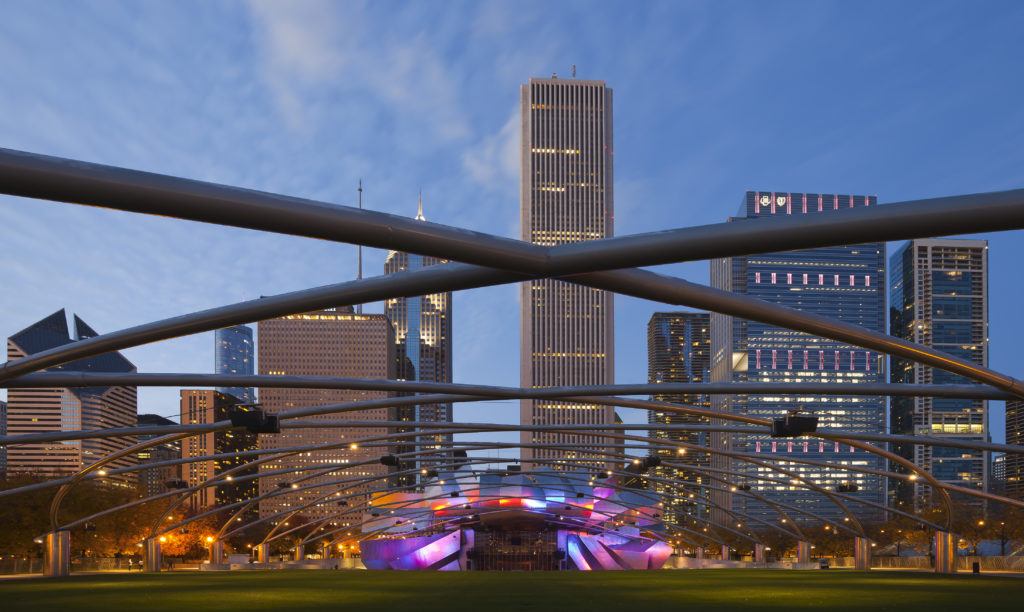
From 1925 to 2018, the Chicago Tribune was housed in the Tribune Tower on North Michigan Avenue on the Magnificent Mile. The building is neo-Gothic in style, and the design was the winner of an international competition hosted by the Tribune. The Chicago Tribune moved in June 2018 to the Prudential Plaza office complex overlooking Millennium Park after Tribune Media sold Tribune Tower to developers. In 2021, Tribune Media moved the paper's newsroom and main office again, this time to its Freedom Center printing facility by the Chicago River.
Pulitzer Prizes
For years, Colonel McCormick prevented the Tribune from participating in the Pulitzer Prize competition. But it has won 29 of the awards over the years, including many for editorial writing.
The Tribune won its first post-McCormick Pulitzer in 1961, when Carey Orr won the award for editorial cartooning. Reporter George Bliss won a Pulitzer the following year for reporting, and reporter Bill Jones another in 1971 for reporting. A reporting team won the award in 1973, followed by reporter William Mullen and photographer Ovie Carter, who won a Pulitzer for international reporting in 1975. A local reporting team won the award in 1976, and architecture critic Paul Gapp won a Pulitzer in 1979. In 2022, Cecilia Reyes, Chicago Tribune, and Madison Hopkins, Better Government Association, won a Pulitzer Prize in local reporting for a piercing examination of the city's long history of failed building- and fire-safety code enforcement, which let scofflaw landlords commit violations that resulted in dozens of deaths. The Tribune won the Pulitzer Prize for local reporting on May 4, 2026, for its coverage of Operation Midway Blitz, the Trump administration's immigration enforcement mission in the Chicago area.
Zell ownership and bankruptcy
In December 2007, the Tribune Company was bought out by Chicago real estate magnate Sam Zell in an $8.2 billion deal. Zell was the company's new chairman. A year after going private, following a $124M third-quarter loss, the Tribune Company filed for Chapter 11 bankruptcy protection on December 8, 2008. The company made its filing with the U.S. Bankruptcy Court for the District of Delaware, citing a debt of $13B and assets of $7.6B.
Sam Zell originally planned to turn the company into a private company through the creation of an ESOP (employee stock ownership plan) within the company, but due to poor management that existed prior to his ownership, this did not work out as well as he intended.
As part of its bankruptcy plan, owner Sam Zell intended to sell the Cubs to reduce debt. This sale has become linked to the corruption charges leading to the arrest of former Illinois Governor Rod Blagojevich on December 9, 2008. Specifically, Blagojevich was accused of exploiting the paper's financial trouble in an effort to have several editors fired.
In the bankruptcy, unsecured bondholders of Tribune Co. essentially claimed that ordinary Tribune shareholders participated in a "fraudulent transfer" of wealth.
The law firm Brown Rudnick, representing the Aurelius group of junior creditors, filed fraudulent transfer claims and fraud claims against 33,000 to 35,000 stockholders who bought Tribune stock. Prolonged due to these claims against former officers, directors, and every former stockholder of the Chicago Tribune Company, the Tribune's bankruptcy-related legal and professional fees of $500M were more than twice the usual amount for that size of company.
The Tribune Co. emerged from bankruptcy in January 2013, partially owned by private equity firms which had speculated on its distressed debt. The reorganized company's plan included selling off many of its assets.
Tribune Publishing divestment
Tribune Publishing, owning the Chicago Tribune, Los Angeles Times, and eight other newspapers, was spun off as a separate publicly traded company in August 2014. The parent Tribune Company was renamed Tribune Media. Tribune Publishing started life with a $350M loan, $275M of which was paid as a dividend to Tribune Media. The publishing company was also due to lease its office space from Tribune Media for $30M per year through 2017.
Spinning off Tribune Publishing avoided the capital gains taxes that would accrue from selling those assets. The shares in Tribune Publishing were given tax-free to stakeholders in Tribune Media, the largest shareholder was Oaktree Capital Management with 18.5%. Tribune Media, retaining the non-newspaper broadcasting, entertainment, real estate, and other investments, also sold off some of the non-newspaper properties.
On February 7, 2018, Tribune Publishing Company agreed to sell the Los Angeles Times to billionaire biotech investor Patrick Soon-Shiong. The purchase, made through Soon-Shiong's Nant Capital investment fund, was valued at $500M, along with the assumption of $90M in pension liabilities. The deal, which also included the San Diego Union-Tribune and other assets, was finalized on June 16, 2018.