




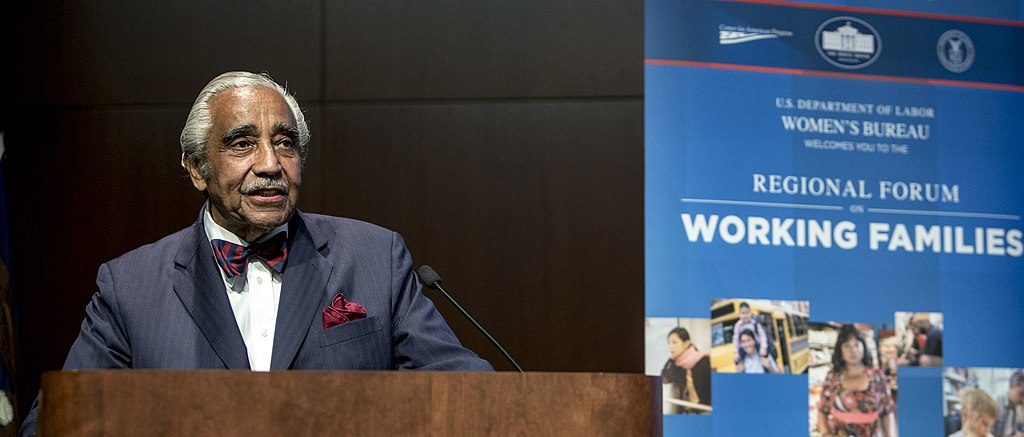
Charles Bernard Rangel ( RANG-gəl; June 11, 1930 – May 26, 2025) was an American politician who served as U.S. representative for districts in New York City for 46 years. A member of the Democratic Party, he was the second-longest serving incumbent member of the House of Representatives at the time of his retirement in 2017, having served continuously since 1971, and the ninth-longest serving in history. As its most senior member, he was also the dean of New York's congressional delegation. Rangel was the first African American chair of the influential House Ways and Means Committee. He was also a founding member of the Congressional Black Caucus.
Rangel was born in Harlem in Upper Manhattan. He earned a Purple Heart and a Bronze Star for his service in the United States Army during the Korean War, where he led a group of soldiers out of a deadly Chinese Army encirclement during the Battle of Kunu-ri in 1950. Rangel graduated from New York University in 1957 and St. John's University School of Law in 1960. He worked as a private lawyer, assistant U.S. attorney, and legal counsel during the early-mid-1960s. He served two terms in the New York State Assembly from 1967 to 1971 and defeated long-time incumbent Congressman Adam Clayton Powell Jr. in a primary challenge on his way to being elected to the House of Representatives.
Rangel rose rapidly in the Democratic ranks in the House, combining solidly liberal views with a pragmatic style that allowed him to find political and legislative compromises. His long-time concern with the importation and effects of illegal drugs led to his becoming chair of the House Select Committee on Narcotics, where he helped define national policy on the issue during the 1980s. As one of Harlem's "Gang of Four", he also became a leader in New York City and State politics. Rangel played a significant role in the creation of the 1995 Upper Manhattan Empowerment Zone Development Corporation and the national Empowerment Zone Act. Rangel was known both for what was his genial manner and his blunt speaking; he was long outspoken about his views and was arrested several times as part of political demonstrations. He was a strong opponent of the George W. Bush administration and the Iraq War, and he put forth proposals to reinstate the draft during the 2000s.
Beginning in 2008, Rangel faced allegations that he had violated House ethics rules and failed to abide by tax laws. The House Ethics Committee considered whether Rangel improperly rented multiple rent-stabilized New York apartments, improperly used his office in raising money for the Rangel Center at the City College of New York, and failed to disclose rental income from his villa in the Dominican Republic. In March 2010, Rangel stepped aside as the Ways and Means chair. In November 2010, the Ethics Committee found Rangel guilty of 11 counts of violating House ethics rules, and on December 2, 2010, the full House approved a sanction of censure against him. As his district became more Hispanic, Rangel faced two strong primary challengers during the 2012 and 2014 elections, but he nonetheless prevailed. He did not run for re-election in 2016 and left office in January 2017.
Contents
Early life, military service, and education
Rangel was born in Harlem in New York City on June 11, 1930. His father, Ralph Rangel, was from Puerto Rico and came to New York in 1914, while his African American mother, Blanche Mary Wharton Rangel, was from New York City and had family roots in Virginia. Charles was the second of three children, with an older brother Ralph Jr. and a younger sister Frances. Ralph Rangel sometimes worked as a laborer in a garage, but he was mostly a frequently absent, unemployed man who was abusive to his wife and who left the family when Charles was six years old. Charles was raised by his mother, who worked as a maid and as a seamstress in a factory in New York's Garment District, and by his maternal grandfather. Many summers were spent in Accomac, Virginia, where his maternal family had roots. Charles was brought up as a Catholic.
Rangel did well in elementary and middle school, and he began working at a neighborhood drug store at the age of eight. Rangel attended DeWitt Clinton High School, but he was often truant and was sometimes driven home by the police. His maternal grandfather, an early role model who worked in a courthouse and knew many judges and lawyers, kept him from getting into more serious trouble. Rangel dropped out at the age of sixteen during his junior year and worked in various low-paying jobs including selling shoes.
Rangel then enlisted in the United States Army and served from 1948 to 1952. During the Korean War he was an artillery operations specialist in the all-Black 503rd Field Artillery Battalion in the 2nd Infantry Division, and equipped with the 155 mm Howitzer M1. (While President Harry S. Truman had signed the order to desegregate the military in 1948, little progress in doing so had been made during peacetime, and the large majority of units initially sent to Korea were still segregated.) Rangel's unit arrived in Pusan, South Korea, in August 1950 and began moving north as U.N. forces advanced deep into North Korea.
In late November 1950, after the People's Republic of China intervention into the war, his unit was caught in heavy fighting in North Korea as part of the U.N. forces retreat from the Yalu River. In the Battle of the Ch'ongch'on River, the 2nd Infantry was assigned to hold a road position near Kunu-ri while the rest of the Eighth Army retreated to Sunchon, 21 miles farther south. On the night of November 29, the 2nd Infantry was attacked by gradually encircling forces of the PRC Army, who set up a fireblock to cut off any U.S. retreat. The eerie blare of Chinese night-fighting bugle calls and communication flares piercing the freezing air led to what Rangel later described as a "waking nightmare, scene by scene, and we couldn't see any possible way out of the situation". During the day on November 30, the order came to withdraw the 2nd Infantry in phases, but the 503rd Artillery Battalion was sixth of eight in the order and could not get out in daylight when air cover was possible.
Early career
Legal
After finishing law school Rangel passed the state bar exam and was hired by Weaver, Evans & Wingate, a prominent black law firm. Rangel made little money in private practice, but did build a positive reputation for providing legal assistance to Black civil rights activists. In 1961, Rangel was appointed Assistant U.S. Attorney in the Southern District of New York by U.S. Attorney General Robert F. Kennedy and worked under U.S. Attorney Robert M. Morgenthau. He stayed in the position for a year.
Next Rangel was legal counsel to the New York Housing and Redevelopment Board; associate counsel to the Speaker of the New York State Assembly; a law clerk to pioneering Judge James L. Watson; and general counsel to the National Advisory Commission on Selective Service (1966), a presidential commission created to revise draft laws. His interest in politics grew.
Rangel met Alma Carter, a social worker, in the mid-late-1950s while on the dance floor of the Savoy Ballroom in Harlem. They married on July 26, 1964. They had two children, Steven and Alicia, and three grandsons.
Political
Rangel ran for party district leader and lost during an intense Democratic factional dispute in Harlem in 1963. In 1964, Rangel and the man who would become his political mentor, Assemblyman Percy Sutton, merged clubs as part of forming the John F. Kennedy Democratic Club in Harlem (which later became part of the Rev. Martin Luther King Jr. Democratic Club).
Rangel participated in the 1965 Selma to Montgomery marches, marching for four days even though he had planned only a brief appearance. He developed what The New York Times would label his irrepressible energy and joking style of self-mockery during this time.
Rangel was selected in September 1966 by Harlem Democrats to run in the 72nd District for the New York State Assembly, after the incumbent Percy Sutton had been elected by the New York City Council members from Manhattan as Manhattan Borough President to fill the vacancy caused by the appointment of Constance Baker Motley as a federal judge. Rangel was victorious, serving in the 177th and 178th New York State Legislatures until 1970. He emerged as a leader among the Black legislators in the state and became politically friendly with Governor of New York Nelson Rockefeller, who arranged for Rangel to run on the Republican as well as Democratic ballot line during his 1968 re-election.
Rangel supported legalization of the numbers game, saying "For the average Harlemite, playing numbers... is moral and a way of life." He also opposed harsher penalties on prostitutes, on grounds of ineffectiveness. He was strongly concerned by the effects of drugs on Harlem, advocated that drug pushers be held accountable for the crimes committed by their users, and in general believed the problem was at the level of a threat to national security.
In 1969, Rangel ran for the Democratic nomination for New York City Council President. In a tumultuous race that featured sportswriter Jimmy Breslin as mayoral candidate Norman Mailer's running mate, Rangel came in last in a field of six candidates.
In 1970, Rangel ran for election to the U.S. House of Representatives, challenging long-time incumbent Congressman Adam Clayton Powell Jr., in the Democratic primary in New York's 18th congressional district. Powell had been an iconic, charismatic, and flamboyant figure who had become embroiled in an ethics controversy in 1967, lost his seat, and then regained it in 1969 due to the U.S. Supreme Court decision in Powell v. McCormack. In a field with five candidates Rangel focused on criticizing Powell's frequent absences from Congress. In the June primary Rangel defeated Powell by 150 votes out of around 25,000 cast. Powell tried to take legal action to overturn the result claiming over 1,000 ballots were improper votes but was unsuccessful. Powell also failed to get on the ballot as an independent. With both Democratic and Republican backing, Rangel won the November 1970 general election—against a Liberal Party candidate and several others—with 88 percent of the vote.
U.S. House of Representatives
Districts, terms, and committees
Initially the strongest electoral challenge to Rangel came during his first re-election bid, in 1972, when he faced a Democratic primary challenge from HARYOU-ACT director Livingston Wingate, who had the backing of the old Powell organization and the Congress of Racial Equality, a Black nationalist group that Rangel publicly denounced. Rangel had the backing of the other Democratic power bases, however, and won the primary by a 3–to–1 margin and the general election easily.
Rangel won re-election every two years until his retirement, usually with over 90 percent of the vote and often with more than 95 percent. In a number of elections Rangel received the backing of the Democratic Party, the Republican Party, and the Liberal Party of New York. Rangel's consistent appeal to his constituents was due to the perception of him as a champion for justice not just in Harlem but elsewhere in the world. He did face a mid-career primary challenge in 1994 when two-term New York City Councilman Adam Clayton Powell IV was his opponent and held Rangel to 58 percent of the vote. Rangel then faced strong primary challenges from 2010 on during and after his ethics troubles.
His district was numbered the Eighteenth District from 1971 to 1973; the Nineteenth District from 1973 to 1983; the Sixteenth District from 1983 to 1993; and the Fifteenth from 1993 to 2013. Early 1970s' reapportionment led to the area that Rangel represented being only 65 percent Black, and by 1979 it was 50 percent non-Hispanic Black, 30 percent white, and 20 percent Puerto Rican. By 2000, only 3 in 10 district residents were non-Hispanic Blacks, while nearly half were Hispanic, with many of the newcomers being Dominican. Subsequently, numbered the Thirteenth, Rangel's area of representation showed a 2-to-1 preponderance of Hispanics over non-Hispanic African Americans.
Rangel was an original member when the Congressional Black Caucus was formed in 1971. While serving as a member of the Congressional Black Caucus' predecessor organization the "Democratic Select Committee", Rangel proposed giving the committee the name "Congressional Black Caucus" during a meeting with other caucus members on February 2, 1971. In 1974, he was elected its chairman and he served in that role until 1976. He remained a member of the caucus for the duration of his time in office. His wife Alma was a founder and a chair of the Congressional Black Caucus Spouses, which engaged in social and fundraising activities for the Congressional Black Caucus Foundation, which in turn gave out college education grants.
1970s: Rapid rise
As a freshman representative Rangel focused on the issue of drugs and was a member of the House Select Committee on Crime. In February 1971, he criticized the Nixon administration for not taking stronger action against Turkey and France, the source and manufacture points for most of the heroin coming into the U.S. His proposal to halt foreign aid to countries not cooperating in the effort against international drug trafficking was unsuccessful, but led to a bill authorizing the president to reduce aid to those countries. Rangel created controversy in New York City by accusing some members of the New York Police Department of cooperating with drug pushers.
On April 14, 1972, Rangel and Louis Farrakhan interfered in the investigation of the murder of New York Police Department patrolman Philip Cardillo, who was fatally shot in a Harlem Nation of Islam mosque where Malcolm X used to preach. Before a suspect could be taken into custody, Farrakhan and Rangel arrived at the scene, saying a riot would likely occur if the suspect and others were not released. Some police department officials also limited the investigation, including deputy commissioner for public affairs Benjamin Ward, who had ordered all white officers away from the scene in acquiescing to the demands of Farrakhan and Rangel.
Despite an initial impression that Rangel was mostly concerned with the "ghetto problems" of drugs and welfare, Rangel focused on many other issues. He consistently backed Israel, including objecting to an anti-Israeli resolution adopted at the National Black Political Convention in 1972 and urging Black Americans to support the civil rights of Soviet Jews in 1975. In other respects Rangel opposed foreign interventions and military spending, voting against bombing in Cambodia, and against funding for the B-1 bomber and supercarriers.
In Congress one of Rangel's first committee assignments was on the House Judiciary Committee; during the Watergate scandal he participated in the 1974 impeachment process against Richard Nixon. Rangel received both national attention and respect for his well-informed questioning style during the hearings. Rangel was also prominent in questioning Governor Rockefeller on his role in handling the Attica Prison riot during Rockefeller's vice presidential confirmation hearing.
Rangel rose rapidly in the House, due to his political skills, hard work, knowledge of legislative matters, and genial manner. In 1974, he became the first African American ever named to the House Committee on Ways and Means, a position he assumed in 1975 (and left the Judiciary Committee) and by 1979 had become the chairman of its important Subcommittee on Health. In 1976, he was named to the House Select Committee on Narcotics Abuse and Control. By 1979, he was a member of the influential House Democratic Steering and Policy Committee. He combined his solidly liberal views–interest group ratings in 1978 indicated he was the most liberal member of the New York State congressional delegation–with a pragmatic approach towards finding political and legislative compromises. Rangel built alliances with others in Congress (collaborating for example with Michigan Republican Guy Vander Jagt on welfare reform measures), with people in governmental agencies, and with the Carter administration. In some cases Rangel was criticized for being too pragmatic, such as when he switched his position on the deregulation of natural gas; Rangel denied that he did so in exchange for the authorization of a new federal building in Harlem. Rangel said of himself, "I guess I'm practical, but you have to live with yourself and make sure you are not so practical that you sell out a part of yourself."
1980s: Influential figure
In 1981, Rangel became chairman of the Ways and Means Subcommittee on Oversight giving him power in attempting to oppose the Reagan administration's cuts in social spending. By 1983 he was the third-ranking member on Ways and Means, and worked well with its powerful chairman, Dan Rostenkowski. Rangel became a protégé of Speaker of the House Tip O'Neill who made him Deputy Majority Whip later that year. In the 1984 United States presidential election, Rangel supported former Vice President Walter Mondale rather than the primary campaign of Jesse Jackson.
By that time Rangel was known as one of the "Gang of Four", who along with his old mentor Percy Sutton, city and state figure Basil A. Paterson, and future mayor David Dinkins were the most prominent politicians in Harlem. They broke racial barriers, attained offices once viewed as not possible for Black Americans to achieve, and paved the way for many others around the nation. As power brokers they would dominate public life in Harlem for a generation.
Rangel endorsed Koch for re-election in 1981; by 1983 his relationship with the mayor had fallen apart: "I don't know anybody in politics that I dislike enough that I would recommend that he sit down with the mayor." By 1984 Rangel was the most influential Black politician in New York State. His position on Ways and Means allowed him to bring federal monies to the state and city for transit projects, industrial development, Medicare needs, low-income housing, and shelters for the homeless. Rangel was one of the city's most recognizable politicians and there was speculation that he would run for mayor in 1985, but Rangel preferred to remain in the House, with the goal of eventually becoming Ways and Means chairman and in the best case scenario even House Speaker. Indeed, Rangel never showed any interest in a different political job other than being the Congressman from Harlem. Such was his association with it that he became known as the "Lion of Lenox Avenue" within the neighborhood.
In 1983, Rangel became chair of the Select Committee on Narcotics solidifying his position as a leading strategist on an issue perennially important to him. Rangel kept the committee going in the face of usual pressure to disband special committees. He battled against proposed cutbacks in the federal anti-drug budget, advocating for increased grants to states and cities for better shelters for the homeless. Rangel's amendments providing increased funding for state and local law enforcement and were included in the Anti-Drug Abuse Act of 1986. He traveled to countries in Central and South America and other places to inspect the sources of drugs and the law enforcement efforts against them; Ebony magazine termed Rangel "a front-line general in the war against drugs." Rangel said "We need outrage!", making reference to the slow reaction by both government and religious leaders to the epidemics of crack cocaine, heroin, PCP, and other drugs that hit American streets during the 1980s. He believed that legalizing drugs would represent "moral and political suicide". He did not refrain from criticizing those most affected by drugs, saying that Hispanic and Black teenagers had no sense of self-preservation, and that drug dealers were so stupid they had to eat in fast-food places because they could not read a menu. By 1988, Rangel was saying that President Ronald Reagan had not done enough in the war on drugs, but that First Lady Nancy Reagan's "Just Say No" campaign had been quite valuable. The narcotics committee itself was termed possibly the most important select committee of its time. The Washington Post said Rangel was "in a powerful position to shape policy on an issue at the top of the nation's agenda". He would remain as chair of the committee through 1993, when it was abolished along with other House select committees.
1990s: Support and opposition
During the 1991 Gulf War, Rangel demanded that Chairman of the Joint Chiefs of Staff Colin Powell investigate allegations of discrimination from Black members of the New York Army National Guard regarding combat training and treatment. During the Clinton administration, Rangel battled with executive branch officials over budget items almost as much as he had during Republican administrations, and always resented when Clinton negotiated directly with Republicans while bypassing congressional Democrats. In 1993, however, Rangel was a key sponsor of increases to the Earned Income Tax Credit that passed.
Rangel's dream of becoming chairman of Ways and Means took a tumble with the Republican Revolution of 1994, which took control of the House away from the Democrats for the first time in decades. He did become the ranking Democrat of the committee in 1996. Rangel was bitterly opposed to the Republican Contract With America, considering it an assault on America's poor, and strongly criticized Democrats such as President Bill Clinton and religious leaders such as John Cardinal O'Connor for perpetuating "the silence of good people" that he likened to what happened in Nazi Germany. When Rangel made a similar allusion directed at new Ways and Means chair Bill Archer in 1995, Archer refused to speak to him for several years except at public meetings. Rangel also strongly opposed the Welfare Reform Act of 1996, accusing Clinton of supporting it for political reasons and predicting its consequences would cast a million children into poverty.
Opening up economic opportunities for minorities and the poor was a focus of Rangel's during the 1990s. His 1993 legislation created "empowerment zones", which provided tax incentives for investment and job creation in inner urban areas; it would eventually account for $5 billion in federal spending across the nation's cities. Rangel played a specific role in the creation of the 1995 Upper Manhattan Empowerment Zone Development Corporation, which led to a $500 million spending of public and private monies towards changing the face of Harlem, including gentrification effects. Rangel served on the corporation's board, and the effort was credited with helping the resurgence of Harlem that took place during the 1990s. The revival of the Apollo Theater in the 1990s was an instance of Rangel's empowerment zones improving the cultural aspect of Harlem.
During the late 1990s, Rangel led an outreach effort on behalf of the Democratic Congressional Campaign Committee that sought to gain African American votes for white candidates in key swing districts. The project may have helped gain or keep several seats during the 1998 mid-term House elections.
2000–2007: Protest and power
During the early 2000s Rangel advocated continued funding of anti-poverty efforts, including Temporary Assistance for Needy Families and Child care and development block grant. Rangel also had an unproductive relationship with Ways and Means chairman Bill Thomas, leading to an incident in which Thomas called the United States Capitol Police on Rangel for having his members read a bill in the library, an action for which Thomas apologized.
Rangel sponsored the African Growth and Opportunity Act, passed in 2000, despite the opposition of labor unions, the textile industry, and the Congressional Black Caucus. For the first time incentives were provided for U.S. trade with sub-Saharan Africa. Indeed, Rangel became known for his support of free trade agreements, in contrast to many of his fellow House Democrats.
Following the September 11 attacks, Rangel helped secure an extension to unemployment benefits. His intent was to help those in New York industries affected by the events.
Motivated by seeing few African American diplomats on his trips abroad, he founded the Charles B. Rangel International Affairs Fellowship Program in 2002. The program is a collaboration between Howard University and the U.S. State Department that has significantly increased the number of minorities working in the U.S. Foreign Service.
In July 2004, Rangel was the first of three sitting U.S. House members to be arrested on trespassing charges, for protesting human rights abuses in Sudan in front of the Sudanese Embassy in Washington (Bobby Rush and Joe Hoeffel would follow). Rangel said, "When human lives are in jeopardy, there should be outrage."
Rangel was an adamant opponent of the George W. Bush administration and of the Iraq War. Feeling powerless to stop the latter in the Republican-controlled Congress, he said in 2007 that he had suffered from nightmares: "It was my lowest point ever in my 37 years in Congress ... It was a sad period where you saw lives being lost [in the war] and you couldn't do anything about it."
In April 2006, Rangel and nine other representatives joined John Conyers' action against George W. Bush and others, alleging violations of the U.S. Constitution in the passing of the Deficit Reduction Act of 2005. Conyers v. Bush was dismissed later that year for lack of standing.
2008–2010: Ethics issues and censure
In July 2008, The Washington Post reported that Rangel was soliciting donations to the Charles B. Rangel Center for Public Service at City College of New York from corporations with business interests before his Ways and Means Committee, and was doing so using Congressional letterhead. The companies and individuals included AIG, Donald Trump, and Nabors Industries, and by this time Rangel's efforts had helped raise $12 million of the $30 million goal for the center. Government watchdog groups and ethics experts criticized Rangel's actions, with the dean of the George Washington University Graduate School of Political Management saying Rangel "has crossed the line".
Rangel denied any wrongdoing and asked the U.S. House Committee on Standards of Official Conduct, commonly known as the House Ethics Committee, to determine if his use of Congressional letterhead while arranging meetings to solicit contributions for the center had violated any House rules. House Speaker Nancy Pelosi agreed to Rangel's request.
The New York Times reported in July 2008 that Rangel rented four apartments at below-market rates in the Lenox Terrace complex in Harlem. It reported that Rangel paid $3,894 monthly for all four apartments in 2007. In contrast, the landlord's going rate for similar apartments in the building was as high as $8,125 monthly. Three adjacent apartments were combined to create his 2,500-square-foot (230 m2) home. A fourth unit was used as a campaign office, which violates city and state regulations that require rent-stabilized apartments to be used as a primary residence. Rangel received thousands of dollars in campaign contributions from one of the landlords, according to the paper. Rangel said his rent does not affect his representation of his constituents.
Congressional ethics experts said the difference in rent between what Rangel was paying and market rates, an estimated $30,000 per year, could be construed as a gift, exceeding the $100 House of Representatives gift limit. In late July, the House voted 254–138 to table a resolution by Republican Minority Leader John Boehner that would have censured Rangel for having "dishonored himself and brought discredit to the House", by occupying the four apartments.
A September 2008 New York Post article reported that Rangel had been using a House parking garage as free storage space for his Mercedes-Benz for years, in apparent violation of Congressional rules. Under Internal Revenue Service regulations, free parking (here, worth $290 a month) is considered imputed income, and must be declared on tax returns. In July 2010 the House Ethics Committee ruled that Rangel had committed no violation, since in practice the parking policy was only applied to Congressional staff and not to members themselves.
2011–2017: Final years in Congress
Republicans took over control of the House as the 112th Congress began in January 2011, meaning Rangel would have lost his Ways and Means chair even without his ethics issues. He was not considered for the ranking member slot either, which after a contested election among the Democratic caucus had gone to former acting chair Sander Levin. His difficulties were not completely over; the National Legal and Policy Center filed a complaint with the Federal Election Commission alleging that he had improperly paid legal bills from a political action committee. To cover both ongoing and past legal expenses he established a legal defense fund (whose creation was approved by the House Ethics Committee). Nonetheless, despite the censure and the issues around it, he was still a respected figure.
He was the first elected politician to use the subsequently-defunct Visible Vote mobile app to interact directly with his constituents.
During 2011 Rangel became the first member of Congress to declare support for the Occupy Wall Street movement and made several visits to their nearby demonstration site in Zuccotti Park. However, the protesters themselves picketed Rangel's office, objecting to his free trade stance (in particular to agreements he supported with Panama and with South Korea that they said resulted in jobs being exported).
In early 2012, Rangel was beset by a back injury and a serious viral infection; he was away from Congress for three months. Moreover, his district had been renumbered as the 13th District following the 2010 census, and its demographics had been changed significantly. He found himself in a district that stretched from Harlem to the Bronx and was now majority-Hispanic; it was 55 percent Hispanic and 27 percent African American. As a result, Rangel faced a serious primary challenge from State Senator Adriano Espaillat. Rangel struggled with fundraising, and he began receiving contributions from fellow members of Congress whom he had helped over the years. In the June 26 primary—the real contest in what was still an overwhelmingly Democratic district—Rangel defeated Espaillat by less than a thousand votes, with a result that took two weeks to fully resolve. He won the subsequent November general election easily.
In April 2013, Rangel filed a lawsuit in the United States District Court for the District of Columbia against several members and staff of the House Ethics Committee, saying that they had engaged in "numerous, flagrant, knowing and intentional violations" in their investigation against him. The suit sought to overturn the measure of censure that had been taken against him. In December 2013, Judge John D. Bates dismissed the suit, saying that there were "insurmountable separation-of-powers barriers" against the courts becoming involved in House of Representatives internal actions. Rangel appealed the dismissal, but the judge's action was upheld by the United States Court of Appeals for the District of Columbia Circuit in May 2015, saying the matter fell outside the jurisdiction of the courts. In October 2015, the United States Supreme Court declined to consider the case, ending Rangel's legal bid.
Later years
After his retirement, Rangel was occasionally active in public life. He gave reflective interviews that also commented on the future course of Harlem. He endorsed Robert Jackson in his successful bid to unseat Marisol Alcantara in New York's 31st State Senate district in a 2018 race, and he endorsed Joe Biden during the 2020 Democratic presidential primaries.
When asked in 2019 whether he had ever witnessed any racist comments made by Donald Trump prior to his presidency, Rangel said he had not, but added: "I don't remember any remarks he ever made that was not sharing with me how much he thought about himself. It was always the same story."
Rangel served as grand marshal of Harlem's African American Day Parade in 2019. He rode in the parade again in 2022, at age 92, when it resumed following COVID-19 cancellations.
After leaving Congress, Rangel served as statesman-in-residence of the City College of New York, with the school's Charles B. Rangel Center for Public Service being named in his honor. In 2022, the Charles B. Rangel Infrastructure Workforce Initiative was begun at City College with the goal of increasing infrastructure-related employment levels in upper Manhattan and in the Bronx.
Rangel's wife, Alma, died in September 2024. Among her activities had been being vice chair of the board of the New York Foundation for Senior Citizens, and Alma Rangel Gardens, an 89-unit subsidized housing unit for seniors on West 137th Street in Harlem, is an entity she helped create.
Death
Rangel died at Harlem Hospital Center on May 26, 2025, at the age of 94. He had been living in the Lenox Terrace apartment complex in Harlem at the time of his death.
Tributes for Rangel came from many senior figures in the Democratic Party. New York Governor Kathy Hochul announced that flags across the state of New York would fly at half-staff in Rangel's honor on May 27 and on June 13, the day of his funeral. He laid in repose at St. Aloysius Church in Harlem on June 9, 2025. Public viewings were held on June 9 and June 10. A memorial service was held by Harlem community leaders on the evening of June 10.
Rangel would lay in state at New York City Hall on June 11 and 12, with public viewing held on June 12. He was the first person to lie in state at New York City Hall since James Davis in 2003. His casket was guarded by uniformed personnel from both the New York Fire and Sanitation Departments. On June 12, New York politicians spoke at a ceremony in City Hall honoring Rangel, including Hillary Clinton and U.S. House Minority Leader Hakeem Jeffries. The same day, an honor guard service was held for Rangel, with the pallbearers representing the African American-led 369th Regiment of the U.S. Army, also known as the "Harlem Hellfighters." On June 13, Rangel's casket was removed from City Hall, and his funeral was held at St. Patrick's Cathedral. At the funeral, New York Governor Kathy Hochul opened the eulogies, with Hakeem Jeffries, Senate Minority Leader Chuck Schumer, former President Bill Clinton, and former House Speaker Nancy Pelosi among the other politicians who delivered eulogies.
Meanwhile, 70 members of the South Korean National Assembly, including Rep. Choi Hyung-du, proposed a resolution to commemorate the deceased. The resolution expresses gratitude for their participation in the Korean War and honors their contributions to the development of the ROK-US alliance.
On July 16, 2025, Charles and Alma Rangel were interred in Section 62, Grave 1957 of Arlington National Cemetery.
Political positions
Various advocacy groups have given Rangel scores or grades as to how well his votes align with the positions of each group. Overall as of 2003, Rangel had an average lifetime 91 percent "liberal quotient" from Americans for Democratic Action. National Journal rates congressional votes as liberal or conservative on the political spectrum, in three policy areas: economic, social, and foreign. For 2005–2006, Rangel's averages were as follows: economic rating 91 percent liberal and 6 percent conservative, social rating 94 percent liberal and 5 percent conservative, and foreign rating 84 percent liberal and 14 percent conservative.
Project Vote Smart provides the ratings of many, many lesser known interest groups with respect to Rangel. Rangel typically had 100 ratings from NARAL Pro-Choice America, and Planned Parenthood and, inversely, 0 ratings or close to that from the National Right to Life Committee. He typically got very high ratings in the 90s or 100 from the American Civil Liberties Union, the Leadership Conference on Civil Rights, and the National Association for the Advancement of Colored People. The League of Conservation Voters usually gave Rangel around a 90 rating. Taxpayers for Common Sense gave Rangel ratings in the middling 40–50 range, while the National Taxpayers Union typically gave Rangel very low ratings or an "F" grade.
Political image
Rangel was known as an energetic, genial, and sociable politician, one who was able to gain friendship and influence by means of charm, humor, and candor. He was called "Charlie" by everyone in Congress from the highest-ranking members to the custodial employees. As one obituary wrote, "He was Charlie to constituents and to colleagues who, had there been a congressional yearbook, would have voted him Mr. Conviviality." Of his political skills, 1980s Ways and Means chair Dan Rostenkowski said, "Charlie has the gifted knack of getting you to change your position, and you actually enjoy doing it. Compromising isn't so unusual in Congress. Enjoying it is." The New York congressman's ability to use humor to catch others off guard before making a political point was called "Rangeling" by lobbyists and others on Capitol Hill. Many of his closest friends and allies in Congress were not other African Americans, but white representatives from working class or rural districts. O'Neill aide Chris Matthews said these members were "tied emotionally and culturally to the people they represent".
Rangel has been described as having a meticulous appearance. Long-time mentor Percy Sutton recalled, "In the beginning I called him Pretty Boy Rangel, to denigrate him, because he was one of those handsome types, hair pushed down and that mustache. But he had a way about him, with that great humor, an ability to influence people." Later The New York Times described him thus: "After three decades in public life, the portly, gravel-voiced Mr. Rangel, who is very much the Old World-style gentleman yet sprinkles his sentences with mild profanity, still takes politics personally." In contrast, Rangel and his office were disorganized, with criticism even from supporters for having taken on more things than he could keep track of. The congressman's life was dominated by politics with no hobbies and few friendships outside of it. Loyalties to Rangel were severely tested when he was being investigated for possible ethics violations and a number of political figures bailed out on a lavish 80th birthday gala planned for Rangel at New York's Plaza Hotel.
Rangel was known for his blunt speaking and candor. When asked how he would like to be remembered, he paraphrased Rhett Butler in Gone with the Wind: "Well, ... if I'm gone, quite frankly, I don't give a damn." Speaking at a Congressional Black Caucus town meeting in September 2005, his frustration over the slow federal response to Hurricane Katrina led him to compare Bush to the Southern Democrat Bull Connor, a 1960s symbol of white opposition to the civil rights movement, saying: "George Bush is our Bull Connor." A few days later he said both figures had become focal points for American Blacks to rally against. His first remark led to a public exchange with Vice President Dick Cheney who said, "I'm frankly surprised at his comments. It almost struck me—they were so out of line, it almost struck me that... Charlie was having some problem. Charlie is losing it, I guess." Rangel responded by saying, "The fact that he would make a crack at my age, he ought to be ashamed of himself... He should look so good at seventy-five." Rangel again expressed his displeasure with the vice president in October 2006—after Cheney had said that "Charlie doesn't understand how the economy works"—by opining that Cheney was "a real son of a bitch" who "enjoys a confrontation" and suggesting that Cheney required professional treatment for mental defects. The White House said that the vice president did not take Rangel's comments personally and had a "big hearty laugh" over them.
Electoral history
After defeating Adam Clayton Powell Jr. in the Democratic primary in 1970, Rangel won re-election to represent New York's 18th, 19th, 16th, 15th, 13th districts at different times.
Awards and honors
Rangel's work with the Congressional Black Caucus resulted in awards being given to him, such as in 1986. These awards, given by the Congressional Black Caucus Foundation and known as the Phoenix Awards, included the William L. Dawson Award in 1986, the Lifetime Distinguished Service Award in 2003, and the CBC Founders Award in 2016.
Rangel was given the Jackie Robinson Foundation's Lifetime Achievement Award in 2005. In 2006, he received the Distinguished Service Award from the Washington International Trade Association.
Rangel received a number of honorary degrees, including ones from Hofstra University (1989), Syracuse University (2001), Suffolk University Law School (2002), and Bard College (2008). In 2006 he received a Presidential Medal from Baruch College.
In 2011, Rangel received the Felton Davis Award of Merit from the New York Association of Chapters of Alpha Phi Alpha Fraternity, Inc.