Plot
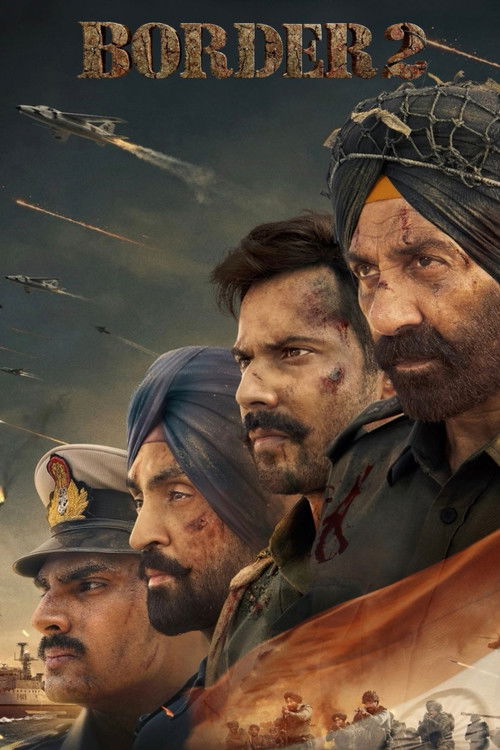
The film begins on 28 November 1971, when an armed group of Pakistani army scouts are reconnoitring an Indian Army post in Jammu and Kashmir near the border. They are intercepted and neutralized by Indian Army Lt Col Fateh Singh Kaler and his soldiers. Fateh recovers reconnaissance maps and other vital intelligence from the killed scouts and shares these findings with his CO at their regiment's HQ. From this data and prevailing circumstances, he infers that a full-scale India–Pakistan war is imminent and that the ultimate outcome will be decided on the western front. During this same window, Indian Army Major Hoshiar Singh Dahiya is posted in the Pathankot district in Punjab near the border; Indian Air Force Fg Offr Nirmal Jit Singh Sekhon is stationed at the Air Force Station in Srinagar district; and Indian Navy Lt Cdr Mahendra Singh Rawat is deployed aboard a frigate in the Arabian Sea near the Diu coast.
The story then flashes back to 1961 at the National War Academy, where the disciplined and strict Major Fateh Singh Kaler trains a new batch of tri-service officer cadets. There, they must endure three years of gruelling, common military training and undergraduate education before advancing to a final year of specialized instruction at their respective branch academies (Army, Air Force, and Navy). Under his rigorous supervision, three recruits – Hoshiar Singh Dahiya (Army), Nirmal Jit Singh Sekhon (Air Force), and Mahendra Singh Rawat (Navy) – develop an unbreakable personal bond. Fateh pushes them to their absolute physical and mental limits, deeply embedding the vital tenets of unified tri-service coordination and selfless dedication to the nation.
In 1965, Lt Col Fateh Singh Kaler suffers a devastating personal tragedy when his only son, Indian Army Captain Angad Singh Kaler, is killed in action during the India–Pakistan war of 1965. The loss creates a profound emotional rift between Fateh and his grieving wife, Simi. Struggling with internal sorrow, Fateh suppresses his grief to maintain his military commitment, ultimately accepting a deployment back to the frontlines.
Six years later, in mid 1971, geopolitical tensions culminate in active military mobilization along the border. Midway through Nirmal's wedding celebration at his village, Isewal, in Punjab, the three former academy peers are abruptly recalled to their respective units. Hoshiar bids farewell to his pregnant wife, Dhanwanti; Nirmal parts from his newly wedded bride, Manjit; and Mahendra leaves behind his wife, Sudha, and their young daughter. Deployed across separate branches of the Indian military, Major Hoshiar Singh Dahiya takes command of a company belonging to the 3rd Battalion of The Grenadiers Regiment in the Pathankot–Jammu sector. Meanwhile, Fg Offr Nirmal Jit Singh Sekhon joins the Indian Air Force's No. 18 Squadron in Srinagar, and Lt Cdr Mahendra Singh Rawat is assigned to the Indian Navy's 14th Frigate Squadron in the Arabian Sea. In early November 1971, full-scale war seems imminent, but with a substantial portion of the Indian military apparatus concentrated on the eastern theatre in East Pakistan, the western front is left structurally vulnerable with limited manpower and resources.
In the present timeline, the conflict escalates into a full-scale war on 3 December 1971, when Pakistan launches Operation Chengiz Khan – a series of preemptive aerial strikes targeting north–western Indian airfields, followed by coordinated ground and naval offensives. Concurrently, Fateh assumes command of the 6th Battalion of the Sikh Regiment and is ordered to take charge of Chak Peeran, a strategically vital Indian Army post across the crucial Mandiala Bridge in the critical Manawar Tawi region of the Jammu–Chumb sector. Upon arrival, Fateh discovers that the post has been seized by a Pakistani company under the command of Major Rasheed, who has brutally executed the captured Indian defenders. Fateh leads his battalion in a fierce counter-attack, defeats the occupying forces, kills Rasheed, and successfully recaptures the post.
On 9 December 1971, 40 nautical miles off the Diu coast, the Pakistani submarine PNS Hangor stalks and attacks Mahendra’s frigate in the treacherous depths of the Arabian Sea. Mahendra immediately orchestrates a high-stakes naval duel against the enemy sub. When catastrophic torpedo strikes rip through his frigate, engulfing it in flames, Mahendra refuses to abandon his post. As the vessel takes on water, he calmly coordinates the evacuation of his crew, saving dozens of lives. With the deck slipping beneath the waves, he executes one final, defiant act of duty – launching a decisive depth charge strike that neutralizes the enemy threat. Honouring the highest naval traditions, Mahendra chooses to go down with his ship, cementing his legacy in the depths he defended.
On 14 December 1971, as bombs rain down during an active Air attack on the Srinagar Airbase, Nirmal single-handedly scrambles his Folland Gnat Lightweight fighter into the smoke-filled skies of the Kashmir Valley. He immediately charges into a wave of six state-of-the-art enemy F-86 Sabre Air-superiority fighter jets. Outnumbered six to one, Nirmal executes a series of breathtaking, razor-sharp aerial maneuvers, turning the sky into a desperate shield for the vital base below. He successfully hammers the enemy formation, scoring direct hits on five Sabres and destroying them. However, the sheer weight of numbers catches up to him. During a dogfight with the final Sabre, he manages to shoot it down, but his fighter jet sustains fatal damage from the onslaught. At a critically low altitude, the aircraft plunges to the ground, killing him in action. His supreme sacrifice saves the airfield from certain destruction.
On the evening of that same day, the radio relays news of the martyrdom of Nirmal Jit Singh Sekhon and Mahendra Singh Rawat, along with the soldiers who fell a few days earlier in another fierce battle fought at Longewala. Hearing the tragic news of the loss of his closest friends, Nirmal and Mahendra, Hoshiar is deeply saddened and overcome with grief.
On the mainland, between 15 December and 17 December 1971, the ground war intensifies across multiple sectors. The Pakistani army launches a large-scale offensive at Manawar Tawi to recapture Chak Peeran and the crucial Mandiala Bridge from Fateh and his battalion. Facing a massive ground offensive of infantry and tanks led by Pakistani commander Lt Col Zaheer Khan, Fateh utilizes defensive fortifications and disciplined artillery coordination to hold the line. Despite sustaining heavy casualties and facing dwindling ammunition, Fateh rallies his remaining men to counter a final enemy breakthrough attempt. Employing clever anti-tank tactics, he personally orchestrates the destruction of the advancing armour, culminating in a fierce hand-to-hand combat sequence. After an intense and grueling engagement, Fateh’s unit breaks the enemy assault, neutralizes the advance, and captures Zaheer Khan as a prisoner of war. This secures a decisive victory at the Battle of Manawar Tawi, effectively halting the enemy's strategic push into Jammu and Kashmir.
Simultaneously, some 60-65 kilometres away from Fateh's location along the frontline, Hoshiar’s infantry company launches an offensive to capture an enemy stronghold at Bara Pind (Jarpal) in the Shakargarh salient, across the Basantar river in Punjab, Pakistan. Facing overwhelming artillery shelling, heavy MMG fire, and a deeply entrenched infantry defense, the assault quickly devolves into an intense trench battle characterized by brutal hand-to-hand bayonet combat. Undeterred by mounting casualties, Hoshiar moves from trench to trench, personally clearing several enemy bunkers despite sustaining severe injury. Hoshiar fights gallantly and successfully leads his company to an initial victory, securing a vital foothold that allows the regiment to consolidate its position against future enemy counter-attacks. However, unknown to them, a second, large armoured company commanded by Lt Col Khalid has advanced rapidly toward their position. The relentless enemy shelling and advancing tank columns eventually overwhelm the initial Indian defensive forces, leading to severe casualties.
Fresh off his victory at Manawar Tawi, Fateh receives word of the desperate situation at Bara Pind. He immediately mobilizes his remaining forces and marches to the sector, arriving just as the situation grows precarious. Fateh steps directly onto the chaotic frontline to reinforce Hoshiar and his company, where he kills Khalid during the height of the clash. Utilizing anti-tank weaponry, precise strategic positioning, and close tank support, Fateh and Hoshiar launch a fierce counteroffensive. Together, they turn the tide of the battle, neutralizing the remaining hostile armoured columns and forcing an enemy retreat to secure the western border. The ground offensive ends on 17 December 1971 with an official roll call back at the base. Standing before the remaining men, the weather-beaten but resolute Fateh and Hoshiar pay formal military tribute to the fallen heroes of the Battle of Basantar.
The film concludes on a solemn note as a grief-stricken Fateh visits a Gurdwara to offer prayers for the fallen soldiers. Amidst the poignant atmosphere, he remembers their valour and salutes the profound sacrifice of the martyrs, underscoring the heavy human cost of protecting national sovereignty.