




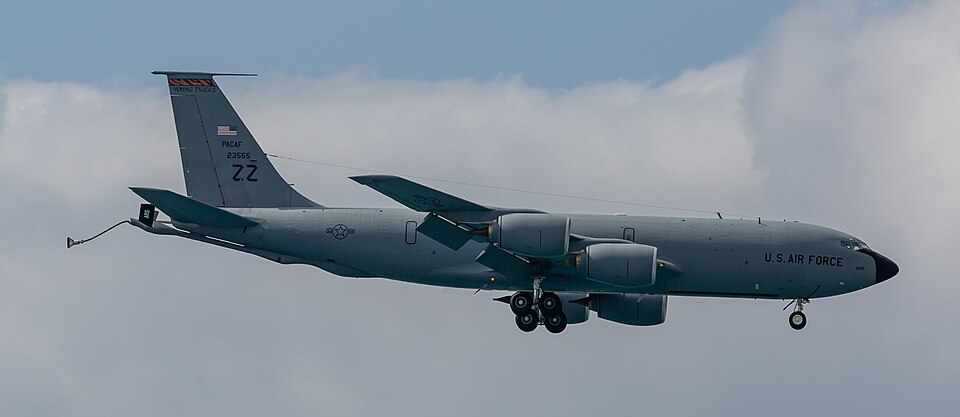
The Boeing KC-135 Stratotanker is an American military aerial refueling tanker aircraft that was developed from the Boeing 367-80 prototype, alongside the Boeing 707 airliner. It has a narrower fuselage and is shorter than the 707. Boeing gave the aircraft the internal designation of Model 717, with the number later assigned to a different Boeing aircraft.
The KC-135 was the United States Air Force's (USAF) first jet-powered refueling tanker; it replaced the KC-97 Stratofreighter. The KC-135 was initially tasked with refueling strategic bombers and was used extensively in the Vietnam War and later conflicts such as Operation Desert Storm and the Iran war to extend the range and endurance of US tactical fighters and bombers.
The KC-135 entered service with the USAF in 1957. It is one of nine military fixed-wing aircraft (six American, three Russian) with over 60 years of continuous service with its original operator. The KC-135 was supplemented by the larger McDonnell Douglas KC-10 Extender. Studies have concluded that many of the aircraft could be flown until 2030, although maintenance costs have greatly increased. The KC-135 is to be partially replaced by the Boeing KC-46 Pegasus.
Contents
Development
Background
In 1950, the USAF operated the world's first production aerial tanker, the Boeing KC-97 Stratofreighter, a gasoline-fueled, piston-engined Boeing Stratocruiser (USAF designation C-97 Stratofreighter) with a Boeing-developed flying boom and extra kerosene (jet fuel) tanks feeding the boom. The Stratocruiser airliner was developed from the Boeing B-29 Superfortress bomber after World War II. In the KC-97, the mixed gasoline/kerosene fuel system was not desirable, and a jet-powered tanker aircraft obviously would be the next development, having a single type of fuel for both its own engines and for passing to receiver aircraft. The 230 mph (370 km/h) cruise speed of the slower, piston-engined KC-97 was also a serious issue, as using it as an aerial tanker forced the newer, jet-powered military aircraft to slow down to mate with the tanker's boom.
Like its sibling, the commercial Boeing 707 jet airliner, the KC-135 was derived from the Boeing 367-80 jet transport "proof of concept" demonstrator, which was commonly called the "Dash-80". The KC-135 is similar in appearance to the 707, but has a narrower fuselage and is shorter than the 707. The KC-135 predates the 707 and is structurally quite different from the civilian airliner. Boeing gave the future KC-135 tanker the initial designation Model 717.
In 1954, USAF's Strategic Air Command (SAC) held a competition for a jet-powered aerial-refueling tanker. In 1955, Lockheed Corporation's tanker version of the proposed Lockheed L-193 airliner with rear fuselage-mounted engines was declared the winner. Since Boeing's proposal was already flying, the KC-135 could be delivered two years earlier and Air Force Secretary Harold E. Talbott ordered 250 KC-135 tankers until Lockheed's design could be manufactured. In the end, orders for the Lockheed tanker were dropped rather than supporting two tanker designs. Lockheed never produced its jet airliner. Boeing eventually dominated the market with a family of airliners based on the 707.
In 1954, the USAF placed an initial order for 29 KC-135As, the first of an eventual 820 of all variants of the basic C-135 family. The first aircraft flew in August 1956. The initial-production Stratotanker was delivered to Castle Air Force Base, California, in June 1957. The last KC-135 was delivered to the USAF in 1965.
Developed in the early 1950s, the basic airframe is characterized by 35°, aft-swept wings and tail, four underwing-mounted engine pods, a horizontal stabilizer mounted on the fuselage near the bottom of the vertical stabilizer with positive dihedral on the two horizontal planes, and a high-frequency radio antenna, which protrudes forward from the top of the vertical fin or stabilizer. These basic features make it strongly resemble the commercial Boeing 707 and 720 aircraft, although it is a different aircraft.
Engine retrofits
All KC-135s were originally equipped with Pratt & Whitney J57-P-59W turbojet engines, which produced 10,000 lbf (44 kN) of thrust dry, and about 13,000 lbf (58 kN) of thrust wet. Wet thrust is achieved through the use of water injection on takeoff, as opposed to "wet thrust" when used to describe an afterburning engine. 670 US gallons (2,500 L) of water are injected into the engines over the course of three minutes. The water is injected into the inlet and the diffuser case in front of the combustion case. The water cools the air in the engine to increase its density; it also reduces the turbine gas temperature, which is a primary limitation on many jet engines. This allows the use of more fuel for proper combustion and creates more thrust for short periods of time, similar in concept to "war emergency power" in a piston-engined aircraft.
In the 1980s, the first modification program retrofitted 157 Air Force Reserve (AFR) and Air National Guard (ANG) tankers with the Pratt & Whitney TF33-PW-102 turbofan engines, from 707 airliners retired in the late 1970s and early 1980s. The modified tanker, designated the KC-135E, was 14% more fuel-efficient than the KC-135A and could offload 20% more fuel on long-duration flights. Only the KC-135E aircraft were equipped with thrust reversers for aborted takeoffs and shorter landing rollouts.
The KC-135E fleet has since either been retrofitted as the R-model configuration or placed into long-term storage ("XJ"), as Congress has prevented the USAF from formally retiring them. The final KC-135E, tail number 56-3630, was delivered by the 101st Air Refueling Wing to the 309th Aerospace Maintenance and Regeneration Group at Davis–Monthan Air Force Base in September 2009.
The second modification program retrofitted 500 aircraft with new CFM International CFM56 (military designation: F108) high-bypass turbofan engines produced by General Electric and Safran. The CFM56 engine produces 22,000 lbf (98 kN) of thrust, nearly double compared to the original J57 engine. The modified tanker, designated KC-135R (modified KC-135A or E) or KC-135T (modified KC-135Q), can offload up to 50% more fuel (on a long-duration sortie), is 25% more fuel-efficient, and costs 25% less to operate than with the previous engines. It is also significantly quieter than the KC-135A, with noise levels at takeoff reduced from 126 to 99 decibels. This 27-decibel noise reduction results in a sound pressure level of about 5% of the original level. The KC-135R's operational range is 60% greater than the KC-135E for comparable fuel offloads, providing a wider range of basing options.
Avionics upgrades
To expand the KC-135's capabilities and improve its reliability, the aircraft has undergone a number of avionics upgrades. Among these was the Pacer-CRAG program (compass, radar, and GPS), which ran from 1999 to 2002 and modified all the aircraft in the inventory to eliminate the navigator position from the flight crew. The fuel-management system was also replaced. The program development was done by Rockwell Collins in Iowa and installation was performed by BAE Systems at the Mojave Airport in California.
Block 40.6 allows the KC-135 to comply with global air-traffic management. The latest block upgrade to the KC-135, the Block 45 program, is online with the first 45 upgraded aircraft delivered by January 2017. Block 45 adds a new glass cockpit digital display, radio altimeter, digital autopilot, digital flight director, and computer updates. The original, no longer procurable analog instruments, including all engine gauges, were replaced. Rockwell Collins again supplied the major avionic modules, with modification done at Tinker AFB.
Further upgrades and derivatives
The KC-135Q variant was modified to carry JP-7 fuel necessary for the Lockheed SR-71 Blackbird, by separating the JP-7 from the KC-135's own fuel supply. The body tanks carry JP-7, and the wing tanks carry JP-4 or JP-8. The tanker also had special fuel systems for moving the different fuels between tanks. When the KC-135Q model received the CFM56 engines, it was redesignated the KC-135T model, which was capable of separating the main body tanks from the wing tanks, where the KC-135 draws its engine fuel.
The only external difference between a KC-135R and a KC-135T is the presence of a clear window on the underside of the empennage of the KC-135T, where a remote-controlled searchlight is mounted. It has two ground refueling ports, located in each rear wheel well, so ground crews can fuel both the body tanks and wing tanks separately.
Eight KC-135R aircraft are receiver-capable tankers, commonly referred to as KC-135R(RT). All eight aircraft were with the 22d Air Refueling Wing at McConnell AFB, Kansas, in 1994. They are primarily used for force extension and special operations missions and are crewed by highly qualified, receiver-capable crews. If not used for the receiver mission, these aircraft can be flown just like any other KC-135R.
The Multi-point Refueling Systems modification adds refueling pods to the KC-135's wings. The pods allow refueling of U.S. Navy, U.S. Marine Corps and most NATO tactical jet aircraft, while keeping the tail-mounted refueling boom. The pods are Flight Refueling Limited MK.32B model pods, and refuel via the probe and drogue method common to Navy/Marine Corps tactical jets, rather than the primary "flying boom" method used by Air Force fixed-wing aircraft. This allows the tanker to refuel two receivers at the same time, which increases throughput compared to the boom drogue adapter.
A number of KC-135A and KC-135B aircraft have been modified to EC-135, RC-135, and OC-135 configurations for use in several different roles. These could also be considered variants of the C-135 Stratolifter family.
Design
The KC-135R has four turbofan engines, mounted under 35° swept wings, which power it to takeoffs at gross weights up to 322,500 pounds (146,300 kg). Nearly all internal fuel can be pumped through the tanker's flying boom, the KC-135's primary fuel transfer method. A boom operator stationed in the rear of the aircraft controls the boom while lying prone, viewing through a window at the bottom of the tail. Both the flying boom and operator's station are similar to those of the previous KC-97.
A special shuttlecock-shaped drogue, attached to and trailing behind the flying boom, may be used to refuel aircraft fitted with probes. This apparatus is significantly more unforgiving of pilot error in the receiving aircraft than conventional trailing hose arrangements; an aircraft so fitted is incapable of refueling by the normal flying-boom method until the attachment is removed. A Cargo deck above the refueling system can hold a mixed load of passengers and cargo. Depending on fuel storage configuration, the KC-135 can carry up to 83,000 pounds (38,000 kg) of cargo.
Operational history
The KC-135 was introduced to support SAC bombers, but by the late 1960s, in the Southeast Asia theater, the KC-135 Stratotanker's ability as a force multiplier came to the fore. Midair refueling of F-105 and F-4 fighter-bombers, as well as B-52 bombers, brought far-flung bombing targets within reach and allowed fighter missions to spend hours at the front, rather than a few minutes, which was usual due to their limited fuel reserves and high fuel consumption.
KC-135 crews refueled USAF, Navy, and Marine Corps aircraft. They changed to probe and drogue adapters depending upon the mission, with the Navy and Marine Corps aircraft not having flying-boom receptacles, since the USAF boom system was impractical for aircraft carrier operations. Crews also helped to bring in damaged aircraft, which could sometimes fly while being fed by fuel to a landing site, or to ditch over the water, specifically those with punctured fuel tanks. KC-135s continued their tactical-support role in later conflicts such as Operation Desert Storm and current aerial strategy.
Strategic Air Command had the KC-135 Stratotanker in service with Regular Air Force SAC units from 1957 to 1992 and with SAC-gained ANG and AFR units from 1975 to 1992. Following a major USAF reorganization that resulted in the inactivation of SAC in 1992, most KC-135s were reassigned to the newly created AMC. A small number of KC-135s were also assigned directly to United States Air Forces in Europe (USAFE), Pacific Air Forces (PACAF) and the Air Education and Training Command (AETC). All AFRC KC-135s and most of the ANG KC-135 fleet became operationally gained by AMC. Alaska Air National Guard and Hawaii Air National Guard KC-135s became operationally gained by PACAF.
AMC managed 396 Stratotankers, of which the AFR and ANG flew 243 in support of AMC's mission as of May 2018. The KC-135 is one of a few military aircraft types with over 50 years of continuous service with its original operator as of 2009.
Israel was offered KC-135s again in 2013, after turning down the aging aircraft twice due to expense of keeping them flying. The IAF again rejected the offered KC-135Es, but said that it would consider up to a dozen of the newer KC-135Rs.
Research usage
Besides its primary role as an inflight aircraft refueler, the KC-135, designated NKC-135, has assisted in several research projects at the NASA Armstrong Flight Research Center at Edwards Air Force Base, California. One such project occurred between 1979 and 1980, when special wingtip "winglets", developed by Richard Whitcomb of the Langley Research Center, were tested at Armstrong, using an NKC-135A tanker lent to NASA by the USAF. Winglets are small, nearly vertical fins installed on an aircraft's wing tips. The results of the research showed that drag was reduced and range could be increased by as much as 7% at cruise speeds. Winglets are now being incorporated into most new commercial and military transport/passenger jets, as well as business aviation jets.
NASA has operated several KC-135 aircraft, without the tanker equipment installed, as their famed Vomit Comet zero-gravity simulator aircraft. From 1973 to 1995, the longest-serving version was KC-135A, AF Ser. No. 59-1481, named Weightless Wonder IV and registered as N930NA.
Replacements
Between 1993 and 2003, the amount of KC-135 depot maintenance work doubled, and the overhaul cost per aircraft tripled. In 1996, it cost $8,400 per flight hour for the KC-135. In 2002, this had grown to $11,000. In 2004, the USAF's 15-year estimates projected significant cost growth to fiscal year 2017. KC-135 fleet operations and support costs were estimated to grow from about $2.2 billion in fiscal year 2003 to $5.1 billion (2003 dollars) in fiscal year 2017, an increase over 130%, which represented an annual operating cost growth rate of about 6.2%.
The USAF projected that E and R models have lifetime flying hour limits of 36,000 and 39,000 hours, respectively. Accordingly, only a few KC-135s would reach these limits by 2040, when some aircraft would be about 80 years old. A 2005 USAF study estimated that KC-135Es upgraded to the R standard could remain in use until 2030.
In 2006, the KC-135E fleet was flying an annual average of 350 hours per aircraft. The KC-135R fleet was flying an annual average of 710 hours per aircraft. In March 2009, the Air Force indicated that KC-135s would require additional skin replacement to allow their continued use beyond 2018.
The USAF decided to replace the KC-135 fleet; it is large, so will need to be replaced gradually. The first batch of replacement planes was to be an air tanker version of the Boeing 767, leased from Boeing. In 2003, this was changed to contract where the USAF would purchase 80 KC-767 aircraft and lease 20 more. In December 2003, the Pentagon froze the contract and in January 2006, the KC-767 contract was canceled. This move followed public revelations of corruption in how the contract was awarded and controversy regarding the original leasing rather than outright purchase agreement. Then-Secretary of Defense Rumsfeld stated that that move would in no way impair the Air Force's ability to deliver the mission of the KC-767, which would be accomplished by implementing continuing upgrades to the KC-135 and KC-10 Extender fleet.
In January 2007, the USAF launched the KC-X program with a request for proposal (RFP). KC-X was the first phase of three acquisition programs meant to replace the KC-135 fleet. In February 2008, the US Defense Department selected the EADS/Northrop Grumman "KC-30" (to be designated the KC-45A) over the Boeing KC-767. In March 2008, Boeing protested the award, citing irregularities in the competition and bid evaluation. In June 2008, the US Government Accountability Office sustained Boeing's protest of the selection of the Northrop Grumman/EADS's tanker.
Variants
KC-135A
Original production version powered by four Pratt & Whitney J57s, 732 built. Initial production batch of 29 aircraft was given the company designation Model 717-100A, while the later batches of 68 and 635 aircraft were respectively designated 717-146 and 717-148.
NKC-135A
Test-configured KC-135A.
KC-135B
Airborne command post version equipped with turbofan engines, 17 built. Provided with in-flight refueling capability and redesignated EC-135C. Company designation Model 717-166.
KC-135D
All four RC-135As (Pacer Swan) were modified to partial KC-135A configuration in 1979. The four aircraft (serial numbers 63-8058, 63-8059, 63-8060 and 63-8061) were given a unique designation KC-135D as they differed from the KC-135A in that they were built with a flight engineer's position on the flight deck. The flight engineer's position was removed when the aircraft were modified to KC-135 standards. They retained their electrically powered wing flap secondary (emergency) drive mechanism and second air conditioning pack which had been used to cool the RC-135As on-board photo-mapping systems. Later re-engined with Pratt & Whitney TF33 engines and a cockpit update to KC-135E standards in 1990 and were retired to the 309th AMARG at Davis-Monthan AFB, AZ in 2007.
KC-135E
Air National Guard and Air Force Reserve KC-135As re-engined with Pratt & Whitney TF33-PW-102 engines from retired 707 airliners (161 modified). All E model aircraft were retired to the 309th AMARG at Davis-Monthan AFB by September 2009 and replaced with R models.
NKC-135E
Test-configured KC-135E. 55-3132 NKC-135E "Big Crow I" and 63-8050 NKC-135B "Big Crow II" used as airborne targets for the Boeing YAL-1 Airborne Laser carrier.
KC-135Q
KC-135As modified to carry JP-7 fuel necessary for the SR-71 Blackbird, 56 modified, survivors to KC-135T.
KC-135R (1960s)
4 JC/KC-135As converted to Rivet Stand (Later Rivet Quick) configuration for reconnaissance and evaluation of above ground nuclear test (55-3121, 59–1465, 59–1514, 58–0126; 58-0126 replaced 59-1465 after it crashed in 1967). These aircraft were powered by Pratt & Whitney J57 engines and were based at Offutt AFB, Nebraska.
KC-135R
KC-135As and some KC-135Es re-engined with CFM56 engines, more than 417 converted.
KC-135R(RT)
Receiver-capable KC-135R Stratotanker; eight modified with either a Boeing or LTV receiver system and a secure voice SATCOM radio. Three of the aircraft (60-0356, -0357, and -0362) were converted to tankers from RC-135Ds, from which they retained their added equipment.
KC-135T
KC-135Q re-engined with CFM56 engines, 54 modified.
C-135F
A new-built variant for France as dual-role tanker/cargo and troop carrier aircraft. 12 were built for the French Air Force with the addition of a drogue adapter on the refueling boom. Given Boeing model numbers 717-164 and 717-165.
C-135FR
11 surviving C-135Fs upgraded with CFM International F108 turbofans between 1985 and 1988. Later modified with MPRS wing pods.
EC-135Y
An airborne command post modified in 1984 to support CINCCENT. Aircraft 55-3125 was the only EC-135Y. Unlike its sister EC-135N, it was a true tanker that could also receive in-flight refueling. Pratt & Whitney TF33-PW-102. Retired to 309th AMARG at Davis-Monthan AFB, AZ.
Operators
Chile
Chilean Air Force operates 3 KC-135Es. It received its first KC-135E in February 2010.
India
Indian Air Force: One has been wet leased from Metrea for training IAF and the Indian Navy pilots. Requirement for such an aircraft was reported in August 2023. The refuelling aircraft is based at Agra Air Force Station and will aid in pilot training for the IAF and the Indian Naval Air Arm prior to retirement of Il-78MKI. The jet landed at Agra AFS on 21 November 2025.
Turkey
Turkish Air Force operates 7 KC-135Rs.
United States
United States Air Force operates 375 KC-135s (157 active duty, 62 Air Force Reserve, and 156 Air National Guard) as of June 2026.
57th Wing – Nellis Air Force Base, Nevada
509th Weapons Squadron – Fairchild Air Force Base, Washington
97th Air Mobility Wing – Altus Air Force Base, Oklahoma
54th Air Refueling Squadron
412th Test Wing – Edwards AFB, California
412th Flight Test Squadron
418th Flight Test Squadron
6th Air Refueling Wing – MacDill AFB, Florida
50th Air Refueling Squadron
91st Air Refueling Squadron
Former operators
France
French Air and Space Force operated 12 C-135FRs, beginning in 1964. They were replaced by Airbus A330 MRTTs, French military designation Phénix, from October 2020 to December 2023. The tankers were sold to private aerospace firm Metrea in June 2024.
Singapore
Republic of Singapore Air Force operated 4 former USAF KC-135R tankers, first delivered September 1999. They were occasionally used as VIP, aeromedical transports and military support. The aircraft were retired in June 2019, replaced by 6 Airbus A330 MRTTs. They were purchased by private US defense services company Metrea (Formerly Meta Aerospace) in October 2020.
United States
NASA (until 2004)
United States Air Force
6th Air Refueling Wing – MacDill AFB, Florida
911th Air Refueling Squadron – Seymour-Johnson AFB, North Carolina (Associate with 916th ARW)
22d Air Refueling Wing – McConnell AFB, Kansas
344th Air Refueling Squadron
97th Air Mobility Wing – Altus Air Force Base, Oklahoma
55th Air Refueling Squadron (1994–2009)
916th Air Refueling Wing – Seymour Johnson AFB, North Carolina
77th Air Refueling Squadron
931st Air Refueling Group – McConnell AFB, Kansas (Associate with 22d ARW)
Accidents
Since entering into service in 1955, 52 Stratotankers have been lost to accidents, involving 385 fatalities.
27 June 1958
USAF KC-135A, serial number 56-3599, stalled and crashed at Westover Air Force Base after the crew failed to extend the flaps on takeoff, killing all 15 on board. The aircraft was attempting a world speed record between New York and London.
31 March 1959
USAF KC-135A, 58-0002, entered a thunderstorm near Killeen, Texas. Two engines separated and one of the engines struck the tail, causing loss of control. The aircraft crashed on a hillside, killing all four crew on board. The aircraft had been delivered just six weeks before the accident.
15 October 1959
USAF KC-135A, 57-1513, collided in mid-air with B-52F 57-0036 at 32,000 feet (9,800 m) over Leitchfield, Kentucky, killing all six on board both aircraft.
3 February 1960
USAF KC-135A, 56-3628, crashed on takeoff in extremely gusty crosswind conditions at Roswell-Walker AFB, New Mexico. The airplane skidded into two other KC-135 tankers (57-1449 and 57–1457) and a hangar and burst into flames. The aircraft was on a training flight, but the instructor pilot was occupying the jump seat instead of one of the pilot seats as directed by the local commander. The destruction of three aircraft, along with the death of all six in the crew plus an additional two deaths on the ground made this a unique mishap.
18 November 1960
USAF KC-135A, 56-3605, crashed on landing at Loring Air Force Base due to an excessive sink rate, killing one of 17 on board.
9 May 1962
USAF KC-135A, 56-3618, crashed on takeoff from Loring Air Force Base due to engine failure, killing all six on board.
Aircraft on display
55-3118 The City of Renton – KC-135A on static display at the entrance to McConnell Air Force Base, Kansas. It was the first aircraft built and was used in a variety of test roles. It was later converted to an EC-135K airborne command post, and restored to a tanker configuration for display.
55-3130 Old Grandad – KC-135A on static display at the March Field Air Museum, March ARB, California.
55-3139 City of Atwater – KC-135A on static display at the Castle Air Museum at the former Castle AFB, California.
56-3595 – KC-135A on static display at the Barksdale Global Power Museum at Barksdale Air Force Base, Louisiana.
56-3611 – KC-135E on static display Scott Field Heritage Air Park at Scott Air Force Base, Illinois.
56-3639 – KC-135A on static display at the Linear Air Park at Dyess Air Force Base, Texas.
56-3658 Iron Eagle – KC-135E on static display at the Kansas Aviation Museum.
57-1429 – KC-135E on static display at the Museum of the Kansas National Guard at Forbes Field Air National Guard Base in Topeka, Kansas.
57-1455 – KC-135E on static display at Pease Air National Guard Base, New Hampshire.
57-1458 – KC-135E on static display at Eielson Air Force Base, Alaska.
57-1495 – KC-135E in storage at Lincoln Air National Guard Base, Nebraska.
57-1507 – KC-135E on static display at the Air Mobility Command Museum at Dover Air Force Base, Delaware.
Specifications (KC-135R)
Data from USAF Fact Sheet, Boeing.com : KC-135General characteristics
Crew: 3 (pilot, co-pilot and boom operator; some KC-135 missions require the addition of a navigator.)
Capacity: up to 80 passengers / 83,000 lb (38,000 kg) or 6 463L pallets
Length: 136 ft 3 in (41.53 m)
Wingspan: 130 ft 10 in (39.88 m)
Height: 41 ft 8 in (12.70 m)
Wing area: 2,433 sq ft (226.0 m2)
Airfoil: root: BAC 310/311/312; tip: BAC 313
Empty weight: 98,392 lb (44,630 kg)
Operating empty weight: 124,000 lb (56,245 kg)
Gross weight: 297,000 lb (134,717 kg)
Max takeoff weight: 322,500 lb (146,284 kg)
Fuel capacity: 200,000 lb (90,718 kg) / 29,850 US gal (112,995 L; 24,855 imp gal)
Powerplant: 4 × CFM International F108-CF-100 turbofan engines, 21,600 lbf (96.2 kN) thrust each
Performance
Maximum speed: 504 kn (580 mph, 933 km/h)
Maximum speed: Mach 0.9
Cruise speed: 460 kn (530 mph, 850 km/h) at 30,000 ft (9,100 m)