





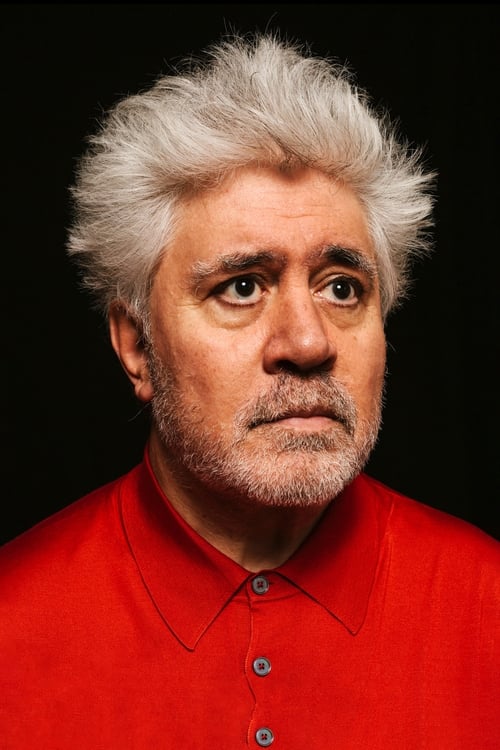













Bitter Christmas (Spanish: Amarga Navidad) is a 2026 Spanish tragicomedy film written and directed by Pedro Almodóvar. It stars Bárbara Lennie and Leonardo Sbaraglia alongside Aitana Sánchez-Gijón, Victoria Luengo, Patrick Criado, Milena Smit, and Quim Gutiérrez. It incorporates elements of embedded story-telling and autofiction.
The film was released theatrically in Spain on 20 March 2026 by Warner Bros. Pictures, and subsequently had its international premiere on 19 May 2026 at the 79th Cannes Film Festival.
Contents
Plot
Bitter Christmas interweaves a frame narrative set in 2025, told chronologically, and a story within a story set in 2004, told in non-chronological order. For clarity, the two narratives are presented separately.
2004
In 2004 Spain, Elsa, a director of commercials, suffers from a migraine during the Constitution Day long weekend. Her boyfriend, Bonifacio, a firefighter and stripper, accompanies her to a hospital. At the hospital, Elsa insists on being hospitalized in one room instead of another. As she explains to Bonifacio and her doctor, before switching to commercials, Elsa directed 2 films, the second of which was set in this hospital, involving one sick character who was hospitalized in her room and survived and the other who stayed in the other room and died.
The next morning, though not completely recovered, Elsa returns home with Bonifacio. She recalls how she met Bonifacio at a strip club he was working at and proposed that he star in her upcoming men's underwear commercial, which he agreed to. Still in pain, Elsa calls her friend Patricia, who connects her with a psychiatrist and tells her to go to another woman, who is hosting a party, for an over-the-counter pain relief medication. After taking the pill and sleeping for a while, she awakes to see her friend Amaia, who is performing at the party. Amaia sings a Chavela Vargas song for Elsa and Bonifacio that moves Elsa to tears.
Elsa receives a call from her friend Natalia. Two years ago, Natalia was driving when an accident happened, killing her young son but allowing her to live. Since then, she has stopped working as a model, moved in with her mother, and been tortured by grief. Elsa planned to visit Natalia over the long weekend but with her sudden panic attack, this is no longer possible. While Bonifacio works at the fire station, Elsa visits Patricia in her home. There, they listen to Chavela Vargas perform another song, which deeply moves both of them. During the song, Patricia receives a call from Ricardo, her husband, which she does not answer. Handing her phone to Elsa, Patricia shows her a low-resolution picture that another friend of hers took of a man, whom Patricia is convinced is Ricardo, embracing another woman. Patricia ruins her phone by putting it in water; in response, Elsa gives her a pill to calm her down. At the psychiatrist, Elsa reveals that a year ago, while shooting the underwear commercial, she received news of her mother's sudden death, which she could not be present at. Hearing that Elsa has not been able to properly face this tragedy head-on due to the hectic nature of her work, they propose that she go on vacation, preferably with someone else.
Patricia accompanies Elsa on vacation to Lanzarote, where the latter begins work on her third film, focusing on two grieving women on a volcanic island. One of them is gradually worn down by her bad husband but ultimately divorces him and achieves liberation. This character is based on Patricia and parallels Elsa's wishes for her; Elsa wants to write a happy ending for Patricia into existence. Patricia, however, is uncomfortable with the amount of real-life detail that will be included in the film and is pessimistic about how her relationship with Ricardo will play out. When Elsa harshly claims that it is in Patricia's nature to stick it out in an unhappy relationship, Patricia calls Ricardo and leaves the next day with Lorenzo. After Patricia leaves, Elsa continues working on her screenplay, during which she recalls her final conversation with her mother, which happened shortly before her death.
2025
In 2025 Spain, it is revealed that Elsa's story is a screenplay being written by celebrated filmmaker Raúl for his new film Amarga Navidad ('Bitter Christmas'), based on his own experiences in 2004 of having a panic attack; she is his alter ego. When asked whether the film will be very confessional by his assistant, Mónica, Raúl explains that he will restrain himself, but reality has a way of creeping into fiction. She then requests an unexplained sabbatical, promising nothing more than to not abandon him and that his boyfriend, Santi, will take over her duties, which Raúl approves of. She also expresses her best wishes for this film. The two then visit a club to film a striptease scene, as Raúl wishes to film Elsa seeing Bonifacio at the strip club, only to be told that stripteases are no longer in fashion.
Some time later, Mónica returns to formally bid her farewell and advises Raúl to diversify his life instead of focusing solely on making films. Pressed by Raúl, Mónica explains that she is leaving to care for her girlfriend Elena, who disappeared from her life years ago but is now struggling to attend to her cancer-afflicted son. After Mónica leaves, Raúl continues working, initially writing that Elsa receives a call from her friend Elena before changing it to her friend Natalia.
Walking out of a screening with Santi, Raúl receives a call from Mónica, who shares that Elena's son has died and she would like to visit them to figure out what to do next. While scouting for locations to shoot the Canary Islands scenes, Raúl receives another call from Mónica, who tells him that Elena recently attempted suicide but that they appear to have found an effective psychiatrist.
Raúl has completed the first draft, which he gives to Santi for feedback, clarifying that Bonifacio is inspired by him. However, feeling that the script is a bit short, he immediately continues by adding on the scenes with Natalia at the end. Some time later, Mónica storms into Raúl's house, accusing him of going too far by writing Elena's suicide in the guise of Natalia's. Despite Raúl's protests that Natalia is very different from Elena and that this is all part of autofiction, Mónica vociferously threatens him with exposing his personal life if he does not remove Natalia from the story. Santi, who has not read this new ending, advises him to be sensitive towards Mónica during this trying time.
Raúl meets up with Mónica at a park to discuss this further where, on top of the criticism regarding Natalia, Mónica accuses him of not having had an original idea in years and failing to recognize that the drama lies with Santi. She acknowledges that he needs to make films but tells him that not all suffering is ripe for filming and that the day has come for him to realize that he cannot allow himself to continue in this direction. Mónica adds that Raúl has lost that spark in his eye from when he would find a story that obsessed him, claiming that he is merely protecting the screenplay out of pride, not because he truly believes in its artistic value. Stunned by Mónica's change in personality and attitude, Raúl tells her that he has finally managed to see her for who she is and should have sought inspiration not from the 2004 long weekend, but from the more than 20 years he has worked with her. Mónica leaves tearfully.
Production
In an interview to IndieWire published in October 2024, Almodóvar pitched Bitter Christmas as "a tragic comedy about gender". In May 2025, Victoria Luengo and Patrick Criado were reported to have been cast. Filming began on 9 June 2025, with Pau Esteve Birba serving as cinematographer. Additional cast members including Bárbara Lennie, Quim Gutiérrez, Leonardo Sbaraglia, Milena Smit, and Aitana Sánchez-Gijón were subsequently reported. The film is an El Deseo production and it had the collaboration of Movistar Plus+. Shooting wrapped on 12 August 2025 in Lanzarote. Shooting locations also included Madrid. Teresa Font took over film editing during post-production.
Almodóvar billed Bitter Christmas as "the film where I've been cruelest with myself".
Release
Warner Bros. Pictures released Bitter Christmas in Spanish theatres on 20 March 2026. It will later be released on streamer Movistar Plus+. Curzon acquired distribution rights for the United Kingdom and Ireland, scheduling a 28 August 2026 theatrical release. In August 2025, Sony Pictures Classics, Almodóvar's recurring North American distributor, acquired distribution rights to the film in that territory.
The film had its international premiere at the main competition of the 79th Cannes Film Festival on 19 May 2026, where it will compete for the Palme d'Or and won the Cannes Soundtrack Award. The film's international festival run continued with selections for screenings in the 'Horizons' slate of the 60th Karlovy Vary International Film Festival, in the 'Special Presentations' slate of the 2026 Toronto International Film Festival (for its North American premiere), in the 'Made in Spain' section of the 74th San Sebastián International Film Festival, at the 2026 Vancouver International Film Festival, and in the main slate of the 2026 New York Film Festival (for its U.S. premiere).
Pathé handled French distribution, programming a 20 May 2026 rollout in French theatres. Warner Bros. also took over Italian, Mexican, Argentine, and Brazilian distribution, respectively scheduling a 21 May 2026 in Italy and 28 May 2026 theatrical release in Mexico, Argentina, and Brazil. Falcon Pictures acquired Indonesian rights to the film.
Reception
Box office
Bitter Christmas opened to a €728,038 (96,852 admissions) debut weekend at the domestic box office in Spain, posting a slightly better performance than Almodóvar's Parallel Mothers (2021) and The Room Next Door (2024). By its second weekend, it had grossed around €1.6 million. It added €120,400 in its fourth weekend to a total gross of around €2.3 million. By September 2026, its worldwide gross revenue was $6 million.
Critical response
On the review aggregator website Rotten Tomatoes, 88% of 60 critics' reviews are positive, with an average rating of 7.3/10. The website's consensus reads: "A visually dazzling and effortlessly fluid late-period Almodóvar entry, Bitter Christmas: charms with its well-crafted characters, comic rhythms, and nested storytelling." Metacritic, which uses a weighted average, assigned the film a score of 70 out of 100, based on 21 critics, indicating "generally favorable" reviews.
First reactions to the film were "largely positive" but "hardly unanimous", with fans lauding the "brutal honesty" while detractors resented the lack of "emotional impact".
Laura Pérez of Fotogramas rated the film 4 out of 5 stars, highlighting the "brutal honesty of its director" as the best thing about it. Pepa Blanes of Cadena SER assessed that the film "features a remarkable and original structure", otherwise considering that Almodóvar has laid his soul bare, almost more so than in Pain and Glory. Andrea G. Bermejo of Cinemanía rated the film 4½ out of 5 stars, declaring it "a self-portrait of brutal honesty".
Raquel Hernández Luján of HobbyConsolas gave the film 68 points, highlighting Sánchez Gijón's character, and how, through her, the director "demonstrates a remarkable degree of self-awareness", while also missing in the film "[Almodovár's] raw passion of yesteryear", as well as a bit more of a sense of humour. Luis Martínez of El Mundo gave the film a 5-star rating, accepting it as a masterpiece insofar masterpiece be defined as a "synonym for risk and freedom, and as another way of describing something new". Manuel J. Lombardo of Diario de Sevilla gave the film a 2-star rating, lamenting that "everything worked and flowed much better" in Pain and Glory.
J. Picatoste Verdejo of Mondo Sonoro rated the film 6 out of 10 stars, lamenting that the film lapses into navel-gazing manierism through a narrative game that is both risky and botched. Carlos Reviriego of El Cultural rated the film 4 out of 5 stars, wondering which other film questions itself as clearly and vehemently as Bitter Christmas does through Sánchez-Gijón's character in a "memorable" final stretch. Marta Medina del Valle of El Confidencial rated the film 3 out of 5 stars, describing it as a derivative film, delighting as it elaborates in its musical performances, but which occasionally loses its way in self-indulgence when it comes to the self-portrait.