Filming
Parker originally planned to shoot scenes in Oakland, California, before visiting the actual Philadelphia locations described in the novel. Upon arriving in Philadelphia, he and producer Alan Marshall set up production offices at a Holiday Inn hotel. Location scouting began as Parker was holding casting calls in New York City. Location manager Rory Enke and production designer Geoffrey Kirkland visited run-down areas of Philadelphia, and offered suggestions to Parker on his weekend visits from New York. Parker made an arrangement with the International Alliance of Theatrical Stage Employees (IATSE) that permitted the British crew members to work alongside members of both the east and west coast union locals. He had to employ no less than four members of the two camera locals in order to allow his past collaborators—director of photography Michael Seresin, camera operator Michael Roberts and editor Gerry Hambling—to work on the film.
Filming was scheduled to start in December 1983, but was postponed for six months to accommodate Modine's shooting schedule for Mrs. Soffel (1984). Principal photography began in Philadelphia on May 15, 1984, with a budget of $12 million. The script required that a total of 24 locations be used for filming in Philadelphia and Santa Clara, California. Animal trainer Gary Gero employed the use of 80 different canaries for various scenes in the film, as well as pigeons, a hornbill, a cat, eighteen dogs and a seagull.
A women's prison wing located in the Philadelphia House of Correction doubled for a scene set in an Atlantic City jail. A scene depicting Birdy and Al climbing an elevated railway was filmed at the 46th Street Station above the intersection of Farragut and Market Street in the Mill Creek neighborhood. The cast and crew then moved to Philadelphia City Hall, where Wilson Goode, the city's first African American mayor, visited the set and gave the production his blessing.
After four weeks of filming in Philadelphia, the cast and crew moved to Wildwood, New Jersey, which doubled for scenes set at the Atlantic City boardwalk. Filming then moved to San Francisco, California. The scene where Birdy and Al climb atop a refinery building was filmed on the rooftop of an abandoned gasworks in Hercules, California. The scene required Modine and Cage to hang off the edge of the roof secured by safety wires, while the sequence in which Birdy falls off the roof was performed by a stunt double.
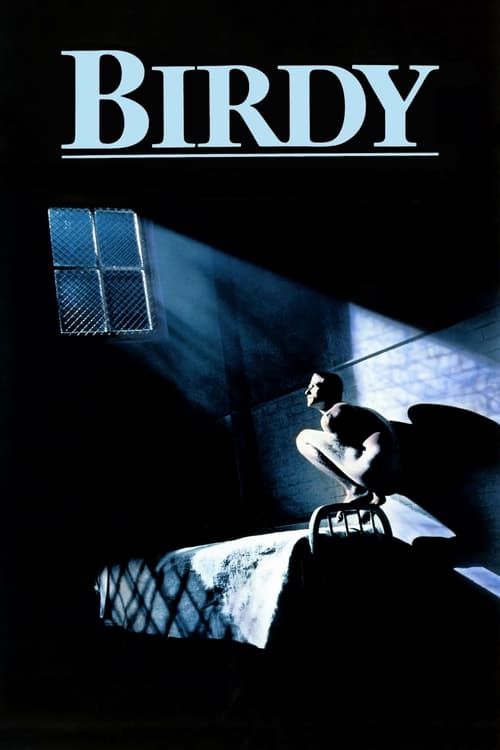
The production next filmed Birdy's flight on an ornithopter at the Newby Island landfill in Santa Clara County. The filming of the scene was considered to be a health concern among the cast and crew, due to the exposed garbage and smell of methane gas. The filmmakers originally planned to shoot Birdy landing in a reservoir thirty feet away from the landfill, but a test of the water had shown it to be hazardous. Parker said, "We experimented with a 100-foot wire hanging from a helicopter to allow us to 'fly' Birdy into a pond we'd constructed at the bottom of a hill of garbage." The military hospital scenes were filmed at the Agnews Developmental Center, a psychiatric and medical care facility located in Santa Clara. A corner of the hospital was used to film scenes set in Birdy's bedroom.
The production then moved to Stockton, California to depict a scene involving Al aboard a train. The Vietnam War sequences were filmed in Modesto, California, where the art department found difficulty in pinpointing filming locations, as the entire area was flooded. The use of helicopters during filming was the subject of frequent discussions with the Federal Aviation Administration (FAA), following an accident during the production of Twilight Zone: The Movie (1983). The special effects department used fifteen 20-gallon drums of gasoline rigged with explosive charges to depict a napalm strike. A total of four cameras were used to film the explosions. Principal photography concluded in early August 1984.
The film was the first to be partially shot with the Skycam, a computer-controlled, cable-suspended camera system created by Garrett Brown, inventor of the Steadicam. The Skycam had 100-foot high posts with four hanging wires controlled by a computer, and a lightweight Panavision camera with 200 feet of film hung at the center of the wires. The filmmakers intended to use the Skycam to fully depict Birdy's point of view during a fantasy sequence in which he imagines himself as a bird flying, but they encountered difficulties, as the camera would often malfunction. Although the Skycam proved successful on its first take, Parker insisted that the filmed footage be shot more rapidly, but the camera system malfunctioned during its second take, after capturing 40 seconds of footage. This resulted in the camera operators shooting the remainder of the sequence with a Steadicam mounted on top of an improvised camera dolly.