1930–1936: Early years in Hollywood
After appearing on Broadway in New York, the 22-year-old Davis moved to Hollywood in 1930 to screen test for Universal Studios. She was inspired to pursue a career as a film actress after seeing Mary Pickford in Little Lord Fauntleroy. Davis and her mother traveled by train to Hollywood. She later recounted her surprise that no-one from the studio was there to meet her. In fact, a studio employee had waited for her, but left because he saw no-one who "looked like an actress". Davis failed her first screen test, but was used in several screen tests for other actors.
In a 1971 interview with television talk show host Dick Cavett, she related the experience with the observation, "I was the most Yankee-est, most modest virgin who ever walked the earth. They laid me on a couch, and I tested fifteen men ... They all had to lie on top of me and give me a passionate kiss. Oh, I thought I would die. Just thought I would die." A second test was arranged for Davis, for the 1931 film A House Divided. Hastily dressed in an ill-fitting costume with a low neckline, she was rebuffed by the film director William Wyler, who loudly commented to the assembled crew, "What do you think of these dames who show their chests and think they can get jobs?".
Carl Laemmle, the head of Universal Studios, considered terminating Davis's employment, but cinematographer Karl Freund told him she had "lovely eyes" and would be suitable for Bad Sister (1931), in which she subsequently made her film debut. Her nervousness was compounded when she overheard the chief of production, Carl Laemmle, Jr., comment to another executive that she had "about as much sex appeal as Slim Summerville", one of the film's male co-stars. The film was not a success, and her next role in Seed (1931) was too brief to attract attention.
Universal Studios renewed her contract for three months, and she appeared in a small role in Waterloo Bridge (1931), before being lent to Columbia Pictures for The Menace, and to Capital Films for Hell's House (all 1932). After one year, and six unsuccessful films, Laemmle elected not to renew her contract.
Davis was preparing to return to New York when actor George Arliss chose Davis for the lead female role in the Warner Bros. picture The Man Who Played God (1932). For the rest of her life, Davis credited him with helping her achieve her "break" in Hollywood. The Saturday Evening Post wrote, "She is not only beautiful, but she bubbles with charm", and compared her to Constance Bennett and Olive Borden. Warner Bros. signed her to a seven-year contract, yet she remained with the studio for the next 18 years.
Davis's first marriage was to Harmon Oscar Nelson on August 18, 1932, in Yuma, Arizona. Their marriage was scrutinized by the press; his $100 a week earnings ($1,900 per week in 2024 dollars) compared unfavorably with Davis's reported $1,000 a week income ($19,000 per week in 2024 dollars). Davis addressed the issue in an interview, pointing out that many Hollywood wives earned more than their husbands, but the situation proved difficult for Nelson, who refused to allow Davis to purchase a house until he could afford to pay for it himself. Nelson was able to enforce his wishes because, at the time, the husband had the management and control of the community property, which included the wife's earnings, and the wife could not obtain credit without her husband's consent. Davis had two abortions during the marriage, each at Nelson's insistence.
Davis played Helen Bauer in the 1933 pre-Code drama Ex-Lady alongside Gene Raymond. However, the film was overshadowed by fellow actress Joan Crawford's divorce from her first husband, Douglas Fairbanks Jr., leading to its failure at the box office. Though Crawford had no malicious intent toward Davis, Davis was nonetheless angered by this turn of events, which led her to resent Crawford and began a lifelong feud between the two actresses.
After more than 20 film roles, she had her critical breakthrough playing the role of the vicious and slatternly Mildred Rogers in the RKO Radio production of Of Human Bondage (1934), a film adaptation of W. Somerset Maugham's novel. It earned Davis her first major critical acclaim, although, contentiously, she was not among the three nominees for the Academy Award for Best Actress that year. Many actresses feared playing unsympathetic characters, and several had refused the role, but Davis viewed it as an opportunity to show the range of her acting skills. Her co-star, Leslie Howard, was initially dismissive of her, but as filming progressed, his attitude changed, and he subsequently spoke highly of her abilities.
The film's director, John Cromwell, allowed her relative freedom. "I let Bette have her head. I trusted her instincts." Davis insisted that she be portrayed realistically in her death scene, and said, "The last stages of consumption, poverty, and neglect are not pretty, and I intended to be convincing-looking."
The film was a success, and Davis's characterization earned praise from critics, with Life writing that she gave "probably the best performance ever recorded on the screen by a U.S. actress". Davis anticipated that her reception would encourage Warner Bros. to cast her in more important roles, and was disappointed when Jack L. Warner refused to lend her to Columbia Studios to appear in It Happened One Night, and instead cast her in the melodrama Housewife. When Davis was not nominated for an Academy Award for Of Human Bondage, The Hollywood Citizen News questioned the omission, and Norma Shearer, herself a nominee, joined a campaign to have Davis nominated. This prompted an announcement from the Academy president, Howard Estabrook, who said that under the circumstances, "any voter...may write on the ballot his or her personal choice for the winners", thus allowing, for the only time in the Academy's history, the consideration of a candidate not officially nominated for an award. The uproar led, however, to a change in academy voting procedures the following year, wherein nominations were determined by votes from all eligible members of a particular branch, rather than by a smaller committee, with results independently tabulated by the accounting firm Price Waterhouse. The next year, A Midsummer Night's Dream became the only film to win a write-in Oscar, for Best Cinematography.
The next year, her performance as a down-and-out troubled actress in Dangerous (1935) received very good reviews and landed Davis her first Best Actress nomination and win. E. Arnot Robertson wrote in Picture Post that, "I think Bette Davis would probably have been burned as a witch if she had lived two or three hundred years ago. She gives the curious feeling of being charged with power which can find no ordinary outlet". The New York Times hailed her as "becoming one of the most interesting of our screen actresses". She won the Academy Award for Best Actress for the role, but commented that it was belated recognition for Of Human Bondage, calling the award a "consolation prize". For the rest of her life, Davis maintained that she gave the statue its familiar name of "Oscar" because its posterior resembled that of her husband, whose middle name was Oscar, although, the Academy of Motion Picture Arts and Sciences officially makes reference to another story.
Davis had not expected to win the award, so she had worn only a plain dress. At the 8th Academy Awards, where she received the award, fellow attendee Joan Crawford said to her, "Dear Bette! What a lovely frock." She had attended with her second husband, Franchot Tone, with whom Davis had been in love, but Crawford had married in 1935. Both of these events led to more contention between the two actresses, who had already clashed in 1933. Later on, when they shared dressing rooms near to each other, Crawford tried to make a truce with Davis by sending her gifts, all of which Davis returned.
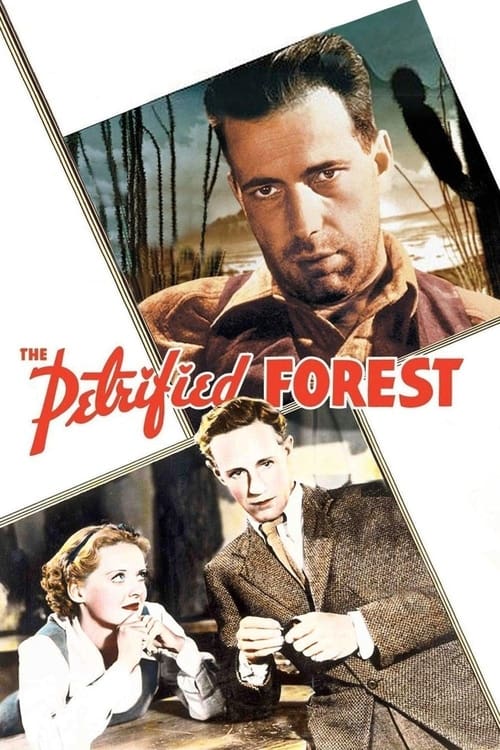
In her next film, The Petrified Forest (1936), Davis co-starred with Leslie Howard and Humphrey Bogart.
In the spring of 1936, Davis asked Warner Bros. to loan her out to RKO to make Mary of Scotland. Warner Bros. refused and assigned Davis two films that were written specifically for her: God's Country and the Woman, and Mountain Justice. However, as God's Country and the Woman was going into production, Davis refused to work, and demanded a salary increase on her contract with Warner Bros. At the time, Davis was earning $1,250 per week. Jack Warner offered Davis an increased salary of $2,250 per week, which Davis refused. Davis's agent, Mike Levee, said: "She's a very stubborn young lady. I asked her how much she wanted, and she said $3,500 a week, plus all radio rights and permission to make outside pictures. I told her, 'Whoa, that's too much!'"
Meanwhile, due to Davis's refusal to continue with God's Country and the Woman, Warner Bros. was incurring excessive production costs because the film was being made in Technicolor, and the Technicolor cameras were rented. In late June, the studio put Davis on suspension for refusal to work, and replaced her in the film with Beverly Roberts.
During negotiations with Warner Bros. regarding her salary and signing Davis for the female lead in Danton, Davis abruptly traveled to England with her husband, Harmon Nelson, on a "vacation". However, in England, Davis signed a contract with British film production company Toplitz, to make the film I'll Take the Low Road in England with Maurice Chevalier for a $50,000 salary.
On September 9, 1936, Warner Brothers filed a legal injunction against Davis in England which forbade her from appearing in film productions without their consent. While on a shopping spree in Paris, Davis publicly declared to the press that she intended to defy Warner Bros' legal injunction and make the film in England.
On October 14, 1936, the British court held a hearing regarding the studio's injunction against Davis. Mr Justice Branson issued his decision on October 19, ruling in favor of Warner Bros. Justice Branson dismissed Davis's representative's claims that she was an "underpaid slave" held under a "life sentence", and ruled that Davis was in breach of her contract to Warner "for no discoverable reason except that she wanted more money".
Davis was ordered to pay Warner Bros. $80,000 in restitution, and was also ordered to pay the studio's legal fees for filing the injunction in England. The British press offered little support to Davis, calling her overpaid and ungrateful.