Syrian civil war (2011–2024)
Protests in Syria began on 26 January 2011 following the Arab Spring
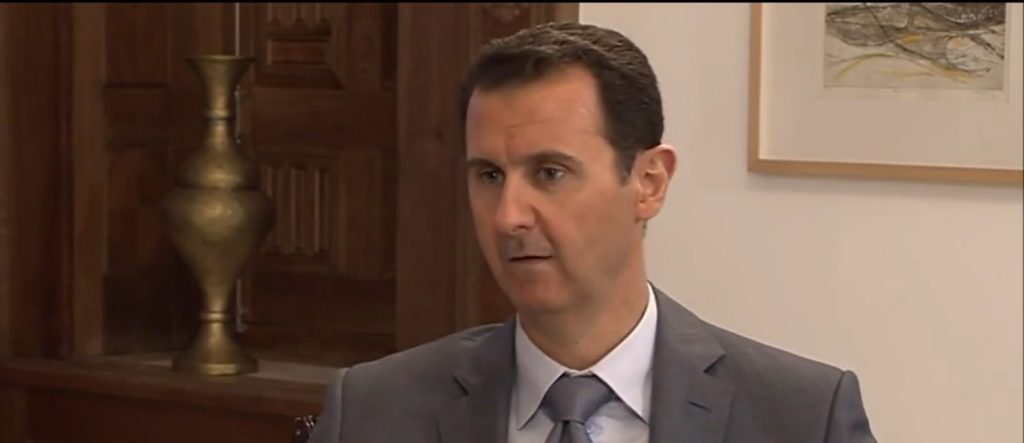
protests that called for political reforms and the reinstatement of civil rights, as well as an end to the state of emergency which had been in place since 1963. One attempt at a "day of rage" was set for 4–5 February, though it ended uneventfully. Protests on 18–19 March were the largest to take place in Syria for decades, and the Syrian authority responded with violence against its protesting citizens. In his first public response to the protests delivered on 30 March 2011, Assad blamed the unrest on "conspiracies" and accused the Syrian opposition and protestors of seditious "fitna", toeing the party-line of framing the Ba'athist state as the victim of an international plot. He also derided the Arab Spring movement, and described those participating in the protests as "germs", foreign agents and fifth-columnists.
The U.S. imposed limited sanctions against the Assad government in April 2011, followed by Barack Obama's executive order as of 18 May 2011 targeting Bashar Assad specifically and six other senior officials. On 23 May 2011, the EU foreign ministers agreed at a meeting in Brussels to add Assad and nine other officials to a list affected by travel bans and asset freezes. On 24 May 2011, Canada imposed sanctions on Syrian leaders, including Assad.
On 20 June, in response to the demands of protesters and international pressure, Assad promised a national dialogue involving movement toward reform, new parliamentary elections, and greater freedoms. He also urged refugees to return home from Turkey, while assuring them amnesty and blaming all unrest on a small number of saboteurs.
In July 2011, U.S. Secretary of State Hillary Clinton said Assad had "lost legitimacy" as president. On 18 August 2011, Barack Obama issued a written statement that urged Assad to "step aside". In August, the cartoonist Ali Farzat, a critic of Assad's government, was attacked. Relatives of the humourist told media outlets that the attackers threatened to break Farzat's bones as a warning for him to stop drawing cartoons of government officials, particularly Assad. Farzat was hospitalised with fractures in both hands and blunt force trauma to the head.
Since October 2011, Russia, as a permanent member of the UN Security Council, repeatedly vetoed Western-sponsored draft resolutions in the UN Security Council that would have left open the possibility of UN sanctions, or even military intervention, against the Assad government.
On 10 January 2012, Assad gave a speech in which he maintained the uprising was engineered by foreign countries and proclaimed that "victory [was] near". He also said that the Arab League, by suspending Syria, revealed that it was no longer Arab. However, Assad also said the country would not "close doors" to an Arab-brokered solution if "national sovereignty" was respected. He also said a referendum on a new constitution could be held in March.
By the end of January 2012, it was reported by Reuters that over 5,000 civilians and protesters (including armed militants) had been killed by the Syrian army, security agents and militia (Shabiha), while 1,100 people had been killed by "terrorist armed forces".
On 27 February 2012, Syria claimed that a proposal that a new constitution be drafted received 90% support during the relevant referendum. The referendum introduced a fourteen-year cumulative term limit for the president of Syria. The referendum was pronounced meaningless by foreign nations including the U.S. and Turkey; the EU announced fresh sanctions against key regime figures. In July 2012, Russian Foreign Minister Sergey Lavrov denounced Western powers for what he said amounted to blackmail thus provoking a civil war in Syria. On 15 July 2012, the International Committee of the Red Cross declared Syria to be in a state of civil war, as the nationwide death toll for all sides was reported to have neared 20,000.
On 6 January 2013, Assad, in his first major speech since June, said that the conflict in his country was due to "enemies" outside of Syria who would "go to Hell" and that they would "be taught a lesson". However, he said that he was still open to a political solution saying that failed attempts at a solution "does not mean we are not interested in a political solution." In July 2014, Assad renewed his third term of presidency after voting process conducted in pro-regime territories which were boycotted by the opposition and condemned by the United Nations. According to Joshua Landis: "He's (Assad) going to say: 'I am the state, I am Syria, and if the West wants access to Syrians, they have to come through me.'"
In 2013, reports emerged about an assassination attempt on Bashar that may have motivated a chemical weapons strike by the Assad regime. NBC News reported that the United States conducted investigations to determine whether a failed attempt on his life had influenced the decision to deploy such weapons. During the early stages of the Syrian Civil War in 2012, multiple reports of assassination attempts were made. These allegations coincided with intensifying conflict and growing opposition to Assad's rule.
After the fall of four military bases in September 2014, which were the last government footholds in the Raqqa Governorate, Assad received significant criticism from his Alawite base of support. This included remarks made by Douraid al-Assad, cousin of Bashar al-Assad, demanding the resignation of the Syrian Defence Minister, Fahd Jassem al-Freij, following the massacre by the Islamic State of hundreds of government troops captured after the IS victory at Tabqa Airbase. This was shortly followed by Alawite protests in Homs demanding the resignation of the governor, and the dismissal of Assad's cousin Hafez Makhlouf from his security position leading to his subsequent exile to Belarus. Growing resentment towards Assad among Alawites was fuelled by the disproportionate number of soldiers killed in fighting hailing from Alawite areas, a sense that the Assad regime has abandoned them, as well as the failing economic situation. Figures close to Assad began voicing concerns regarding the likelihood of its survival, with one saying in late 2014; "I don't see the current situation as sustainable ... I think Damascus will collapse at some point."
In 2015, several members of the Assad family died in Latakia under unclear circumstances. On 14 March, an influential cousin of Assad and founder of the shabiha, Mohammed Toufic al-Assad, was assassinated with five bullets to the head in a dispute over influence in Qardaha – the ancestral home of the Assad family. In April 2015, Assad ordered the arrest of his cousin Munther al-Assad in Alzirah, Latakia. It remains unclear whether the arrest was due to actual crimes.
After a string of government defeats in northern and southern Syria, analysts noted growing government instability coupled with continued waning support for the Assad government among its core Alawite base of support. Reports indicated that Assad's relatives, Alawites, and businessmen were increasingly fleeing Damascus for Latakia and foreign countries. Intelligence chief Ali Mamlouk was placed under house arrest sometime in April and stood accused of plotting with Assad's exiled uncle Rifaat al-Assad to replace Bashar as president. Further high-profile deaths included the commanders of the Fourth Armoured Division, the Belli military airbase, the army's special forces and of the First Armoured Division, with an errant air strike during the Palmyra offensive killing two officers who were reportedly related to Assad.
On 4 September 2015, when prospects of Assad's survival looked bleak, Russian President Vladimir Putin said that Russia was providing the Assad government with sufficiently "serious" help: with both logistical and military support. Shortly after the start of direct military intervention by Russia on 30 September 2015 at the formal request of the Syrian government, Putin stated the military operation had been thoroughly prepared in advance and defined Russia's goal in Syria as "stabilising the legitimate power in Syria and creating the conditions for political compromise". Putin's intervention saved the Assad regime at a time when it was on the verge of a looming collapse. It also enabled Moscow to achieve its key geo-strategic objectives such as total control of Syrian airspace, naval bases that granted permanent martial reach across the Eastern Mediterranean and easier access to intervene in Libya.
In November 2015, Assad reiterated that a diplomatic process to bring the country's civil war to an end could not begin while it was occupied by "terrorists", although it was considered by BBC News to be unclear whether he meant only ISIL or Western-supported rebels as well. On 22 November, Assad said that within two months of its air campaign Russia had achieved more in its fight against ISIL than the U.S.-led coalition had achieved in a year. In an interview with Czech Television on 1 December, he said that the leaders who demanded his resignation were of no interest to him, as nobody takes them seriously because they are "shallow" and controlled by the United States. At the end of December 2015, senior U.S. officials privately admitted that Russia had achieved its central goal of stabilising Syria and, with the expenses relatively low, could sustain the operation at this level for years to come.
In December 2015, Putin stated that Russia was supporting Assad's forces and was ready to back anti-Assad rebels in a joint fight against IS. On 22 January 2016, the Financial Times, citing anonymous "senior western intelligence officials", claimed that Russian general Igor Sergun, the director of GRU, the Main Intelligence Directorate of the General Staff of the Armed Forces of the Russian Federation, had shortly before his sudden death on 3 January 2016 been sent to Damascus with a message from Vladimir Putin asking that President Assad step aside. The Financial Times' report was denied by Putin's spokesman.
It was reported in December 2016 that Assad's forces had retaken half of rebel-held Aleppo, ending a 6-year stalemate in the city. On 15 December, as it was reported government forces were on the brink of retaking all of Aleppo – a "turning point" in the civil war, Assad celebrated the "liberation" of the city, and stated, "History is being written by every Syrian citizen."
After the election of Donald Trump, the priority of the U.S. concerning Assad was unlike the priority of the Obama administration, and in March 2017, U.S. Ambassador to the UN Nikki Haley stated the U.S. was no longer focused on "getting Assad out", but this position changed in the wake of the 2017 Khan Shaykhun chemical attack. Following the missile strikes on a Syrian airbase on the orders of President Trump, Assad's spokesperson described the U.S.' behaviour as "unjust and arrogant aggression" and stated that the missile strikes "do not change the deep policies" of the Syrian government. President Assad also told the Agence France-Presse that Syria's military had given up all its chemical weapons in 2013, and would not have used them if they still retained any, and stated that the chemical attack was a "100 percent fabrication" used to justify a U.S. airstrike. In June 2017, Russian President Putin said "Assad didn't use the [chemical weapons]" and that the chemical attack was "done by people who wanted to blame him for that". UN and international chemical weapons inspectors from the Organisation for the Prohibition of Chemical Weapons (OPCW) found the attack was the work of the Assad regime.
On 7 November 2017, the Syrian government announced that it had signed the Paris Climate Agreement. In May 2018, it recognised the independence of Russian-occupied separatist republics of Abkhazia and South Ossetia in Georgia, leading to backlash from the European Union, United States, Canada and other countries. On 30 August 2020, the First Hussein Arnous government was formed, which included a new Council of Ministers. Lebanese general Abbas Ibrahim alleges that around 2020, Assad refused an offer by the United States to lift sanctions and remove troops in Syria in exchange for Austin Tice's whereabouts.
In the 2021 presidential elections held on 26 May, Assad secured his fourth 7-year tenure; by winning 95.2% of the eligible votes. The elections were boycotted by the opposition and SDF; while the refugees and internally displaced citizens were disqualified to vote; enabling only 38% of Syrians to participate in the process. Independent international observers as well as representatives of Western countries described the elections as a farce. United Nations condemned the elections for directly violating Resolution 2254; and announced that it has "no mandate".
On 10 August 2021, the Second Hussein Arnous government was formed. Under Assad, Syria became a strong supporter of the 2022 Russian invasion of Ukraine and was one of the five countries that opposed the UN General Assembly resolution denouncing the invasion, which called upon Russia to pull back its troops. Three days prior to the invasion, Foreign Minister Faisal Mekdad was dispatched to Moscow to affirm Syria's recognition of Donetsk and Luhansk separatist republics. A day after the invasion, Assad praised the invasion as "a correction of history and a restoration of balance in the global order after the fall of the Soviet Union" in a phone call with Vladimir Putin. Syria became the first country after Russia to officially recognise the "independence and sovereignty" of the two breakaway regions in June 2022. Syria formally broke its diplomatic ties to Ukraine on 20 July 2022, citing the principle of reciprocity.
On the 12th anniversary of beginning of the protests of Syrian Revolution, Assad held a meeting with Vladimir Putin during an official visit to Russia. In a televised broadcast with Putin, Assad defended Russia's "special military operation" as a war against "neo-Nazis and old Nazis" of Ukraine. He recognised the Russian annexation of four Ukrainian oblasts and ratified the new Russian borders, claiming that the territories were "historically Russian". Assad also urged Russia to expand its military presence in Syria by establishing new bases and deploying more troops on the ground, strengthening its military role in Syria.
In March 2023, Assad visited the United Arab Emirates and met with UAE's President Mohamed bin Zayed Al Nahyan. In May 2023, he attended the Arab League summit in Jeddah, Saudi Arabia, where he was welcomed by Saudi Crown Prince Mohammed bin Salman. He met with Egyptian President Abdel Fattah el-Sisi and other Arab leaders. Following a year of normalization attempts, Turkish President Erdoğan expressed in July 2023 readiness to meet Assad, but rejected withdrawal from northern Syria as a condition. Assad insisted that any meeting could not occur on Turkey's terms and maintained his demand for full Turkish withdrawal.
In September 2023, Assad attended the Asian Games opening ceremony in Hangzhou and met with Chinese President Xi Jinping. They announced the establishment of a China–Syria strategic partnership. In November 2023, Assad attended the Arab–Islamic extraordinary summit in Riyadh. In May 2024, he attended the Arab League summit in Bahrain. In this time period the government refused any major incentives for reconciliation and repatriation of the "former" rebel groups. Bashar was encouraged to do so by its allies, such as those in the Axis of Resistance, but he did not follow up on these suggestions leaving the society polarised.