Homoerotic subtext
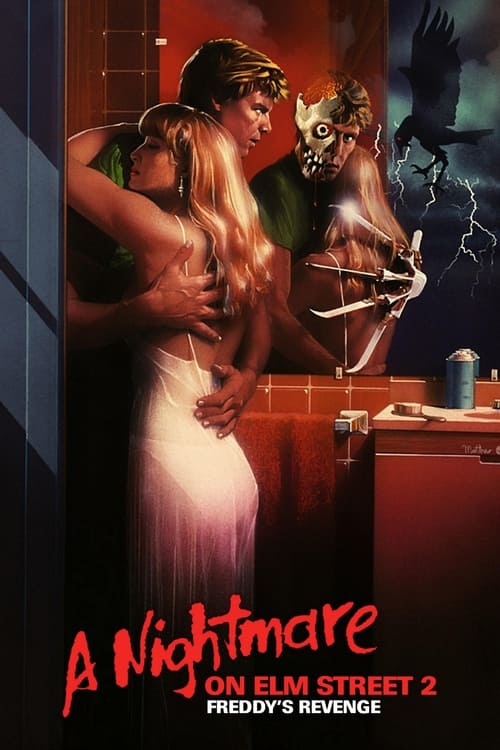
Film commentators have often remarked on the film's perceived homoerotic theme, claiming its subtext suggests Jesse is a repressed homosexual. They note, in particular, the scenes where he encounters his gym teacher Coach Schneider at a fetish club, and his flight to his male friend Grady's house after he attempts to make out with his girlfriend Lisa at her pool party. Further, actor Mark Patton, who plays Jesse, played a role so often written as female in the subgenre (such as in the first film) that it has become known as the "final girl". At the time of its release, one publication referred to it as "the gayest horror film ever". In the 21st century, it has become a cult film for gay audiences. On Never Sleep Again: The Elm Street Legacy, David Chaskin refers to a 2009 list on Cracked.com which lists "The 5 Most Unintentionally Gay Horror Movies", with Freddy's Revenge as number one, and states that "There is nothing logical that can explain the level of homoeroticism in this movie".
The book Welcome to Our Nightmares: Behind the Scene with Today's Horror Actors elaborates on the film's homoerotic subtext, stating that: "The film suggested an undertone of homosexuality, starting with the protagonist's gender-neutral name. Jesse's rarely fully clothed. He and a tormentor have a sweaty wrestling match. His coach, clad in leather, basically hits on him in a gay bar, then gets killed by Freddy, including a bare-ass spanking. Freddy emerges from Jesse's stomach in the same forced-birth technique that made the Alien films legendary."
Mark Patton has claimed the film's gay subtext was increasingly emphasised through script rewrites as production progressed. "It just became undeniable" he told BuzzFeed in 2016. "I'm lying in bed and I'm a pietà and the candles are dripping and they're bending like phalluses and white wax is dripping all over. It's like I'm the center of a [...] bukkake video." He has felt betrayed since he knew the filmmakers were aware he was gay, but closeted. They had considerable leverage over him in having him perform a role that, combined with his performance as a gay teen in Come Back to the 5 & Dime, Jimmy Dean, Jimmy Dean the year before, led to him being typecast as gay. The role called attention to what he was trying to avoid discussing and would have forestalled him getting any significant roles in 1980s Hollywood.
In particular, Patton blames Chaskin, who he says claimed the subtext arose from how Patton played the part. "I love when [he] uses the word 'subtext,'" he complained. "Did you actually go to a freshman English course in high school? This is not subtext." In 2016 he said Chaskin "sabotage[d]" him. "Nobody ever affected my confidence—the boys that threw rocks at me, nobody—but this man did." Chaskin denied for years that there was a gay subtext in his screenplay. Instead, at one point, he told a reporter that Patton had simply played the part "too gay". The emotional stress of the film led Patton to leave acting shortly afterwards for a career in interior decorating.
While Chaskin has tried to reach out and apologize to Patton over the years, with limited success, he maintains that Patton's "interpretations of Jesse were choices that he made ... I have to believe that he 'got it' and that was how he decided to play it." In 2010, Chaskin finally admitted it was a deliberate choice on his part. "Homophobia was skyrocketing and I began to think about our core audience—adolescent boys—and how all of this stuff might be trickling down into their psyches," he explained. "My thought was that tapping into that angst would give an extra edge to the horror."
One scene that would have made the gay subtext more apparent was toned down. Englund was actually prepared to insert one of his hand's knife blades into Jesse's mouth instead of merely caressing his lips with it as he does in the finished film, but Patton did not feel comfortable with it. The film's makeup artist suggested to Patton that he not do the scene that way to protect his image.
In a February 2010 interview with Attitude magazine, Englund said "... the second Nightmare on Elm Street is obviously intended as a bisexual themed film. It was early '80s, pre-AIDS paranoia. Jesse's wrestling with whether to come out or not and his own sexual desires was manifested by Freddy. His friend is the object of his affection. That's all there in that film. We did it subtly but the casting of Mark Patton was intentional too, because Mark was out and had done Come Back to the Five & Dime, Jimmy Dean, Jimmy Dean."
In an article written by Brent Hartinger for AfterElton.com, he notes that a "frequent debate in gay pop culture circles is this: Just how 'gay' was 1985's A Nightmare on Elm Street 2: Freddy's Revenge (the first Elm Street sequel)? The imagery in the movie makes it seem unmistakably gay — but the filmmakers have all along denied that that was their intention." During his interview segment for the 2010 documentary film Never Sleep Again: The Elm Street Legacy, David Chaskin admitted that the gay themes were intentional, something he had denied until that point.
In a 2020 interview director Jack Sholder said he never had any discussions with Chaskin or anybody at New Line about a gay subtext in the script during production. He did add that in his view the movie was about "repressed sexual angst that every teenager experiences" and that "that angst can express itself in the question: Am I gay?". He also pointed out that Mark Patton did not pick up on any gay subtext when he read the script, but that it was pointed out to him by one of the crew members. Sholder concluded by saying: "Looking back on it, there were a whole bunch of decisions, starting with casting Mark that really... If you look at some of the exegeses as to why it’s the gayest horror film of all time, some of it is people reading stuff into things, some of it was intentional and some of it was stuff that people added that fed into that idea."
Others in the cast and crew have said that they were unaware of any such themes at the time they made the film, but that a series of creative decisions on the part of director Jack Sholder unintentionally brought Chaskin's themes to the forefront. In an interview Sholder said, "I simply didn't have the self-awareness to realize that any of this might be interpreted as gay". Now-out Mark Patton said, "I don't think that [the character] Jesse was originally written as a gay character. I think it's something that happened along the line by serendipity". Patton also wrote Jesse's Lost Journal about Jesse's life after the film and dealing with his homosexuality.
In 2019, Patton produced and starred in the documentary film Scream, Queen! My Nightmare on Elm Street, which focuses on the legacy of Freddy's Revenge and how it affected him.