Historical accuracy
In the actual Battle of Thermopylae, the Spartans had already joined an alliance with other Greek poleis against the Persians. During the Battle of Thermopylae, Xerxes's invasion of Greece coincided with a Spartan religious festival, the Carneia, in which the Spartans were not permitted to make war. Still, realizing the threat of the Persians and not wanting to appear as Persian sympathizers, the Spartan government, rather than Leonidas alone, decided to send Leonidas with his personal 300-strong bodyguard to Thermopylae. Other Greek poleis joined the 300 Spartan men and totaled somewhere between 5,000 and 6,000 total Greek troops. The historical consensus among both ancient chroniclers and current scholars was that Thermopylae was a clear Greek defeat, and the Persian invasion would be pushed back only in later ground and naval battles.
Since few records on the actual martial arts used by the Spartans survive aside from accounts of formations and tactics, the fight choreography, led by the stunt coordinator and fight choreographer Damon Caro, was a synthesis of different weapon arts with Filipino martial arts as the base.
Paul Cartledge, Professor of Greek History at Cambridge University, advised the filmmakers on the pronunciation of Greek names and said that they "made good use" of his published work on Sparta. He praised the film for its portrayal of "the Spartans' heroic code" and of "the key role played by women in backing up, indeed reinforcing, the male martial code of heroic honour", but he expressed reservations about its "'West' (goodies) vs 'East' (baddies) polarization". Cartledge wrote that he enjoyed the film but found Leonidas' description of the Athenians as "boy lovers" ironic since the Spartans themselves incorporated institutional pederasty into their educational system.
Ephraim Lytle, assistant professor of Hellenistic history at the University of Toronto, said that 300 selectively idealized Spartan society in a "problematic and disturbing" fashion and portrayed the "hundred nations of the Persians" as monsters and non-Spartan Greeks as weak. He suggested that the film's moral universe would have seemed "as bizarre to ancient Greeks as it does to modern historians". Lytle also commented, "Ephialtes, who betrays the Greeks, is likewise changed from a local Malian of sound body into a Spartan outcast, a grotesquely disfigured troll who by Spartan custom should have been left exposed as an infant to die. Leonidas points out that his hunched back means Ephialtes cannot lift his shield high enough to fight in the phalanx. This is a transparent defense of Spartan eugenics, and convenient given that infanticide could as easily have been precipitated by an ill-omened birthmark."
Victor Davis Hanson, a National Review columnist and former professor of classical history at California State University, Fresno, wrote the foreword to a 2007 reissue of the graphic novel and said that the film demonstrates a specific affinity with the original material of Herodotus in that it captures the martial ethos of ancient Sparta and represents Thermopylae as a "clash of civilizations". He remarked that Simonides, Aeschylus, and Herodotus viewed Thermopylae as a battle against "Eastern centralism and collective serfdom", which opposed "the idea of the free citizen of an autonomous polis". He also said that the film portrays the battle in a "surreal" manner and that the intent was to "entertain and shock first, and instruct second".
Touraj Daryaee, who is now Baskerville Professor of Iranian History and the Persian World at the University of California, Irvine, criticized the film's use of classical sources by writing:
Some passages from the Classical authors Aeschylus, Diodorus, Herodotus and Plutarch are spilt over the movie to give it an authentic flavor. Aeschylus becomes a major source when the battle with the "monstrous human herd" of the Persians is narrated in the film. Diodorus' statement about Greek valor to preserve their liberty is inserted in the film, but his mention of Persian valor is omitted. Herodotus' fanciful numbers are used to populate the Persian army, and Plutarch's discussion of Greek women, specifically Spartan women, is inserted wrongly in the dialogue between the "misogynist" Persian ambassador and the Spartan king. Classical sources are certainly used, but exactly in all the wrong places, or quite naively. The Athenians were fighting a sea battle during this.
Robert McHenry, the former editor-in-chief of Encyclopædia Britannica and the author of How to Know, said that the film "is an almost ineffably silly movie. Stills from the film could easily be used to promote Buns of Steel, or AbMaster, or ThighMaster. It's about the romanticizing of the Spartan 'ideal', a process that began even in ancient times, was promoted by the Romans, and has survived over time while less and less resembling the actual historical Sparta."
Snyder stated in an MTV interview that "the events are 90 percent accurate. It's just in the visualization that it's crazy.... I've shown this movie to world-class historians who have said it's amazing. They can't believe it's as accurate as it is." Nevertheless, he also said the film is "an opera, not a documentary. That's what I say when people say it's historically inaccurate." He was also quoted in a BBC News story as saying that the film is, at its core "a fantasy film". He also describes the film's narrator, Dilios, as "a guy who knows how not to wreck a good story with truth".
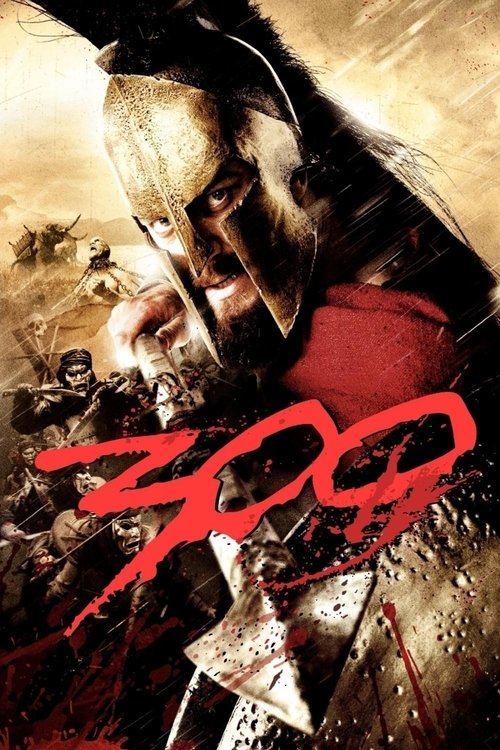
In an interview, Miller stated, "The inaccuracies, almost all of them, are intentional. I took those chest plates and leather skirts off of them for a reason. I wanted these guys to move and I wanted 'em to look good. I knocked their helmets off a fair amount, partly so you can recognize who the characters are. Spartans, in full regalia, were almost indistinguishable except at a very close angle. Another liberty I took was, they all had plumes, but I only gave a plume to Leonidas, to make him stand out and identify him as a king. I was looking for more an evocation than a history lesson. The best result I can hope for is that if the movie excites someone, they'll go explore the histories themselves. Because the histories are endlessly fascinating."
Kaveh Farrokh, in the paper "The 300 Movie: Separating Fact from Fiction", noted that the film falsely portrayed "the Greco-Persian Wars in binary terms: the democratic, good, rational 'Us' versus the tyrannical, evil and irrational, 'other' of the ever-nebulous (if not exotic) 'Persia'". He highlighted three points regarding the contribution of the Achaemenid Empire to the creation of democracy and human rights: "The founder of the Achaemenid Empire, Cyrus the Great, was the world's first emperor to openly declare and guarantee the sanctity of human rights and individual freedom.... Cyrus was a follower of the teachings of Zoroaster, the founder of one of the world's oldest monotheistic religions.... When Cyrus defeated King Nabonidus of Babylon, he officially declared the freedom of the Jews from their Babylonian captivity. This was the first time in history that a world power had guaranteed the survival of the Jewish people, religion, customs and culture." He abolished slavery.