




The 2012 United States Senate election in Wisconsin took place on November 6, 2012, alongside a U.S. presidential election as well as other elections to the United States Senate and House of Representatives and various state and local elections. Incumbent Democratic Senator Herb Kohl retired instead of running for re-election to a fifth term. This was the first open Senate seat in Wisconsin since 1988, when Kohl won his first term.
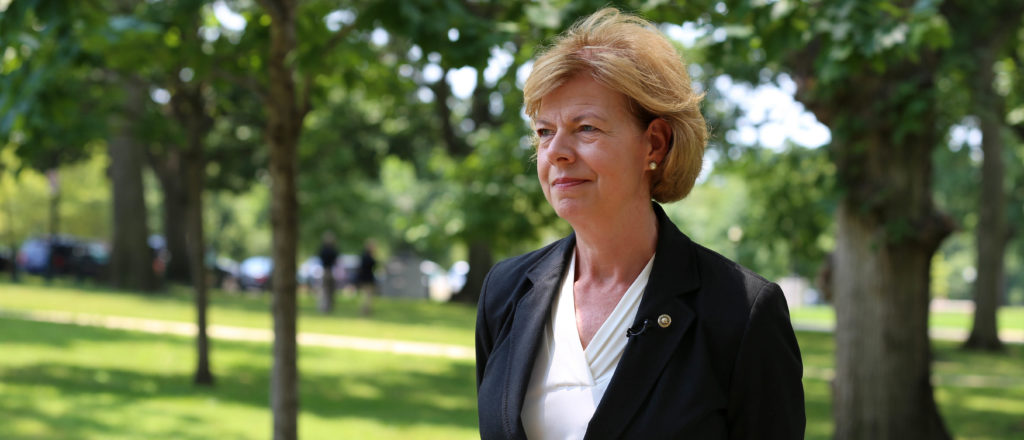
Primary elections were held on August 14, 2012. Congresswoman Tammy Baldwin of Wisconsin's 2nd congressional district ran unopposed in the Democratic primary. The Republican nominee was former Wisconsin Governor and U.S. Secretary of Health and Human Services Tommy Thompson, who won with a plurality in a four-way primary race. In the general election, Baldwin defeated Thompson and won the open seat. She became the first woman elected to represent Wisconsin in the Senate and the first openly gay U.S. senator in history. This is also the only time Thompson lost a statewide race. Both Baldwin and Thompson won half of the counties in the state, an unusual result.
Contents
Background
Incumbent Democratic senator Herb Kohl was re-elected to a fourth term in 2006, beating Republican attorney Robert Lorge by 67% to 30%. Kohl's lack of fundraising suggested his potential retirement. There was speculation that Kohl might decide to retire to allow Russ Feingold, who lost his re-election bid in 2010, to run again, although Mike Tate, chairman of the Wisconsin Democratic Party, dismissed speculation about Kohl's potential retirement. Ultimately, Kohl announced in May 2011 that he would not run for re-election in 2012.
Democratic primary
Despite speculation that Kohl would retire to make way for his former Senate colleague Russ Feingold, who had been unseated in 2010, Feingold chose not to enter the race. Other potential candidates also declined to run, leaving Baldwin unopposed in the Democratic primary.
Candidates
Tammy Baldwin, U.S. representative
Tom Barrett, mayor of Milwaukee
Kathleen Falk, former Dane County executive (1997–2011)
Russ Feingold, former U.S. senator
Steve Kagen, former U.S. representative for Wisconsin's 8th congressional district (2006–2011)
Ron Kind, U.S. representative for Wisconsin's 3rd congressional district
Herb Kohl, incumbent U.S. senator
Gwen Moore, U.S. representative for Wisconsin's 4th congressional district
Tim Sullivan, businessman
Republican primary
Congressman and House Budget Committee Chairman Paul Ryan stated he would not run if Kohl sought reelection, but would contemplate a run if Kohl retired. Ryan later stated that he was "95 percent sure" that he would not run. He was later chosen as the Republican nominee for vice president by presidential nominee Mitt Romney.
Six candidates declared for the seat, although two later withdrew. The contest turned out to be a four-way fight. Although a large majority of Republican primary voters consistently expressed a preference for a nominee "more conservative" than Tommy Thompson, Eric Hovde and Mark Neumann split the conservative vote, allowing Thompson to narrowly prevail with a plurality of the vote.
Candidates
Jeff Fitzgerald, Speaker of the Wisconsin State Assembly
Eric Hovde, businessman
Mark Neumann, former U.S. representative, nominee for the U.S. Senate in 1998, and candidate for governor in 2010
Tommy Thompson, former governor of Wisconsin and former secretary of Health and Human Services
Frank Lasee, state senator (endorsed Eric Hovde)
Kip Smith, physical therapist
Mark Andrew Green, former U.S. representative and former United States ambassador to Tanzania
Theodore Kanavas, former state senator
Paul Ryan, U.S. representative
Tim Sullivan, businessman
J. B. Van Hollen, Wisconsin attorney general
Polling
+ Commissioned by Eric Hovde
General election
Candidates
Tammy Baldwin (Democratic), U.S. Representative
Tommy Thompson (Republican), former governor and former Secretary of Health and Human Services
Joseph Kexel (Libertarian), IT consultant
Nimrod Allen III (independent), consultant and former Marine
Debates
Baldwin and Thompson agreed to three debates: September 28, October 18 and 26, all broadcast statewide, and nationwide through C-SPAN.
The first debate originated from the studios of Milwaukee Public Television and was coordinated by the Wisconsin Broadcasters Association. It aired on MPTV, Wisconsin Public Television, Wisconsin Public Radio and several commercial stations throughout the state.
The second debate originated from the Theater for Civic Engagement on the campus of the University of Wisconsin–Marathon County in Wausau and was coordinated by WPT/WPR, the Milwaukee Journal Sentinel and Milwaukee's WTMJ-TV. Again it was carried on MPTV, WPT/WPR, and several commercial stations, including WTMJ-TV.
The third debate originated from Eckstein Hall on the campus of Marquette University Law School and was coordinated by WISN-TV in Milwaukee. It aired on that station and across the state's other ABC affiliated stations.
External links
Complete video of debate, September 28, 2012 - C-SPAN
Complete video of debate, October 18, 2012 - C-SPAN
Complete video of debate, October 26, 2012 - C-SPAN
Results
Barron (largest city: Rice Lake)
Brown (largest city: Green Bay)
Burnett (largest village: Grantsburg)
Calumet (largest city: Chilton)
Clark (largest city: Neillsville)
Iron (largest city: Hurley)
Jefferson (largest city: Watertown)
Kewaunee (largest city: Algoma)
Langlade (largest city: Antigo)
Manitowoc (largest city: Manitowoc)
Marathon (largest city: Wausau)
Marinette (largest city: Marinette)
Monroe (largest city: Sparta)
Oconto (largest city: Oconto)
Oneida (largest city: Rhinelander)
Outagamie (largest city: Appleton)
Rusk (largest city: Ladysmith)
Shawano (largest city: Shawano)
Washburn (largest city: Spooner)
Waupaca (largest city: New London)
Waushara (largest city: Berlin)
Adams (largest city: Adams)
Aftermath
Brian Schimming, the vice chairman of the Wisconsin Republican Party, partly blamed Thompson's defeat on the fact that he had to face a competitive primary whereas Baldwin was unopposed for the Democratic nomination: "[Thompson] blew all his money going through the primary. So when he gets through the primary, it was like three weeks before he was up on the air. [Baldwin] piled on immediately." He claimed "If [Thompson] hadn't had as ugly a primary, we could have won that seat."