




One Small Step: The Whole World Looks Up
For one night, 600 million people watched the same grainy picture and felt like one species: a man on the Moon.
FaithTap · Oct 7, 2026 · 9 min read
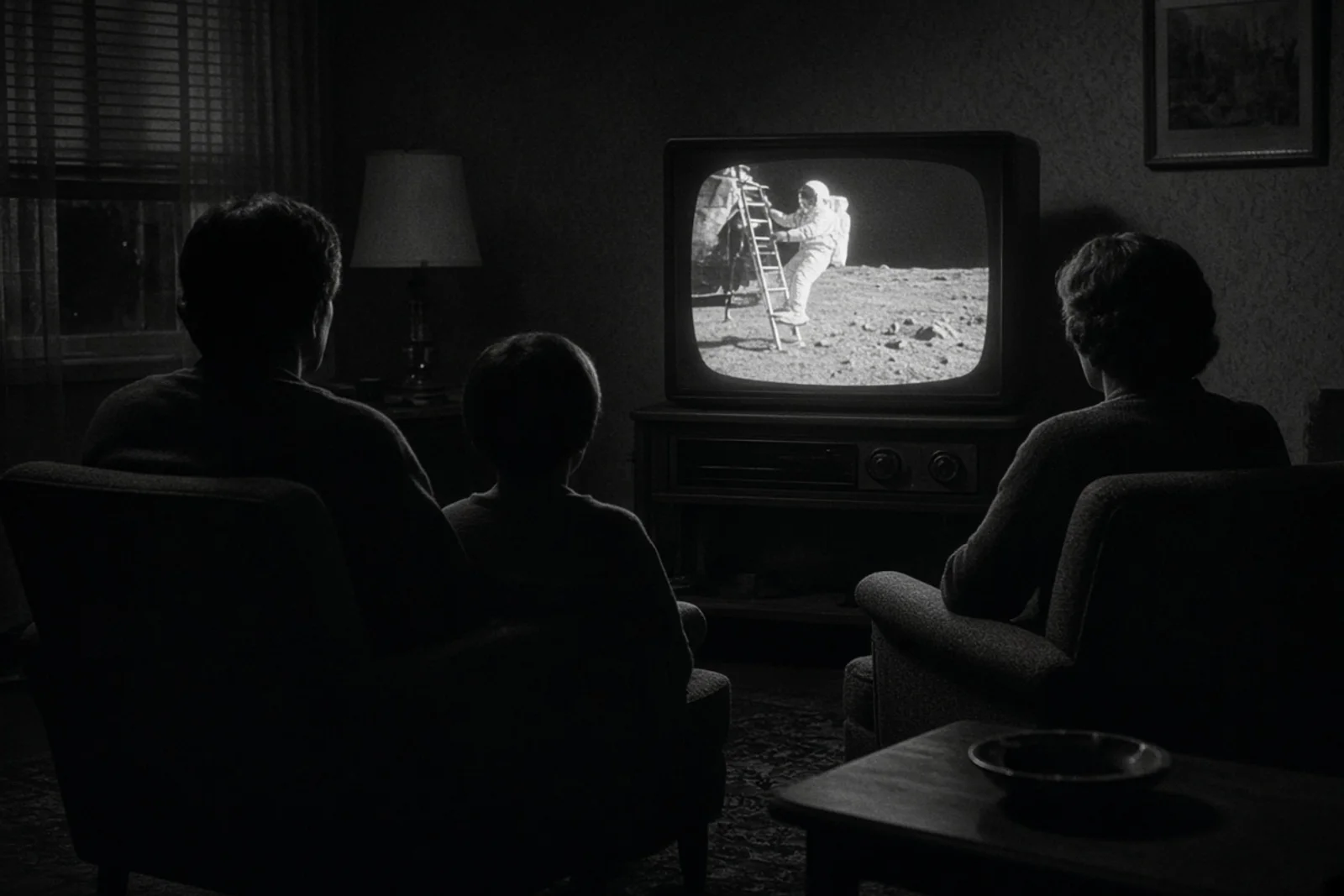
The static came first, always the static, a hiss like wind through wheat before the picture steadied on the console screen in the corner of the room. I was seventeen that July, sitting cross-legged on a neighbor's braided rug in Wapakoneta, Ohio, a town so small the streetlights went off at midnight and nobody minded. We all knew whose son was up there. Everybody in that town could point to the house on Neil Armstrong's parents' street and say, that's where he grew up, that's the yard, that's the porch. It made the whole thing feel closer than it should have, closer than a quarter-million miles has any right to feel.
By the fifth day of the mission, the whole world had rearranged itself around a single television signal. Nearly six hundred million people, we would later learn, were watching some version of what we watched — the same grainy gray light in living rooms from Manila to Munich to our own small parlor with its rabbit-ear antenna. Six hundred million strangers, holding their breath together, and none of us knowing the others were doing it.
Aboard Apollo 11, Neil Armstrong, Buzz Aldrin, and Michael Collins had begun their fifth day in space at the end of their ninth trip around the Moon. In Houston, at the Manned Spacecraft Center, Eugene Kranz's White Team took the console, with astronaut Charles Duke serving as capsule communicator. There was something almost domestic about it, the reporters told us — a quick breakfast, the donning of pressure suits, the checklist voices going back and forth as calm as men discussing the weather. Aldrin and Armstrong began waking the lunar module Eagle from its long sleep, unfolding its legs like some patient insect stirring.
Near the end of the twelfth orbit, Duke's voice came through, giving the go-ahead to undock. It happened behind the Moon, out of radio contact, the two men trusting instruments and each other in silence none of us on Earth could share. When Eagle and Columbia came back around into view, Armstrong's voice crackled through: the Eagle has wings. Collins answered that he had a fine-looking flying machine there, despite the fact it was upside down, and Armstrong came back dry as a Kansas creek bed: somebody's upside down. I remember the room laughing, a nervous laugh, the kind that comes when you need somewhere to put the feeling that has nowhere else to go.
From there the minutes moved faster than the room could hold. The viewing gallery in Houston filled with agency officials and astronauts crowding in to watch history happen without them. Duke gave the go for the descent orbit insertion burn, thirty seconds of engine fire behind the Moon that dropped Eagle's low point down to fifty thousand feet. Then came Powered Descent Initiation — the real beginning, the point of no easy turning back. Eagle's antenna kept losing its lock on Earth, so for a while Houston had to talk to the lander through Collins alone in Columbia, a strange relay of voices bouncing off a man in lunar orbit.
The engine ran low, ten percent thrust for twenty-six seconds, then opened up to full. Eagle flew down engine-first, windows toward the surface, three hundred miles out from the Sea of Tranquility. Armstrong watched the landmarks slide past below him against a stopwatch in his head, and noticed they were arriving two or three seconds early — which meant, he calculated, they'd overshoot the plan by about three miles. He would turn out to be right, almost exactly.
Somewhere around forty thousand feet he tipped the spacecraft up, windows forward now, radar reading the ground rushing beneath them. And then, at thirty-three thousand feet, a tone none of them had ever heard outside a rare simulation: program alarm 1202. I didn't know what that meant sitting on that rug in Ohio, only that the man reading the wire-service bulletin on our screen said the word "alarm" and every grown-up in the room went still. It passed in seconds — cleared by men on the ground who understood the guidance computer better than its own designers, maybe — but for those seconds nobody in Wapakoneta breathed, and nobody six hundred million strong anywhere else did either.
Then Armstrong's hands took over from the automatic program, hunting past boulders the size of cars for a stretch of gray dust smooth enough to trust, fuel ticking down toward numbers the engineers had circled in red. And then the words that cracked the room wide open — the Eagle has landed — and Wapakoneta did not stay quiet after that. Someone's father whooped. Someone's mother cried into a dish towel. I remember running out onto the porch just to look up, foolishly, as if I might catch some flicker of him up there, though of course there was nothing, only the same ordinary stars that had hung over that town every July night before.
Hours later, past midnight our time, Armstrong climbed down the ladder and set his boot into gray dust that had waited some four and a half billion years for a footprint. The words came through, thin and flattened by distance but unmistakable — a small step for a man, a giant leap for mankind — and in that instant the town, the country, the six hundred million, were not separate audiences anymore. We were one shape, one held breath, looking at the same impossible picture.