




Every dollar you spend is hours of your life
Robin and Dominguez reframe money as finite life energy so tracking, a personal enough point, and investment income can free work from wages.
IJR · Oct 12, 2026 · 12 min read
In 60 seconds
- Money is life energy: wages convert finite hours into purchases, so a $150 pair of shoes at a $30 after-tax wage costs five irreplaceable hours.
- Most people have already earned enough; lifetime earnings often top a million while net worth lags because money leaked untracked.
- A stated salary overstates pay: job costs and unpaid hours can drop a $50,000 worker from roughly $24 to about $11 real hourly wage.
- Category tracking converted to life hours, plus three questions on fulfillment, values, and post-job desire, can cut expenses twenty to fifty percent without felt sacrifice.
- Financial independence is the crossover when investment income permanently tops expenses, after which work is chosen for meaning rather than pay.
The big idea
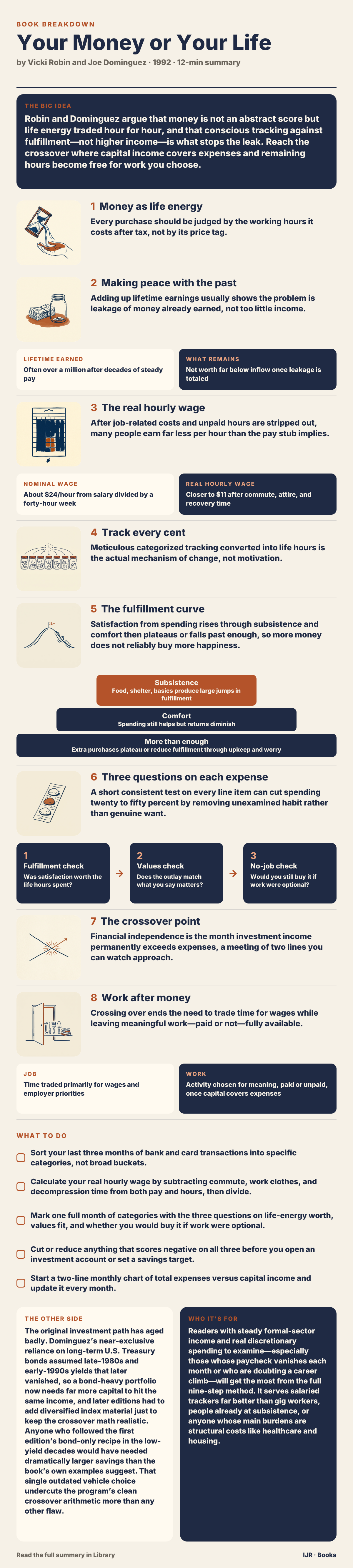
Robin and Dominguez argue that money is not an abstract score but life energy traded hour for hour, and that conscious tracking against fulfillment—not higher income—is what stops the leak. Reach the crossover where capital income covers expenses and remaining hours become free for work you choose.
The book in brief
The book starts from a simple reframe: wages are a conversion rate between your remaining hours and the things you buy, so budgeting in dollars hides the real cost. Most people feel short on money while money moves through their hands unseen, which makes ordinary advice to earn more miss the point.
The program first rebuilds a factual baseline—what has already been earned and what remains—then recalculates true earnings after the hidden costs of holding a job. With that honest rate in hand, every inflow and outflow is logged in fine categories and converted back into hours of life.
Tracked spending is then set against remembered satisfaction to sketch a personal fulfillment curve and locate enough in each category. A short set of questions turns that curve into a monthly practice that removes waste without asking for deprivation.
Savings are invested and plotted monthly against falling expenses until investment income crosses above the expense line. Past that threshold the need to trade time for wages ends, while meaningful work stays fully open and the chart is still watched so the threshold is not crossed back.
The arc closes where it began: once money is seen as life energy, the point of the whole system is conscious control over the hours that remain.
Context
Vicki Robin and Joe Dominguez published the program in 1992 after Dominguez himself crossed into financial independence young and the pair taught the method widely, later founding the New Road Map Foundation and giving away royalties. The book became a founding text of the modern FIRE movement by tying frugality and simple investing to a life-energy ethic rather than to get-rich tactics.
The key ideas

1
Money as life energy
Every purchase should be judged by the working hours it costs after tax, not by its price tag.
Robin and Dominguez open by rejecting money as an abstract pile of numbers. Hours go into a job; a wage comes out; that wage is simply the exchange rate between remaining life and goods. Dollars feel infinite and replaceable; hours do not.
Once the unit of account shifts, spending decisions change without lectures on willpower. A mid-level worker earning thirty dollars an hour after tax does not buy a hundred-fifty-dollar pair of shoes; that person permanently hands over five hours of finite life for footwear. The authors do not demand guilt—only consciousness—because most spending runs on autopilot.
Everything later in the program depends on this reframe. Real hourly wage, the tracking ledger, and the fulfillment curve all treat time, not currency, as the true unit of wealth. Without it the rest reads as ordinary budgeting; with it, budgeting becomes an accounting of a life.
In practice: At thirty dollars after tax, a hundred-fifty-dollar pair of shoes equals five hours of working life handed over for good.

2
Making peace with the past
Adding up lifetime earnings usually shows the problem is leakage of money already earned, not too little income.
Lifetime earned
Often over a million after decades of steady pay
What remains
Net worth far below inflow once leakage is totaled
Step one has readers total every dollar ever earned from tax records, pay stubs, or Social Security statements back to a first job. The authors call the exercise making peace with the past because the sum is often shocking and removes shame as the starting frame.
A modest forty-five thousand a year across twenty-five years already exceeds a million dollars in, yet net worth may sit far below that. Side by side with a full net-worth list of assets and liabilities, the gap between what came in and what remains becomes the program’s real target.
An inventory of belongings with resale value often surfaces thousands in dormant assets. Structurally the step kills the excuse of low income before behavior change begins and hands readers a factual baseline instead of a vague sense of failure. The whole book then pivots from earn-more advice toward understanding what already happened to money already received.
In practice: Twenty-five years at forty-five thousand a year totals over a million earned, yet many readers hold far less in net worth.

3
The real hourly wage
After job-related costs and unpaid hours are stripped out, many people earn far less per hour than the pay stub implies.
Nominal wage
About $24/hour from salary divided by a forty-hour week
Real hourly wage
Closer to $11 after commute, attire, and recovery time
Building on life energy, readers start with annual income and subtract everything the job itself demands: commute cost and time, work clothes, dry cleaning, daycare, work lunches, decompression evenings, even illness tied to stress. Adjusted income is then divided by adjusted hours that now include unpaid preparation and travel.
A worker at fifty thousand a year who spends ninety minutes round-trip commuting, three hundred a month on business attire and cleaning, and two hours a night unwinding may land near eleven dollars an hour rather than the roughly twenty-four implied by a standard forty-hour week. That lower figure becomes the currency for every later purchase test.
The gap explains why a seemingly solid salary still feels tight. Raises and promotions often arrive bundled with higher job costs and more consumed time, so real hourly wage can stay flat or fall even while the offer letter climbs. Honest accounting here prevents the rest of the program from using a fantasy rate.
In practice: A fifty-thousand-dollar salary with heavy commute, clothing, and unwind time can fall from about twenty-four dollars nominal to roughly eleven real.

4
Track every cent
Meticulous categorized tracking converted into life hours is the actual mechanism of change, not motivation.
Step two demands a record of every cent in or out with no minimum and no exceptions. Categories must be specific enough to reveal behavior: groceries, restaurants, coffee, and work lunches stay separate rather than collapsing into food.
At month end each category total is divided by the real hourly wage so the ledger speaks in hours of life. A household spending one hundred eighty a month on takeout coffee at a fifteen-dollar real wage is spending twelve hours—roughly a day and a half of working life—on coffee alone.
The aim is accurate information, not guilt. The authors hold that most financial distress is a mismatch between assumed and actual spending, and the mismatch survives because tracking is tedious and people quit early. Several unbroken months are required before patterns stabilize across ordinary seasonal swings; without that ledger the fulfillment curve and crossover math have no reliable data.
In practice: One hundred eighty dollars a month on takeout coffee at fifteen dollars real wage equals twelve life hours—about a day and a half of work.

5
The fulfillment curve
Satisfaction from spending rises through subsistence and comfort then plateaus or falls past enough, so more money does not reliably buy more happiness.
- SubsistenceFood, shelter, basics produce large jumps in fulfillment
- ComfortSpending still helps but returns diminish
- More than enoughExtra purchases plateau or reduce fulfillment through upkeep and worry
With tracking in hand the authors sketch spending on one axis and satisfaction on the other. At the low end, money for food, shelter, and basic clothing produces large jumps in fulfillment. In the comfort middle, returns diminish. Past the point they call more than enough, added spending can flatten or drop as stuff demands storage, insurance, maintenance, and worry.
The curve is a heuristic readers test against their own ledgers and remembered satisfaction, category by category, not a lab instrument. A second car may add real convenience; a fourth mostly adds parking and premiums. A larger house past a certain size adds cleaning and heat without matching comfort.
Enough is personal and category-specific. Someone who values books may rightly keep a large home library while spending almost nothing on clothes or entertainment. Frugality stops being a moral contest and becomes a diagnostic: maximize fulfillment per life hour spent, which only appears when actual spending sits beside remembered satisfaction.
In practice: A second car can add convenience; a fourth mainly adds a parking problem and an insurance bill.

6
Three questions on each expense
A short consistent test on every line item can cut spending twenty to fifty percent by removing unexamined habit rather than genuine want.
- 1Fulfillment checkWas satisfaction worth the life hours spent?
- 2Values checkDoes the outlay match what you say matters?
- 3No-job checkWould you still buy it if work were optional?
After the curve is sketched, every recorded expense faces three questions: Did it give fulfillment in proportion to the life energy spent? Is it aligned with personal values? How would it change if I never had to work for money again?
The third question separates desire from job compensation—expensive vacations that mainly repair work stress, or convenience buys that exist only because the job leaves no time to cook or repair. Readers mark months of categories plus, minus, or zero by life-energy worth.
Seminar case studies the authors report show expense drops of twenty to fifty percent by dropping what scored consistently negative: unused gym memberships, untouched subscriptions, oversized houses kept for habit or status. Done honestly and repeatedly, the practice nudges spending toward the curve’s plateau and produces the stable monthly expense figure the crossover calculation later needs.
In practice: Attendees cut twenty to fifty percent of expenses by zeroing unused memberships, dead subscriptions, and status housing that scored negative on all three questions.

7
The crossover point
Financial independence is the month investment income permanently exceeds expenses, a meeting of two lines you can watch approach.
The central mechanic is a wall chart with two monthly lines: total expenses and income from invested capital alone. As values-based cuts lower the expense line and ordinary saving plus compounding raise capital income, the lines move toward each other. Where investment income stays above expenses, labor is no longer required to fund life—that is the authors’ definition of financial independence.
In the original edition Dominguez favored long-term U.S. Treasury bonds so interest stayed predictable and market swings could not wreck the math. His own crossover arrived in 1969 at age thirty-one on a modest portfolio that covered an annual budget he kept around six to seven thousand dollars by design.
The variable most under personal control is the expense line, which is why tracking and fulfillment matter more than heroic investing or high salary. A household that holds real expenses at thirty thousand reaches crossover on far less capital than one spending eighty thousand, whatever either earns while still employed.
In practice: Dominguez crossed in 1969 at thirty-one on interest that covered roughly six to seven thousand dollars a year he had deliberately kept low.

8
Work after money
Crossing over ends the need to trade time for wages while leaving meaningful work—paid or not—fully available.
Job
Time traded primarily for wages and employer priorities
Work
Activity chosen for meaning, paid or unpaid, once capital covers expenses
Final steps separate a job, done mainly for income, from work done for its own value regardless of pay. Once employment no longer funds life, activity can follow contribution and interest: paid projects, volunteering, caregiving, art, civic effort, in any mix.
The authors reject independence as idleness. Their own later years went into unpaid teaching, writing, and founding the New Road Map Foundation, where they gave away royalties and taught the program free. They argue total community contribution often rises because work no longer has to fit what an employer will fund.
Money management continues: keep tracking and watch the wall chart so capital income keeps pace with inflation and changing needs. Crossover is a threshold that can be crossed backward if spending climbs or yields fall. The stage returns agency—earlier steps cleared waste; this one decides, without financial coercion, what a life is for.
In practice: After crossover the authors taught unpaid, wrote, and ran the New Road Map Foundation, giving royalties away and offering the program free.
Key terms
- Life energy The finite hours of your life that wages convert into money and purchases.
- Real hourly wage Earnings after subtracting job costs and unpaid job hours, then dividing by those fuller hours.
- Fulfillment curve The arc where spending lifts satisfaction through needs and comfort, then flattens or falls past enough.
- Enough Your personal spending level in each category that maximizes fulfillment per life hour.
- Crossover point The month when income from invested capital permanently exceeds monthly expenses.
- Wall chart The simple graph that plots expenses and investment income together until they meet.
- Job vs work A job is done mainly for pay; work is chosen for its own value once pay is optional.
What to do
- Sort your last three months of bank and card transactions into specific categories, not broad buckets.
- Calculate your real hourly wage by subtracting commute, work clothes, and decompression time from both pay and hours, then divide.
- Mark one full month of categories with the three questions on life-energy worth, values fit, and whether you would buy it if work were optional.
- Cut or reduce anything that scores negative on all three before you open an investment account or set a savings target.
- Start a two-line monthly chart of total expenses versus capital income and update it every month.
Questions to think with
- If every purchase were priced only in hours of your real wage, which current habit would look most expensive?
- Where does your own fulfillment curve already peak, and which categories are past enough?
- What spending exists mainly to recover from or compensate for your job?
- How would your weekly calendar change if capital income already covered your current expenses?
- Which structural costs in your life sit outside tracking and values work, and how does that limit the program?
The other side
The original investment path has aged badly. Dominguez’s near-exclusive reliance on long-term U.S. Treasury bonds assumed late-1980s and early-1990s yields that later vanished, so a bond-heavy portfolio now needs far more capital to hit the same income, and later editions had to add diversified index material just to keep the crossover math realistic. Anyone who followed the first edition’s bond-only recipe in the low-yield decades would have needed dramatically larger savings than the book’s own examples suggest. That single outdated vehicle choice undercuts the program’s clean crossover arithmetic more than any other flaw.
Who it's for
Readers with steady formal-sector income and real discretionary spending to examine—especially those whose paycheck vanishes each month or who are doubting a career climb—will get the most from the full nine-step method. It serves salaried trackers far better than gig workers, people already at subsistence, or anyone whose main burdens are structural costs like healthcare and housing.