




Name resistance, turn pro, then leave room for the muse
Anyone quietly abandoning a book or business gets a tactical map for self-sabotage—and Pressfield's closing bet that discipline earns mystical help he refuses to explain.
IJR · Oct 16, 2026 · 12 min read
In 60 seconds
- Creative stalling is usually one internal enemy Pressfield names Resistance, not missing talent or time.
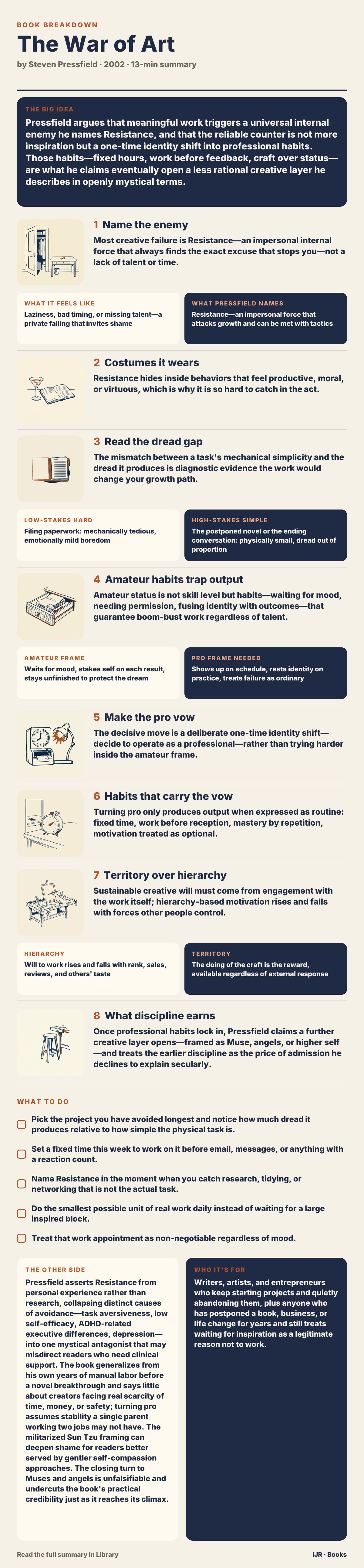
- It hides in acts that feel useful: reorganizing a closet, polishing a logo for months, pitching scripts at parties with no pages written.
- The projects you avoid hardest are often the ones that would change you most—use that gap as a filter.
- Amateurs wait for mood and stake identity on each result; pros decide once to show up on schedule.
- Sustainable drive comes from the craft itself, not bestseller rank or peer approval.
- Locked-in pro habits are, in his account, the price of admission to inspiration he frames as Muse or angels and will not reduce to technique.
The big idea
Pressfield argues that meaningful work triggers a universal internal enemy he names Resistance, and that the reliable counter is not more inspiration but a one-time identity shift into professional habits. Those habits—fixed hours, work before feedback, craft over status—are what he claims eventually open a less rational creative layer he describes in openly mystical terms.
The book in brief
Pressfield opens on a novelist who must reorganize her closet before she can write, an entrepreneur who spends months on a logo instead of launching, and a would-be musician who never signs up for lessons. The real obstacle, he insists, is not circumstance but an internal force he calls Resistance—impersonal, universal, and precise at finding the excuse that stops you. Naming it turns vague shame into a fightable opponent, closer to war than self-help, a deliberate echo of Sun Tzu.
He catalogues the costumes. Procrastination arrives as 'I'll start tomorrow.' Self-doubt says you are unqualified. Slipperier masks look virtuous: endless research, networking, sudden illness before a deadline, even a grant or book deal that triggers sabotage once the stakes feel real. A screenwriter pitches ideas at parties for years, draws real interest, and never writes a page; the socializing itself becomes the disguise. Spot your recurring mask early and you catch the derailment sooner.
Avoidance intensity then becomes a working filter. Filing paperwork produces mild boredom. A novel postponed a decade, or the conversation that would end an unhealthy relationship, produces dread far beyond typing or talking. That mismatch marks growth stakes. The amateur waits for the right mood, fuses self-worth with each day's result, and stays unfinished so the dream never faces judgment.
The hinge is turning pro: a decision, almost a vow, to operate like someone with a day job who shows up whether inspired or not. Identity rests on continuing the practice. Bad output gets filed; tomorrow continues. Daily habits make the vow real—fixed time, consistent volume, finish the unit before checking reviews, expect motivation to be rare.
Motivation itself must come from territory, not hierarchy. Chasing rank, sales, and acclaim hands your will to forces other people control and reintroduces mood swings. Treating the doing of the craft as the reward keeps drive available every day. Recognition can be a welcome byproduct; it should never be the source of the will to work.
The book then shifts register. Once professional habits manage Resistance, Pressfield claims another layer becomes available—material that seems to arrive from beyond ordinary effort. He uses the language of Muse, angels, and higher self, treats historical muse-invocation as lost practical wisdom, and frames earlier discipline as the price of admission. Talent without showing up does not get access; daily showing up does. He leaves the source unexplained in secular terms.
Context
Steven Pressfield published this in 2002 after years of manual labor and failure before his breakthrough as a novelist. It mattered because it gave working artists and would-be artists a shared vocabulary for self-sabotage, turning a vague feeling of stuckness into a nameable, fightable opponent.
The key ideas
1
Name the enemy
Most creative failure is Resistance—an impersonal internal force that always finds the exact excuse that stops you—not a lack of talent or time.
What it feels like
Laziness, bad timing, or missing talent—a private failing that invites shame
What Pressfield names
Resistance—an impersonal force that attacks growth and can be met with tactics
Pressfield insists the obstacle between you and the book, business, or life change is not external circumstance. It is an internal force he names Resistance. He calls it impersonal, universal, and infallible in its aim. It always knows which excuse, distraction, or fear will stop you.
Vague laziness invites shame. A named enemy invites strategy. If procrastination is only a personal failing, the response is self-criticism, which rarely produces action. If Resistance predictably attacks any attempt at growth, the response becomes tactical: recognize it, expect it, act anyway.
He frames the fight as closer to war than self-help. The title deliberately echoes Sun Tzu, treating creative struggle as a real battlefield with its own terrain and casualties.
In practice: A novelist who suddenly needs to reorganize her closet before writing, and an entrepreneur who spends months on a logo instead of launching, are meeting the same force in different masks.

2
Costumes it wears
Resistance hides inside behaviors that feel productive, moral, or virtuous, which is why it is so hard to catch in the act.
Procrastination is the obvious costume, yet it rarely feels like laziness. It feels like waiting until conditions are better. Self-doubt is another: the voice that says you are not qualified. Pressfield claims that specific doubt is actually proof you are, because frauds feel certain.
More surprising masks look like good behavior. Self-medication through alcohol or drugs sits beside excessive research, networking, and preparation that never converts into the actual work. Trouble at home, sudden illness before a big deadline, and unexplained restlessness all make his list.
Even success can be a mask. Landing a grant or book deal can trigger anxiety and sabotage right when things should feel easiest, because the stakes of producing are now real. Resistance studies you and picks the personalized weakness that stops you without looking like avoidance.
In practice: A screenwriter spent years pitching ideas at parties, got real interest, and never wrote a page; the socializing became indistinguishable from work until nothing was finished.

3
Read the dread gap
The mismatch between a task's mechanical simplicity and the dread it produces is diagnostic evidence the work would change your growth path.
Low-stakes hard
Filing paperwork: mechanically tedious, emotionally mild boredom
High-stakes simple
The postponed novel or the ending conversation: physically small, dread out of proportion
People routinely treat intense avoidance as a reason to abandon a project—if it were meant to be, it would not feel this hard. Pressfield argues the correct reading runs the opposite direction. Resistance expends effort in proportion to the threat a given act poses to the status quo.
Ordinary difficulty is different. Tedious paperwork generates mild boredom, not deep avoidance. A novel wanted for a decade, or a conversation that would end an unhealthy relationship, generates dread disproportionate to the physical act. Writing is typing. The conversation is talking.
That gap is usable information when choosing what to show up for. Between two projects, the one producing far more avoidance behavior deserves attention, not less. He is careful: not everything hard is automatically worthwhile. The test is specifically mechanical simplicity paired with outsized emotional resistance.
In practice: Filing paperwork versus starting the novel postponed for a decade—the physical effort is similar, the dread is not.

4
Amateur habits trap output
Amateur status is not skill level but habits—waiting for mood, needing permission, fusing identity with outcomes—that guarantee boom-bust work regardless of talent.
Amateur frame
Waits for mood, stakes self on each result, stays unfinished to protect the dream
Pro frame needed
Shows up on schedule, rests identity on practice, treats failure as ordinary
A technically skilled hobbyist can still be an amateur in Pressfield's sense, and a beginner can already think like a professional. The amateur treats creative work as something that requires the right mood, the right circumstances, or validation from others before it can happen. Engagement then depends on internal states outside their control.
Taking the work too personally locks the pattern in. When identity has not been separated from the outcome of any single piece, a bad day or rejected pitch feels like a verdict on personal worth. Continuing becomes unbearable.
Fear of exposure adds a final lock. Full commitment with possible failure would leave no excuses. Staying unfinished protects the comfort that the novel might still have been great. The chapter's aim is recognition without shame: inconsistency is structural, not a private character flaw.
In practice: Bursts of enthusiasm when inspiration hits, followed by long stretches of nothing once mood drops.
5
Make the pro vow
The decisive move is a deliberate one-time identity shift—decide to operate as a professional—rather than trying harder inside the amateur frame.
Trying harder as an amateur does not fix inconsistency. Adopting the frame working professionals already use does. A professional shows up on schedule regardless of mood. A professional does not wait to feel like it. The craft becomes a job with its own discipline, not an expression of momentary feeling.
A person with a day job does not call in sick because they lack inspiration. They show up because the role has structural obligations independent of internal state. Creative work, Pressfield argues, deserves the same treatment, self-imposed, since no external boss enforces it.
Failure changes meaning under this identity. A professional's self rests on continuing the work, not on any single outcome being good. Bad output gets filed; they return tomorrow. No existential crisis, because self was never staked on that day's result. The decision is made once—almost a private vow—so daily Resistance faces a closed question rather than an open negotiation.
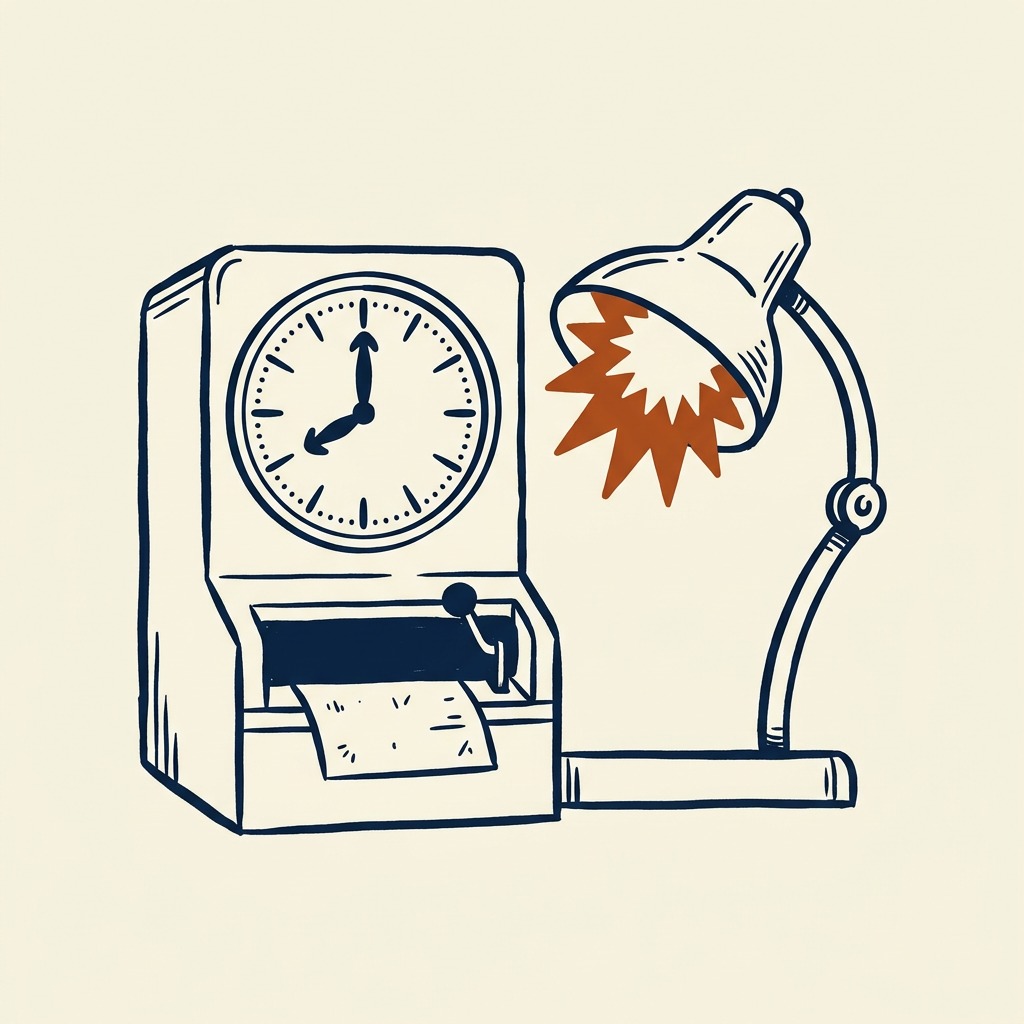
In practice: A shift worker who clocks in whether or not they feel inspired that day.
6
Habits that carry the vow
Turning pro only produces output when expressed as routine: fixed time, work before reception, mastery by repetition, motivation treated as optional.
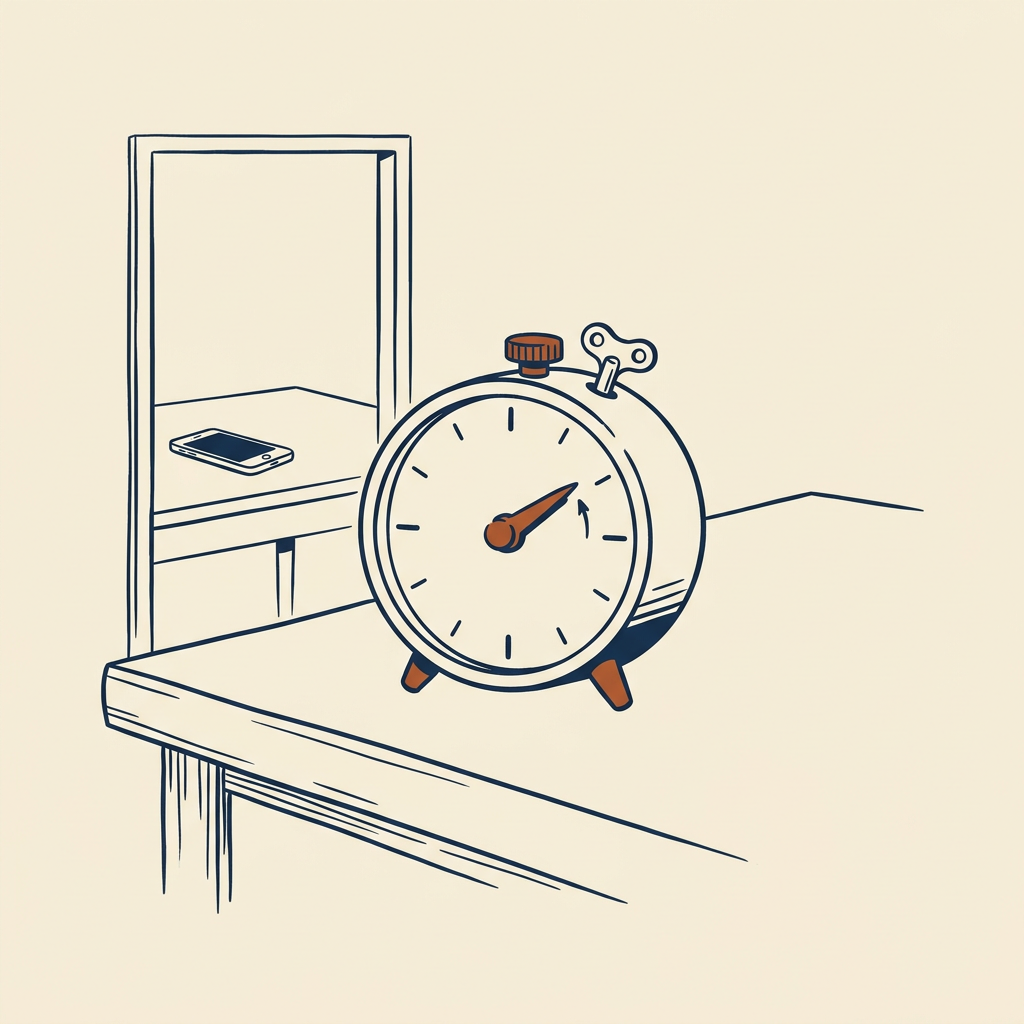
A one-time mental decision without daily machinery stays inspiring and inert. Pressfield stresses routine over intensity. Professionals work at consistent times and volumes rather than unpredictable bursts. The value is less the exact schedule than the removal of the daily negotiation over whether today is a work day.
Skill is treated as incremental. Competence arrives slowly through repetition. A bad day becomes one data point in a long series, not evidence the whole path is wrong.
Reception is separated in time from production. Finish the day's unit before any evaluative thought about reviews, engagement, or feedback. Checking mid-process pulls outcome anxiety back in—the fusion the amateur chapter warned against.
Endurance is assumed. Professionals do not expect to feel motivated most of the time. They structure habits so the work gets done anyway. That repeatable machinery is what turns the vow into months and years of output.
In practice: Finishing the day's unit of work before allowing any thought about how it will be received.
7
Territory over hierarchy
Sustainable creative will must come from engagement with the work itself; hierarchy-based motivation rises and falls with forces other people control.
Hierarchy
Will to work rises and falls with rank, sales, reviews, and others' taste
Territory
The doing of the craft is the reward, available regardless of external response
Pressfield splits two orientations toward a field. Hierarchical orientation chases a ranked position—bestseller lists, critical acclaim, industry status. Territorial orientation aims at mastery of and engagement with the work, independent of anyone else's opinion.
Hierarchy hands control of motivation to reviewers, markets, algorithms, and other people's taste. Commitment then swings with forces you do not control, reintroducing the mood dependence that defined the amateur. Territory treats the actual doing—the writing, the practice—as the reward, so drive stays available every day.
He does not call hierarchy career-irrelevant. Recognition, sales, and status matter practically. His claim is narrower: hierarchy should never be the source of the will to work, only a secondary byproduct. Needing the hierarchy's approval to keep showing up builds a fragile practice.
Working before checking reception is a territorial move. So is an identity defined by continuing the work rather than by any single outcome.
In practice: Mid-process checking of reviews or engagement, which lets hierarchical anxiety seize the day's motivation.
8
What discipline earns
Once professional habits lock in, Pressfield claims a further creative layer opens—framed as Muse, angels, or higher self—and treats the earlier discipline as the price of admission he declines to explain secularly.
The final movement shifts from tactical to almost spiritual. Once Resistance is managed through habit, he says moments arrive where work seems to come from beyond ordinary effort. He reaches for the ancient idea of invoking a Muse. He describes sensing help from angels or a higher self and treats that not as decoration but as a real claim about where certain breakthroughs come from.
His case is experiential and traditional, not empirical. He points to historical artists who literally invoked a muse before beginning. He reads that ritual as evidence earlier cultures understood something modern secular framing has lost: showing up with humility and readiness changes what material becomes accessible.
Strip the mysticism and the functional point remains. The professional habits are not discipline for its own sake. They are, in his account, what earns access to this further layer. Talent without the showing-up does not get in. Showing up daily does, regardless of talent level.
The whole preceding arc becomes preparation for a collaboration between disciplined human effort and a source he declines to fully explain in secular terms. It is the book's most personal and least arguable claim.
In practice: Earlier cultures' practice of literally invoking a muse before work, which Pressfield treats as practical wisdom rather than quaint myth.
Key terms
- Resistance The internal force Pressfield says rises whenever you try meaningful work, precise at finding the excuse that stops you
- Amateur Someone who waits for mood or permission and ties self-worth to each outcome, regardless of actual skill
- Turning pro A one-time decision to show up on schedule and treat the craft like a job whose obligations do not depend on feeling ready
- Territory Orientation where mastery of the work itself supplies the daily will to continue
- Hierarchy Orientation where ranked status, sales, or acclaim supply motivation—and other people control those signals
- Muse Pressfield's mythic name for inspiration he says becomes available once professional habits are locked in
What to do
- Pick the project you have avoided longest and notice how much dread it produces relative to how simple the physical task is.
- Set a fixed time this week to work on it before email, messages, or anything with a reaction count.
- Name Resistance in the moment when you catch research, tidying, or networking that is not the actual task.
- Do the smallest possible unit of real work daily instead of waiting for a large inspired block.
- Treat that work appointment as non-negotiable regardless of mood.
Questions to think with
- What recurring errand, worry, or side project appears right before your hardest work?
- If you chose the next project by avoidance intensity rather than ease, what would you start?
- Where are you still waiting for permission, the right mood, or external validation?
- Is today's will to work coming from the craft itself or from imagined rank and reception?
- What would change if inspiration were the reward for showing up rather than the prerequisite?
The other side
Pressfield asserts Resistance from personal experience rather than research, collapsing distinct causes of avoidance—task aversiveness, low self-efficacy, ADHD-related executive differences, depression—into one mystical antagonist that may misdirect readers who need clinical support. The book generalizes from his own years of manual labor before a novel breakthrough and says little about creators facing real scarcity of time, money, or safety; turning pro assumes stability a single parent working two jobs may not have. The militarized Sun Tzu framing can deepen shame for readers better served by gentler self-compassion approaches. The closing turn to Muses and angels is unfalsifiable and undercuts the book's practical credibility just as it reaches its climax.
Who it's for
Writers, artists, and entrepreneurs who keep starting projects and quietly abandoning them, plus anyone who has postponed a book, business, or life change for years and still treats waiting for inspiration as a legitimate reason not to work.