




A good life means choosing which pain deserves your attention
Manson claims endless positivity chasing breeds anxiety, while happiness comes from picking a few worthwhile struggles and accepting their cost.
IJR · Oct 11, 2026 · 12 min read
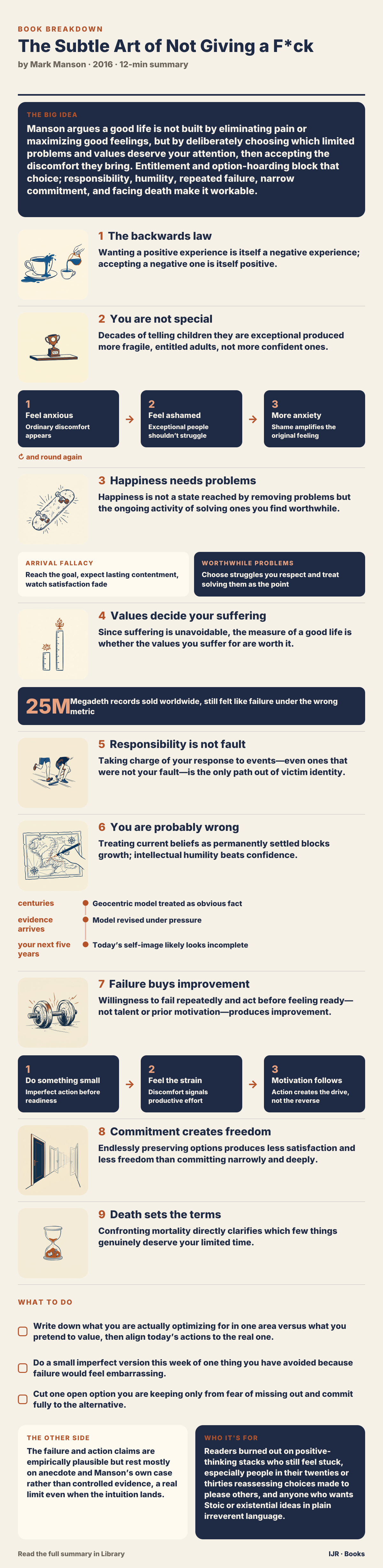
In 60 seconds
- Chasing positive feelings as a goal creates more anxiety; accepting negative experience as normal lifts the pressure.
- Telling every child they are exceptional produced fragile adults who treat ordinary struggle as identity crisis.
- Happiness is the ongoing work of solving problems you find worthwhile, not a problem-free destination.
- Values decide whether suffering builds something or multiplies misery—swap comparison-driven ones for controllable ones.
- Fault is who caused an event; responsibility is who owns what happens next, and reclaiming it ends victim identity.
- Finite life and mortality make selective caring the only way any caring becomes meaningful.
The big idea
Manson argues a good life is not built by eliminating pain or maximizing good feelings, but by deliberately choosing which limited problems and values deserve your attention, then accepting the discomfort they bring. Entitlement and option-hoarding block that choice; responsibility, humility, repeated failure, narrow commitment, and facing death make it workable.
The book in brief
Manson starts from a modern trap: the more people chase constant positivity and inflated self-esteem, the more anxious and stuck they feel. He reframes the skill of living as not giving equal concern to everything, but rationing finite attention toward a few struggles that actually matter.
He then dismantles the specialness myth that makes ordinary setbacks feel like personal catastrophe, and replaces the fantasy of a problem-free life with the claim that happiness is problem-solving you care about. Values become the pivot: bad ones (fame, being liked, fixed mood) turn even success into failure; good ones (honesty, responsibility, curiosity) make pain productive.
The middle chapters separate fault from responsibility so readers stop outsourcing their next move to circumstance, then treat current beliefs as provisional so growth stays possible. Failure is recast as the ordinary price of improvement, and action as the thing that creates motivation rather than the reverse.
Commitment closes the loop: keeping every option open produces less freedom than going deep on a few paths. The book ends on mortality as the final filter—limited time is why selective caring is not cynicism but the only way any care counts.
Context
Mark Manson published the book in 2016. It became a cultural phenomenon by rejecting Instagram-era positivity culture and self-esteem-movement optimism in favor of blunt honesty about limitation, failure, and mortality.
The key ideas

1
The backwards law
Wanting a positive experience is itself a negative experience; accepting a negative one is itself positive.
Manson borrows the backwards law from Alan Watts to flip the usual happiness script. Constantly chasing good feelings reminds you that you lack them now, which manufactures more unhappiness. Treating anxiety, boredom, or failure as unremarkable features of being alive stops casting the present as a problem that must be fixed.
The pressure then lifts on its own, not because life improved, but because you stopped demanding it feel different every minute. Not giving a f*ck, in this framing, is not apathy. It is refusing to spend limited concern on things that do not deserve it so the remainder can go to the few that do.
Everyone has finite time, energy, and emotional investment. The real skill is therefore selective endurance of struggle, not the elimination of struggle. This reframing underwrites every later claim: negative experience is never the enemy; misallocated attention to the wrong negative experiences is.
In practice: Charles Bukowski spent decades drinking, working menial jobs, and collecting rejection letters yet kept writing because that was the one struggle he refused to abandon; publishers finally took notice in his late forties.

2
You are not special
Decades of telling children they are exceptional produced more fragile, entitled adults, not more confident ones.
- 1Feel anxiousOrdinary discomfort appears
- 2Feel ashamedExceptional people shouldn’t struggle
- 3More anxietyShame amplifies the original feeling
↻ and round again
Manson traces a Western parenting and education shift from the 1960s through the 1980s self-esteem movement that told children they were gifted and destined for greatness regardless of achievement. He points to Jean Twenge’s work on generational narcissism showing rising self-reported uniqueness and entitlement without a matching rise in actual accomplishment, and to David McCullough Jr.’s 2012 “You Are Not Special” commencement address as rare public pushback.
The result is the feedback loop from hell: anxiety, then shame at being anxious because an exceptional person supposedly should not struggle, which breeds more anxiety. Ordinary disappointment inflates into an identity crisis because it collides with an inflated self-image.
Healthy self-esteem, for Manson, rests on average expectations. Assuming you are basically ordinary frees you to fail without treating failure as proof you are broken. That removal of the specialness obstacle is what later lets failure and rejection become usable information instead of injustice.
In practice: A person feels anxious, then ashamed for feeling anxious because exceptional people supposedly do not struggle, which produces still more anxiety.

3
Happiness needs problems
Happiness is not a state reached by removing problems but the ongoing activity of solving ones you find worthwhile.
Arrival fallacy
Reach the goal, expect lasting contentment, watch satisfaction fade
Worthwhile problems
Choose struggles you respect and treat solving them as the point
A problem-free life is not only unattainable; it would not produce happiness if it existed, because humans generate new problems as soon as old ones are solved. Wealthy people who clear financial worries typically report fresh anxieties about relationships, health, or purpose—the arrival fallacy that reaching a goal will lock in lasting satisfaction when the glow fades and a new goal appears.
Manson’s own twenties of repeatedly moving abroad showed the same restlessness following him with a new local problem set attached. The skill is therefore not escape but better selection of problems and higher tolerance for solving them.
A skateboarder who accepts the repeated pain of falling while learning a trick is, in his terms, happier than someone who avoids all discomfort, because enjoying the process of problem-solving is functionally what happiness is. The same logic applies to careers and relationships: love the specific problems or keep chasing a mirage of none.
In practice: An entrepreneur who loves the concrete problems of running a business ends up more content than one chasing wealth alone.

4
Values decide your suffering
Since suffering is unavoidable, the measure of a good life is whether the values you suffer for are worth it.
25M
Megadeth records sold worldwide, still felt like failure under the wrong metric
Manson uses Dave Mustaine—fired from Metallica in 1983, later founding Megadeth and selling more than 25 million records—yet still feeling like a failure because his metric was surpassing Metallica, not succeeding on his own terms. The values you measure yourself against decide whether objective success feels like failure.
Bad values sit outside your control or damage relationships: pleasure for its own sake, material wealth as an end, being liked by everyone, always being right, clinging to a fixed positive mood. They are short-term, comparison-driven, and validation-dependent, so they generate endless dissatisfaction.
Good values are reality-based, socially constructive, and within control: honesty, curiosity, creativity, standing up for a belief, accepting responsibility. Suffering attached to them—practice discomfort, hard conversations—builds something over time. The practical task is auditing which values actually drive daily choices and swapping the ones that only manufacture misery.
In practice: Mustaine’s external success still felt like failure because the internal scoreboard was “did I surpass Metallica.”

5
Responsibility is not fault
Taking charge of your response to events—even ones that were not your fault—is the only path out of victim identity.
Manson draws a sharp line: fault is who caused an event; responsibility is who decides what happens next. People conflate them by refusing responsibility because something was not their fault, or by assigning themselves fault for things beyond control out of misplaced guilt.
He generalizes into an entitlement problem running both ways. Genuine victims can slide into victimhood chic, treating suffering as an identity that excuses further avoidance. People who have suffered little can develop the opposite entitlement, believing comfort or talent exempts them from effort. Both outsource responsibility to circumstance.
Everything later about failure, rejection, and commitment depends on accepting that you own your reactions regardless of who caused the situation. Separating the two questions—what happened to me versus what I do now—is the hinge.
In practice: A woman survived a teenage sexual assault that was entirely not her fault; years later she remained stuck until she reclaimed responsibility for her recovery without taking blame for the assault.

6
You are probably wrong
Treating current beliefs as permanently settled blocks growth; intellectual humility beats confidence.
- centuriesGeocentric model treated as obvious fact
- evidence arrivesModel revised under pressure
- your next five yearsToday’s self-image likely looks incomplete
Certainty is comfortable but corrosive. Manson points to the geocentric model accepted as obvious fact for over a thousand years before evidence forced revision, then applies the same logic to personal identity: today’s values and self-image were built from information that will look incomplete in five years, just as age-fifteen beliefs look naive now.
If that pattern has held your whole life, assuming it stops now is arrogant. He calls this the law of being wrong: you are almost certainly wrong about something important right now; you just do not know which thing. The goal is continual updating, not final correctness.
People cling to bad values partly because admitting a value is wrong feels like personal failure instead of ordinary growth. Strong emotional reactions to being challenged become signals worth investigating rather than threats to dismiss. Even the book’s own claims, Manson notes, should be treated as useful for now and subject to revision.
In practice: The geocentric universe model held by educated people for over a thousand years was overturned when evidence demanded it.

7
Failure buys improvement
Willingness to fail repeatedly and act before feeling ready—not talent or prior motivation—produces improvement.
- 1Do something smallImperfect action before readiness
- 2Feel the strainDiscomfort signals productive effort
- 3Motivation followsAction creates the drive, not the reverse
The law of avoidance says the more something threatens or improves your identity, the more you instinctively avoid it, because failure at something central feels more dangerous than failure at something peripheral. That is why people dodge the exact actions that would help most—asking someone out, submitting work, starting a venture.
Manson flips the usual order with the “do something” principle: action generates motivation, not the reverse. Waiting to feel ready is usually backward. He compares emotional and professional discomfort to soreness after training—the literal mechanism of growth, not a sign something went wrong.
This rests on earlier moves: the entitled mindset avoids failure because it threatens specialness; the responsibility framework lets you treat failure as yours to learn from rather than an injustice to resent. Improvement is mostly imperfect reps, not inspiration.
In practice: Manson spent years on small online ventures that fizzled before his site gained traction, treating each flop as the ordinary cost of finding what worked.

8
Commitment creates freedom
Endlessly preserving options produces less satisfaction and less freedom than committing narrowly and deeply.
The common belief that freedom means keeping every career, relationship, and lifestyle door open is, Manson argues, backward. Unlimited choice tends to produce paralysis and dissatisfaction. Breadth without depth rarely yields meaning; depth is where meaning forms.
Commitment necessarily involves rejection—choosing one path turns away many others—and the discomfort of that rejection is the entry fee for a meaningful life, not proof of a wrong choice. In relationships, repeated small commitments and resolved conflicts produce more intimacy than a string of exits at the first difficulty.
This builds on failure tolerance: if you can stand being wrong sometimes, you can stop needing every choice guaranteed correct in advance. The argument runs deliberately against contemporary optionality culture.
In practice: In the mid-1990s jam study by Iyengar and Lepper, shoppers given a smaller selection bought more and reported more satisfaction than those facing a much larger array.

9
Death sets the terms
Confronting mortality directly clarifies which few things genuinely deserve your limited time.
Manson grounds the close in the death of his friend Josh, killed in a car accident in his early twenties. The sudden loss stripped the illusion that there would always be more time to sort priorities later and forced an immediate reassessment of where attention had been going.
He links this to Ernest Becker’s 1973 argument that much human ambition—career, fame, children—functions as an unconscious immortality project, a way to create something that outlasts the body and soothes death fear. Most people manage the fear by refusing to look at it, which keeps them chasing symbolic substitutes like status instead of values they would choose if time were taken seriously.
Regularly considering your own death is clarifying, not merely morbid. It strips concerns that only matter under the assumption of unlimited runway. Limited fucks to give is not a psychological gimmick; it is a literal fact about a finite life, and mortality is the ultimate case for ruthlessness about which values and struggles still deserve the remainder.
In practice: Josh’s death in a car accident in his early twenties forced Manson to reassess what actually mattered among the things consuming his attention.
Key terms
- Backwards law Chasing a positive experience creates a negative one; accepting a negative experience creates a positive one.
- Feedback loop from hell Anxiety followed by shame at being anxious because you think you should be exceptional, which creates more anxiety.
- Arrival fallacy The belief that reaching a goal will produce lasting satisfaction when the feeling fades and a new goal appears.
- Bad values Metrics outside your control or harmful to others—pleasure, pure wealth, universal liking, always being right, fixed positive mood.
- Good values Reality-based, constructive, controllable standards such as honesty, curiosity, creativity, and responsibility.
- Fault vs responsibility Fault is who caused an event; responsibility is who owns the next move.
- Law of being wrong You are almost certainly wrong about something important now; keep updating instead of defending certainty.
- Do something principle Action creates motivation; waiting to feel ready reverses the real order.
- Immortality project Ambition and legacy-building used unconsciously to soothe the fear of death.
What to do
- Write down what you are actually optimizing for in one area versus what you pretend to value, then align today’s actions to the real one.
- Do a small imperfect version this week of one thing you have avoided because failure would feel embarrassing.
- Cut one open option you are keeping only from fear of missing out and commit fully to the alternative.
Questions to think with
- Which struggle in your life are you enduring only because you have not audited the value underneath it?
- Where are you still treating fault for a past event as if it cancels responsibility for your next move?
- What belief are you defending hardest right now, and what would change if it were provisional?
- Which option are you keeping open that is quietly draining attention from something you already chose?
- If your remaining time were suddenly short, which current concerns would look ridiculous?
The other side
The failure and action claims are empirically plausible but rest mostly on anecdote and Manson’s own case rather than controlled evidence, a real limit even when the intuition lands.
Who it's for
Readers burned out on positive-thinking stacks who still feel stuck, especially people in their twenties or thirties reassessing choices made to please others, and anyone who wants Stoic or existential ideas in plain irreverent language.