




Wealth needs no cleverness, only a plan you leave alone
Building freedom is less about beating markets than clearing debt, saving hard, and holding one cheap index fund for decades.
IJR · Oct 12, 2026 · 12 min read
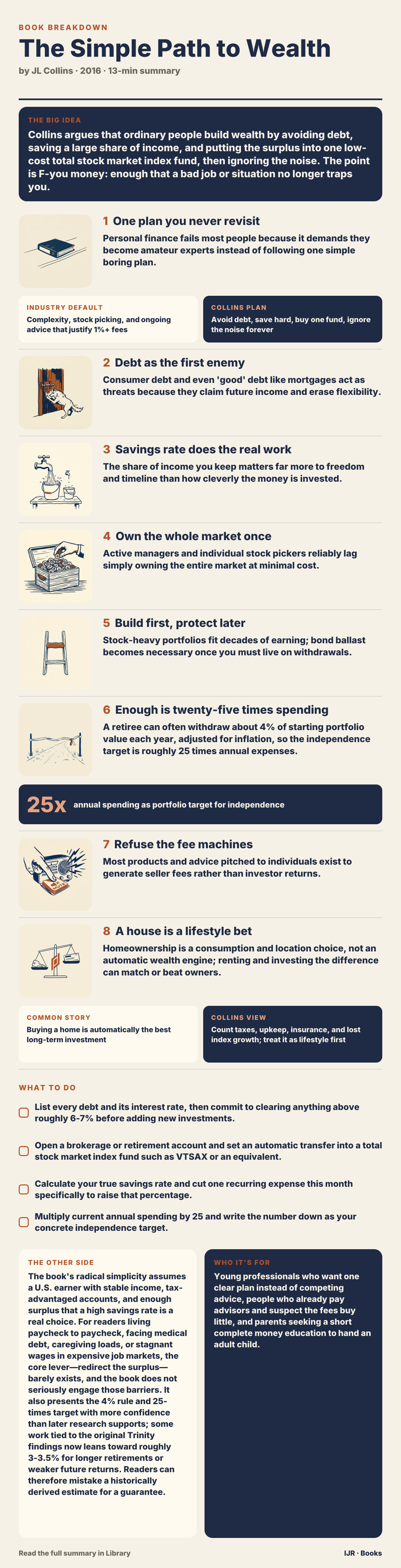
In 60 seconds
- Debt must go first because high interest and lost flexibility block every later step.
- Savings rate, not investing skill, sets how fast you reach the freedom to walk away.
- One low-cost total stock market index fund beats most active managers and stock pickers once fees count.
- Hold nearly all stocks while earning; add bonds only when you start living off the portfolio.
- Financial independence is roughly 25 times annual spending, supporting about a 4% inflation-adjusted withdrawal.
- Decline advisors, cash-value insurance, forecasts, and complexity sold mainly to generate fees.
The big idea
Collins argues that ordinary people build wealth by avoiding debt, saving a large share of income, and putting the surplus into one low-cost total stock market index fund, then ignoring the noise. The point is F-you money: enough that a bad job or situation no longer traps you.
The book in brief
Collins opens by rejecting the demand that ordinary savers become amateur experts. The industry profits from complexity that justifies fees, so he offers the opposite: one boring plan someone who never wants to think about money can still follow for life.
He starts with debt as the first obstacle. Until payments stop claiming future income, raises and investment gains simply service the leak. Clearing consumer balances, and treating even student loans and mortgages as liabilities to shrink faster than usual, restores the optionality everything else needs.
With the leak closed, the real lever appears: the gap between earnings and spending. A high savings rate does double work, filling the nest egg faster while shrinking the lifestyle that nest egg must one day cover. Fund choice and allocation sit downstream of this decision.
Only then does money placement matter. Rather than picking winners or paying managers, he argues for owning the entire market through one cheap index fund and holding it through crashes and rallies alike. Working years can stay almost entirely in stocks; years of drawing income call for some bonds so a temporary drop does not force permanent damage.
A concrete finish line closes the arc: a portfolio large enough to sustain spending without running dry. Along the way he clears distractions—conflicted advice, insurance sold as investment, market predictions, and the automatic belief that a house is always the superior wealth builder. The destination is not luxury. It is the freedom to leave because money no longer decides for you.
Context
JL Collins first shaped these ideas as letters to his daughter, who was capable and uninterested in making money a hobby. The 2016 book gathered that advice into a short complete plan and became a foundational text of the FIRE movement for readers chasing financial independence through high saving and simple investing.
The key ideas

1
One plan you never revisit
Personal finance fails most people because it demands they become amateur experts instead of following one simple boring plan.
Industry default
Complexity, stock picking, and ongoing advice that justify 1%+ fees
Collins plan
Avoid debt, save hard, buy one fund, ignore the noise forever
Collins frames the whole book as letters to a daughter who did not want money management as a hobby. Most writing assumes readers will pick stocks, track markets, and study economics. He rejects that premise outright.
The industry, he argues, has a vested interest in complexity because complexity justifies fees. A retail investor paying a 1% advisory fee or sitting in a fund with a 1.5% expense ratio hands over a meaningful slice of lifetime returns for advice that, on average, fails to beat a plain index.
His standard is severe and intimate: every later chapter must survive being explained once to someone who never wants to hear about finance again. The tone stays low-jargon and practical for that reason.
This is not a path to getting rich quickly or cleverly. It is a method for removing emotion and complexity from a process that mostly works when left alone.
In practice: He wrote the original posts for his smart, capable daughter who simply did not want investing to become another job.

2
Debt as the first enemy
Consumer debt and even 'good' debt like mortgages act as threats because they claim future income and erase flexibility.
Before any investing talk, Collins insists debt must be cleared and treated with something close to fear. Credit-card rates of 15-25% deliver a guaranteed return no portfolio reliably matches, so paying them down wins on pure math.
The deeper case is optionality. Every dollar owed is a claim on future pay that cannot go to savings, cannot fund walking away from a bad job, and cannot be redirected when life changes. Student loans and mortgages may sometimes be necessary, yet they still shrink freedom and should be retired faster than conventional advice suggests.
Carrying revolving consumer debt while trying to invest is close to self-sabotage. You cannot out-earn a high-interest balance with market returns.
Everything that follows—the savings rate, the index fund, eventual F-you money—depends on first stopping the leak. Without that step, higher income simply funds more debt service.
In practice: He treats paying off 15-25% credit-card balances as the highest-return move available anywhere.

3
Savings rate does the real work
The share of income you keep matters far more to freedom and timeline than how cleverly the money is invested.
Collins introduces F-you money as a sum large enough that you no longer tolerate a bad boss, job, or situation out of pure necessity. The point is leverage over your own life, not luxury.
He shows that savings rate is the dominant variable. Someone saving 10% needs roughly forty-plus working years to reach independence; someone saving 50% can cut that to well under twenty. The higher rate both builds the pile faster and shrinks the annual spending the pile must cover.
Lifestyle choices therefore become investment decisions. A smaller house, cheaper car, or fewer subscriptions are direct inputs into the freedom timeline. A modest salary with a high savings rate beats a large salary that is fully spent.
Later chapters on funds and allocation are optimizations on top of this gap. Without a real surplus, no strategy produces independence inside a normal working life.
In practice: He contrasts a 10% saver needing forty-plus years with a 50% saver finishing in well under twenty.

4
Own the whole market once
Active managers and individual stock pickers reliably lag simply owning the entire market at minimal cost.
Collins recounts his own early years in a high-fee managed fund that trailed the broader market while charging him for the privilege. From that mistake he draws the book's technical core: put savings into a total stock market index fund.
He points specifically to Vanguard's VTSAX, which holds a slice of essentially every U.S. public company for a fraction of a percent. Most actively managed funds underperform their benchmark once fees are counted, and nobody can reliably name the future winners in advance.
Individual stock picking fares worse still—overconfidence, chasing recent winners, and panic selling during drops. An index removes the need to guess; it simply captures the market's average return, which has been strongly positive over long horizons even though short-term moves stay unpredictable.
He does not claim markets are risk-free. He claims that selection and timing add cost and risk without reliably adding return, so the default answer after debt and saving is one fund held steadily.
In practice: His own high-fee managed fund lagged the market for years while still collecting its fee.

5
Build first, protect later
Stock-heavy portfolios fit decades of earning; bond ballast becomes necessary once you must live on withdrawals.
Collins splits an investing life into two phases with different jobs. During accumulation—the working years—he favors stocks almost exclusively. A multi-decade horizon can ride out crashes such as 2000 or 2008, and stocks have historically outgrown other assets across such spans.
Bonds in this phase mainly dampen returns without adding much safety, because fresh savings keep arriving and the investor can simply wait.
Once withdrawals begin, the math flips. A severe drop early in retirement, paired with selling shares to live, can permanently wound a portfolio in a way that never happens while new money is still flowing in. He therefore shifts some money into a total bond market index, with the exact mix set by risk tolerance and how flexibly spending can shrink in a bad year.
He refuses one universal ratio. The point is the reasoning: the danger is no longer 'will the market recover' but 'will I be forced to sell into a temporary crash.'
In practice: He cites riding out the 2000 and 2008 downturns during earning years versus protecting against the same drops once withdrawals start.

6
Enough is twenty-five times spending
A retiree can often withdraw about 4% of starting portfolio value each year, adjusted for inflation, so the independence target is roughly 25 times annual expenses.
25x
annual spending as portfolio target for independence
Collins anchors 'enough' in the Trinity study from the mid-1990s, which tested historical U.S. returns to see what withdrawal rate survived a 30-year retirement. Roughly 4% initial withdrawal, raised each year for inflation, made it through nearly every period examined, including starts that preceded major crashes.
The practical translation is simple arithmetic: multiply expected annual spending by 25. That product is the portfolio size at which financial independence becomes reasonable to claim.
Lower spending therefore does double duty again—it shrinks the required number and shortens the years of saving needed to reach it. He is frank that the figure rests on historical U.S. data and is not a promise.
Sequence-of-returns risk remains real: a rotten market in the first years of retirement does outsized damage even if long-run averages look fine. His answer is flexibility—willingness to trim spending in bad years or the presence of some non-portfolio income—rather than false precision.
In practice: Someone spending $40,000 a year needs roughly $1,000,000; someone spending $25,000 needs about $625,000.

7
Refuse the fee machines
Most products and advice pitched to individuals exist to generate seller fees rather than investor returns.
After the core plan is built, Collins clears the alternatives readers will keep meeting. Advisors, even well-meaning ones, are often paid by commissions on products or by a percentage of assets under management—structures that reward gathering and holding money more than efficient growth.
He is especially sharp on whole-life and other cash-value insurance sold as investments. They bundle an expensive, inefficient investment vehicle with coverage that could be bought far more cheaply as plain term life.
Market timing and economic forecasts receive the same treatment. Professional predictors, as a group, show a poor record calling recessions, crashes, or rallies with consistency. That is why his plan never asks anyone to predict; it only asks them to keep buying the whole market and hold it.
Knowing the right steps is not enough. Readers must also recognize and decline the steady stream of pitches from banks, agents, and media that profit from activity and complexity.
In practice: He flags whole-life policies that wrap costly investing inside insurance better bought as cheap term coverage.

8
A house is a lifestyle bet
Homeownership is a consumption and location choice, not an automatic wealth engine; renting and investing the difference can match or beat owners.
Common story
Buying a home is automatically the best long-term investment
Collins view
Count taxes, upkeep, insurance, and lost index growth; treat it as lifestyle first
Collins challenges the default belief that buying is always the sound financial move. Owners routinely omit property taxes, maintenance, insurance, and the lost market growth on down payment and principal that could have sat in an index fund instead.
Once those costs are counted, a disciplined renter who invests the difference can match or exceed a homeowner's net worth in many markets over long stretches. He does not claim renting always wins—only that the assumption of automatic superiority collapses under real arithmetic.
The same chapter gathers related contrarian notes: suspicion of retirement matches that lock workers into employer stock, wariness of target-date funds' higher fees versus a self-kept simple portfolio, and a general rule that anything too complex to explain in one sentence probably serves the seller.
The method is consistent with earlier chapters: run the actual numbers, and distrust any normalized choice that raises fixed costs and reduces freedom.
In practice: He compares full ownership costs against a renter who steadily invests the cash difference into an index fund.
Key terms
- F-you money A portfolio large enough that you can leave a bad job or situation because finances no longer force you to stay
- VTSAX Vanguard's total stock market index fund that owns a slice of essentially every U.S. public company at very low cost
- Savings rate The percentage of income you keep rather than spend; the main lever for how fast independence arrives
- 4% rule Guideline that a retiree can often withdraw about 4% of the starting portfolio each year, adjusted for inflation
- 25x expenses Portfolio target equal to twenty-five times annual spending, the arithmetic twin of the 4% rule
- Accumulation phase Working years of earning and saving, when Collins favors holding stocks almost exclusively
- Preservation phase Years of living on the portfolio, when some bonds help avoid selling stocks into a crash
- Sequence-of-returns risk The danger that poor markets in the first years of withdrawal do lasting damage even if long-run averages look fine
What to do
- List every debt and its interest rate, then commit to clearing anything above roughly 6-7% before adding new investments.
- Open a brokerage or retirement account and set an automatic transfer into a total stock market index fund such as VTSAX or an equivalent.
- Calculate your true savings rate and cut one recurring expense this month specifically to raise that percentage.
- Multiply current annual spending by 25 and write the number down as your concrete independence target.
Questions to think with
- What would you change tomorrow if you already had enough F-you money to walk away?
- Which of your fixed costs exist more from habit or sales pressure than from clear need?
- If you treated housing purely as lifestyle and location, would you still choose the same roof?
- How many years would a doubled savings rate cut from your current path to 25 times expenses?
- Which pieces of financial advice you receive mainly keep someone else paid?
The other side
The book's radical simplicity assumes a U.S. earner with stable income, tax-advantaged accounts, and enough surplus that a high savings rate is a real choice. For readers living paycheck to paycheck, facing medical debt, caregiving loads, or stagnant wages in expensive job markets, the core lever—redirect the surplus—barely exists, and the book does not seriously engage those barriers. It also presents the 4% rule and 25-times target with more confidence than later research supports; some work tied to the original Trinity findings now leans toward roughly 3-3.5% for longer retirements or weaker future returns. Readers can therefore mistake a historically derived estimate for a guarantee.
Who it's for
Young professionals who want one clear plan instead of competing advice, people who already pay advisors and suspect the fees buy little, and parents seeking a short complete money education to hand an adult child.