




Success comes from the one action that makes the rest easier
Professionals and entrepreneurs buried under long to-do lists who can shape their calendars and want a method for choosing what to drop.
IJR · Oct 12, 2026 · 12 min read
In 60 seconds
- Ask what single action would make every other action easier or unnecessary, then drop the rest.
- Sequence small moves like dominoes so each one is sized to topple the next larger step.
- Replace equal-weight to-do lists with a short success list topped by one priority.
- Multitasking is rapid switching with a cost; do the one thing first without competing inputs.
- Use brief discipline to build one habit at a time, and put the one thing in your strongest early hours.
- Time-block that priority like an unmovable appointment and accept the cost of saying no.
The big idea
Keller and Papasan contend that extraordinary results come from extreme focus on one priority, not broad effort across many goals. A repeatable focusing question names the action that makes other work easier or unnecessary, and time blocking defends it on the calendar before anything else claims the hours.
The book in brief
The book starts from a familiar bind: people chase many worthy goals at once and finish few of them well. Scattered good intentions fill the day while the move that would matter most stays half-done.
Its answer is a single focusing question meant to cut the noise. Find the one action that would make other actions easier or pointless, then treat that answer as a lever rather than another item on a long list.
The argument next turns to sequence. Small moves, lined up correctly, can compound far past their size. Six common beliefs then get cleared as obstacles—equal task weight, multitasking, broad permanent discipline, on-demand willpower, daily life balance, and fear of large goals—so attention and energy can concentrate instead of split.
The closing practice ties purpose to a current priority and locks that priority into protected calendar hours. The uncomfortable landing is that most of what fills a normal day should be left undone, and that extreme focus defended in actual hours beats effort spread thin.
Context
Published in 2013 by Gary Keller and Jay Papasan, the book became a bestseller by challenging multitasking, balanced-life ideals, and willpower-driven discipline. Keller drew the approach from leading Keller Williams Realty; it later influenced popular productivity writing.
The key ideas

1
The focusing question
The single action that makes every other action easier or unnecessary beats a long list of good priorities.
- 1Name the optionsList everything you could do right now
- 2Cut to the vital fewKeep only the fraction that moves results
- 3Go recursiveRepeat the cut until one lever remains
- 4Act on the oneLet the rest wait or drop
In 2008, during the housing collapse, Keller Williams Realty faced falling revenue and panicked franchise owners. Rather than cut everywhere at once, Keller asked what one move would matter most for the business and doubled down on agent training and lead-generation systems while competitors slashed those budgets. The company came through the recession larger than before.
The focusing question is a subtraction tool, not a ranking tool. Of everything you could do right now, what is the one action that would make every other action either easier or pointless. Most planning tools treat every item as worth pursuing; this question forces everything else off the table.
The authors push Pareto’s 80/20 rule further by applying it recursively: find the vital twenty percent, then the vital twenty percent inside that, until one item remains. Scattered effort across many good priorities, they claim, produces worse outcomes than concentrated effort on one correctly chosen priority—even when that means visibly neglecting other legitimate demands for a while.
In practice: Keller’s 2008 choice to fund training and lead systems instead of across-the-board cuts carried Keller Williams through the housing collapse larger than before.
2
The domino effect
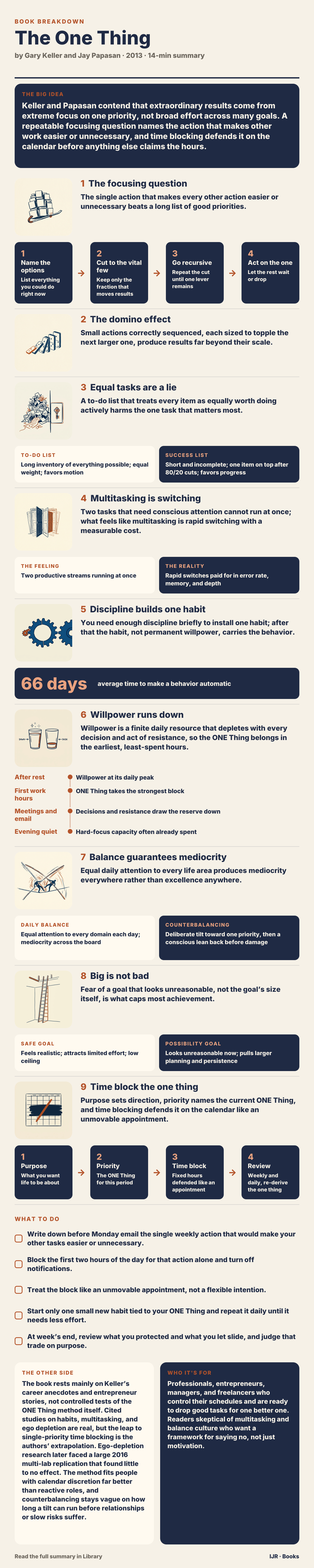
Small actions correctly sequenced, each sized to topple the next larger one, produce results far beyond their scale.
In 1983, physicist Lorne Whitehead showed a domino can topple another roughly fifty percent larger than itself. Chain that ratio and a fingernail-sized piece can, in theory, topple a building-height domino after fewer than thirty steps.
On this view success is rarely one dramatic leap. It is a line of tasks where each completion is scaled to make the next, slightly larger task fall. Before asking what matters most, ask what must come first.
Aim too big at the start and the chain stalls. Size the first move for right now and each win supplies momentum and resources for the next. The focusing question names the lever; the domino effect sizes and orders it.
In practice: For a career change, the first domino may be updating one specific skill this month, which topples the interview, which topples the offer—not “get a new job” as a single leap.

3
Equal tasks are a lie
A to-do list that treats every item as equally worth doing actively harms the one task that matters most.
To-do list
Long inventory of everything possible; equal weight; favors motion
Success list
Short and incomplete; one item on top after 80/20 cuts; favors progress
To-do lists inventory everything that could be done; they are not judgments about what should be done, and by design they grow faster than they shrink. The replacement is a success list: short, deliberately incomplete, built by running the 80/20 filter until one item sits on top.
Most items on a normal list should simply be left undone, not merely ranked lower. Unfinished tasks leave attention residue that impairs focus on whatever comes next, so an undifferentiated list damages performance on the priority.
Motion and progress are different things. A list that does not rank items by their power to cause other things to happen will always favor motion over progress, and that habit sets up the pull toward multitasking.
In practice: A salesperson spends a morning answering forty emails, none individually urgent, and reaches noon having done nothing that will close a contract.

4
Multitasking is switching
Two tasks that need conscious attention cannot run at once; what feels like multitasking is rapid switching with a measurable cost.
The feeling
Two productive streams running at once
The reality
Rapid switches paid for in error rate, memory, and depth
The brain can pair automatic acts, like walking while talking. Two tasks that both demand deliberate thought cannot share the channel. What feels like doing both is rapid switching, and each switch carries a cost in comprehension and recovery time longer than the interruption itself.
Work associated with Clifford Nass in 2009 found that people who called themselves habitual multitaskers performed worse than non-multitaskers on switching, memory, and filtering irrelevant information—the opposite of what the multitaskers expected.
That cost lands hardest on the one task named by the focusing question, which by definition needs more than shallow attention. Do that task first, without competing inputs, then return to lower-value work that can tolerate interruption.
In practice: Checking a phone during a meeting does not only pause the meeting; it weakens grasp of what was said in those seconds and delays full attention afterward.

5
Discipline builds one habit
You need enough discipline briefly to install one habit; after that the habit, not permanent willpower, carries the behavior.
66 days
average time to make a behavior automatic
Successful people are not simply more disciplined across the board. Discipline here is a short-term input aimed at a single habit, after which the habit carries the behavior forward without ongoing strain.
Phillippa Lally’s 2009 tracking of people building routines like drinking water after lunch found an average of sixty-six days to make a behavior automatic, with a range from eighteen to two hundred fifty-four days depending on difficulty. The intensity is front-loaded, then freed.
People who try to become “more disciplined” by adopting several new habits at once burn the same limited reserve on all of them. Sequence habits like dominoes: master one behavior tied to the current ONE Thing, let it go automatic, then apply the freed discipline to the next link.
In practice: Someone who tries to become an early riser, a daily exerciser, and a meal-planner in the same week is likely to fail at all three; automating wake time first, then adding exercise, is far more likely to stick.

6
Willpower runs down
Willpower is a finite daily resource that depletes with every decision and act of resistance, so the ONE Thing belongs in the earliest, least-spent hours.
- After restWillpower at its daily peak
- First work hoursONE Thing takes the strongest block
- Meetings and emailDecisions and resistance draw the reserve down
- Evening quietHard-focus capacity often already spent
Willpower is not a fixed trait available equally at any hour. It runs down with use. Lab work associated with Roy Baumeister found that people who first resisted a plate of cookies later persisted less on a hard puzzle than people who had not depleted themselves.
Every later choice and resistance—snacks, tough conversations, minor work decisions—draws on the same reserve. By the time the day feels “quiet,” capacity for sustained hard focus is often already spent.
Put the ONE Thing in whatever window willpower and focus are naturally strongest. For most people that is the first hours of the workday, before meetings and email. Treat those hours as non-interchangeable.
In practice: People who save their most important work for evenings when things are quiet often find the hard focus already spent on everything that came before.
7
Balance guarantees mediocrity
Equal daily attention to every life area produces mediocrity everywhere rather than excellence anywhere.
Daily balance
Equal attention to every domain each day; mediocrity across the board
Counterbalancing
Deliberate tilt toward one priority, then a conscious lean back before damage
A perfectly balanced day across work, family, health, and the rest sounds responsible. On this account it spreads energy too thin for excellence in any category. The ONE Thing framework needs unequal allocation, at least temporarily, toward whatever priority currently matters most.
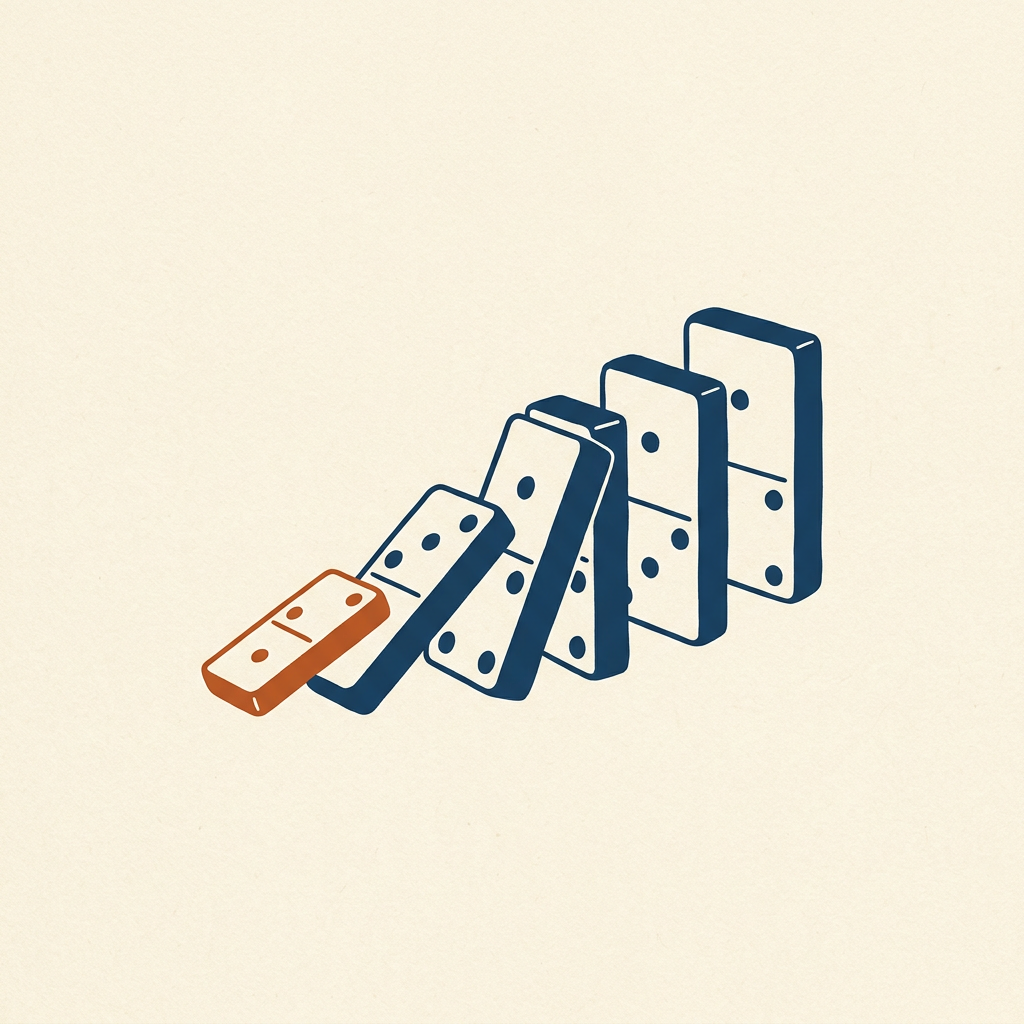
The alternative is counterbalancing: lean hard into one priority for a defined stretch, then consciously lean back toward a neglected area before it breaks—more like a rope walker’s pole than a fixed scale.
People already live this way informally and inconsistently. Naming the tilt and doing it on purpose, the authors argue, beats the guilt-driven attempt to give every domain equal daily attention, which leaves every domain underfed.
In practice: A person building a business works long hours for a defined stretch, then takes a protected weekend or vacation to repair family time rather than pretending both can be maximized every day.
8
Big is not bad
Fear of a goal that looks unreasonable, not the goal’s size itself, is what caps most achievement.
Safe goal
Feels realistic; attracts limited effort; low ceiling
Possibility goal
Looks unreasonable now; pulls larger planning and persistence
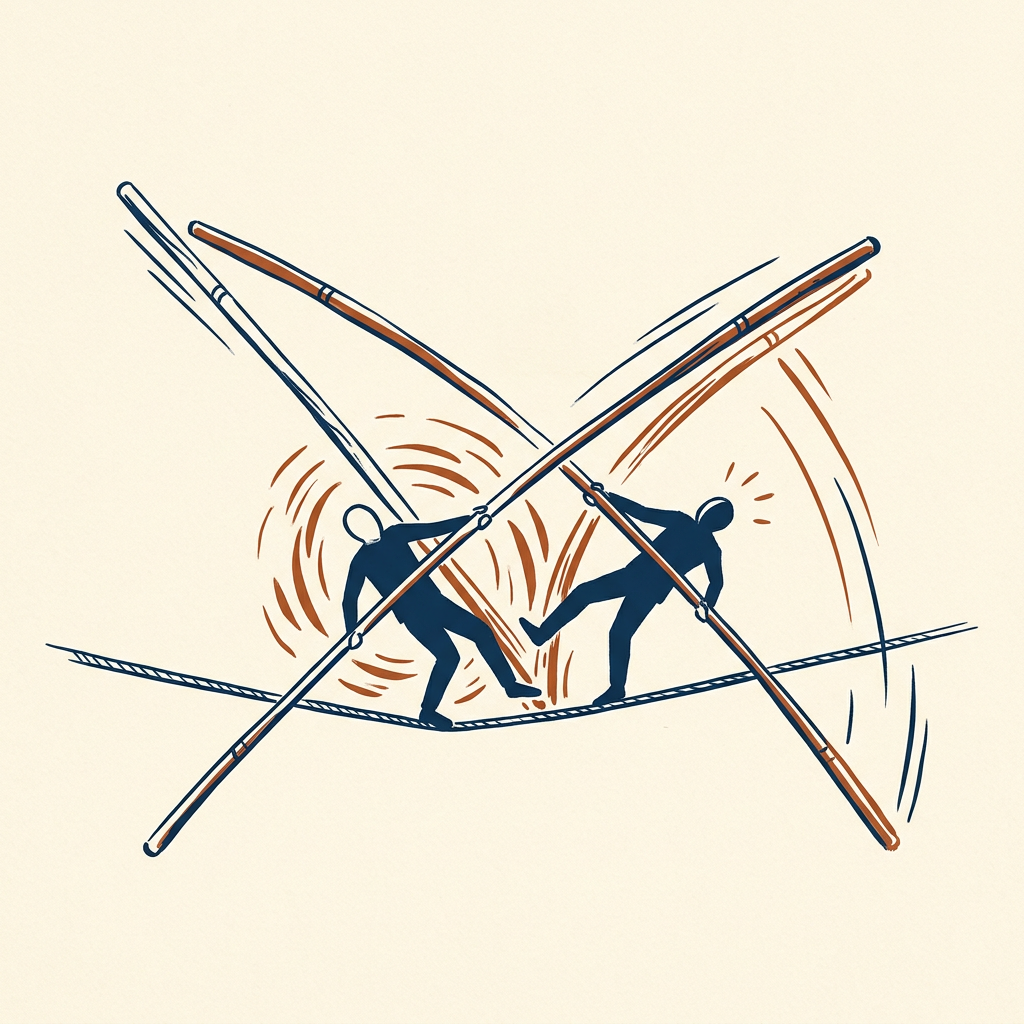
Modest ambitions feel safe and wise. The book treats them as the real ceiling, because people unconsciously scale effort, planning, and persistence to match the size of the goal they set. A goal sized to feel comfortable attracts limited effort.
Thinking in possibility rather than probability—what could be true, not what has been typical—opens a larger first domino. Breakthroughs, on this telling, often began as targets that looked unreasonable on the current trajectory, then worked backward to the first move.
Bigger goals invite bigger visible failure, and most people would rather fail quietly at something small. When using the focusing question, test whether fear of looking unrealistic has already shrunk the answer, since the same narrowing discipline works at any scale and the size chosen sets the ceiling.
In practice: The chapter leans on stories from Keller’s real estate career and other entrepreneurs who set targets that looked out of reach, then worked backward to the first domino.

9
Time block the one thing
Purpose sets direction, priority names the current ONE Thing, and time blocking defends it on the calendar like an unmovable appointment.
- 1PurposeWhat you want life to be about
- 2PriorityThe ONE Thing for this period
- 3Time blockFixed hours defended like an appointment
- 4ReviewWeekly and daily, re-derive the one thing
Purpose answers what you want your life to be about. Priority applies the focusing question to the present period given that purpose. Productivity is the mechanical layer that turns the answer into hours actually spent.
Time blocking means reserving a fixed daily window—at minimum a few hours—for undistracted work on the ONE Thing and treating interruptions as violations to reschedule, not accept. Separate planning blocks for weekly and daily review keep the ONE Thing fresh as earlier dominoes fall.
The real cost is saying no to reasonable, legitimate requests. Discomfort at disappointing people is part of the method, not a side effect to smooth away. Without the calendar defense, the focusing question stays only an intention.
In practice: The book treats the blocked hours the way a doctor’s appointment would be treated: protected first, with lower-value work fitting around them.
Key terms
- Focusing question What one action would make everything else easier or unnecessary?
- Domino effect Small, correctly ordered actions each sized to topple the next larger result
- Success list A short, deliberately incomplete list with one priority on top after repeated 80/20 cuts
- Attention residue The cognitive trace unfinished tasks leave that weakens focus on what comes next
- Counterbalancing Leaning hard into one life area for a stretch, then deliberately leaning back before it breaks
- Time blocking Reserving and defending fixed calendar hours for the ONE Thing alone
- The ONE Thing The single priority that makes the largest difference right now
What to do
- Write down before Monday email the single weekly action that would make your other tasks easier or unnecessary.
- Block the first two hours of the day for that action alone and turn off notifications.
- Treat the block like an unmovable appointment, not a flexible intention.
- Start only one small new habit tied to your ONE Thing and repeat it daily until it needs less effort.
- At week’s end, review what you protected and what you let slide, and judge that trade on purpose.
Questions to think with
- What single action this week would make the most other work easier or unnecessary?
- Which tasks on your list are motion rather than progress?
- When in your day is willpower actually strongest, and what currently fills that window?
- Where are you aiming for daily balance and getting mediocrity instead?
- Has fear of looking unrealistic already shrunk your answer to the focusing question?
The other side
The book rests mainly on Keller’s career anecdotes and entrepreneur stories, not controlled tests of the ONE Thing method itself. Cited studies on habits, multitasking, and ego depletion are real, but the leap to single-priority time blocking is the authors’ extrapolation. Ego-depletion research later faced a large 2016 multi-lab replication that found little to no effect. The method fits people with calendar discretion far better than reactive roles, and counterbalancing stays vague on how long a tilt can run before relationships or slow risks suffer.
Who it's for
Professionals, entrepreneurs, managers, and freelancers who control their schedules and are ready to drop good tasks for one better one. Readers skeptical of multitasking and balance culture who want a framework for saying no, not just motivation.