




Treat your startup like a science experiment, not a plan
Ries claims startups fail by executing fixed plans under extreme uncertainty instead of running cheap experiments that prove or kill assumptions fast.
IJR · Oct 11, 2026 · 12 min read
In 60 seconds
- A startup is any institution built to create something new under extreme uncertainty, not a mini-corporation executing a known plan.
- Progress is validated learning—evidence that customer behavior changed—not vanity metrics like cumulative signups or press hits.
- An MVP is the smallest product that tests a specific hypothesis with real customers, even if it is ugly, manual, or embarrassing.
- Plan the build-measure-learn loop backward: decide what to learn, then what metric proves it, then the minimum build that produces that metric.
- Teams must periodically pivot or persevere using evidence set in advance, not sunk-cost attachment to the original vision.
- Sustainable growth comes from one engine at a time—sticky, viral, or paid—each with its own metrics and failure modes.
The big idea
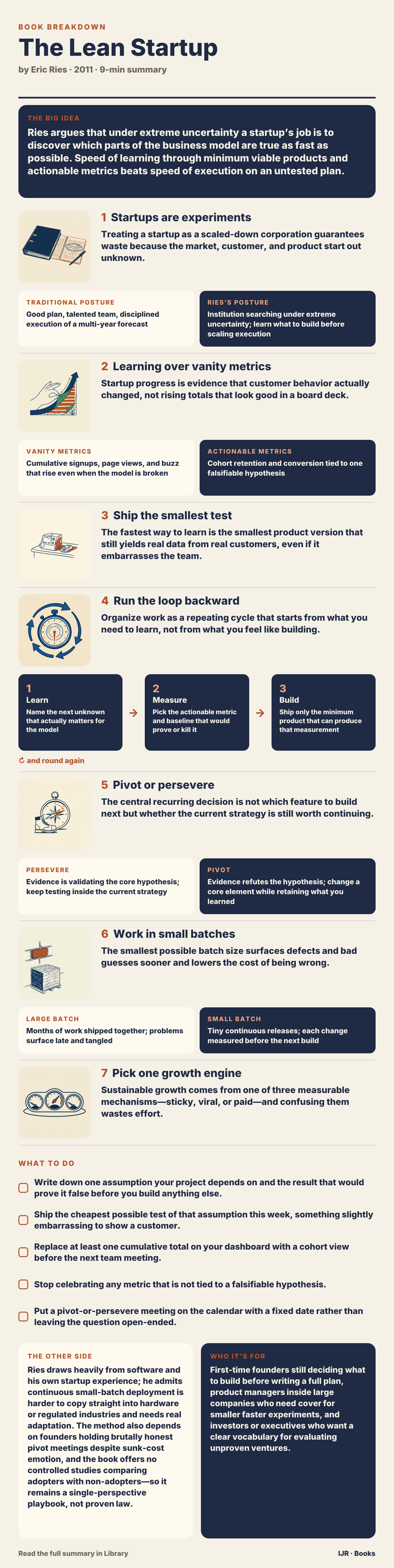
Ries argues that under extreme uncertainty a startup’s job is to discover which parts of the business model are true as fast as possible. Speed of learning through minimum viable products and actionable metrics beats speed of execution on an untested plan.
The book in brief
Ries opens by rejecting the usual formula of a good plan, a talented team, and disciplined execution. He defines a startup as any human institution designed to create something new under extreme uncertainty, including ventures inside large companies. Because the market, customer, and product are all unknown, a multi-year business plan is closer to fiction than forecast. Traditional milestones can look rigorous while revealing nothing about real product-market fit.
He reframes the work as science. Management’s job is not to execute a known plan efficiently but to figure out the right thing to build through validated learning. Failure gets redefined: shipping something nobody wants is mainly a failure to learn, and that waste was avoidable. Speed of learning, not speed of shipping, becomes the true measure of productivity.
The method centers on the minimum viable product and the build-measure-learn loop. Teams decide what they must learn, what metric would prove it, and only then what smallest product can produce that evidence. Innovation accounting turns milestones into experiments with predicted outcomes and clear baselines so progress is visible and attributable.
With evidence in hand, the recurring strategic choice is pivot or persevere. A pivot keeps one foot in what has been learned while changing a core element of strategy. Working in small batches makes wrong turns cheap and easy to isolate, borrowing the logic of lean manufacturing.
Growth is not generic. It comes from one of three engines—sticky retention, viral referral, or paid acquisition—and clarity about which engine is running focuses experiments and dashboards. The arc lands on a shared vocabulary for cutting the waste of building things nobody wants.
Context
Eric Ries published the book in 2011 after costly false starts building products on untested assumptions. It mattered because it replaced faith-based founder mythology with a repeatable methodology and gave Silicon Valley and corporate innovators a common language for judging unproven ventures.
The key ideas

1
Startups are experiments
Treating a startup as a scaled-down corporation guarantees waste because the market, customer, and product start out unknown.
Traditional posture
Good plan, talented team, disciplined execution of a multi-year forecast
Ries’s posture
Institution searching under extreme uncertainty; learn what to build before scaling execution
Ries rejects the story that startups mainly need a solid plan, strong talent, and tight execution. He defines a startup as any human institution designed to create something new under extreme uncertainty. That definition includes internal corporate ventures, not only garage-stage companies.
When customer, market, and product are all unproven, a five-year plan functions more like fiction than forecast. Tools borrowed from established firms—milestone charts, conventional market research—can look disciplined while saying nothing true about whether anyone will use what you build.
The posture he wants is scientific. Management’s job is to discover the right thing to build as fast as possible, not to run a known playbook efficiently. Learning speed becomes the real productivity metric.
Under that frame, a team that burns years and a large budget on a product nobody wants has not chiefly failed at execution. It has failed to learn, and the loss was avoidable.
In practice: At IMVU, his team spent six months building a full-featured 3D instant-messaging add-on on assumptions about what users wanted, only to find at launch that almost no one used it, and those who did used it for reasons the team never expected.

2
Learning over vanity metrics
Startup progress is evidence that customer behavior actually changed, not rising totals that look good in a board deck.
Vanity metrics
Cumulative signups, page views, and buzz that rise even when the model is broken
Actionable metrics
Cohort retention and conversion tied to one falsifiable hypothesis
Ries treats validated learning as the unit of progress. He sets it against vanity metrics—total registered users, page views, press mentions—that can climb whether or not the business model works.
A smooth upward signup chart can hide broken retention and weak monetization. Ordinary dashboards often never surface the break. Actionable metrics, by contrast, attach to a specific falsifiable hypothesis and support comparison across time and cohorts.
Cohort analysis is the practical alternative he keeps returning to: watch how each week’s or month’s new customers behave over their lifecycle instead of staring at cumulative totals. That shows whether a change truly moved retention or conversion for that group.
He argues most startup failure is a failure of accounting. Teams build, ship, and declare success on numbers never tied to a testable belief about the business.
In practice: A team can celebrate soaring cumulative registrations while each new cohort retains no better than the last, because overall growth masks the flat lifecycle behavior.

3
Ship the smallest test
The fastest way to learn is the smallest product version that still yields real data from real customers, even if it embarrasses the team.
The minimum viable product is the mechanism for validated learning. Ries defines it as the version that gathers the most validated learning about customers with the least effort. It is deliberately incomplete, built to test a specific hypothesis, not merely a low-quality full product.
Founders often resist releasing anything unfinished. He reads that discomfort as a useful signal: if you are not embarrassed by the first version, you probably waited too long and learned too late.
An MVP can be a demo video, a manual concierge service that only looks automated, or any other cheap path to observed behavior. It is often ugly and unscalable by design.
The point is to avoid locking in expensive engineering before demand and real use patterns are known. The MVP is an experiment, not a miniature finished product.
In practice: Dropbox’s Drew Houston made a simple demonstration video of how file syncing would work instead of building the full infrastructure first; it drove tens of thousands of signups overnight and validated demand before heavy engineering began.

4
Run the loop backward
Organize work as a repeating cycle that starts from what you need to learn, not from what you feel like building.
- 1LearnName the next unknown that actually matters for the model
- 2MeasurePick the actionable metric and baseline that would prove or kill it
- 3BuildShip only the minimum product that can produce that measurement
↻ and round again
Ries formalizes MVP practice into the build-measure-learn feedback loop. Planning should read that loop backward: first name what you must learn, then what metric would prove it, then what minimum product can produce that metric.
Most teams instinctively work forward—build first, figure out measurement later—and burn the very speed the loop is meant to create. The aim is to minimize total time through the whole cycle, not time spent in any one phase. A slower but clearer build can shorten overall learning.
Innovation accounting supports the loop by turning milestones into a sequence of experiments with predicted outcomes. Teams can then judge whether they are moving toward a viable business or merely staying busy.
Running the loop in small batches with explicit baselines turns activity into evidence and evidence into a defensible next decision.
In practice: A team sets a baseline conversion rate from a first crude release, then runs one experiment at a time to see whether that single change moved the baseline, instead of shipping many unrelated updates and guessing what worked.

5
Pivot or persevere
The central recurring decision is not which feature to build next but whether the current strategy is still worth continuing.
Persevere
Evidence is validating the core hypothesis; keep testing inside the current strategy
Pivot
Evidence refutes the hypothesis; change a core element while retaining what you learned
Once measurement and learning are in place, Ries turns to what teams do with the evidence. Periodically they must hold a pivot-or-persevere meeting, face the accumulated data, and ask whether the strategic hypothesis is being validated or refuted.
A pivot is not surrender. It is a structured course correction that keeps one foot planted in what has already been learned while changing a fundamental element of the strategy. He catalogs forms such as a zoom-in pivot, where a single feature becomes the whole product; a customer-segment pivot, same product aimed at a different customer; and a platform pivot, application becoming platform or the reverse.
The hard part is emotional. Founders tied to a vision must admit a hypothesis was wrong. Two failure modes sit on either side: pivoting at every disappointing blip without giving a strategy a fair test, and never pivoting while treating bad data as a temporary setback.
Innovation accounting exists to cool that decision. Teams decide in advance what result will count as validation and what will count as failure.
In practice: Flickr began as a photo-sharing feature inside a multiplayer game called Game Neverending; once users showed that feature was what they actually cared about, the team spun it out as the entire company—a zoom-in pivot.

6
Work in small batches
The smallest possible batch size surfaces defects and bad guesses sooner and lowers the cost of being wrong.
Large batch
Months of work shipped together; problems surface late and tangled
Small batch
Tiny continuous releases; each change measured before the next build
Ries borrows from lean manufacturing and the Toyota Production System’s emphasis on small-batch, single-piece flow. In product work, a large batch means building a suite of features for months before any release; a small batch means releasing continuously, sometimes many times a day, and measuring each change before building the next.
Problems then appear immediately and close to their cause. In a big release months later, a bug or a cold customer reaction is hard to isolate. Under uncertainty, detection speed matters more than any efficiency large batches seem to offer.
Intuitions from factory scale and from traditional software management—that big polished releases are safer or cheaper—break down when you still do not know what to build. The cost of a mistake compounds the longer it stays hidden.
He is candid that the case is cleaner for software, where deployment cost is near zero, than for physical products or regulated industries, which need real adaptation rather than a straight copy of the practice.
In practice: One team pushed code to production dozens of times a day; each change was small enough that a break pointed to the exact culprit within minutes and could be reverted quickly.

7
Pick one growth engine
Sustainable growth comes from one of three measurable mechanisms—sticky, viral, or paid—and confusing them wastes effort.
Ries names three engines of growth instead of treating growth as a vague goal. The sticky engine grows when retention outpaces churn, watched through cohort retention rather than total headcount. The viral engine grows when ordinary product use drives new acquisition, tracked by a viral coefficient for how many new users each existing user brings in. The paid engine grows when spend on acquisition is more than covered by revenue per customer.
Each engine demands different metrics, different experiments, and different organizational focus. A team that confuses them optimizes the wrong lever—for example chasing referral stunts when the real model depends on high-margin retention.
He urges concentrating on one engine at a time. Each has its own leading indicators and its own ways to fail. Even a working engine can run out of fuel; a viral loop can saturate its addressable market.
So early growth patterns are not permanent. Testing continues, and clarity about which engine you are actually running keeps the dashboard honest.
In practice: Early Hotmail grew through the viral engine by appending a signup invitation to every outgoing email, so normal use recruited the next wave of users.
Key terms
- Startup Any human institution designed to create something new under conditions of extreme uncertainty, including projects inside large companies.
- Validated learning Progress measured as hard evidence that customer behavior changed in response to what you shipped.
- Vanity metrics Impressive-looking numbers such as total signups or page views that can rise even when the business model is broken.
- Actionable metrics Figures tied to a specific falsifiable hypothesis and reported so you can compare cohorts and time periods.
- Minimum viable product The smallest version of a product that yields the most validated learning about customers with the least effort.
- Build-measure-learn The core feedback loop; plan it backward from the learning goal to the metric to the minimum build.
- Innovation accounting Setting milestones as experiments with baselines and predicted outcomes so you can tell real progress from busyness.
- Pivot A structured course correction that keeps what you learned while changing a fundamental element of the strategy.
- Engines of growth The three sustainable growth mechanisms—sticky, viral, and paid—each with its own metrics and focus.
- Cohort analysis Tracking how each group of new customers behaves over its lifecycle instead of relying on cumulative totals.
What to do
- Write down one assumption your project depends on and the result that would prove it false before you build anything else.
- Ship the cheapest possible test of that assumption this week, something slightly embarrassing to show a customer.
- Replace at least one cumulative total on your dashboard with a cohort view before the next team meeting.
- Stop celebrating any metric that is not tied to a falsifiable hypothesis.
- Put a pivot-or-persevere meeting on the calendar with a fixed date rather than leaving the question open-ended.
Questions to think with
- Which assumption in your current plan has never been tested against real customer behavior?
- Which dashboard numbers would still rise if customers quietly disliked the product?
- Are you actually running a sticky, viral, or paid growth engine—or mixing tactics without noticing?
- What fail condition did you set in advance for your last major experiment?
- What would a one-week MVP look like for the riskiest belief on your roadmap?
The other side
Ries draws heavily from software and his own startup experience; he admits continuous small-batch deployment is harder to copy straight into hardware or regulated industries and needs real adaptation. The method also depends on founders holding brutally honest pivot meetings despite sunk-cost emotion, and the book offers no controlled studies comparing adopters with non-adopters—so it remains a single-perspective playbook, not proven law.
Who it's for
First-time founders still deciding what to build before writing a full plan, product managers inside large companies who need cover for smaller faster experiments, and investors or executives who want a clear vocabulary for evaluating unproven ventures.