




Four agreements can replace the rules you never chose
Most human suffering comes from childhood beliefs absorbed without consent, and freedom comes from four daily commitments about speech, reaction, interpretation, and effort.
IJR · Oct 14, 2026 · 12 min read
In 60 seconds
- Children absorb a dense, mostly invisible rulebook of right and wrong through reward and punishment long before they can evaluate it.
- An internal Judge and Victim then enforce that unchosen Book of Law, turning small mistakes into automatic self-punishment.
- Being impeccable with your word means treating language as a spell that builds belief, so you stop using it against yourself or others.
- Other people’s words and acts reflect their own experience and fears, not objective verdicts on your worth.
- Most needless conflict starts when the mind fills information gaps with unchecked guesses and then reacts to those guesses.
- Matching effort to today’s real capacity keeps the other three agreements from collapsing into the same rigid perfectionism they were meant to escape.
The big idea
Ruiz argues that most suffering comes from rules we absorbed as children without ever agreeing to them, enforced by an internal judge that convicts and a victim that accepts the sentence. Freedom, he claims, comes from consciously replacing those inherited rules with four simple commitments about how to speak, react, interpret, and act.
The book in brief
A child is punished for crying and learns, without ever consenting, that certain emotions are shameful. Ruiz starts there: over years, thousands of such lessons accumulate into a dense rulebook about how to think, feel, dress, love, and succeed. People live inside it and call it personality, mistaking one family’s or culture’s preferences for objective truth.
He then shows how that rulebook hardens into a personal Book of Law. An inner Judge evaluates every action against it. An inner Victim accepts the blame and serves the sentence by replaying the moment or withdrawing for the rest of the day. A small mistake at work can trigger hours of self-punishment that has little to do with the event itself.
Against that machinery he offers four replacement agreements. First, treat words as generative rather than neutral: stop calling yourself stupid after a mistake, and stop planting similar seeds in others through gossip or careless criticism. Second, treat other people’s opinions—including praise—as information about the speaker, not truth about you, so their stress does not become another rule your Judge will enforce.
Third, refuse to fill gaps with guesses. A missed call or short reply is not automatically anger or a slight; ask what it meant instead of inventing a story and reacting to your own invention. Fourth, match effort to today’s actual capacity—tired, sick, distracted, or grieving—so the first three agreements do not become a new impossible standard.
The close is practice, not a single insight. Old agreements keep reasserting under stress. Freedom, Ruiz says, comes from catching the impulse in the moment—the reflexive apology for existing, the harsh self-verdict—and choosing differently, again and again, until you author a different dream. As one person’s internal rules change, their relationships often shift with them through less projection and clearer speech.
Context
Don Miguel Ruiz published the book in 1997, framing it as ancient Toltec wisdom passed through his family. It became a global self-help phenomenon by turning abstract spiritual ideas into a short, repeatable daily practice.
The key ideas

1
Humans get domesticated
Nearly all self-judgment and belief about right and wrong was installed by other people through reward and punishment, not chosen by us.
Inherited rulebook
Rules installed by reward and punishment before critical thought; lived as personality and objective truth
Chosen agreements
Rules identified and kept or replaced once the person notices the training and can renegotiate
Ruiz opens with a claim borrowed loosely from anthropology: children are trained the way animals are trained. Punishment and reward teach what is acceptable long before a child can evaluate the rules.
Over years those lessons pile up into a mostly invisible code covering thought, feeling, dress, love, and success. Because the code was absorbed before critical thought was possible, most people never examine it. They simply live inside it and call it their personality.
His point is not that every inherited rule is bad. It is that we mistake the rules for objective truth rather than one particular culture’s or family’s preferences. Noticing the training is the first precondition for change. Without that premise, the four agreements that follow would read as arbitrary new rules instead of a deliberate replacement for rules we never chose.
In practice: A child punished for crying learns, without consent, that boys don’t cry or that certain emotions are shameful.

2
Judge, victim, book of law
Suffering is maintained by an internal judge that punishes us by standards we never chose, paired with an internal victim that accepts the punishment as deserved.
- TThe JudgeInner voice that scores every action, thought, and failure against the unchosen Book of Law
- TThe VictimInner part that accepts blame, feels shame, and agrees the punishment is deserved
- BBook of LawPersonal internal code covering manners, worth, love, and success, absorbed before it could be examined
The absorbed rules crystallize into what Ruiz calls a personal Book of Law—an internal code covering everything from table manners to self-worth. Enforcing it is an inner Judge that evaluates every action, thought, and failure.
Opposite the Judge sits the Victim, the part that accepts blame, feels shame, and agrees the punishment is warranted. Ruiz argues this pairing runs almost continuously beneath awareness. Neither character serves actual well-being; they simply enforce a code that was never chosen and rarely examined.
This turns domestication from an abstract idea into a mechanism a reader can watch in their own head. If suffering is produced by this internal machinery rather than by external events themselves, the solution is not to change circumstances but to change the code the Judge enforces. The Judge and Victim will keep operating on the old rules unless the rules themselves are deliberately replaced.
In practice: A small mistake at work triggers the Judge’s verdict; the Victim serves the sentence by replaying the moment, feeling inadequate, or withdrawing for the rest of the day.
3
Be impeccable with your word
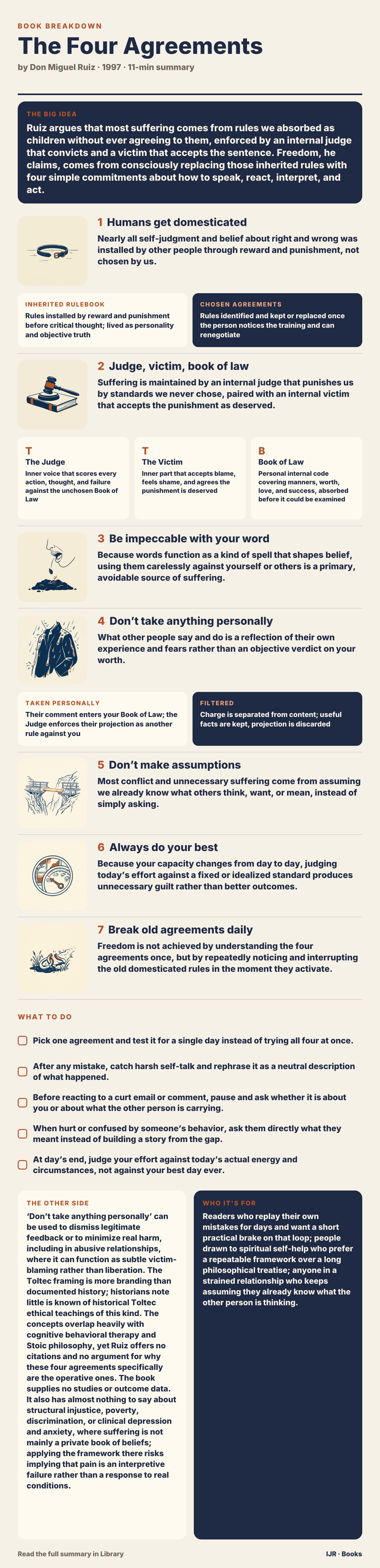
Because words function as a kind of spell that shapes belief, using them carelessly against yourself or others is a primary, avoidable source of suffering.
Ruiz treats language as generative rather than merely descriptive. What you say about yourself and others does not just report reality; it helps build it. He uses ‘impeccable’ in its literal sense—without sin—meaning without turning language against yourself.
Repeated self-condemnation becomes a belief the mind tends to act out. The same logic applies outward: gossip, insults, and careless criticism plant similar seeds in other people. He argues this is why casual cruelty in families and workplaces does lasting damage out of proportion to the words used.
The remedy is not silence but precision and honesty aimed at truth and self-respect rather than habit or spite. This agreement comes first because it is the tool through which the other three are practiced. Refusing to take things personally, resisting assumptions, and calibrating effort all depend on describing your own experience accurately instead of through the accumulated insults of the internal Judge.
In practice: Calling yourself stupid after a mistake is not a neutral observation; repeated often enough, it becomes a belief that shapes future behavior.

4
Don’t take anything personally
What other people say and do is a reflection of their own experience and fears rather than an objective verdict on your worth.
Taken personally
Their comment enters your Book of Law; the Judge enforces their projection as another rule against you
Filtered
Charge is separated from content; useful facts are kept, projection is discarded
This agreement asks the reader to treat other people’s opinions, including praise, as information about the speaker rather than truth about the listener. Taking a comment personally means importing someone else’s internal state into your own Book of Law.
Ruiz calls the susceptibility being vulnerable to poison: other people’s words only wound to the degree that you agree with them internally. The aim is not to ignore useful feedback. It is to separate the emotional charge of an insult from any factual content and evaluate the content on its own terms.
The logic ties straight back to the first agreement. If words are not neutral, and if other people’s words often carry their own unexamined domestication, then absorbing every comment as fact means inheriting other people’s Judges in addition to your own. The second agreement acts as a filter that reduces that inherited noise.
In practice: A dismissive or harsh comment from someone having a bad day reflects their stress, not an accurate judgment of your value.

5
Don’t make assumptions
Most conflict and unnecessary suffering come from assuming we already know what others think, want, or mean, instead of simply asking.
Ruiz argues that the mind abhors ambiguity and will fill any gap in information with a guess, then treat that guess as settled fact. An entire argument can unfold on a premise that turns out to be false.
This agreement follows from the second. If other people’s behavior is not automatically about you, then guessing at hidden meanings is doubly risky: you may construct an insult out of nothing and then react to your own construction.
His remedy is direct in principle and rare in practice: ask questions, state needs explicitly, and communicate your own position clearly enough that others do not have to guess either. The chapter’s contribution is naming assumption as a distinct everyday failure mode—separate from dishonesty or malice—that damages relationships through accumulated small misunderstandings rather than dramatic betrayals.
In practice: A partner who doesn’t call is assumed angry; the real cause may be a dead phone battery, yet the argument has already begun.

6
Always do your best
Because your capacity changes from day to day, judging today’s effort against a fixed or idealized standard produces unnecessary guilt rather than better outcomes.
The fourth agreement is a safeguard against applying the first three with the same rigid perfectionism the Judge already imposes. Ruiz observes that ‘your best’ is not constant. It depends on whether you are tired, sick, distracted, or grieving.
Demanding identical output regardless of condition is itself a form of the old domestication—an arbitrary standard imposed without regard to context. Doing your best, properly understood, is not a license for low effort. He is clear it means genuine effort matched honestly to real conditions, not the minimum required to avoid criticism.
Without this agreement, someone practicing impeccable speech, non-personalization, and non-assumption could still fall back into self-judgment by holding those practices to an impossible standard. Its purpose is to make the first three sustainable over years rather than achievable only in ideal conditions.
In practice: Doing a full day’s work while ill, in fewer hours and at reduced intensity, and treating that reduced output as sufficient because it matched the day’s actual capacity.
7
Break old agreements daily
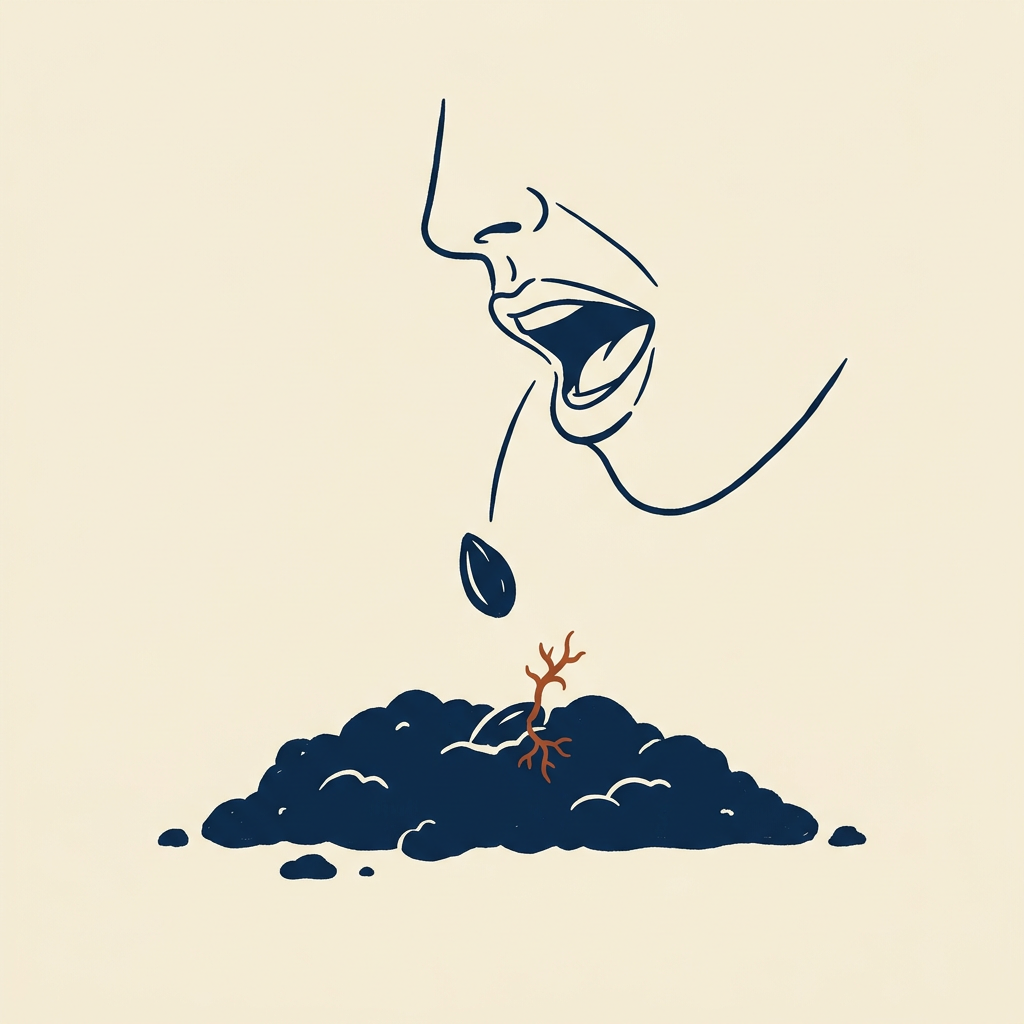
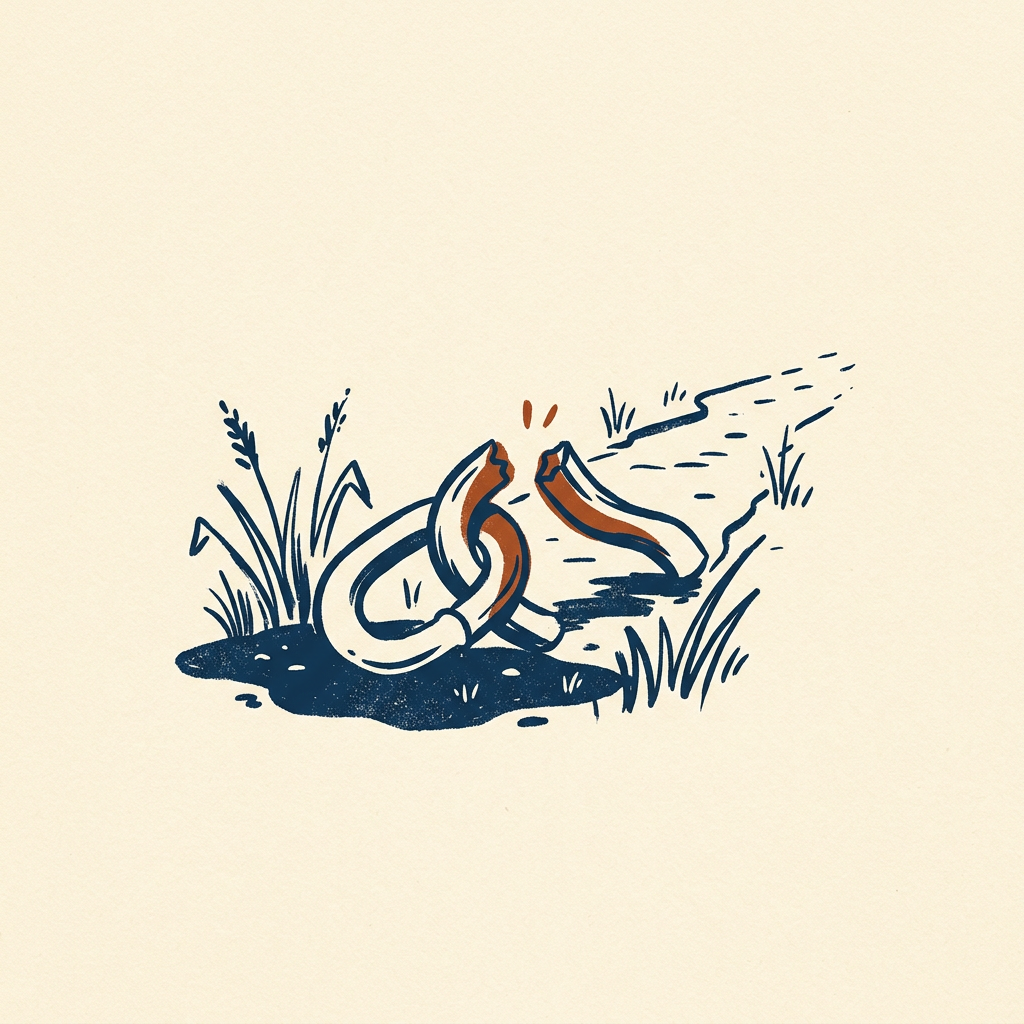
Freedom is not achieved by understanding the four agreements once, but by repeatedly noticing and interrupting the old domesticated rules in the moment they activate.
The closing argument is that insight alone does not change behavior. The Judge and Victim are habitual, and habits require repeated, deliberate interruption to weaken. Ruiz frames this as breaking old agreements—the specific inherited rules—one at a time through daily attention rather than a single decisive realization.
The accumulation of many small corrections, not a single transformation, is what he calls becoming a new dreamer: someone who consciously authors their own beliefs rather than running inherited ones by default. He describes the reward as a kind of personal heaven—a life no longer governed by fear-based self-judgment—contrasted with the hell of the old domesticated dream.
Lapses are expected, especially under stress, and are not evidence of failure. As one person’s internal rules change, their relationships often change with them, since less projection, less inherited blame, and clearer communication alter how others respond in turn. He presents this as an observed pattern, not a guaranteed mechanism.
In practice: Someone who reflexively apologizes for their own existence learns to notice the impulse and, in that instant, chooses a different response.
Key terms
- Domestication The way children are trained by reward and punishment into a dense rulebook they never chose and later mistake for personality.
- Book of Law The personal internal code of right, wrong, and worth that crystallizes from those inherited lessons.
- The Judge The inner voice that scores every action, thought, and failure against the Book of Law.
- The Victim The inner part that accepts the Judge’s verdict, feels shame, and serves the emotional sentence.
- Impeccable with your word Using language without turning it against yourself or others; words treated as spells that build belief.
- Poison Other people’s words and projections that wound only to the degree you agree with them internally.
- New dreamer Someone who repeatedly interrupts old agreements and consciously authors their own beliefs instead of running inherited ones.
- Personal heaven Ruiz’s name for a life no longer governed by fear-based self-judgment, contrasted with the hell of the old domesticated dream.
What to do
- Pick one agreement and test it for a single day instead of trying all four at once.
- After any mistake, catch harsh self-talk and rephrase it as a neutral description of what happened.
- Before reacting to a curt email or comment, pause and ask whether it is about you or about what the other person is carrying.
- When hurt or confused by someone’s behavior, ask them directly what they meant instead of building a story from the gap.
- At day’s end, judge your effort against today’s actual energy and circumstances, not against your best day ever.
Questions to think with
- Which rule in your own Book of Law still feels like objective truth rather than something you once absorbed?
- When did you last import someone else’s bad day into a verdict on your worth?
- What assumption are you currently treating as fact that you have not actually checked?
- Where are you holding today’s effort to yesterday’s or an idealized standard?
- Which old agreement reappears most reliably under stress, and what would interrupting it once look like?
The other side
‘Don’t take anything personally’ can be used to dismiss legitimate feedback or to minimize real harm, including in abusive relationships, where it can function as subtle victim-blaming rather than liberation. The Toltec framing is more branding than documented history; historians note little is known of historical Toltec ethical teachings of this kind. The concepts overlap heavily with cognitive behavioral therapy and Stoic philosophy, yet Ruiz offers no citations and no argument for why these four agreements specifically are the operative ones. The book supplies no studies or outcome data. It also has almost nothing to say about structural injustice, poverty, discrimination, or clinical depression and anxiety, where suffering is not mainly a private book of beliefs; applying the framework there risks implying that pain is an interpretive failure rather than a response to real conditions.
Who it's for
Readers who replay their own mistakes for days and want a short practical brake on that loop; people drawn to spiritual self-help who prefer a repeatable framework over a long philosophical treatise; anyone in a strained relationship who keeps assuming they already know what the other person is thinking.