




Rare shocks nobody sees coming drive history and markets
A turkey’s thousand safe feedings end the week before Thanksgiving—and Taleb says finance and forecasting still make that same mistake.
IJR · Oct 10, 2026 · 13 min read
In 60 seconds
- History, markets, and lives are reshaped mainly by rare extreme events that are invisible in advance and only seem obvious after tidy stories are built backward.
- Mediocristan quantities stay bounded so one case cannot swing the total; Extremistan quantities let one observation dwarf the rest, and finance wrongly imports the first domain’s math into the second.
- After-the-fact narratives and survivor-only samples hide contingency and erase the failures that would correct our odds.
- Long-range expert forecasts in politics, economics, and finance land near chance, yet institutions keep rewarding confident precision about open systems.
- Casino-style probability and the bell curve systematically understate market tail risk, as 1987 and Long-Term Capital Management showed.
- Since specific Black Swans cannot be forecast, barbell exposure—extreme safety for most resources, small capped-downside upside bets, plus slack—beats better prediction.
The big idea
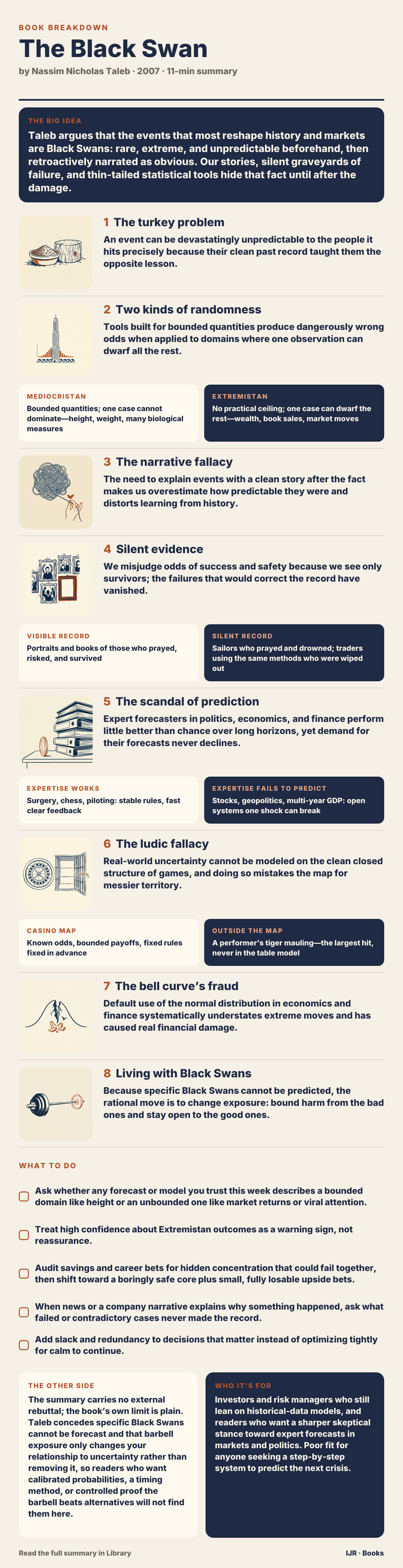
Taleb argues that the events that most reshape history and markets are Black Swans: rare, extreme, and unpredictable beforehand, then retroactively narrated as obvious. Our stories, silent graveyards of failure, and thin-tailed statistical tools hide that fact until after the damage.
The book in brief
Taleb starts from a structural blind spot: people and institutions treat tomorrow as a smooth extension of the recent past, while the shocks that actually matter arrive as ruptures. A turkey fed for a thousand days grows more sure humans mean well until day 1001; Beirut’s cosmopolitan 1970s order tips into a fifteen-year civil war overnight. The same shape, he claims, marks the assassination that opened World War I and the rise of the internet—rare, massive, outside the model, and only “predictable” in hindsight.
He then splits randomness into two domains. In Mediocristan, physical or practical limits keep any single observation from swinging the total, so averages behave. In Extremistan—wealth, book sales, city size, market moves—one case can dwarf all the rest, and a tiny few capture almost everything. The error is importing Mediocristan tools, especially the bell curve, into Extremistan because they are tractable and reassuring.
The middle of the book dissects the habits that lock the error in. The narrative fallacy compresses messy contingency into stories that feel inevitable. Silent evidence lets us study only survivors while the drowned and the wiped-out vanish from the sample. Expert forecasters in open social systems perform near chance over long horizons, yet demand for confident multi-year forecasts never falls.
He widens the charge to the ludic fallacy—treating life like a casino with known odds—and to the Gaussian curve’s quiet fraud in finance, where models called the 1987 one-day crash and the moves that sank Long-Term Capital Management essentially impossible. Elegant math spread the wrong tool through banks and regulators anyway.
The close refuses better prediction. Structure exposure instead: bound harm from negative Black Swans, stay open to positive ones, favor a barbell of boring safety plus small unlimited-upside bets, and choose redundancy over fragile optimization. The posture does not erase uncertainty; it survives being wrong.
Context
Taleb published the book in 2007, months before a financial crisis that matched his account of hidden tail risk, broken risk models, and overconfident forecasts almost exactly. It hit investors and risk managers who still trusted historical-data machinery, and readers already suspicious of expert certainty.
The key ideas

1
The turkey problem
An event can be devastatingly unpredictable to the people it hits precisely because their clean past record taught them the opposite lesson.
Taleb opens with a turkey fed every day for a thousand days. Each meal raises its confidence that humans wish it well. On day one thousand and one, the week before Thanksgiving, the feeding stops in the worst possible way.
That is the Black Swan pattern: rare, extreme in consequence, and only “obvious” after people invent a tidy backward explanation. Beforehand, more safe days only deepened the wrong certainty; the data never pointed to the break.
He makes it concrete with his family’s Lebanon. Beirut in the 1970s looked cosmopolitan and stable after centuries of coexistence among religious communities. Nobody there expected a fifteen-year civil war. It did not creep in; it arrived as a rupture that made prior projections worthless overnight.
The same shape, he claims, marks history’s most consequential turns. We still build insurance, financial models, institutions, and personal plans on the assumption that tomorrow will resemble the recent past. The point is not paranoia; it is suspicion of confidence built only on a record of things not yet going wrong.
In practice: The turkey’s perfect feeding history made it more sure of safety right up to the day that history became fatal.

2
Two kinds of randomness
Tools built for bounded quantities produce dangerously wrong odds when applied to domains where one observation can dwarf all the rest.
Mediocristan
Bounded quantities; one case cannot dominate—height, weight, many biological measures
Extremistan
No practical ceiling; one case can dwarf the rest—wealth, book sales, market moves
Taleb divides the world into Mediocristan and Extremistan. In the first, quantities have physical or practical ceilings; no single case swings the total. Sample a thousand people by height, add the tallest person alive, and the average barely moves.
In Extremistan there is no such ceiling. Sample a thousand net worths, add Jeff Bezos, and the average is transformed. Wealth, book sales, city populations, and financial market moves live here. A handful of books, films, or albums take almost all the revenue; averaging past sales does not forecast the next outlier.
The practical failure is importing Mediocristan mathematics—the bell curve and thin tails—into Extremistan, where it understates extreme outcomes. A mortality insurance model can be reasonably safe; a stock-crash model built on the same logic is not.
Before any risk argument, he insists you first ask which domain you are in. Most professional risk management skips that question and defaults to tools that feel tractable and reassuring rather than ones that fit the underlying reality.
In practice: Adding the tallest person barely shifts average height; adding Bezos rewrites average wealth.

3
The narrative fallacy
The need to explain events with a clean story after the fact makes us overestimate how predictable they were and distorts learning from history.
Once something has happened, the mind will not leave it unexplained. It builds a causal chain that compresses a messy, contingent sequence into a story that feels inevitable. Taleb calls this the narrative fallacy and treats it as a chief reason Black Swans keep surprising people who think hindsight made them wiser.
Historians of World War I describe alliances and grievances that make the war look almost predetermined. No contemporary observer in 1913 predicted it with that clarity; miscommunications and accidents of timing kept the path open. The later story hides how undecided the moment actually was.
Give people a string of random stock moves and most will invent a trend, a reason, a turning point—even when a coin flip produced the numbers. Journalism runs on the same reflex, attaching single causes to market moves each evening whether any real explanation exists.
Because a good story feels like understanding, it breeds false confidence that the next similar shock could have been foreseen and therefore can be. Hold historical narratives loosely as one plausible reconstruction, not proof that the past—or the future—is fundamentally legible.
In practice: Coin-flip price series still get narrated as if they contained real turning points and motives.

4
Silent evidence
We misjudge odds of success and safety because we see only survivors; the failures that would correct the record have vanished.
Visible record
Portraits and books of those who prayed, risked, and survived
Silent record
Sailors who prayed and drowned; traders using the same methods who were wiped out
Taleb revives a story attributed to Cicero: a man is shown paintings of sailors who prayed in a storm and survived, offered as proof that prayer works. He asks where the paintings are of those who prayed and drowned. There are none; they are not around to commission them.
That absence quietly corrupts what people treat as established wisdom. Biographies of successful entrepreneurs credit habits also shared by thousands who failed and never received biographies. Books on winning traders ignore the larger population that used identical methods and was wiped out—sometimes by the same move that enriched the survivors.
A trader who took large improbable risks and won looks like a genius in retrospect; the version who lost is invisible. Any strategy that occasionally blows up completely can look brilliant for years simply because the blowup has not happened yet. A sample of survivors alone always understates the true danger of the whole class of strategies.
His remedy is not more data from winners but deliberate attention to the graveyard: ask who is not in the room and why.
In practice: Missing paintings of drowned sailors who also prayed undercut the claim that prayer explains survival.

5
The scandal of prediction
Expert forecasters in politics, economics, and finance perform little better than chance over long horizons, yet demand for their forecasts never declines.
Expertise works
Surgery, chess, piloting: stable rules, fast clear feedback
Expertise fails to predict
Stocks, geopolitics, multi-year GDP: open systems one shock can break
Taleb draws on long-running studies of political and economic experts to argue that expertise in these fields does not reliably become predictive power. Multi-year forecasts of elections, GDP growth, and currencies land near random guessing on average. Confident experts often do worse than tentative ones because certainty blinds them to disconfirming signals.
He separates domains where expertise clearly works—surgery, chess, piloting—from domains where it does not—stock prices, geopolitical crises. The first group faces stable, rule-bound systems with fast clear feedback. The second faces open Extremistan systems where a single unforeseen event can invalidate the trend the forecast rested on.
Central banks and investment banks still produce detailed multi-year forecasts every year. Institutions reward the appearance of knowledge over its substance. Taleb watched risk models fail during market shocks their creators had rated as astronomically unlikely.
The target is less any individual forecaster than a system that demands precision about the unpredictable and punishes those who admit limits. Know the category before trusting anyone’s forecast; treat long-range claims about markets, politics, or complex social systems as guesses dressed in certainty’s language.
In practice: Finance risk models that labeled major shocks astronomically unlikely failed when those shocks arrived.

6
The ludic fallacy
Real-world uncertainty cannot be modeled on the clean closed structure of games, and doing so mistakes the map for messier territory.
Casino map
Known odds, bounded payoffs, fixed rules fixed in advance
Outside the map
A performer’s tiger mauling—the largest hit, never in the table model
Drawing on years as an options trader, Taleb names the ludic fallacy: treating life’s uncertainty as if it followed the tidy rules of a game of chance. In a casino the odds are known, outcomes bounded, and exposure calculable because the game’s structure is fixed in advance.
He recounts a casino that spent enormous effort modeling every way it could lose at the tables, then took its largest single loss when a performer’s tiger mauled him during a show—an event entirely outside the gambling model. Formal probability training, including much of what business schools teach, implicitly teaches that casino version: known distributions, known payoffs, calculable risk.
Most consequential uncertainty does not come from inside a known game; it comes from possibilities nobody put in the sample space. Pre-crisis financial models used historical volatility as if markets were a fixed-odds game and were repeatedly blindsided by moves they called nearly impossible.
Competence at poker or formal statistics does not protect against Black Swans and may worsen blindness to them, because it trains trust in calculable risk over the much larger unenumerated space.
In practice: A tiger attack during a show—not a bad run at the tables—produced the casino’s biggest single loss.

7
The bell curve’s fraud
Default use of the normal distribution in economics and finance systematically understates extreme moves and has caused real financial damage.
Taleb reserves particular anger for the Gaussian bell curve as modern finance’s default tool. It assumes extreme deviations from the average become vanishingly rare very quickly—reasonable for human height, poor for markets, where large moves arrive far more often than the model allows.
In 1987 the Dow fell over twenty percent in a single day, an event standard models of the time rated as something that should not occur even once across the age of the universe. Myron Scholes and Robert Merton had helped build option-pricing foundations on Gaussian assumptions; Long-Term Capital Management, the firm they were later involved with, collapsed in 1998 after market moves its own risk models treated as essentially impossible.
Because the math is elegant and the outputs look precise, the tool spread through banking and regulation despite the wrong fit to fat tails. Regulators and rating agencies relied on the same models to certify institutions as safe.
He treats the mismatch as a structural flaw, not a one-time embarrassment: scientific appearance hid how much tail risk banks actually carried—the warning he pressed publicly before 2008.
In practice: Long-Term Capital Management collapsed in 1998 after moves its Gaussian models had treated as essentially impossible.

8
Living with Black Swans
Because specific Black Swans cannot be predicted, the rational move is to change exposure: bound harm from the bad ones and stay open to the good ones.
Taleb closes by leaving diagnosis for a way of operating. Forecasting the content of the next large surprise is not available, so structure decisions so negative Black Swans do limited, bounded damage while positive ones can pay without a ceiling.
He calls the posture a barbell: keep a large share of resources extremely safe and protected from ruin; commit a small share to high-risk bets with limited downside and theoretically unlimited upside; avoid the broad middle of moderate risk that feels prudent but carries hidden fat-tail exposure. As a trader he bought inexpensive options that paid enormously in rare crashes while the bulk of capital stayed conservatively protected—a pattern that worked in 1987 and again in 2008.
The logic extends past finance. A writer can hold a stable day job while running a low-cost creative project with unbounded upside instead of staking everything on one moderately risky path. Prefer reducing fragility over improving prediction: redundancy, small size, and slack over tightly optimized, highly leveraged systems that look efficient in calm and snap when a shock hits.
He is candid that this does not eliminate uncertainty. It trades the illusion of control for a structure that can survive being wrong.
In practice: Cheap crash-paying options on a protected capital base performed well in the 1987 crash and again in 2008.
Key terms
- Black Swan A rare, extreme-impact event that is unpredictable in advance and only seems obvious after people build a tidy story backward from the outcome.
- Mediocristan The domain where quantities have practical limits and no single observation can dominate the total—human height and weight live here.
- Extremistan The domain where one observation can dwarf all others combined—wealth, book sales, city populations, market moves.
- Narrative fallacy The habit of forcing messy contingent events into a clean causal story that makes the past look more inevitable than it was.
- Silent evidence The missing record of failures and non-survivors that would correct our odds if they were still visible.
- Ludic fallacy Treating real-world uncertainty as if it followed the known odds and fixed rules of a casino game.
- Gaussian bell curve A thin-tailed distribution that makes extreme deviations look vanishingly rare and, Taleb argues, badly misfits financial markets.
- Barbell approach Extreme safety for most resources plus a small set of high-upside, limited-downside bets, avoiding the fragile moderate middle.
What to do
- Ask whether any forecast or model you trust this week describes a bounded domain like height or an unbounded one like market returns or viral attention.
- Treat high confidence about Extremistan outcomes as a warning sign, not reassurance.
- Audit savings and career bets for hidden concentration that could fail together, then shift toward a boringly safe core plus small, fully losable upside bets.
- When news or a company narrative explains why something happened, ask what failed or contradictory cases never made the record.
- Add slack and redundancy to decisions that matter instead of optimizing tightly for calm to continue.
Questions to think with
- Where are you still using Mediocristan tools on an Extremistan problem?
- Which success stories you admire would change if the silent failures were visible?
- What would a barbell version of your portfolio or career look like this month?
- When did a clean historical narrative last give you false confidence about what comes next?
- Which of your models assume the rules of the game cannot themselves change?
The other side
The summary carries no external rebuttal; the book’s own limit is plain. Taleb concedes specific Black Swans cannot be forecast and that barbell exposure only changes your relationship to uncertainty rather than removing it, so readers who want calibrated probabilities, a timing method, or controlled proof the barbell beats alternatives will not find them here.
Who it's for
Investors and risk managers who still lean on historical-data models, and readers who want a sharper skeptical stance toward expert forecasts in markets and politics. Poor fit for anyone seeking a step-by-step system to predict the next crisis.