



Nothing is original, so steal from many sources at once
Makers frozen by originality fear get a short, illustrated stack for collecting influences, making daily, and sharing unfinished work without shame.
IJR · Oct 8, 2026 · 12 min read
In 60 seconds
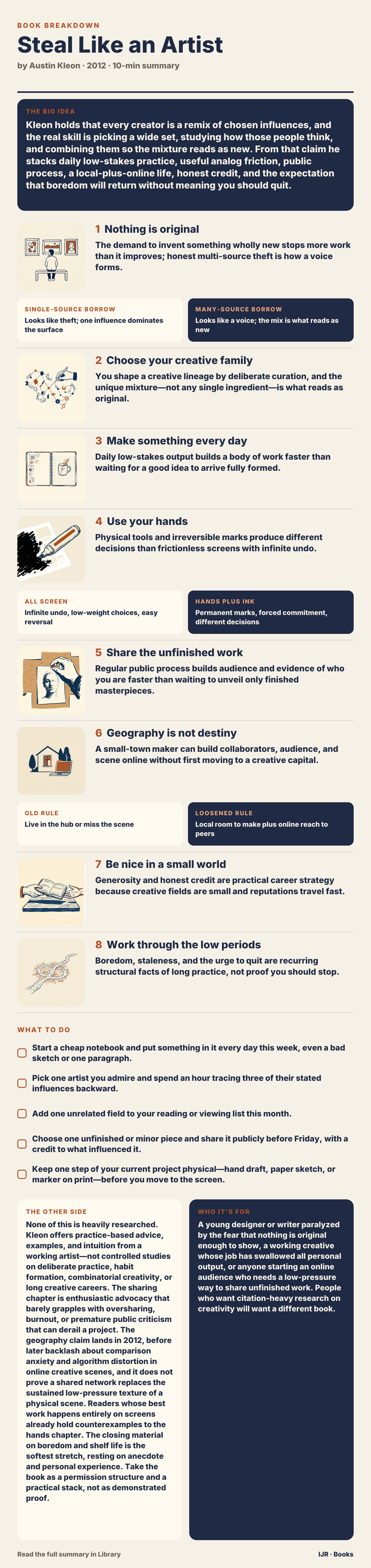
- Originality is a myth; borrow from many sources so the mix, not any single theft, becomes your voice.
- Build a creative lineage by tracing one loved artist backward to their sources, then add an unrelated field.
- Make something every day in a cheap notebook; volume catches good ideas better than waiting for inspiration.
- Keep part of the process physical—a permanent marker on newsprint forces choices a delete key never will.
- Share unfinished work regularly; process builds an audience faster than rare unveiled masterpieces.
- Live anywhere with an online scene, stay generous about credit, and keep working through boredom and doubt.
The big idea
Kleon holds that every creator is a remix of chosen influences, and the real skill is picking a wide set, studying how those people think, and combining them so the mixture reads as new. From that claim he stacks daily low-stakes practice, useful analog friction, public process, a local-plus-online life, honest credit, and the expectation that boredom will return without meaning you should quit.
The book in brief
The book opens by killing the purity test. Stop waiting to invent something wholly new. Songwriters learn by covering songs. Painters once trained by copying masters in museums. The real mistake is borrowing from only one source, which looks like theft; borrowing from many at once starts to look like a voice. Permission replaces paralysis.
Next comes curation. You do not choose your biological family, but you do choose your creative lineage. Find one artist you love completely, learn how they thought, then follow who they stole from. Repeat until you hold a constellation nobody else shares. Reach outside your field so a novelist studies architecture or a musician studies cooking and the combinations stay unexpected.
Production follows consumption. Keep a cheap notebook. Put something in it every day, even bad work. Most ideas are mediocre, so the path to good ones is volume, not a lightning strike of inspiration. Lower the stakes on purpose: formats nobody will grade, practice instead of portfolio.
Friction gets its own chapter. Digital undo and infinite options can flatten decisions. Kleon’s newspaper blackout poems—one real page, one permanent marker—cannot be reversed once the ink hits. He wants some part of any process kept analog: sketch before the screen, draft by hand, build a physical mockup. Constraint becomes generative.
Then the stack turns outward. The old model hid for years and unveiled a finished masterpiece. The newer model shares sketches, drafts, and side projects so range and growth stay visible and the right people can find you early. Pick one practice, document it as you go, put pieces in front of an audience without waiting for permission. Geography loosens too: a small-town maker can build collaborators and reputation online while still keeping a quieter local room to work. Pair both.
The close is about conduct and endurance. Credit influences openly. Promote other people’s work. Answer strangers. Creative fields are smaller than they look and reputations travel. Boredom, doubt, and the sense you have nothing left will recur; they are structural, not proof you chose wrong. Keep the small daily habits running so a low period has a place to work inside instead of a cold start.
Context
Austin Kleon published this short illustrated manifesto in 2012 for internet-age makers raised on remix culture and anxious about copying. It gave them a permission structure for making things in public without shame, and its push to share process early anticipated the later common habit of building in public on social platforms and newsletters.
The key ideas
1
Nothing is original
The demand to invent something wholly new stops more work than it improves; honest multi-source theft is how a voice forms.
Single-source borrow
Looks like theft; one influence dominates the surface
Many-source borrow
Looks like a voice; the mix is what reads as new
Kleon borrows a line of thought from filmmaker Jim Jarmusch: nothing is original, so quit trying to be. Every artist carries a genealogy of influences. Growing means tracing that genealogy on purpose instead of pretending it is not there.
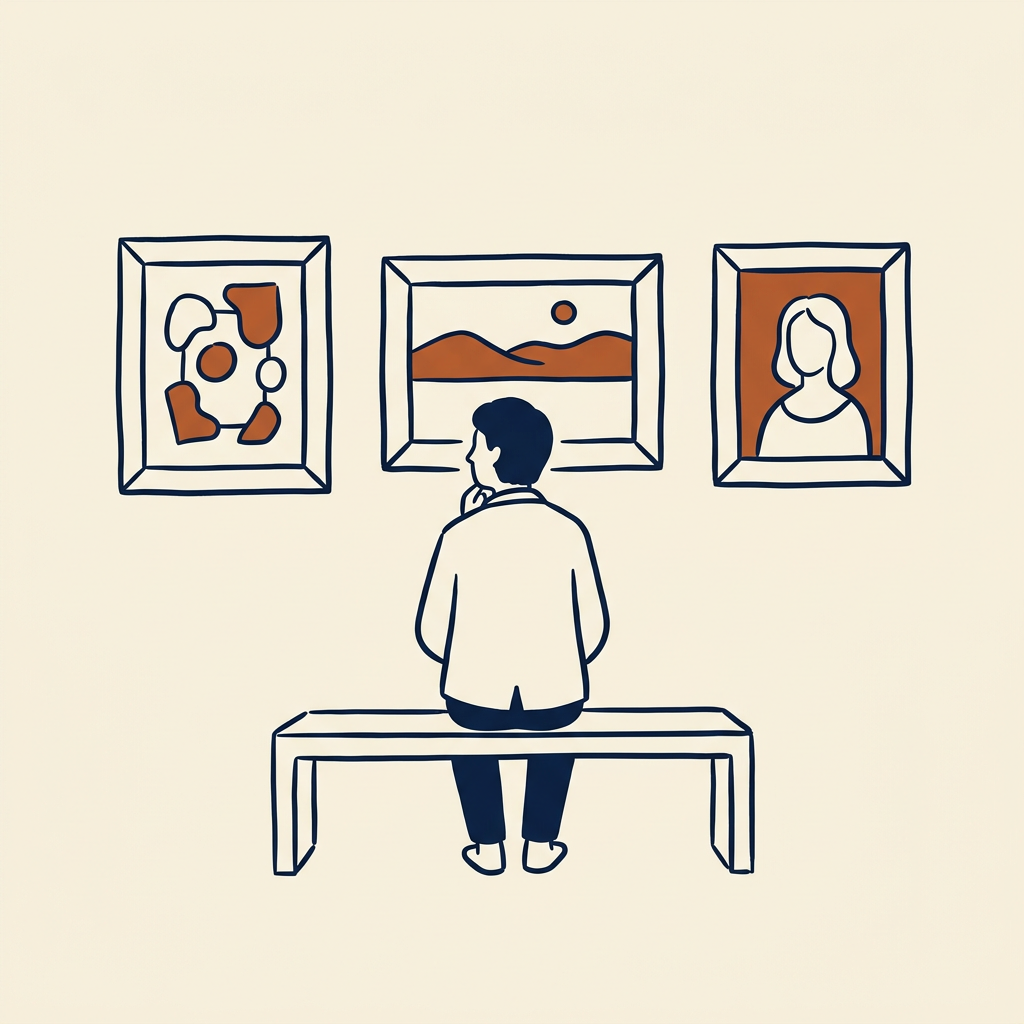
Songwriters cover other people’s songs before they write their own. Painters historically copied masters in museums. Borrowing itself is not the failure. Borrowing from a single source is. That reads as theft. Taking from many sources at once begins to read as a new voice.
The practical move is narrow and clear. Pick a few creators you genuinely love. Study them until you understand how they thought, not only what they finished. Steal method and way of seeing. Point that way of seeing at different material. Copying a finished product is plagiarism; copying a lens and aiming it elsewhere is how style appears.
The chapter’s real job is permission. It swaps the paralyzing bar of pure invention for a lower, more honest bar of transparent synthesis. Everything later in the book rests on that swap.
In practice: A painter trains by copying masters in a museum; a songwriter learns structure by covering someone else’s song before writing an original.

2
Choose your creative family
You shape a creative lineage by deliberate curation, and the unique mixture—not any single ingredient—is what reads as original.
Biological family arrives without a vote. Creative lineage does not. Kleon treats curation itself as the core creative act: deciding which artists, writers, and thinkers you will let shape you.
The method is a trail. Find one artist you love completely. Learn everything about them. Then ask who they stole from and follow that thread to three or four more sources. Repeat. The resulting constellation is unlikely to match anyone else’s exactly, because the combination is rare even when no single piece is new.
Stay inside one genre and you will sound like that genre. A writer who only reads peers in the same lane blends in. Reach into adjacent or unrelated fields—a novelist studying architecture, a musician studying cooking—and unexpected pairs appear.
This is how “stealing” produces work that feels original. The material is shared. The specific mixture is not.
In practice: Love one artist completely, map three of their influences, then add one unrelated field to your reading list so the mix stays yours alone.
3
Make something every day
Daily low-stakes output builds a body of work faster than waiting for a good idea to arrive fully formed.
Attention swings from what to consume to what to produce. The habit of daily making matters more than the quality of any single day.
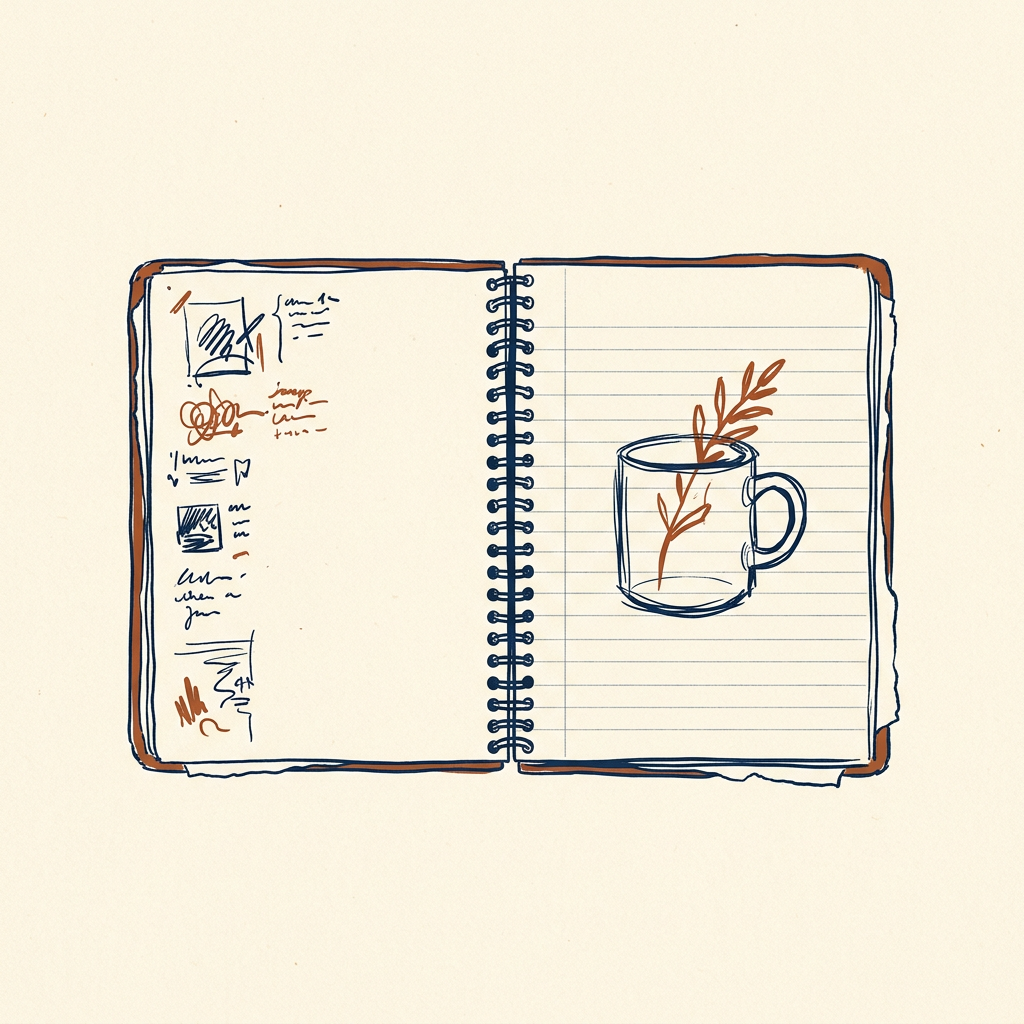
A sketchbook or notebook externalizes thought before judgment arrives. The page becomes a net. Ideas that would be forgotten or never surface get caught. Most ideas are mediocre. The route to the good ones is to generate many, not to wait for inspiration to hand you a winner.
Lower the stakes on purpose. Use a cheap notebook. Work in a format nobody else will see. Treat the day’s output as practice, not a portfolio piece. Fear of making something bad often blocks making anything at all. Daily practice reframes bad work as expected and fine.
Without this raw material, later chapters on sharing have nothing to share. Volume first.
In practice: Fill a cheap notebook every day with a bad sketch or a single paragraph; the goal is the streak, not a gallery wall.
4
Use your hands
Physical tools and irreversible marks produce different decisions than frictionless screens with infinite undo.
All screen
Infinite undo, low-weight choices, easy reversal
Hands plus ink
Permanent marks, forced commitment, different decisions
Digital tools remove friction. Undo buttons and endless options can shrink the weight of any single choice. Kleon wants some of that weight back.
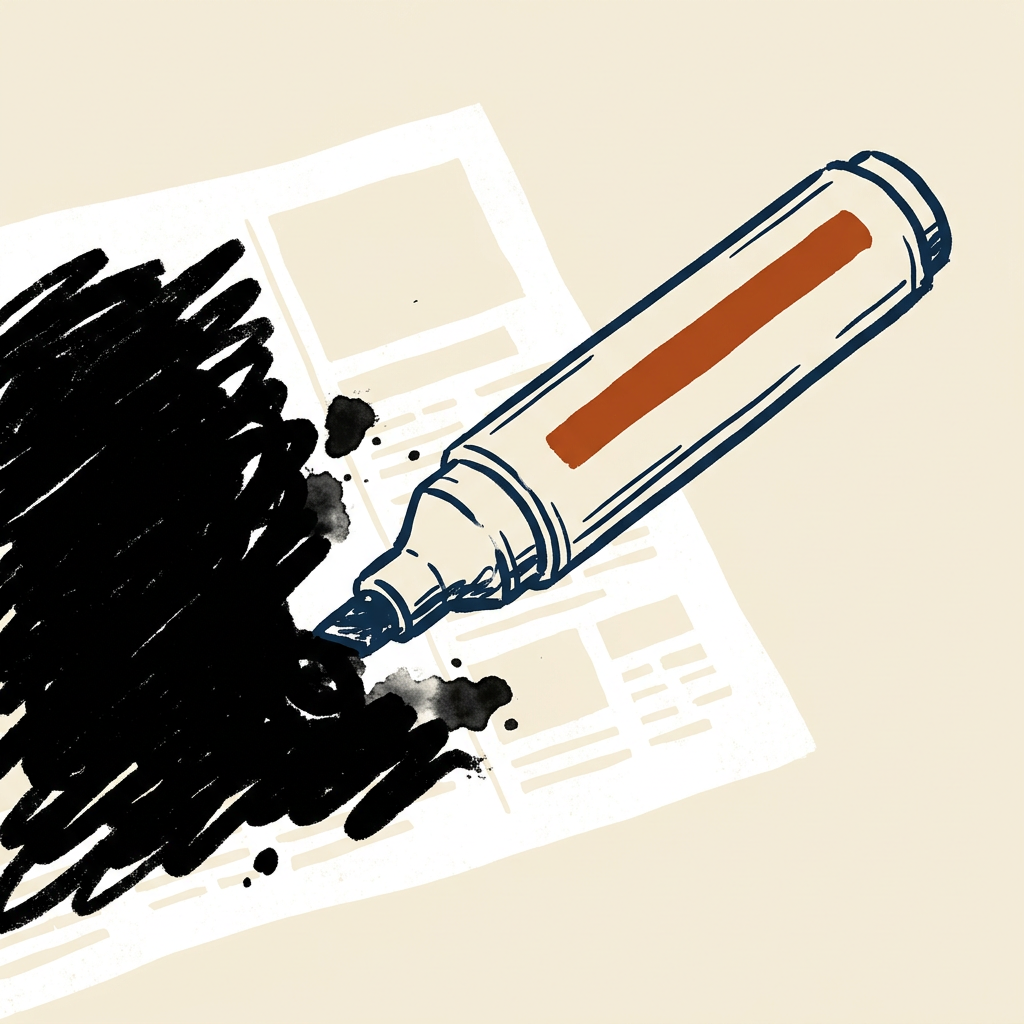
His newspaper blackout poems are the clearest case. Take a real newspaper page and a permanent marker. Black out words until a poem remains. Once the marker touches the page, the move cannot be undone or lightly edited. Commitment rises. The quality of the decision changes.
The wider rule is not anti-digital. Keep some part of the process analog: sketch before you design on a computer, write a first draft by hand, build a physical mockup. He uses digital tools himself for distribution and much of the later process. The argument is combination, not purity.
Constraint stops being only an obstacle. It becomes a generator.
In practice: A newspaper page and a permanent marker produce a blackout poem that cannot be ctrl-Z’d once the ink lands.
5
Share the unfinished work
Regular public process builds audience and evidence of who you are faster than waiting to unveil only finished masterpieces.
Daily practice now links to audience. The old creative life hid for years and then revealed a polished masterpiece. Kleon describes a replaced model: share process, not only product.
The internet lets anyone show sketches, drafts, and side projects. That visibility has value. It shows range. It shows growth. It lets the right people find you before your best work exists.
The instruction is concrete. Pick one project or practice. Document it as you go. Put pieces online or in front of some audience on a regular rhythm. Do not wait for permission or completion. Discomfort is real—sharing bad or unfinished work feels risky—yet most people are not watching that closely, and the ones who are often forgive process more easily than a single failed finished piece.
Reputation becomes a trail of making, not a single unveiling.
In practice: Document one side project as you go and post a piece of it before it feels ready, along with a note about what influenced it.

6
Geography is not destiny
A small-town maker can build collaborators, audience, and scene online without first moving to a creative capital.
Old rule
Live in the hub or miss the scene
Loosened rule
Local room to make plus online reach to peers
Creative movements once required physical proximity. Paris, New York, or another hub was where artists gathered, traded ideas, and built reputations. Kleon says the internet has loosened that rule.
A person working in a small town can find collaborators, an audience, and a scene without relocating. Geography is not irrelevant. He still values local, physical community. In-person relationships carry texture and trust that online contact does not fully replace.
The practical design is two-part. Keep a local place to make work—ideally quieter and cheaper than a major hub. Pair it with an active online presence that reaches peers and influences farther away.
The chapter rebuts the excuse that an unglamorous zip code disqualifies you. It does not claim place never matters.
In practice: Work in a quiet, cheaper town for the making hours, and use an online presence to reach the wider circle of peers.
7
Be nice in a small world
Generosity and honest credit are practical career strategy because creative fields are small and reputations travel fast.
Making work is not the whole job. Conduct inside the field matters. Kleon treats generosity—crediting influences, promoting other people’s work, answering strangers who reach out—as something that pays off over time.
Part of the frame is self-interest. People remember who was generous early. Those relationships compound. Part is ethics tied to the book’s first claim. If you openly borrow, the honest complement is openly crediting. Pretending influences do not exist breaks the bargain.
Credit builds goodwill with the people whose work you draw from and with their audiences. The instruction is to keep it from turning into theater. Give credit when nobody is watching. Respond when there is no obvious benefit. Treat generosity as a default, not a calculated trade. Unfaked kindness reads differently than strategic networking.
Fields look large from the outside. They behave like small towns.
In practice: Credit a source in public even when it helps them more than you, and answer a stranger’s note when there is no immediate payoff.
8
Work through the low periods
Boredom, staleness, and the urge to quit are recurring structural facts of long practice, not proof you should stop.
The closing turn faces the psychological lows. Boredom. Self-doubt. The feeling that you have already said everything you have to say. Kleon treats these stretches as structurally inevitable, not as personal failure.
The response is not to wait for inspiration to return. Keep working through the low period, often on smaller or different projects, until momentum comes back. Long-practicing artists hit walls partway through a career. Some change medium. Some return to earlier influences. Some simply keep producing mediocre work until better work resumes.
Earlier chapters sound upbeat—daily practice, public sharing. This one refuses to pretend those habits erase the difficulty of sustaining a creative life across years. The practical hedge is already in place if you built it: the daily notebook, the ongoing side projects. During a low stretch you step into a habit that already exists instead of trying to restart from zero while discouraged.
Doubt becomes weather. You keep walking.
In practice: When the main project feels dead, keep the daily notebook going and switch to a smaller side piece until energy returns.
Key terms
- Steal like an artist Openly collect many influences, copy how they think, and combine them on new material instead of faking pure invention
- Creative lineage The family of artists and thinkers you choose and study on purpose, unlike the family you are born into
- Transparent synthesis Mixing many sources in plain sight so the result reads as a voice rather than as theft from one place
- Blackout poem A poem made by redacting a real newspaper page with a permanent marker so the leftover words form the piece
- Share process Putting sketches, drafts, and side work in public regularly instead of waiting to unveil only finished masterpieces
- Low-stakes daily practice Making something every day in a cheap, private format where bad output counts as success because the streak is the point
What to do
- Start a cheap notebook and put something in it every day this week, even a bad sketch or one paragraph.
- Pick one artist you admire and spend an hour tracing three of their stated influences backward.
- Add one unrelated field to your reading or viewing list this month.
- Choose one unfinished or minor piece and share it publicly before Friday, with a credit to what influenced it.
- Keep one step of your current project physical—hand draft, paper sketch, or marker on print—before you move to the screen.
Questions to think with
- Which three influences already shape your work, and which one outside your field could you add this month?
- What would change if your daily output were graded only on whether it happened, not on whether it was good?
- Where in your process could an irreversible physical step improve the decisions you make?
- What unfinished piece could you show this week, and who would actually need to see it polished first?
- When boredom last arrived, did you treat it as a verdict or as weather you could work through?
The other side
None of this is heavily researched. Kleon offers practice-based advice, examples, and intuition from a working artist—not controlled studies on deliberate practice, habit formation, combinatorial creativity, or long creative careers. The sharing chapter is enthusiastic advocacy that barely grapples with oversharing, burnout, or premature public criticism that can derail a project. The geography claim lands in 2012, before later backlash about comparison anxiety and algorithm distortion in online creative scenes, and it does not prove a shared network replaces the sustained low-pressure texture of a physical scene. Readers whose best work happens entirely on screens already hold counterexamples to the hands chapter. The closing material on boredom and shelf life is the softest stretch, resting on anecdote and personal experience. Take the book as a permission structure and a practical stack, not as demonstrated proof.
Who it's for
A young designer or writer paralyzed by the fear that nothing is original enough to show, a working creative whose job has swallowed all personal output, or anyone starting an online audience who needs a low-pressure way to share unfinished work. People who want citation-heavy research on creativity will want a different book.