




Most management failures come from misplaced kindness not malice
After a Google talk, Sheryl Sandberg told Scott she said “um” so often she sounded less intelligent than she was—and no colleague had flagged something so fixable.
IJR · Oct 7, 2026 · 12 min read
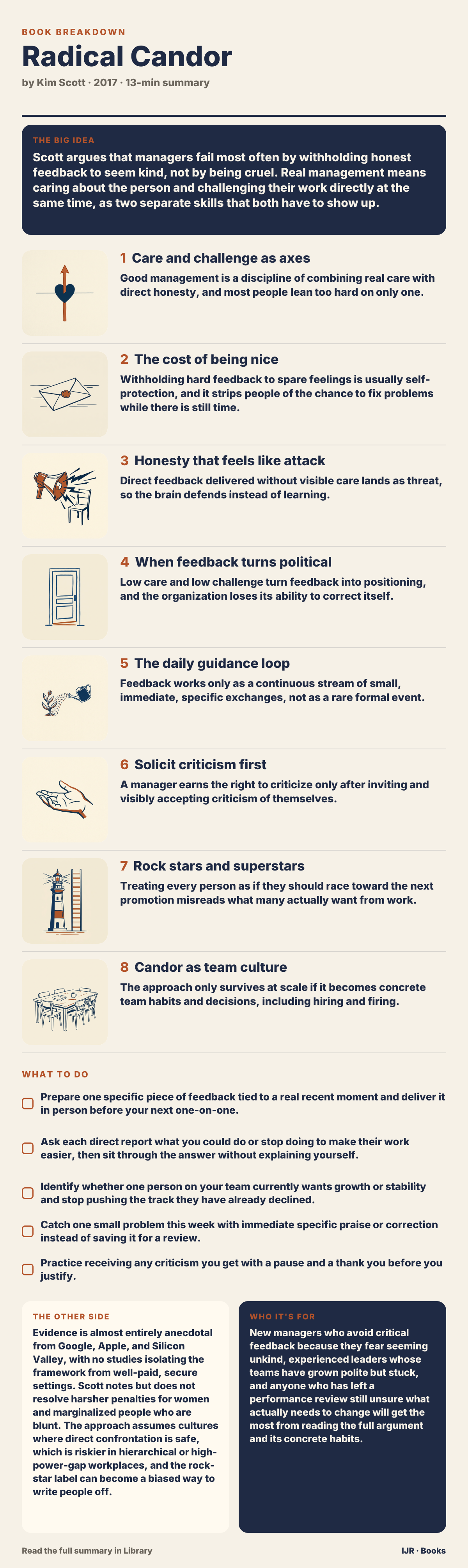
In 60 seconds
- Scott argues most managers fail through misplaced kindness, withholding honest feedback because they fear seeming harsh.
- She plots two axes—care personally and challenge directly—into four quadrants, with Radical Candor as both high.
- Ruinous empathy (high care, low challenge) looks virtuous yet removes a person’s chance to fix problems while there is still time.
- Feedback works only as a continuous loop of small, immediate, specific, in-person exchanges, not annual reviews.
- A manager must solicit and visibly accept criticism of themselves before earning the right to criticize others.
- Guidance must match whether someone is a superstar chasing steep growth or a rock star valuing stable excellence in the current role.
The big idea
Scott insists caring about a person and challenging their work are separate skills, and management only works when both run high at once. Silence sold as kindness, she argues, is often self-protection that later arrives as surprise firings, stalled careers, and teams that gossip instead of correct.
The book in brief
Scott starts from a blunt diagnosis: managers usually mean well, yet they still fail people by softening or skipping hard feedback. She treats that pattern as misplaced kindness rather than malice, and she builds a two-axis map to explain it—how much you show personal care, and how directly you challenge the work.
Plot those axes and four quadrants appear. Radical Candor is both high. The other three name the usual collapses: ruinous empathy when care stays high but challenge drops; obnoxious aggression when challenge stays high but care disappears; and manipulative insincerity when both fall and feedback turns into political theater.
She walks each failure through workplace cases. Ruinous empathy produces the well-liked employee who declines for months, hears only soft signals, and is stunned by a firing that never felt coming. Obnoxious aggression produces the blunt boss whose accurate criticism still triggers a threat response, so people hide problems instead of fixing them. Manipulative insincerity spreads when people nod in meetings and trash plans privately, making every later agreement suspect.
The practical core is a guidance loop: small, specific, immediate praise and criticism delivered in person, often enough that trust accumulates and big blowups become rare. Scott pairs that with a sequencing rule—ask for criticism of yourself first, thank it without defensiveness, and change—because structural power makes downward feedback safer than upward feedback unless the boss proves the channel is safe.
She then separates superstars, who want steep growth and new challenges, from rock stars, who deliver excellent steady work and do not want the next promotion. Treating everyone as a superstar, she argues, pushes reliable contributors into the wrong roles or out the door.
The book lands on culture. Radical Candor has to become skip-level conversations, rotating meeting leads, stated norms that treat silent consent as a red flag, and firing practices that never surprise. Otherwise the habit dies when one good manager leaves. Her closing claim is simple: an uncomfortable truth delivered with visible care is usually the kinder act, and withholding it to feel nice is usually the more selfish one.
Context
Kim Scott built the framework from years managing at Google and advising near Apple, including watching how senior executives actually gave feedback in real meetings. Published in 2017, it spread as a shared language for feedback, praise, and team culture among leaders who already knew annual reviews were failing them.
The key ideas

1
Two axes, four outcomes
Scott treats good management as a discipline of high personal care plus direct challenge, not a personality trait, and argues most people habitually lean on one axis while neglecting the other.
Care personally (high→low) ↑ · Challenge directly (low→high) →
Ruinous Empathy
High care, low challenge: kindness that withholds hard truths
Radical Candor
High care, high challenge: the target zone
Manipulative Insincerity
Low care, low challenge: political praise, silence, positioning
Obnoxious Aggression
Low care, high challenge: honesty that lands as attack
She splits the work into two independent levers. One is how clearly you show you care about the person. The other is how directly you challenge the work when it falls short. Plot them and you get four quadrants; Radical Candor is the corner where both run high.
Most failures, she argues, are not bad intentions. They are a default to one lever. Before a hard conversation she wants a manager to diagnose which dimension is missing. Distrust of motives usually signals thin personal care. A repeated mistake usually signals thin directness.
Treating the levers as separate, rather than one vague blend called niceness, is the book’s organizing move. Everything else—praise, criticism, hiring, exits—follows from staying in the high-high quadrant under pressure.
In practice: Scott’s own missed speaking-habit feedback at Google showed colleagues protecting feelings while skipping a fixable flaw that had already cost her professionally.

2
Ruinous empathy’s hidden bill
Scott names high care with low challenge “ruinous empathy” and treats it as the dominant American management failure because it disguises harm as virtue.
What it looks like
Softened feedback meant to spare feelings and protect the relationship
What it costs
The person cannot course-correct in time; the ending arrives as a shock
A manager softens the truth about a sloppy report or a credibility-killing habit and tells themselves they are being considerate. Scott’s claim is harsher: the manager is often avoiding their own discomfort, not sparing the other person.
The lasting damage is time. Soft signals remove someone’s ability to fix a problem while repair is still possible. Comfort in the short conversation is paid for with a worse conversation later—a surprise firing, a blown project, or quiet resentment.
She scales the same pattern to whole teams. A workplace pleasant to everyone’s face and critical behind their backs runs on ruinous empathy at volume. It produces gossip, stalled careers, and blowups that earlier, smaller corrections could have prevented.
In practice: Scott kept softening feedback to “Bob,” a well-liked teammate whose work had declined for months, then fired him; he was genuinely surprised because nothing in his reviews had prepared him.

3
Honesty without visible care
Scott labels high challenge with low care “obnoxious aggression”: direct feedback delivered without evident personal investment reads as attack, so the brain treats it as threat rather than information.
Substance
The criticism of the work may be correct
Effect
Threat response blocks processing; people hide problems and nurse the injury
The domineering boss may be right about the work and still fail. Blunt, cutting delivery in front of colleagues triggers defensiveness. People spend energy managing the emotional injury instead of fixing the underlying problem, and they learn to hide issues rather than surface them early.
Scott draws on basic threat-response psychology for the mechanism. Without visible care, criticism lands like a personal assault and shuts down the listener’s ability to process content. The practical result can be worse than silence: trust erodes while behavior still does not change.
She notes a gendered and cultural asymmetry once: women and people from some racial and cultural backgrounds who attempt the same blunt, low-care style are often penalized more harshly than men. That does not excuse the behavior, she says, but it means the standard for what counts as “harsh” is not applied evenly.
In practice: Consulting near Apple, Scott watched Steve Jobs tell people in open meetings that an idea or their thinking was simply bad, in terms accurate enough on substance yet cutting enough to teach teams to conceal problems.

4
Silence turned into politics
When managers neither care openly nor challenge honestly, Scott argues feedback becomes instrumental—praise for show, silence for advantage—and the organization loses its ability to correct itself.
Manipulative insincerity is the low-care, low-challenge quadrant. It thrives after people have been burned by aggression or exhausted by empty niceness and decide honesty is not worth the cost.
The pattern compounds. Once a few people manage impressions instead of giving real feedback, everyone else learns to read between the lines. Trust thins further. The next person’s incentive to be sincere weakens too.
Scott’s standard is purpose, not technique. Judge every piece of feedback, including your own, by whether it aims at the other person’s improvement or at your positioning. That test is what keeps a team out of this quadrant under deadline pressure.
In practice: A peer nods through a meeting, agrees the plan is solid, then criticizes it privately afterward—a pattern Scott says can destroy a team faster than any single bad decision.

5
The continuous guidance loop
Scott’s core mechanism is a guidance loop: feedback works only as frequent, small, immediate, specific exchanges, not as an occasional formal event like the annual review.
She treats the annual review as nearly useless for behavior change. It arrives too late, too rarely, and often about situations the person barely remembers. By then course-correction windows have closed.
Mechanics matter. Prefer in-person delivery so tone and face carry what text strips out. Be specific—“that report was unclear” works; “communicate better” does not. Keep a rough mix of praise and criticism delivered the same immediate way, because criticism-only managers get tuned out and praise-only managers become unreliable narrators.
She compares the habit to exercise: one giant session a year does less than frequent small repetitions. Trust, in her account, is the accumulation of many small honest exchanges, which makes dramatic confrontations rarer because problems get caught while they are still small.
In practice: Scott urges a daily discipline of tiny, moment-close notes on real work rather than saving a stack of comments for a scheduled review months later.

6
Solicit criticism before giving it
Scott’s sequencing rule is that a manager earns the right to criticize only after actively inviting criticism of themselves and receiving it without defensiveness or retaliation.
Most feedback pushes fail, she argues, because bosses introduce downward criticism before proving the channel is safe both ways. Power skews the risk: an employee has far more to lose by criticizing a boss than the reverse, so the boss must work harder and more visibly.
She favors concrete prompts over generic ones. “What could I do or stop doing that would make it easier to work with me?” beats “Any feedback?” because open asks usually yield silence while behavioral prompts yield usable answers.
The hard part is the first second after the answer. The instinct is to explain, justify, or subtly punish. Scott insists the only correct first move is a pause, a thank you, and later real behavior change. The first time honest upward feedback backfires—irritation or a cold shoulder—the loop breaks permanently.
In practice: She has managers open with a low-stakes, specific ask about their own behavior, then sit through the reply without defending themselves in the moment.

7
Rock stars are not unfinished superstars
Scott argues that treating every employee as if they should race toward the next promotion misreads what many people want, and good guidance must match the trajectory the person has actually chosen.
She splits strong performers into superstars—steep growth, hungry for the next challenge—and rock stars—excellent at the current role, deeply valuable, content to stay. Most review templates and promotion cycles, she says, are built almost entirely around the superstar assumption.
That damages rock stars. Steady excellence gets quietly labeled unambitious. People get pushed toward management tracks they do not want, then either leave or land in roles they neither enjoy nor fit.
Stability is not stagnation in her framing. The same person may be a superstar in one life season and a rock star in another. The corrective is an honest conversation about which trajectory they are on right now, then tailored opportunities instead of one growth template for everyone. Seeing what someone wants and confirming it is, for Scott, its own form of care.
In practice: A longtime individual contributor does excellent reliable work with no interest in managing others, yet annual reviews keep shoving him toward a management path because that is the only growth the system recognizes.

8
Make candor a team habit
Scott insists Radical Candor dies as a private managerial style unless it is built into concrete team habits, hiring, and firing decisions.
Individual virtue is not enough. When the good manager leaves or gets busy, the practice collapses unless the team already runs on shared norms.
She names institutional moves: regular skip-level talks where a manager’s manager hears directly from the team; rotating who leads meetings so juniors practice candor in front of authority; explicit rules that disagreement is expected and silence will be read as a red flag rather than consent.
She extends the same standard to exits. Avoiding a necessary firing is ruinous empathy paid for by the rest of the team covering the gap and by the underperformer denied a clear signal to find a better-fit role. If the guidance loop has actually been running, a firing should never be a surprise—the specific concerns should already have been heard multiple times.
In practice: Scott wants firing decisions preceded by repeated, specific in-loop concerns so the ending confirms a pattern the person already knows, rather than arriving as a sudden verdict.
Key terms
- Radical Candor High personal care plus high direct challenge at the same time—the quadrant Scott wants managers to stay in.
- Care personally Showing genuine concern for the human being, not just their output.
- Challenge directly Naming problems with the work clearly and specifically, without softening the substance away.
- Ruinous empathy High care with low challenge; kindness that withholds hard truths and later blindsides people.
- Obnoxious aggression High challenge with low care; blunt honesty that triggers threat and defensiveness.
- Manipulative insincerity Low care and low challenge; feedback used for show or political advantage rather than help.
- Guidance loop Frequent, small, immediate, specific praise and criticism in person, instead of rare formal reviews.
- Go first Scott’s rule that bosses must solicit and accept criticism of themselves before criticizing others.
- Superstars People on a steep growth path who want more responsibility and the next challenge.
- Rock stars People excellent and content in their current role; stability here is value, not stagnation.
What to do
- Prepare one specific, moment-tied piece of praise or correction for your next one-on-one and deliver it in person.
- Ask each direct report what you could do or stop doing to make their work easier, then hear the answer without explaining yourself.
- Watch your own defensiveness if someone criticizes you back, and respond first with a pause and thanks.
- Name whether one teammate is currently seeking growth or stability, and stop pushing a promotion path they have already declined.
- Stop saving feedback for the next scheduled review; give the small version this week while the details are fresh.
Questions to think with
- Which axis do you usually drop first under stress—personal care or direct challenge—and what recent conversation showed it?
- Where is your team pleasant to people’s faces and critical behind their backs, and what small correction was avoided?
- Have you proven upward criticism is safe, or only announced that feedback is welcome?
- Who on your team is being treated as a stalled superstar when they may be a deliberate rock star?
- If someone had to be let go tomorrow, would the guidance loop have already made the reasons unsurprising?
The other side
The book’s evidence is almost entirely anecdotal from Google, Apple-adjacent consulting, and Silicon Valley stories; there is no controlled study, no longitudinal data, and no isolation of the framework from the advantages of well-paid, highly selected, relatively secure employees. Scott names the harsher penalty women and marginalized people often pay for blunt challenge but does not resolve it, and critics add that “rock star” labels can quietly excuse under-investment or encode manager bias. The approach also assumes a culture where direct verbal confrontation is legible and eventually rewarded—riskier in hierarchical, collectivist, unionized, or large power-gap settings—and the phrase itself is often later invoked to justify the very obnoxious aggression the book warns against.
Who it's for
Managers who freeze on critical feedback, leaders whose teams have grown polite and flat, and anyone who has left a review still unsure what to change will get the most from the full book—especially readers ready to rehearse the daily loop and the “go first” ask, not just learn the quadrant names.