




Turn painful failures into explicit decision principles
Dalio argues that after his 1982 public miss forced him to fire everyone and borrow $4,000 from his father, lasting success requires logging root causes and weighting views by proven track record, not gut certainty.
IJR · Oct 8, 2026 · 12 min read
In 60 seconds
- Dalio's 1982 wrong depression call wiped out Bridgewater, leading him to lay off every employee and borrow $4,000 from his father—the origin of his whole system.
- He treats truth-seeking as non-negotiable and builds external systems to route around the ego barrier and the blind-spot barrier.
- A five-step sequence—clear goals, problems, root-cause diagnosis, design, execute—must be run in order and in writing.
- Radical transparency (recorded meetings, open subordinate criticism) plus believability weighting beats pure hierarchy or equal-vote consensus.
- Mistakes get logged, tagged by root cause, and searched firm-wide; pain plus reflection equals progress.
- People have relatively fixed cognitive traits, so match roles to wiring instead of trying to motivate someone into a mismatch.
The big idea
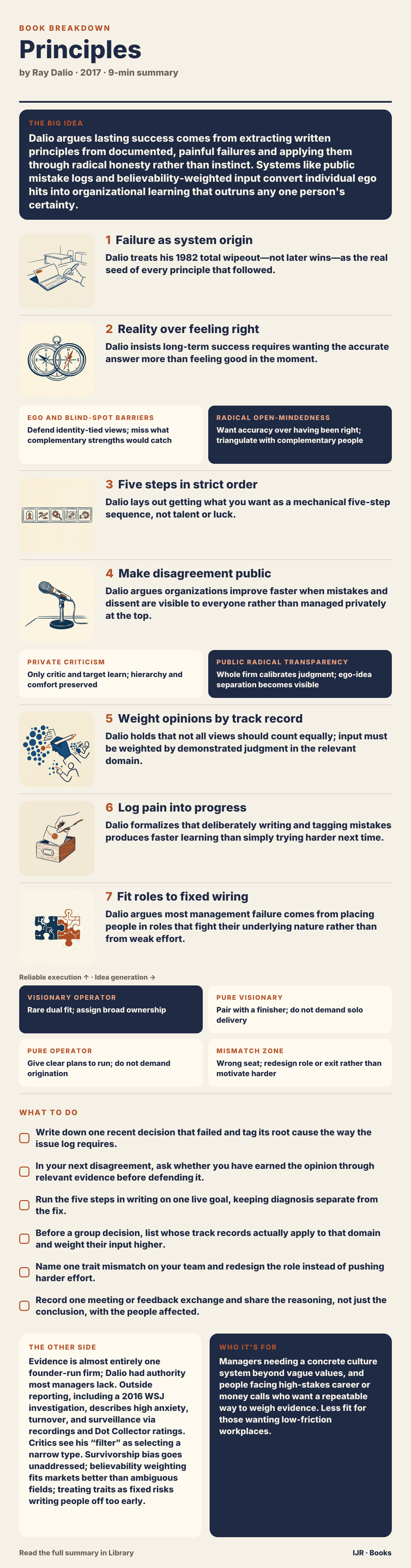
Dalio argues lasting success comes from extracting written principles from documented, painful failures and applying them through radical honesty rather than instinct. Systems like public mistake logs and believability-weighted input convert individual ego hits into organizational learning that outruns any one person's certainty.
The book in brief
The book opens with Dalio's 1982 collapse. He went on television predicting a depression from Latin American defaults and a slowing economy, was publicly wrong as markets rallied for years, lost so much that he laid off every employee, and borrowed $4,000 from his father to cover family bills. He treats that humiliation as the most valuable event of his career because it exposed overconfidence even when individual facts had been right, and it drove him to seek out thoughtful disagreement instead of defending his own certainty.
From that pivot he builds a value system: accurate reality beats feeling right in the moment. Two mental habits block this—the ego barrier that defends identity-tied views, and the blind-spot barrier that comes from each person's particular strengths. He refuses to rely on willpower alone and instead designs external systems that route around both.
He then lays out a mechanical five-step process for any goal: set clear goals, identify problems, diagnose root causes, design a plan, and push through to execute. Steps must stay separate and written; most people jump from symptom to fix and therefore watch the same problem recur. Diagnosis often reveals role mismatch rather than laziness, which links directly to the culture chapters that follow.
Those chapters describe radical truth and radical transparency at Bridgewater—meetings recorded and shared, juniors criticizing Dalio in documented exchanges—so the whole firm calibrates on judgment instead of a few people learning in private. The cost is emotional strain and high new-hire turnover, which he frames as a filter. To keep open disagreement from becoming noise, he adds believability weighting: opinions count according to verifiable track record in the relevant domain, tracked in tools such as the Dot Collector, so a junior specialist can outweigh a senior generalist on a narrow question.
He formalizes the personal habit of logging mistakes into an organizational issue log tagged by root cause, repeating that pain plus reflection equals progress. Knowing and not-knowing mistakes are treated differently from failures to follow known principles. Finally he argues that cognitive traits are relatively fixed, so psychometric shared vocabulary should place people in roles that fit their wiring—separating idea generation from reliable execution—rather than punishing mismatch. The arc ends by tying individual psychology to institutional design so learning outlasts any single employee.
Context
Ray Dalio, founder of Bridgewater Associates, published the book in 2017 to turn hedge-fund risk practices into a general theory of how individuals and organizations should learn, disagree, and improve. It mattered because it gave managers a concrete operating system instead of vague values statements and showed how one of the world's largest hedge funds actually ran itself internally.
The key ideas

1
Failure as system origin
Dalio treats his 1982 total wipeout—not later wins—as the real seed of every principle that followed.
In 1982 he publicly and confidently predicted a depression on television from Latin American debt defaults and a slowing economy. He was wrong; the market rallied for years. Bridgewater lost so much that he laid off every employee and borrowed $4,000 from his father to pay household bills.
He frames the humiliation as the most valuable event of his career. It forced him to see that he had been overconfident even while being right about separate facts. He resolved never again to trust his own certainty without stress-testing it against people smarter than him in specific domains.
Most people, he says, protect ego, avoid the same bet, or blame circumstances. He instead wrote down the failed reasoning so he could locate the flawed decision rule, not just the bad prediction. That habit of logging mistakes and root causes became the seed of the later firm-wide practice.
Principles, in this view, are not abstract ideals. They are conclusions extracted from specific, painful, well-documented failures and retested until they hold across many similar situations. Without the 1982 stakes, the later system has no origin story.
In practice: After the televised miss and total staff layoff, Dalio borrowed $4,000 from his father and began seeking out the most thoughtful people who disagreed with him.

2
Reality over feeling right
Dalio insists long-term success requires wanting the accurate answer more than feeling good in the moment.
Ego and blind-spot barriers
Defend identity-tied views; miss what complementary strengths would catch
Radical open-mindedness
Want accuracy over having been right; triangulate with complementary people
His starting axiom is that an accurate grasp of reality is the foundation of any good outcome. He calls the needed discipline radical open-mindedness: caring more about being right than about having been right.
Two built-in habits fight this. The ego barrier is the instinct to defend an existing view because identity is attached to it. The blind-spot barrier is the fact that each person's way of seeing is shaped by particular strengths, so a big-picture thinker systematically misses what a detail person catches and vice versa.
He does not try to erase the barriers by willpower. He builds external systems that route around them. On his investment team he triangulates a macro thinker with someone skilled at execution so each catches errors the other would miss.
The practical test he offers is simple: in any disagreement, ask whether you have earned the right to your opinion through relevant experience or evidence; if not, actively seek someone who has. Emotional attachment to being right is treated as a design flaw to engineer against.
In practice: A macro-thinker paired with an execution specialist on the investment team catches errors neither would catch alone.

3
Five steps in strict order
Dalio lays out getting what you want as a mechanical five-step sequence, not talent or luck.
The sequence is: set clear goals, identify the problems blocking them, diagnose the root causes of those problems, design a plan to address the roots, and push through to execute. He insists the steps stay roughly in order and be treated as separate mental exercises.
Most people blur them, jumping from noticing a problem straight to a fix without asking why the problem exists. That is why the same problems keep recurring. Diagnosis therefore gets special weight: treat symptoms and the underlying pattern survives.
Weaknesses are not to be white-knuckled forever. If a root cause is a genuine limitation in ability, the answer is redesign of role or task, not simply more effort. The whole process only works when you can see your own roots clearly, which later requires other people's honest input.
He presents the five steps as something to run explicitly and in writing. Writing exposes fuzzy thinking at each stage that casual mental review hides.
In practice: A Bridgewater employee kept missing deadlines; the surface fix was a stricter deadline, but diagnosis showed the person was in a role mismatched to actual capabilities.

4
Make disagreement public
Dalio argues organizations improve faster when mistakes and dissent are visible to everyone rather than managed privately at the top.
Private criticism
Only critic and target learn; hierarchy and comfort preserved
Public radical transparency
Whole firm calibrates judgment; ego-idea separation becomes visible
At Bridgewater, meetings are recorded and often shared company-wide. Employees are expected to state disagreements with superiors openly, and Dalio himself has been publicly criticized by junior staff in documented exchanges.
Most companies suppress that friction to protect comfort and hierarchy. He claims the suppression is exactly what lets bad decisions and hidden incompetence persist. When criticism stays private, only the two people involved learn; when it is public, the whole organization calibrates its view of the person's judgment and of the issue.
He acknowledges the cost: the approach is emotionally brutal, and Bridgewater carries a documented reputation for high turnover and psychological strain among new hires who cannot adjust—a strain outside reporting has also described as surveillance-heavy. He answers that transparency is meant as a filter, sorting people who can separate ego from ideas from those who cannot.
Trust, he claims, paradoxically rises from the exposure: people trust colleagues more once they have watched them give and take direct criticism without retaliation. Without a shared method for weighing the open disagreement, though, the same transparency would produce only chaotic conflict.
In practice: Junior staff have criticized Dalio in documented, shared exchanges; meetings are recorded so the firm, not just the participants, can learn.

5
Weight opinions by track record
Dalio holds that not all views should count equally; input must be weighted by demonstrated judgment in the relevant domain.
Open disagreement risks becoming an unproductive shouting match. His answer is believability weighting: give more weight to people who have repeatedly shown good judgment in a given domain through a verifiable track record, regardless of title or seniority.
Bridgewater built software, including the Dot Collector, so employees rate one another in real time on qualities such as reliability or open-mindedness during meetings. Over time each person accumulates a quantified believability profile across decision types.
Junior voices are not silenced. A talented new analyst's sharp insight on a narrow technical question can outweigh a senior partner on that specific question, while the partner's view may dominate on overall portfolio risk. The system sits between pure hierarchy, which ignores good ideas from below, and pure consensus, which treats uninformed and informed opinions as equal.
It only functions if reasoning and track records stay visible over time—the radical transparency of the prior chapter. Hidden politeness or politics would make believability impossible to assess.
In practice: During meetings the Dot Collector lets staff rate one another in real time, building visible believability scores so a junior specialist can outrank a senior generalist on a narrow technical call.

6
Log pain into progress
Dalio formalizes that deliberately writing and tagging mistakes produces faster learning than simply trying harder next time.
He turns his post-1982 personal habit into firm practice: employees log their own mistakes and others' mistakes, tagged by root cause, searchable across the company. The repeated formula—pain plus reflection equals progress—is meant literally.
Emotional discomfort is not an unfortunate side effect to minimize; it is the fuel that makes people willing to change mental models. Without pain, reflection is skipped. Without structured reflection, pain produces only avoidance or defensiveness.
He separates mistakes from not knowing something, which are forgivable and instructive, from mistakes that come from not following known principles, which signal a discipline failure. The practical tool is the issue log: anyone can flag a problem as it happens, tag its likely root cause, and route it to the people who can fix the underlying pattern rather than just the incident.
Over years the log becomes a searchable record of actual failure patterns—more valuable, he argues, than any static rulebook because it is built from real, dated, specific cases. Individual reflection thereby turns into institutional memory that outlasts any single employee.
In practice: Anyone at Bridgewater can flag a live problem in the issue log, tag its root cause, and route it to the people positioned to fix the pattern, not just the one incident.

7
Fit roles to fixed wiring
Dalio argues most management failure comes from placing people in roles that fight their underlying nature rather than from weak effort.
Reliable execution ↑ · Idea generation →
Visionary operator
Rare dual fit; assign broad ownership
Pure visionary
Pair with a finisher; do not demand solo delivery
Pure operator
Give clear plans to run; do not demand origination
Mismatch zone
Wrong seat; redesign role or exit rather than motivate harder
He holds that people carry relatively fixed psychological and cognitive traits—big-picture versus detail, reliable finisher versus creative starter—and that motivation or training mostly fails to rewrite them. Bridgewater used psychometric tools, including a proprietary assessment alongside frameworks like Myers-Briggs, to build a shared vocabulary so managers could place people where their wiring fit.
He separates the skill of having good ideas from the skill of reliably executing them. A great visionary and a great operator are often different people; hiring for one and expecting the other, or forcing one person to be both, is a common avoidable failure.
Self-knowledge from honest assessment plus the mistake log should directly decide what job you take or assign. The five-step diagnosis applied to a person often shows the root of underperformance is mismatch, not laziness or incompetence.
He is explicit that this can mean telling someone a role—or even the company—is not right for them. He frames that directness as kindness enabled by honesty rather than a management failure, though the broader critique notes the risk of writing people off too early when a skill is merely underdeveloped.
In practice: Bridgewater separates idea generation from reliable execution when assigning work, using shared trait vocabulary so a visionary is not punished for weak follow-through that an operator would handle.
Key terms
- Radical open-mindedness Caring more about being right than about having been right; wanting accurate reality over comfort.
- Ego barrier The instinct to defend an existing view because your identity is attached to it.
- Blind-spot barrier Systematic gaps in seeing that come from your particular strengths missing what complementary strengths catch.
- Five-step process Goals, problems, root-cause diagnosis, design, execute—run in order and in writing.
- Radical transparency Making disagreements and mistakes visible firm-wide (recorded meetings, open subordinate criticism) so everyone calibrates.
- Believability weighting Counting opinions by verifiable track record in the relevant domain rather than by title or equal vote.
- Dot Collector Bridgewater tool where people rate one another in real time during meetings to build believability profiles.
- Pain + reflection = progress The claim that emotional discomfort from a mistake, paired with structured written analysis, is what actually changes mental models.
- Issue log Searchable firm-wide record where anyone flags problems, tags root causes, and routes them to pattern owners.
What to do
- Write down one recent decision that failed and tag its root cause the way the issue log requires.
- In your next disagreement, ask whether you have earned the opinion through relevant evidence before defending it.
- Run the five steps in writing on one live goal, keeping diagnosis separate from the fix.
- Before a group decision, list whose track records actually apply to that domain and weight their input higher.
- Name one trait mismatch on your team and redesign the role instead of pushing harder effort.
- Record one meeting or feedback exchange and share the reasoning, not just the conclusion, with the people affected.
Questions to think with
- Where are you still protecting a view because it is tied to your identity rather than to evidence?
- Which recurring problem have you been fixing at the symptom level instead of diagnosing the root?
- Whose believability in a specific domain should actually outrank title in your next call?
- What pain have you felt recently that you have not yet turned into a written, tagged reflection?
- Which role on your team is asking someone to be both visionary and reliable finisher at once?
The other side
Evidence is almost entirely one founder-run firm; Dalio had authority most managers lack. Outside reporting, including a 2016 WSJ investigation, describes high anxiety, turnover, and surveillance via recordings and Dot Collector ratings. Critics see his “filter” as selecting a narrow type. Survivorship bias goes unaddressed; believability weighting fits markets better than ambiguous fields; treating traits as fixed risks writing people off too early.
Who it's for
Managers needing a concrete culture system beyond vague values, and people facing high-stakes career or money calls who want a repeatable way to weigh evidence. Less fit for those wanting low-friction workplaces.