




Your belief about ability decides who grows after failure
Parents, teachers, managers, and anyone stuck treating a setback as permanent proof get a clear map of why some people keep improving and others shut down.
IJR · Oct 11, 2026 · 13 min read
In 60 seconds
- Dweck argues people run on one of two beliefs: ability is a fixed trait to prove, or a capacity built by effort and strategy.
- That belief, she claims, shapes how people take failure, challenge, and criticism in school, sports, business, and relationships.
- Praising a child as smart, her research found, pushed safer choices and worse bounce-back; praising effort pushed harder work and recovery.
- Fixed-mindset talent cultures hide mistakes; growth-mindset leadership treats bad news as input, she argues across sports and firms.
- Mindset can shift through workshops and everyday language, but later large trials found modest, uneven effects.
- The narrow practical lever: treat setbacks as data on strategy, not verdicts on worth.
The big idea
Dweck argues that a single implicit belief—whether ability is fixed or developable—governs how people answer failure, challenge, and criticism across every domain she studies. That belief, more than raw talent, she claims, predicts who keeps improving after a setback and who collapses, deflects, or quits.
The book in brief
Dweck starts from a split she first saw watching children face hard puzzles: some treated difficulty as an insult to escape, others as an invitation. She traces the split to an underlying belief about ability itself—fixed and revealed by performance, or a starting point grown by practice, instruction, and persistence. The same bad grade can feel permanent in one frame and merely informational in the other.
She then shows why effort becomes threatening under a fixed view. Hard try plus failure seems to expose what you are, so people protect self-image instead of learning—comparing downward, quitting solvable problems, avoiding the very work that would help.
A concrete praise study anchors the mechanism: one sentence labeling a child smart versus hardworking changed which puzzle they chose next, how they felt after real struggle, whether they inflated scores, and whether they improved or sank on a return to easy work.
From there the book walks the same switch through sports champions, corporate cultures that worship innate brilliance versus ones that invest in learning, and romantic partners who read friction as proof of a wrong match versus ordinary work still in progress.
It closes on transmission and change. Children absorb mindset less from lectures on intelligence than from how adults react in the moment of failure; small language moves like “not yet” reframe a closed grade as a point on a path. Short workshops can shift beliefs and grades for some students, yet Dweck frames change as ongoing practice, and later large studies found the lever real but modest and uneven rather than a universal fix.
Context
Carol S. Dweck’s research on this split reaches back to graduate work in the 1970s watching children on hard puzzles. The 2006 book gathered that line of work into a single teachable distinction aimed at educators, managers, and parents who needed an explanation for why some people improve after setbacks and others do not.
The key ideas
1
Two beliefs about ability
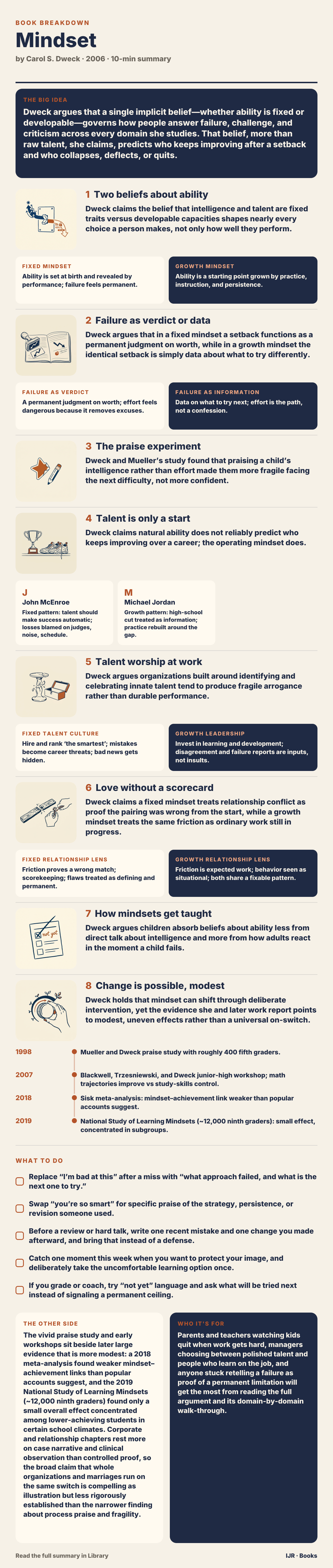
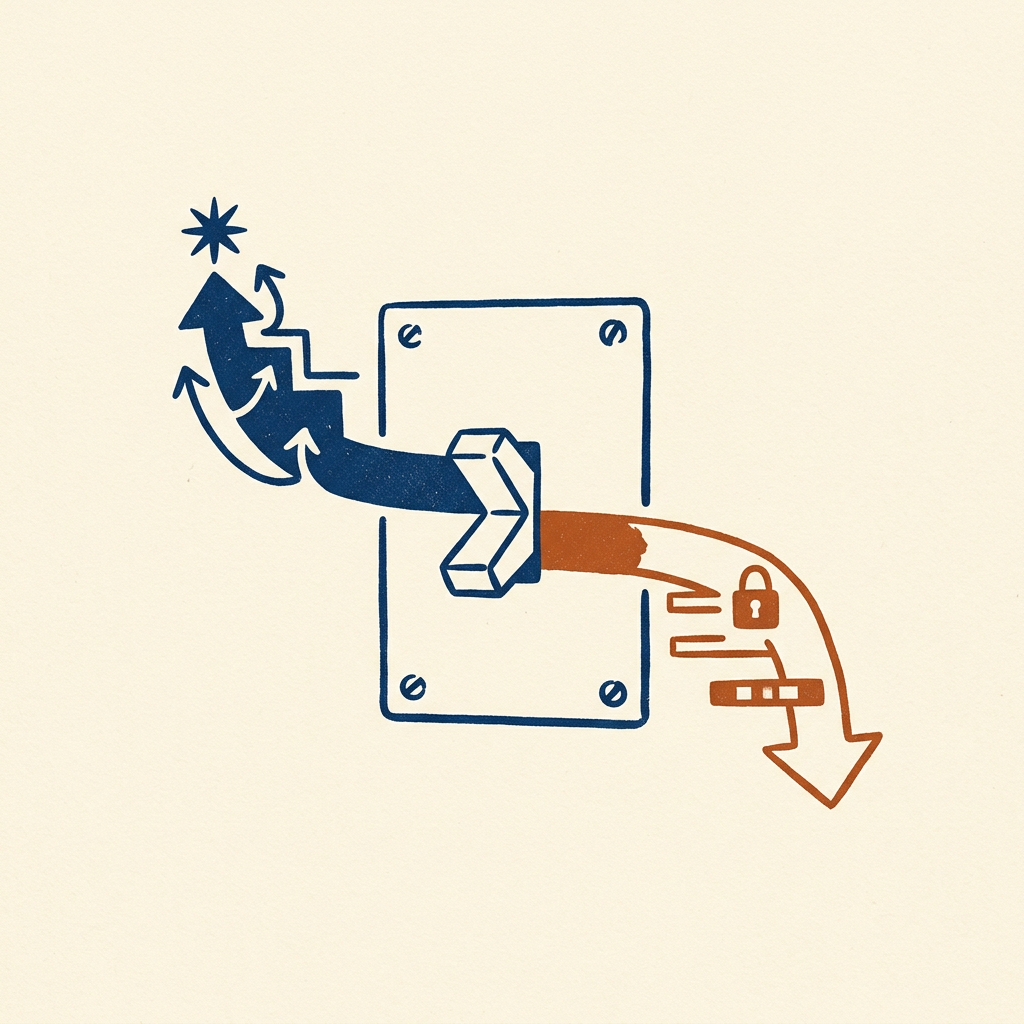
Dweck claims the belief that intelligence and talent are fixed traits versus developable capacities shapes nearly every choice a person makes, not only how well they perform.
Fixed mindset
Ability is set at birth and revealed by performance; failure feels permanent.
Growth mindset
Ability is a starting point grown by practice, instruction, and persistence.
Her early puzzle work sorted kids into two camps regardless of measured ability. Some treated a hard problem as an insult to escape or explain away. Others lit up and treated the same problem as an invitation.
She names the underlying belief a mindset. The fixed version holds that intelligence, talent, and personality are basically set and revealed by performance. The growth version holds they are starting points grown through practice, instruction, and persistence.
The split is not optimism versus pessimism. Two children can fail the same test and feel equally bad. What differs is meaning: a permanent verdict on a fixed quantity called ability, or information about where more work is needed that says nothing final about capacity.
Dweck insists this is not a personality trait like extroversion. It is a belief about the nature of ability, and beliefs can be identified, questioned, and sometimes changed. The rest of the book applies that one distinction to tennis, leadership, marriage, and classrooms.
In practice: Kids facing the same hard puzzle either fled the insult or leaned in as if invited, sorted by belief rather than by measured ability.

2
Failure as verdict or data
Dweck argues that in a fixed mindset a setback functions as a permanent judgment on worth, while in a growth mindset the identical setback is simply data about what to try differently.
Failure as verdict
A permanent judgment on worth; effort feels dangerous because it removes excuses.
Failure as information
Data on what to try next; effort is the path, not a confession.
Because each test becomes a referendum on inherent ability, effort itself turns threatening. Try hard and still fail, and you can no longer blame lack of effort—the failure seems to expose what you are.
Fixed-mindset students given a hard test after an easy success often chose to compare scores against people who did worse. The aim was feeling less exposed, not learning. Growth-mindset students more often asked to see the work of people who outperformed them, hunting what they were missing.
That produces an asymmetry: the people most likely to need extra effort after a setback are often least likely to make it, because extra effort seems to confirm failure rather than fix it. Fixed-mindset individuals also gave up sooner on solvable problems when persistence itself felt like an admission.
A classroom or workforce protecting self-image from evidence will, she argues, systematically underperform one that treats even bad evidence as useful. This reframing—verdict versus feedback—organizes every domain that follows.
In practice: After a hard test, fixed-mindset students sought worse scores to feel safer; growth-mindset students sought better work to see what they lacked.

3
The praise experiment
Dweck and Mueller’s study found that praising a child’s intelligence rather than effort made them more fragile facing the next difficulty, not more confident.
Roughly 400 fifth graders in New York schools solved easy puzzles, then heard one brief comment: “you must be smart at this” or “you must have worked hard.”
Offered a harder puzzle framed as a chance to learn or an easier one that guaranteed looking competent, intelligence-praised children overwhelmingly picked the safe option; effort-praised children mostly picked the harder one.
Everyone then hit a genuinely difficult puzzle and struggled. Intelligence-praised children later said they enjoyed puzzles less and were more likely to exaggerate scores to peers. Back on easy puzzles like the first round, effort-praised children improved; intelligence-praised children performed worse than at the start, though nothing about their skill had changed.
One sentence of praise, delivered once, altered risk-taking and how a ten-year-old read later failure. Dweck treats this as core evidence that process praise builds resilience while ability praise builds fragility.
In practice: After one “you must be smart” line, kids chose safer puzzles, enjoyed them less after struggle, inflated scores, and did worse when easy work returned.

4
Talent is only a start
Dweck claims natural ability does not reliably predict who keeps improving over a career; the operating mindset does.
- JJohn McEnroeFixed pattern: talent should make success automatic; losses blamed on judges, noise, schedule.
- MMichael JordanGrowth pattern: high-school cut treated as information; practice rebuilt around the gap.
She contrasts two athletes to make the point concrete. John McEnroe, by his account and her reading, treated considerable natural talent as something that should have made success automatic. Losses often drew blame toward line judges, crowd noise, or scheduling rather than adjustments to his game—fixed-mindset logic in a champion: talent should carry you, so failure needs an external cause.
Michael Jordan, cut from his high school varsity team as a sophomore, did not conclude he lacked basketball ability. He treated the cut as information about where he stood and restructured practice around it—growth mindset in action, on her account.
Talent still matters as a starting point. The mindset brought to that starting point, she argues, decides whether the gap between current skill and possible skill ever closes.
Coaches who build rosters only around “naturals” can end up with players who resist coaching, because coaching implies imperfection. The more durable edge is treating every loss as usable information rather than a threat to deflect.
In practice: McEnroe externalized losses to protect the talent story; Jordan used a varsity cut to redesign practice instead of concluding he lacked ability.

5
Talent worship at work
Dweck argues organizations built around identifying and celebrating innate talent tend to produce fragile arrogance rather than durable performance.
Fixed talent culture
Hire and rank ‘the smartest’; mistakes become career threats; bad news gets hidden.
Growth leadership
Invest in learning and development; disagreement and failure reports are inputs, not insults.
She points to Enron’s 1990s culture—hiring the smartest people and ranking them aggressively—as an organization-wide fixed mindset. When the system certifies who is brilliant, admitting a mistake becomes career-threatening, a dynamic she links to the concealment and overreach behind the 2001 collapse.
Lou Gerstner’s IBM turnaround in the 1990s is her contrast: less protecting a legacy self-image as technology pioneer, more organizational learning, strategy change, and open acknowledgment of what was not working.
Jack Welch at GE is a mixed case—demanding, sometimes brutal style, yet heavy investment in developing managers through Crotonville, treating leadership as buildable rather than merely sorted.
Fixed-mindset executives, she argues, surround themselves with people who will not challenge them, because challenge threatens the smartest-in-the-room image; that insulation often precedes decline. Growth-mindset leadership treats disagreement and failure reports as necessary inputs. This chapter rests on case narrative more than controlled study.
In practice: Enron’s brilliance ranking made mistakes dangerous to admit; Gerstner’s IBM push treated what was not working as something to say out loud and fix.
6
Love without a scorecard
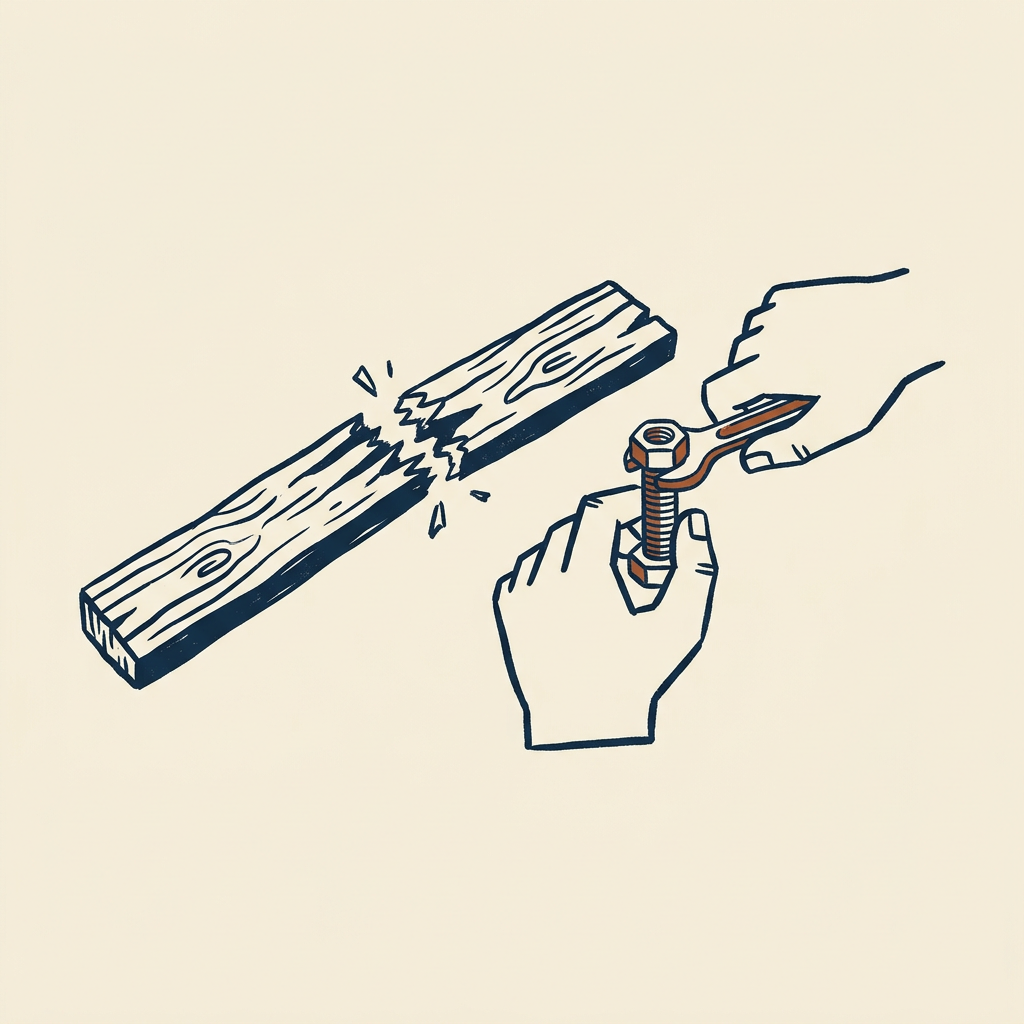
Dweck claims a fixed mindset treats relationship conflict as proof the pairing was wrong from the start, while a growth mindset treats the same friction as ordinary work still in progress.
Fixed relationship lens
Friction proves a wrong match; scorekeeping; flaws treated as defining and permanent.
Growth relationship lens
Friction is expected work; behavior seen as situational; both share a fixable pattern.
Under a fixed view, a good relationship should feel effortless if the match is right. Recurring arguments or incompatibilities read as fundamental mismatch, often prompting withdrawal or a search for a different partner instead of repair.
Under a growth view, disagreement is expected. The question shifts from “is this the wrong person” to “what do we need to work out.”
Fixed-mindset partners, she reports, more often keep score of grievances and treat a partner’s flaw as a fixed defining trait—“he always,” “she never”—language that closes off change. Growth-mindset partners more often describe behavior as situational and changeable, which keeps direct address possible.
Blame follows the same split: fixed thinking needs one flawed character to explain the problem; growth thinking lets both hold responsibility for a fixable pattern without condemning either as broken. This section draws more on cases and clinical observation than hard trials, but the claim matches the book’s core switch.
In practice: Fixed partners tally “always/never” flaws and shop for a better match; growth partners treat the same fight as a pattern both can still change.

7
How mindsets get taught
Dweck argues children absorb beliefs about ability less from direct talk about intelligence and more from how adults react in the moment a child fails.
Labeling children gifted, even kindly, can teach a fixed mindset by implying the important thing is a quality they possess rather than a process they engage. A child told she is smart organizes identity around protecting the label; struggle threatens the label itself.
Some Chicago-area high schools gave failing students “not yet” instead of an F—language that frames the outcome as a point on a trajectory rather than a closed verdict, and that she argues changes how students plan the next attempt.
Parental reaction to failure matters more than praise of success. Alarm about what a poor grade means for the child’s future signals fixed thinking; asking what was learned and what to try next signals growth. Children pick this up over repeated instances even when intelligence is never named.
Coaches show the pattern too: process and daily practice habits over talk of natural gifts, she says, help teams recover from losses faster than talk of who has “it.” Mindset transmits through modeled response to difficulty—harder to fake, harder to fix with one speech.
In practice: A “not yet” grade instead of an F reframes failure as unfinished trajectory; parents who ask “what will you try next” teach growth without lecturing about brains.

8
Change is possible, modest
Dweck holds that mindset can shift through deliberate intervention, yet the evidence she and later work report points to modest, uneven effects rather than a universal on-switch.
- 1998Mueller and Dweck praise study with roughly 400 fifth graders.
- 2007Blackwell, Trzesniewski, and Dweck junior-high workshop; math trajectories improve vs study-skills control.
- 2018Sisk meta-analysis: mindset–achievement link weaker than popular accounts suggest.
- 2019National Study of Learning Mindsets (~12,000 ninth graders): small effect, concentrated in subgroups.
With Lisa Blackwell and Kali Trzesniewski (2007), New York City junior high students attended a short workshop teaching that the brain forms new connections through effortful practice—a neuroplasticity lesson aimed at implicit beliefs. Those students showed improved math-grade trajectories over following months versus a control group given study-skills content without mindset material. Related classroom material later packaged as Brainology spread widely.
Dweck is careful: change is not a one-time realization. It is ongoing practice of noticing the defensive inner voice after criticism and answering with “what can I learn here” instead of “what does this say about me.”
Later large-scale work complicated the story. The National Study of Learning Mindsets (2019), a randomized trial of roughly 12,000 American ninth graders, found a small overall effect concentrated mainly among lower-achieving students and in schools with a particular peer climate. A 2018 meta-analysis by Sisk and colleagues found the correlation between mindset and academic achievement weaker than popular accounts often suggest.
The psychological mechanism she describes appears real; its size and reliability as a lever for large institutional change remains contested.
In practice: A brief brain-plasticity workshop lifted some junior-high math trajectories; a later trial of roughly 12,000 ninth graders found only a small effect, strongest for lower achievers in certain school climates.
Key terms
- fixed mindset Belief that intelligence, talent, and personality are basically set and revealed by performance.
- growth mindset Belief that those same qualities are starting points developed through practice, instruction, and persistence.
- mindset The underlying belief about the nature of ability itself, not a mood or a personality type.
- failure as verdict Reading a setback as permanent proof of what you are worth or capable of.
- failure as information Reading the same setback as data about strategy and where more work is needed.
- process praise Specific credit for effort, strategy, persistence, or revision rather than for being smart.
- not yet Grading language that frames a fail as unfinished progress instead of a closed F.
- Brainology Classroom material from the workshop approach that teaches the brain grows connections through effortful practice.
What to do
- Replace “I’m bad at this” after a miss with “what approach failed, and what is the next one to try.”
- Swap “you’re so smart” for specific praise of the strategy, persistence, or revision someone used.
- Before a review or hard talk, write one recent mistake and one change you made afterward, and bring that instead of a defense.
- Catch one moment this week when you want to protect your image, and deliberately take the uncomfortable learning option once.
- If you grade or coach, try “not yet” language and ask what will be tried next instead of signaling a permanent ceiling.
Questions to think with
- When did you last treat a setback as proof of a permanent limit rather than as data on strategy?
- Do you praise children or colleagues for being smart, or for the process they used when work got hard?
- In your team or family, is admitting a mistake career- or status-threatening, or routine input?
- After conflict with a partner, do you hear “always/never” scorekeeping or a fixable pattern you both own?
- Where this week will you notice the defensive inner voice and answer it with “what can I learn here?”
The other side
The vivid praise study and early workshops sit beside later large evidence that is more modest: a 2018 meta-analysis found weaker mindset–achievement links than popular accounts suggest, and the 2019 National Study of Learning Mindsets (~12,000 ninth graders) found only a small overall effect concentrated among lower-achieving students in certain school climates. Corporate and relationship chapters rest more on case narrative and clinical observation than controlled proof, so the broad claim that whole organizations and marriages run on the same switch is compelling as illustration but less rigorously established than the narrower finding about process praise and fragility.
Who it's for
Parents and teachers watching kids quit when work gets hard, managers choosing between polished talent and people who learn on the job, and anyone stuck retelling a failure as proof of a permanent limitation will get the most from reading the full argument and its domain-by-domain walk-through.