




Consistent automatic investing beats frugality and market timing
Savers who freeze at every dip learn why Maggiulli says a skill-driven raise crushes decades of skipped coffees.
IJR · Oct 19, 2026 · 13 min read
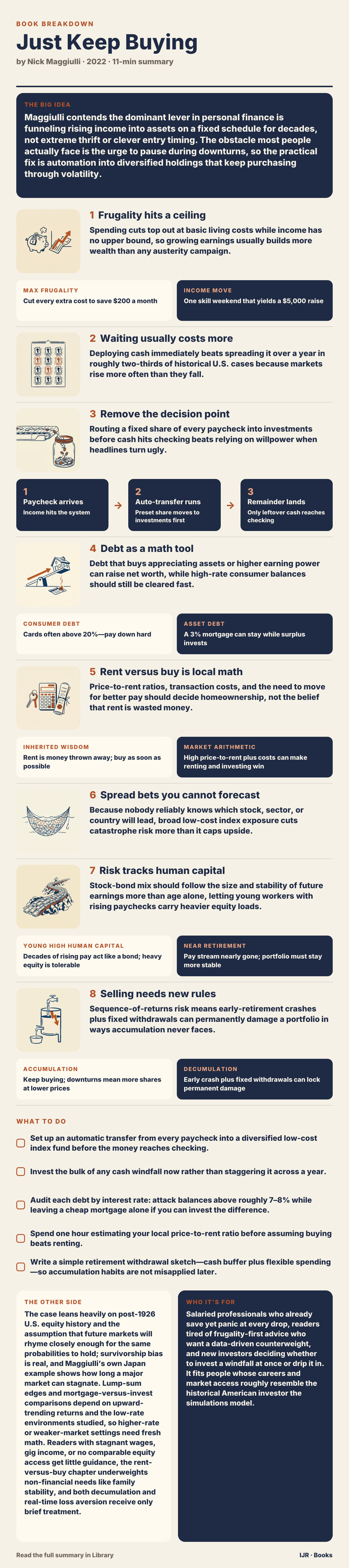
In 60 seconds
- Expense cuts hit a hard floor while income has no ceiling, so an $80,000 earner saving a smaller share usually ends richer than a hyper-frugal $40,000 earner.
- Historical U.S. simulations show investing a lump sum right away beats spreading it over twelve months roughly two-thirds of the time because markets rise more years than they fall.
- Automating a fixed transfer from every paycheck into investments removes the willpower failure that stops people from buying during crashes.
- Low-rate debt that funds a home or higher earnings can be kept on purpose; high-rate consumer debt above roughly 20% should be killed fast.
- Rent versus buy is local price-to-rent math plus mobility needs, not a morality test, and broad index funds plus human-capital-aware risk beat stock-picking and age-only bond rules.
- Retirement flips the script: sequence-of-returns risk means withdrawal rules must differ from the accumulation habit of just keeping purchases going.
The big idea
Maggiulli contends the dominant lever in personal finance is funneling rising income into assets on a fixed schedule for decades, not extreme thrift or clever entry timing. The obstacle most people actually face is the urge to pause during downturns, so the practical fix is automation into diversified holdings that keep purchasing through volatility.
The book in brief
Maggiulli starts by attacking the popular fixation on tiny daily cuts. He shows spending has a floor—shelter, food, baseline costs—so savings from frugality top out, while income has no ceiling. A higher earner who saves a modest percentage typically accumulates more than a low earner who pinches every discretionary dollar; energy therefore belongs first on skills, negotiation, and career moves, with expense cuts as a secondary lever.
Once money is available, the next trap is waiting for a perfect dip. Using decades of U.S. stock data, he compares deploying a lump sum immediately against spreading it across a year and finds the immediate path wins most of the time because markets trend up far more often than they fall. Sitting in cash through periods like 2009 meant missing the long recovery that followed. The expected cost of delay exceeds the expected benefit of a better entry.
Theory fails without a behavior fix, so he turns to automation: route a fixed share of every paycheck straight into a brokerage or retirement account before the cash can be second-guessed. Employer auto-enrollment precedents show defaults raise participation because inertia favors whatever is pre-set. Consistency during downturns—buying more shares when prices are low—outweighs the loss of manual control.
He widens the frame to the whole balance sheet. Debt funding consumption differs from debt funding appreciating assets or earning power; a manageable mortgage or low-rate student loan can raise lifetime wealth, while credit-card rates demand aggressive payoff. Homeownership is treated the same way: price-to-rent ratios, transaction costs, taxes, maintenance, and the chance to move for higher pay decide rent versus buy, not folk wisdom that rent is “thrown away.”
Holdings should be broad low-cost index funds across domestic and international equities, and sometimes real assets, because a few winners drive most market returns and single-country stories (Japan after 1989) can stall for decades. Stock-bond mix should track human capital—the bond-like stream of future paychecks—more than age alone, so a young worker with rising earnings can carry heavier equity risk than a near-retiree. An unlucky buyer right before 2008 still came out ahead by continuing scheduled purchases into the recovery.
The final turn is decumulation. Sequence-of-returns risk means an early retirement crash plus fixed withdrawals can lock in permanent damage that a still-working contributor would outlast. Retirees need separate tools—flexible spending, cash buffers, different instincts—because the accumulation mandate does not reverse cleanly. The working-life answer remains narrow and mechanical: earn more, automate diversified buys, and keep purchasing through fear.
Context
Nick Maggiulli published the book in 2022 as a data-heavy counterpoint to frugality-first personal finance. It mattered because it reordered everyday advice around income growth and automatic, unglamorous consistency instead of clever timing or ever-tighter spending.
The key ideas

1
Frugality hits a ceiling
Spending cuts top out at basic living costs while income has no upper bound, so growing earnings usually builds more wealth than any austerity campaign.
Max frugality
Cut every extra cost to save $200 a month
Income move
One skill weekend that yields a $5,000 raise
Maggiulli opens by dismantling the cult of small daily sacrifices. Eliminating a five-dollar coffee every day for decades still produces only a modest pile next to what a raise or side income can add. Everyone still needs shelter, food, and a baseline of costs, so the savings available from cutting eventually flatline.
Income works the opposite way. He compares a $40,000 earner who saves aggressively with an $80,000 earner who saves a smaller percentage; the higher earner almost always finishes richer because absolute dollars invested matter more than the savings rate. The point is not to ignore spending but to reorder effort: skills, negotiation, and career moves first, expense trimming second.
That reordering becomes the lens for everything that follows. Once the priority is accumulation rather than restriction, the size of what you put to work—not the cleverness of any single purchase—dominates long-term outcomes. Later chapters on timing, automation, and debt all rest on this shift from pinching to earning.
In practice: A barista who strips every discretionary cost to save $200 a month still loses the math contest to someone who spends one weekend learning a skill that produces a $5,000 raise.

2
Waiting usually costs more
Deploying cash immediately beats spreading it over a year in roughly two-thirds of historical U.S. cases because markets rise more often than they fall.
After establishing that earnings should flow into assets, Maggiulli attacks the instinct to hold out for a dip. He runs long-range simulations of lump-sum investment versus twelve-month averaging on U.S. equity data and finds the immediate path wins about two-thirds of the time. Markets simply spend more calendar years rising than falling.
The comfort of averaging is real, yet it carries a statistical price. Since 1926 the S&P 500 has posted positive returns in the majority of years, so any given day is more likely to be followed by gains than losses. People who try to pick the bottom often sit in cash for long stretches and miss compounding entirely.
The chapter’s blunt lesson supplies the book’s title impulse: once money is ready, the better default is to purchase on a schedule and treat short-term volatility as the fee for long-term participation. Hesitation after you have already maximized earnings becomes the next large, avoidable error.
In practice: Investors who held cash through 2009 waiting for a clearer bottom missed the decade-long bull run that followed.

3
Remove the decision point
Routing a fixed share of every paycheck into investments before cash hits checking beats relying on willpower when headlines turn ugly.
- 1Paycheck arrivesIncome hits the system
- 2Auto-transfer runsPreset share moves to investments first
- 3Remainder landsOnly leftover cash reaches checking
Knowing that prompt investing wins still fails when fear appears. Maggiulli treats behavioral collapse, not ignorance, as the main reason people underinvest. Even convinced readers freeze when a crash leads the news.
His fix is mechanical. Set automatic transfers on payday so money moves into a brokerage or retirement account before it ever reaches spending range. He leans on the pattern of employer 401(k) auto-enrollment: default options sharply raise participation and contribution rates because inertia now works for the investor instead of against them.
Objections about lost flexibility get a direct reply. The value of continuing purchases at lower prices during downturns outweighs manual control. Automation turns the earlier timing argument into a system that does not depend on mood, encoding “keep purchasing” as plumbing rather than pep talk.
In practice: A fixed percentage leaves each paycheck and lands in a diversified account before the earner can second-guess the week’s market story.

4
Debt as a math tool
Debt that buys appreciating assets or higher earning power can raise net worth, while high-rate consumer balances should still be cleared fast.
Consumer debt
Cards often above 20%—pay down hard
Asset debt
A 3% mortgage can stay while surplus invests
Many money books treat every liability as a moral stain. Maggiulli separates consumption debt from debt that funds assets or income growth. A mortgage at a manageable rate, when the property has reasonable appreciation odds, has historically lifted net worth more than waiting to buy only when debt-free.
The same arithmetic applies to low-interest student loans that unlock higher-earning careers, looping back to the income-first priority. He compares a person who aggressively prepays a 3% mortgage with one who invests the difference instead; across most multi-decade stretches average market returns beat that low mortgage rate, so the investor finishes ahead.
None of this is blanket permission. Credit-card debt often above 20% has no reliable investment that outruns it, so those balances demand aggressive payoff. The chapter reframes the whole balance sheet as numbers—what to keep, what to retire, what to leverage—rather than character tests.
In practice: Historically, keeping a 3% mortgage on schedule and investing the surplus beat the person who threw extra cash at principal instead of the market.

5
Rent versus buy is local math
Price-to-rent ratios, transaction costs, and the need to move for better pay should decide homeownership, not the belief that rent is wasted money.
Inherited wisdom
Rent is money thrown away; buy as soon as possible
Market arithmetic
High price-to-rent plus costs can make renting and investing win
Maggiulli rejects the slogan that renting always throws money away. He centers the price-to-rent ratio—home price compared with annual rent in that market—and shows that in high-ratio coastal cities buying can cost more overall once taxes, maintenance, closing costs, and the opportunity cost of a down payment are counted.
A side-by-side of two people in an expensive market, one leveraged into a house and one renting a similar place while investing the monthly difference, sometimes leaves the renter-investor ahead after a decade. Ownership is simply a leveraged bet on local real estate that pays only under specific price and rate conditions.
Mobility receives equal weight. Renting keeps the option to relocate for higher pay, which again serves the income-growth priority. The chapter refuses a universal winner; it insists the choice is market- and stage-specific arithmetic, not a referendum on adult responsibility.
In practice: In a pricey coastal market the renter who invests the monthly savings can finish a decade ahead of the buyer after taxes, upkeep, and down-payment opportunity cost.

6
Spread bets you cannot forecast
Because nobody reliably knows which stock, sector, or country will lead, broad low-cost index exposure cuts catastrophe risk more than it caps upside.
After fixing how money enters the market, Maggiulli turns to what it holds. Historical records show a large share of individual stocks lag diversified index funds over long spans; a handful of extreme winners drive most of the market’s total return. Stock-picking therefore carries a high chance of missing the few names that matter.
His default is automatic contributions into broad, low-cost index funds. That single pipe removes both the timing problem and the selection problem. He extends the same logic across borders and, for some investors, into real assets, because no one can know which region or asset class will dominate the next decade.
Diversification here is survival gear, not a return-maximizing trick. It keeps ordinary human blindness about the future from wrecking a plan that otherwise keeps purchasing on schedule.
In practice: Japan’s market after 1989 endured a multi-decade slump despite earlier dominance, a warning against treating any single country’s past strength as a guarantee.

7
Risk tracks human capital
Stock-bond mix should follow the size and stability of future earnings more than age alone, letting young workers with rising paychecks carry heavier equity loads.
Young high human capital
Decades of rising pay act like a bond; heavy equity is tolerable
Near retirement
Pay stream nearly gone; portfolio must stay more stable
The rule that bond percentage should equal age ignores an investor’s human capital—the bond-like stream of expected future pay. A 25-year-old with decades of rising earnings can absorb portfolio swings because the paycheck itself cushions against forced sales in a crash.
Someone near retirement has nearly exhausted that stream and must live off the portfolio, so stability and bonds matter more. Maggiulli therefore treats allocation as a personal labor-market fact, not a birthday formula, layering this lens on top of broad asset diversification.
Fear of buying right before a collapse gets the same treatment. Even an investor who lump-summed immediately before the 2008 crisis finished ahead within several years by continuing scheduled contributions that bought shares at depressed prices. Ongoing human capital plus ongoing purchases repaired the timing bruise.
In practice: The unlucky buyer who entered just before 2008 still came out ahead after a few years by keeping contributions going through the recovery.

8
Selling needs new rules
Sequence-of-returns risk means early-retirement crashes plus fixed withdrawals can permanently damage a portfolio in ways accumulation never faces.
Accumulation
Keep buying; downturns mean more shares at lower prices
Decumulation
Early crash plus fixed withdrawals can lock permanent damage
After chapters built for earning years, Maggiulli faces the quieter problem of spending a portfolio down. The buying discipline that worked for decades does not simply reverse. A downturn early in retirement, paired with steady withdrawals, locks in losses that a still-working contributor would eventually outgrow.
He surveys practical responses: fixed-percentage rules, spending that flexes with portfolio value, and cash buffers that avoid selling beaten-down assets. Once human capital is gone, the portfolio must carry the entire load, so both its mix and the withdrawal method matter far more than they did during accumulation.
Emotion shifts too. The accumulation instinct—purchase regardless of price—clashes with the preservation instinct retirement demands. The chapter exists to stop readers from misapplying the book’s central mandate to every life stage; keep buying governs the long earning climb, then a second, harder playbook begins.
In practice: A retiree withdrawing a fixed percentage through a crash crystallizes losses that a worker still adding fresh money would later recover.
Key terms
- Savings ceiling The hard limit on how much wealth you can create by cutting spending once basic living costs remain
- Lump-sum investing Putting available cash into the market immediately instead of dripping it in over months
- Dollar-cost averaging Spreading a large cash pile into purchases over time, often for psychological comfort
- Human capital The bond-like value of your expected future paychecks and career trajectory
- Price-to-rent ratio Local home prices divided by annual rent; a high number can make buying costlier than renting and investing the gap
- Sequence-of-returns risk The danger that a market drop early in retirement, combined with withdrawals, permanently shrinks what a portfolio can safely provide
- Auto-enrollment default A preset that moves money into investments unless you opt out, using inertia to raise contribution rates
- Broad index funds Low-cost vehicles holding wide slices of the market so missing a few big winners does not wreck results
What to do
- Set up an automatic transfer from every paycheck into a diversified low-cost index fund before the money reaches checking.
- Invest the bulk of any cash windfall now rather than staggering it across a year.
- Audit each debt by interest rate: attack balances above roughly 7–8% while leaving a cheap mortgage alone if you can invest the difference.
- Spend one hour estimating your local price-to-rent ratio before assuming buying beats renting.
- Write a simple retirement withdrawal sketch—cash buffer plus flexible spending—so accumulation habits are not misapplied later.
Questions to think with
- Where is your next realistic income jump, and what single skill or negotiation would unlock it faster than another round of expense cuts?
- If your paycheck already auto-invested, would last month’s market headlines have changed anything you did?
- Which of your debts are high-rate consumption balances versus low-rate bets on assets or earning power?
- Does your city’s price-to-rent math, plus your need to move for work, actually favor owning right now?
- When human capital eventually runs out, which withdrawal rule would keep you from selling at the worst moment?
The other side
The case leans heavily on post-1926 U.S. equity history and the assumption that future markets will rhyme closely enough for the same probabilities to hold; survivorship bias is real, and Maggiulli’s own Japan example shows how long a major market can stagnate. Lump-sum edges and mortgage-versus-invest comparisons depend on upward-trending returns and the low-rate environments studied, so higher-rate or weaker-market settings need fresh math. Readers with stagnant wages, gig income, or no comparable equity access get little guidance, the rent-versus-buy chapter underweights non-financial needs like family stability, and both decumulation and real-time loss aversion receive only brief treatment.
Who it's for
Salaried professionals who already save yet panic at every drop, readers tired of frugality-first advice who want a data-driven counterweight, and new investors deciding whether to invest a windfall at once or drip it in. It fits people whose careers and market access roughly resemble the historical American investor the simulations model.