




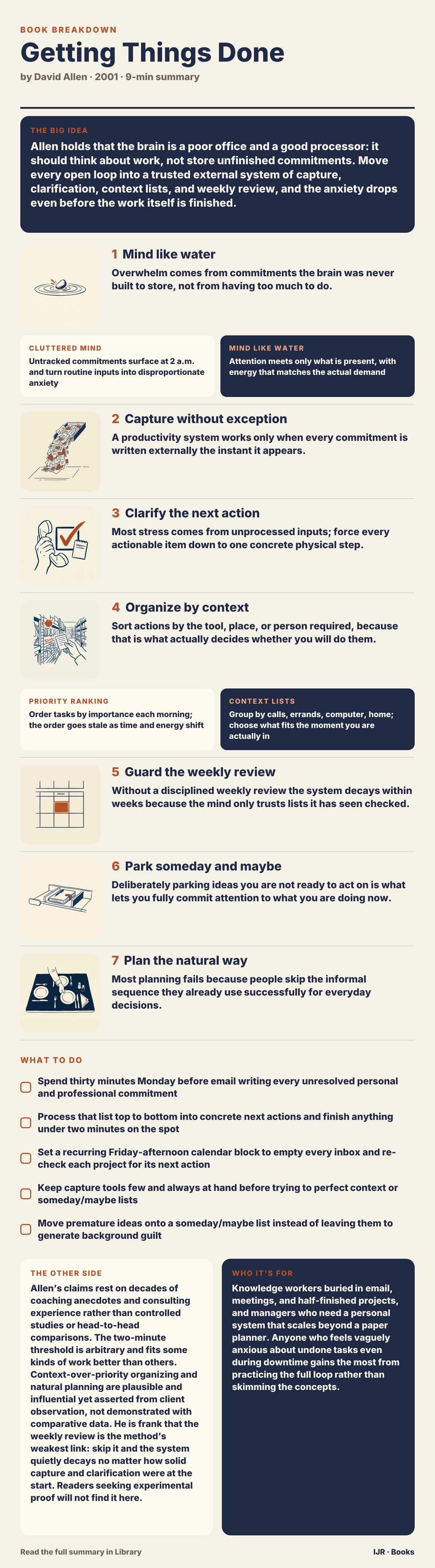
Stress comes from untracked commitments, not too much work
A first mind sweep often surfaces over a hundred neglected commitments, and Allen’s closed loop exists to pull every one out of your head so attention can stay on the work in front of you.
IJR · Oct 9, 2026 · 11 min read
In 60 seconds
- Work anxiety comes from commitments left unresolved in the mind, not from the sheer volume of tasks.
- Every commitment must be captured externally at once; partial capture fails because the mind still monitors what you skipped.
- Each item gets clarified into trash, reference, someday/maybe, or one concrete next physical action.
- Do anything under two minutes immediately; park the rest on lists sorted by context such as calls or errands, not fixed priority.
- A weekly review keeps the external system trustworthy; skip it and the lists go stale and mental nagging returns.
- Ideas you are not ready to start go on a someday/maybe list so they stay real without generating guilt.
The big idea
Allen holds that the brain is a poor office and a good processor: it should think about work, not store unfinished commitments. Move every open loop into a trusted external system of capture, clarification, context lists, and weekly review, and the anxiety drops even before the work itself is finished.
The book in brief
An executive cannot enjoy a Saturday hike because a hiring decision keeps looping with no home outside his head. Allen starts from scenes like that: people feel overwhelmed less by workload size than by every unresolved commitment still living only in memory—gifts to buy, vendors to chase, faucets to fix, boards to prep—each flashing up at 2 a.m. instead of when action is possible. He names the target state mind like water: attention that meets only what is present because nothing else is competing behind the scenes.
The method opens with total capture. The moment a commitment appears, it goes into a few always-ready external tools—notebook, phone, tray—never memory. Capture is not organizing; the inbox is only a temporary holding pen that must be emptied. Without ruthless completeness, later stages have nothing reliable to work with.
Clarification then runs each item through a strict decision. Is it actionable? If not, trash it, file it, or park it as someday/maybe. If yes, name the very next physical step—call Maria about the venue, not “plan the retreat.” Anything under two minutes gets done on the spot because tracking costs more than finishing.
Organization sorts those next actions by context: calls, computer, errands, home, agenda for a boss. Priority shifts with time, energy, and place, so a rigid morning ranking goes stale by midmorning. A separate projects list holds every outcome needing more than one step; context lists answer what can be done right now.
The weekly review is the habit that keeps the loop credible. Empty every inbox, confirm a current next action on every project, revisit someday/maybe, and scan the coming calendar. Premature ideas stay on someday/maybe so they remain real without nagging. Planning itself follows a natural sequence—purpose, envisioned outcome, brainstorm, organize, next actions—that people already trust for a dinner party but often skip at work. The promised payoff is attention free for whatever is in front of you because the rest already has an external home.
Context
Allen offered knowledge workers a concrete, portable methodology at the moment email and open-ended jobs had outpaced older to-do-list habits. The book mattered because it replaced vague priority advice with a full closed-loop system people could carry across paper and digital tools.
The key ideas

1
Mind like water
Overwhelm comes from commitments the brain was never built to store, not from having too much to do.
Cluttered mind
Untracked commitments surface at 2 a.m. and turn routine inputs into disproportionate anxiety
Mind like water
Attention meets only what is present, with energy that matches the actual demand
Allen opens with a blunt observation: people do not feel crushed because the workload is large; they feel crushed because the mind is trying to hold open loops it cannot reliably track. Birthday gifts, vendor follow-ups, leaking faucets, board prep—each occupies a sliver of attention and tends to surface at the worst moment.
Mind like water is the target state he borrows from martial arts. A pond answers a thrown pebble with a ripple that matches the pebble and then goes still. A mind cluttered with untracked obligations answers a routine email with disproportionate anxiety because background loops are still competing for bandwidth.
In his coaching view the brain is a poor office and a good processor. It should be used for thinking about things, not for storing them. Separate the storing from the thinking and the anxiety falls even before any of the tasks themselves are finished.
In practice: An executive on a Saturday hike cannot relax because an unresolved hire decision has no external home and keeps looping in the background.

2
Capture without exception
A productivity system works only when every commitment is written externally the instant it appears.
The first practical discipline is immediate external capture. Allen insists the habit must be total. A partial capture habit is worse than none because the mind cannot distinguish the items you wrote down from the one you skipped, so it keeps low-grade tabs on all of them.
Collection tools should be few, physical or digital, and always at hand: notebook, phone app, voice recorder, desk trays. The specific tool matters less than the completeness of the habit. Capture is not the same as organizing or acting; the inbox is only a temporary holding pen.
Many systems fail right here: people capture diligently into an inbox that never gets emptied, which simply recreates the original anxiety in a new location. Without ruthless, complete capture, none of the later stages have anything trustworthy to process.
In practice: An executive sits down and dumps every unresolved item—personal and professional—into one external list before any organizing or acting begins.

3
Clarify the next action
Most stress comes from unprocessed inputs; force every actionable item down to one concrete physical step.
Once items are captured, processing is a strict decision procedure applied one at a time from the top of the inbox. First question: is this actionable? If not, it becomes trash, reference material, or a someday/maybe item. If yes, the next question is the very next physical action required to move it forward.
This is where the method departs from generic to-do lists. Writing “plan company retreat” leaves a project disguised as a task; the mind stalls for weeks because there is no discrete step to grab. The fix is to force the item down to “call Maria about venue availability” or “draft three date options and email the team.”
The two-minute rule lives here: if the next action takes less than two minutes, do it immediately rather than log it, because the overhead of tracking exceeds the cost of finishing. The threshold is rough and fits quick replies better than deep-focus work, yet the larger point survives—clarifying converts vague dread into doable steps.
In practice: A retreat left as “plan company retreat” sits untouched; broken into a venue call and a short date draft, it finally starts moving.

4
Organize by context
Sort actions by the tool, place, or person required, because that is what actually decides whether you will do them.
Priority ranking
Order tasks by importance each morning; the order goes stale as time and energy shift
Context lists
Group by calls, errands, computer, home; choose what fits the moment you are actually in
Allen’s organizing scheme is built around context lists rather than project lists or priority rankings. A context is the tool, location, or person needed to execute: calls, at-computer, errands, at-home, agenda-for-boss.
When you are standing in a hardware store you need everything you can buy while you are there, not a master list of open projects sorted by importance. Priority is not fixed at dawn; it shifts with available time, energy, and location, so a rigid ranking becomes stale by midmorning.
He pairs context lists with a separate projects list—the master inventory of every outcome requiring more than one action, reviewed periodically rather than daily. Projects answer what you are committed to; contexts answer what you can do right now.
In practice: A manager who once carried one overwhelming list cleared a dozen calls during a commute layover once those calls lived on their own context list, apart from report-writing tasks.

5
Guard the weekly review
Without a disciplined weekly review the system decays within weeks because the mind only trusts lists it has seen checked.
Allen treats the weekly review as the single habit that keeps the entire system credible. Schedule a fixed block—he suggests Friday afternoon—empty every inbox, review every project for its current next action, revisit someday/maybe, and look ahead at the calendar.
The reasoning is psychological as much as organizational. The mind will stop nagging about a passport renewal or a stalled client only when it has repeated, firsthand evidence that the external system is actually being examined. A list that is captured but never revisited becomes mental clutter simply relocated to paper.
Most people who abandon the method do so not because capture or context lists failed, but because they let the review lapse during a busy stretch and the system quietly rotted from that point. The upfront discipline is heavier than many expect; the quiet mind appears only after the habit is sustained for weeks, not days.
In practice: Skip the Friday block during a crunch week and even well-captured lists stop feeling trustworthy; background nagging returns.
6
Park someday and maybe
Deliberately parking ideas you are not ready to act on is what lets you fully commit attention to what you are doing now.
A recurring failure is the person who will not write down an idea because it feels premature—a business concept for five years out, a book they might read someday. Without a home those ideas either vanish or keep resurfacing as low-grade mental noise.
The someday/maybe list is explicitly for commitments you are not committing to yet. Logged and revisited during the weekly review, the idea stops generating guilt and becomes a real weekly decision: not now, still no, or actually start.
Allen distinguishes the psychology of an open commitment from an active one. Something on someday/maybe is still captured and still real, but it has been explicitly downgraded. The mind treats “tracked and deferred” very differently from “floating and forgotten.”
In practice: A professional who wanted to learn Mandarin felt periodic guilt until the wish sat on someday/maybe and turned into a calm weekly choice instead of background noise.

7
Plan the natural way
Most planning fails because people skip the informal sequence they already use successfully for everyday decisions.
Natural planning is a five-step sequence: define purpose, envision the outcome, brainstorm, organize, identify next actions. People already do this for a dinner party—how it should feel, what ideas arise, how to sequence them, what to do first—then abandon the sequence at work and jump straight to meetings and assignments.
Starting with why the work matters and what success looks like in concrete sensory terms produces both clearer plans and more energized execution. The team understands the purpose behind the tasks rather than only the tasks themselves.
Allen does not claim the model is original; he insists people apply a process they already trust in one domain to another. Even planning must be captured, clarified, and turned into a next action, or the model itself becomes just another good idea sitting unused.
In practice: Two product launches diverge when one lead schedules meetings immediately while the other first defines why the launch matters and what a successful outcome looks and feels like before brainstorming.
Key terms
- open loop Any commitment that has not been captured, clarified, and parked somewhere the mind can trust
- mind like water A state in which attention answers only what is present, with energy that matches the demand
- next action The next concrete physical step that moves a project forward
- two-minute rule If a next action takes under two minutes, do it immediately instead of tracking it
- context list Actions grouped by the place, tool, or person required to do them
- projects list Master inventory of every outcome that needs more than one action
- weekly review Scheduled sweep that empties inboxes, refreshes next actions, and keeps the system trusted
- someday/maybe A list for ideas you are not committing to yet, revisited on purpose during the review
- natural planning Purpose, vision, brainstorm, organize, next actions—the sequence people already use for simple personal plans
What to do
- Spend thirty minutes Monday before email writing every unresolved personal and professional commitment
- Process that list top to bottom into concrete next actions and finish anything under two minutes on the spot
- Set a recurring Friday-afternoon calendar block to empty every inbox and re-check each project for its next action
- Keep capture tools few and always at hand before trying to perfect context or someday/maybe lists
- Move premature ideas onto a someday/maybe list instead of leaving them to generate background guilt
Questions to think with
- Which commitments are looping in your head right now with no external home?
- Where does your current list mix whole projects with next actions so nothing feels grabable?
- When did you last empty every inbox and confirm a next action on every open project?
- What ideas keep resurfacing as guilt that belong on a deferred list instead?
- Are you jumping straight to tasks without first defining purpose and a concrete successful outcome?
The other side
Allen’s claims rest on decades of coaching anecdotes and consulting experience rather than controlled studies or head-to-head comparisons. The two-minute threshold is arbitrary and fits some kinds of work better than others. Context-over-priority organizing and natural planning are plausible and influential yet asserted from client observation, not demonstrated with comparative data. He is frank that the weekly review is the method’s weakest link: skip it and the system quietly decays no matter how solid capture and clarification were at the start. Readers seeking experimental proof will not find it here.
Who it's for
Knowledge workers buried in email, meetings, and half-finished projects, and managers who need a personal system that scales beyond a paper planner. Anyone who feels vaguely anxious about undone tasks even during downtime gains the most from practicing the full loop rather than skimming the concepts.