




Luck masquerades as skill when only survivors speak
Traders, investors, and bias-curious readers who treat recent wins as proof of genius get a hard corrective rooted in markets.
IJR · Oct 17, 2026 · 12 min read
In 60 seconds
- Nassim Nicholas Taleb argues short-run trading success is often statistically indistinguishable from luck once you count how many people tried.
- Survivorship bias hides the failures who used the same methods, so business lore reverse-engineers skill from a filtered sample.
- Strategies that bank small steady gains can hide catastrophic tail risk until a rare move wipes out years of profit.
- A decision must be judged by the full range of paths it could have taken, not the single outcome that occurred.
- Our minds invent tidy cause-and-effect stories for noise, and knowing the bias rarely stops it without rules and precommitment.
- No streak, including your own, is finished until enough varied time has passed for hidden tail risk to show.
The big idea
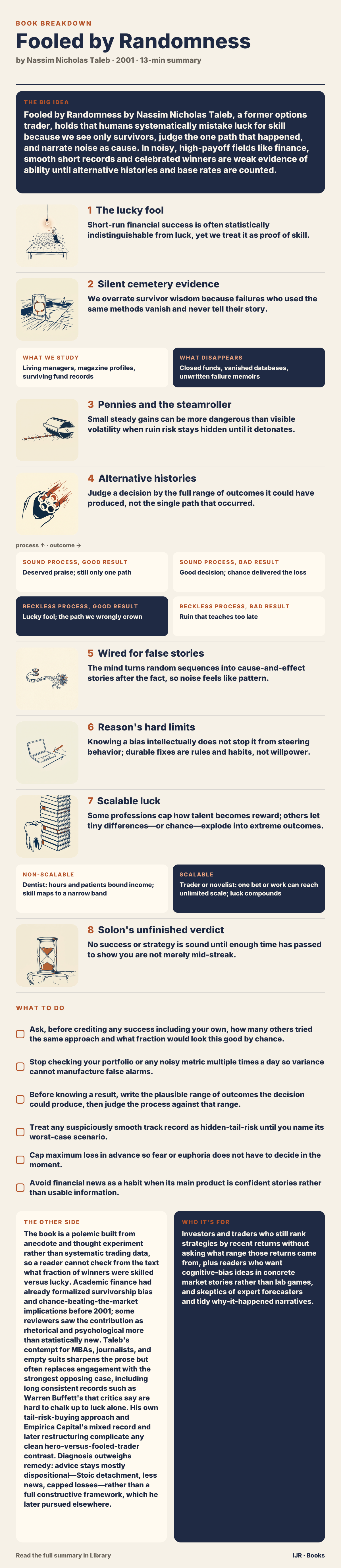
Fooled by Randomness by Nassim Nicholas Taleb, a former options trader, holds that humans systematically mistake luck for skill because we see only survivors, judge the one path that happened, and narrate noise as cause. In noisy, high-payoff fields like finance, smooth short records and celebrated winners are weak evidence of ability until alternative histories and base rates are counted.
The book in brief
Taleb starts from a simple arithmetic problem: when enough people take noisy bets, a few will look like geniuses by chance alone, and markets plus media will crown them. He opens with the coin-flip room and two fictional traders—one cautious, one riding a lucky streak—to show that a hot track record in a low-predictability field has almost no diagnostic value without a base-rate check. He then widens the lens to survivorship. Failures disappear from databases, memoirs, and magazine profiles, so lessons drawn from star managers and self-made winners systematically overstate skill. The same habits that explain the living also filled a silent cemetery of funds and careers nobody studies. From there the book turns to payoff shape. Strategies that pick up small premiums while carrying hidden ruin risk look calm and professional until the rare blowup—Long-Term Capital Management's 1998 collapse after Russia's default is the emblem. Conventional metrics reward the dangerous negative-skew pattern because the disaster has not yet entered the sample. Taleb next insists on alternative histories: reconstruct the other paths a bet could have taken before praising the realized one, the way surviving Russian roulette does not make the choice wise. He links this to how cognition imposes stories on random market moves, how hindsight rewrites what felt uncertain, and how intellectual awareness of bias fails under emotional pressure, so durable defense needs rules—less news, less mark-to-market sampling, capped downside—rather than willpower. He contrasts scalable careers (trader, novelist) with non-scalable ones (dentist), where tiny differences or pure chance can explode into extreme inequality, then closes with Solon's warning to Croesus: call no success sound until time and rare conditions have had their say, a lesson he ties to a trader he knew whose multi-year brilliance ended in a single tail wipeout.
Context
Published in 2001, the book drew on Taleb's years as an options trader to challenge the finance industry's cult of the successful trader. It mattered because it made survivorship, skewed payoffs, and narrative fallacy vivid for a general audience and anticipated ideas he later expanded in The Black Swan.
The key ideas

1
The lucky fool
Short-run financial success is often statistically indistinguishable from luck, yet we treat it as proof of skill.
Taleb's opening move is scale. Put enough players in a noisy game and a few perfect streaks become arithmetically inevitable; those streaks then get bonuses, magazine covers, and solemn explanations of method. He contrasts a contemplative trader, Nero Tulip, who hedges against rare disaster, with a flashier rival whose swagger rests on a run of favorable outcomes rather than demonstrated edge. Nothing in the hot streak itself separates skill from the arithmetic of large numbers. He ties the pattern to colleagues promoted and profiled for returns that simple probability said chance alone would produce given how many similar traders were competing. Before crediting judgment, count how many others tried and what accidental-success base rate that population implies. Without that comparison a track record is one data point dressed as a life story.
In practice: Ten thousand people each flip a coin once a year; after five years a predictable handful have won every flip and will be paid to explain their method.

2
Silent cemetery evidence
We overrate survivor wisdom because failures who used the same methods vanish and never tell their story.
What we study
Living managers, magazine profiles, surviving fund records
What disappears
Closed funds, vanished databases, unwritten failure memoirs
Taleb borrows the old sailors-who-prayed logic: survivors are shown as proof the method works; the drowned who prayed the same way leave no testimony. Finance runs the same filter. Business books study living fund managers and reverse-engineer habits, while failed funds close, drop out of databases, and commission no memoirs. From inside firms he watched people with the same training and models diverge wildly; survivors called it insight, failures left quietly. Any claim that successful traders share trait X is empty unless X is rarer among the failures too—and popular accounts almost never check. The public sample of millionaires and star managers has already been filtered by survival, so it looks far more skill-driven than the underlying population was. Admiration for a survivor, absent that check, is admiration for luck wearing a method's mask.
In practice: Sailors who prayed before a storm and lived were cited as proof prayer works, with no count of those who prayed and drowned.

3
Pennies and the steamroller
Small steady gains can be more dangerous than visible volatility when ruin risk stays hidden until it detonates.
Taleb describes traders who sell out-of-the-money options, collecting small premiums month after month while carrying a tiny chance of catastrophic loss—picking up pennies in front of a steamroller. For years the book looks steadier than volatile peers, earns bonuses, and reads as disciplined professionalism. Then one adverse stretch erases years of gains. The near-collapse of Long-Term Capital Management in 1998 is the emblem: Nobel-staffed, model-driven, treating large moves as effectively impossible, then losing more than four billion dollars in weeks when Russia defaulted and correlations broke. Negative-skew distributions (frequent small wins, rare huge losses) look superior to positive-skew ones if you only measure short windows or average return. Smooth track records and high win rates actively reward the more dangerous shape because disaster has not yet entered the sample. Ask not how often the strategy makes money, but what the worst plausible outcome looks like and how it has been kept out of the sample you are judging.
In practice: Long-Term Capital Management lost more than four billion dollars in weeks in 1998 after Russia's default shattered its models' assumptions.

4
Alternative histories
Judge a decision by the full range of outcomes it could have produced, not the single path that occurred.
process ↑ · outcome →
Sound process, good result
Deserved praise; still only one path
Sound process, bad result
Good decision; chance delivered the loss
Reckless process, good result
Lucky fool; the path we wrongly crown
Reckless process, bad result
Ruin that teaches too late
We observe one realization of a random process and treat it as the verdict. Taleb wants the unseen paths restored to the scorecard. His Russian-roulette sketch: a man is paid to pull the trigger on a revolver with one bullet in six chambers. Survival looks lucky or brave; five survivals might look like genius risk management. The choice was reckless either way, because most imagined universes end in disaster and only the inhabited one shows him thriving. In finance, an enormous undiversified bet that won still requires reconstructing what fraction of market paths would have meant ruin. Confusing process quality with outcome quality is how reckless risk-taking gets copied. He loosely borrows ergodicity: the average across many parallel instances can differ from one instance followed over time. Mentally generate the unseen histories before praising the visible one.
In practice: Surviving a one-in-six revolver pull—or five in a row—does not make the decision sound; most parallel paths end in ruin.
5
Wired for false stories
The mind turns random sequences into cause-and-effect stories after the fact, so noise feels like pattern.
Cognition evolved to spot predators fast; it did not evolve to sit quietly with genuine randomness. So we impose narrative. Financial television assigns a tidy cause to every day's move—an interest-rate rumor, an earnings print—when most single-day moves are fluctuation inside a range and no headline drove them. Show commentators the same series without dates or news and they cannot reliably tell a real price path from one built from noise; the explanations are fitted afterward. Hindsight compounds the error: once the ending is known, we overestimate how predictable it felt beforehand, making past choices look more foolish or brilliant than they were in real time. Taleb kept a private log of predictions and reasons before outcomes arrived because memory rewrites itself once results are in. Discomfort with randomness is structural, which is why being told about the bias rarely stops it.
In practice: Commentators given market data stripped of dates and headlines cannot reliably separate real history from a randomly generated series.

6
Reason's hard limits
Knowing a bias intellectually does not stop it from steering behavior; durable fixes are rules and habits, not willpower.
Taleb admits professional knowledge of randomness did not spare him anxiety when a position moved against him by an amount his models called meaningless. The circuitry that feels gains and losses is largely deaf to the circuitry that computes probabilities. He turns to Stoic rehearsal of loss—imagining the worst case calmly before it arrives—not as a logic proof but as a way to blunt emotional shock. Practical rules followed: refuse to check portfolio value many times a day, because frequent sampling of a noisy process manufactures emotionally charged losses from variance alone even when the long-term path is fine; avoid financial news, which mainly supplies false-conviction narratives; structure bets so maximum loss is capped and known in advance. Rationality is not a switch flipped by a book. It has to be built into the environment and the precommitments, because in the moment emotion usually beats calculation.
In practice: He stopped checking marks repeatedly and avoided financial news so variance and tidy narratives could not hijack decisions.

7
Scalable luck
Some professions cap how talent becomes reward; others let tiny differences—or chance—explode into extreme outcomes.
Non-scalable
Dentist: hours and patients bound income; skill maps to a narrow band
Scalable
Trader or novelist: one bet or work can reach unlimited scale; luck compounds
A dentist's income is bounded by hours and patients; twice the skill might mean higher fees or a longer list, but the outcome band stays narrow. A trader, novelist, or musician works in a scalable field where one decision or work can reach an unlimited market, so small gaps in timing or pure chance produce enormous disparities among people of similar ability. That is why finance and creative industries mint extreme winners: incomes stretch into a long thin tail where a handful capture a disproportionate share because luck can compound instead of averaging out. Being top dentist in town is strong evidence of skill. Being top trader in the world that year may be skill—or the random path that diverged furthest. Same skill, wider and more luck-dependent outcome range; infer less from any single scalable success.
In practice: Taleb contrasts a dentist's hour-bound practice with a trader or novelist whose single output can scale without linear labor.

8
Solon's unfinished verdict
No success or strategy is sound until enough time has passed to show you are not merely mid-streak.
Herodotus records Solon visiting wealthy Croesus, who wants confirmation he is the happiest man alive. Solon refuses: call no man happy until life is over; fortune can reverse. Croesus later loses his kingdom. Taleb applies the warning to finance: years of being right do not certify skill until the strategy has survived a long, varied stretch that includes the rare adverse event it may be quietly exposed to. He points to Victor Niederhoffer, a trader he knew with an outstanding multi-year record before a sharp late-1990s market move wiped out the fund—years of apparent brilliance that never removed structural tail vulnerability. Survivorship shows us Croesus before the fall; skewed payoffs make the fall sudden; alternative-histories thinking should have doubted the run; narrative instinct will already have explained the genius before the reversal. Treat every run, including your own, as an unfinished experiment.
In practice: Victor Niederhoffer's strong multi-year record ended when a single sharp late-1990s move wiped out his fund.
Key terms
- Lucky fool Someone whose streak looks like genius but sits inside what chance alone would produce at that scale
- Survivorship bias Judging a method from winners only while failures who did the same thing drop out of view
- Pennies before the steamroller Collecting small steady gains while carrying a hidden chance of catastrophic loss
- Negative skew A payoff shape of frequent small wins and rare huge losses that looks calm until it detonates
- Alternative histories The other paths a random process could have taken; judge the decision against that set, not one result
- Ergodicity (loose use) When the average across many parallel lives differs from one life followed over time
- Scalability Whether small skill or chance gaps can explode into extreme outcome gaps because output is not hour-bound
- Hindsight bias Once the ending is known, overestimating how predictable it felt beforehand
What to do
- Ask, before crediting any success including your own, how many others tried the same approach and what fraction would look this good by chance.
- Stop checking your portfolio or any noisy metric multiple times a day so variance cannot manufacture false alarms.
- Before knowing a result, write the plausible range of outcomes the decision could produce, then judge the process against that range.
- Treat any suspiciously smooth track record as hidden-tail-risk until you name its worst-case scenario.
- Cap maximum loss in advance so fear or euphoria does not have to decide in the moment.
- Avoid financial news as a habit when its main product is confident stories rather than usable information.
Questions to think with
- If a hundred people ran my strategy, how many would show a record this clean by chance alone?
- What does this approach's worst plausible week look like, and why is that week missing from the sample I admire?
- Am I praising a process or only the one path that happened to occur?
- Which parts of my work are scalable enough that luck can dominate the outcome gap?
- What rule would blunt my worst emotional reaction to noise without needing willpower in the moment?
The other side
The book is a polemic built from anecdote and thought experiment rather than systematic trading data, so a reader cannot check from the text what fraction of winners were skilled versus lucky. Academic finance had already formalized survivorship bias and chance-beating-the-market implications before 2001; some reviewers saw the contribution as rhetorical and psychological more than statistically new. Taleb's contempt for MBAs, journalists, and empty suits sharpens the prose but often replaces engagement with the strongest opposing case, including long consistent records such as Warren Buffett's that critics say are hard to chalk up to luck alone. His own tail-risk-buying approach and Empirica Capital's mixed record and later restructuring complicate any clean hero-versus-fooled-trader contrast. Diagnosis outweighs remedy: advice stays mostly dispositional—Stoic detachment, less news, capped losses—rather than a full constructive framework, which he later pursued elsewhere.
Who it's for
Investors and traders who still rank strategies by recent returns without asking what range those returns came from, plus readers who want cognitive-bias ideas in concrete market stories rather than lab games, and skeptics of expert forecasters and tidy why-it-happened narratives.