




Progress is real when reason, science, and humanism win
Measurable human welfare has surged since the 1700s because societies applied reason, science, and humanism, not because history drifts upward on its own.
IJR · Oct 17, 2026 · 13 min read
In 60 seconds
- Pinker argues life has improved on health, wealth, safety, knowledge, and freedom since the eighteenth century by measurable indicators.
- He traces the gains to deliberate Enlightenment tools—reason, science, humanism—and specific institutions, not luck or cosmic inevitability.
- Cognition and news make progress feel invisible: vivid disasters stick; slow declines in poverty or disease never register as events.
- Extreme poverty fell from roughly 90 percent of humanity around 1820 to under 10 percent, driven mainly by markets and technology spread.
- Homicide, war, slavery, and major diseases declined through institutions that remain contingent and reversible if neglected.
- Defending science’s self-correcting method and a secular concern for sentient wellbeing is how the gains continue against tribal and dogmatic attacks.
The big idea
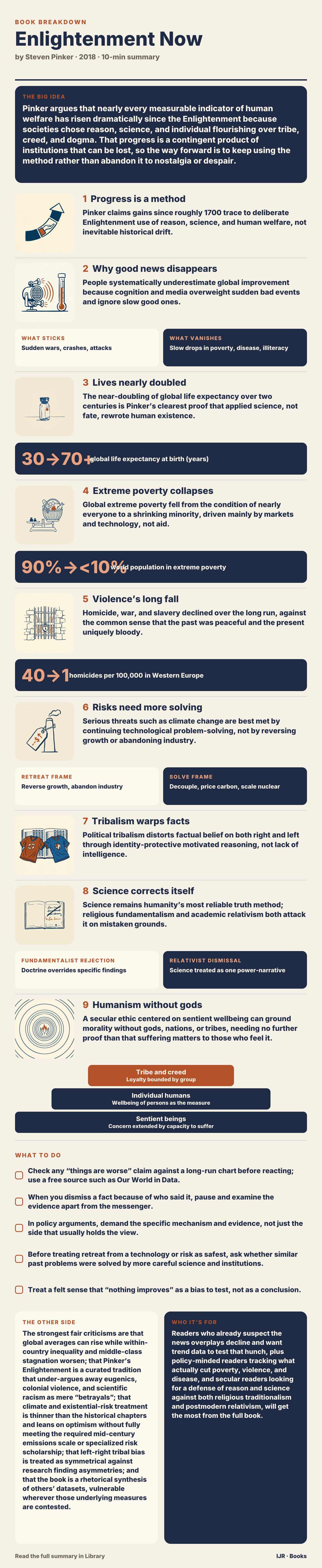
Pinker argues that nearly every measurable indicator of human welfare has risen dramatically since the Enlightenment because societies chose reason, science, and individual flourishing over tribe, creed, and dogma. That progress is a contingent product of institutions that can be lost, so the way forward is to keep using the method rather than abandon it to nostalgia or despair.
The book in brief
Pinker starts from a narrow definition of the Enlightenment: the eighteenth-century turn, in thinkers such as Kant, Hume, Voltaire, and Smith, toward evidence-based understanding of the world and toward individual human flourishing as the measure of a good society. He rejects both religious providence and historical determinism. Progress is what happens when those tools are applied on purpose; the last two centuries are the test case, read mainly through long-run charts on life expectancy, income, and literacy.
Before the data, he explains why the gains feel unreal. The availability heuristic makes sudden horrors easy to recall and gradual improvements invisible. News rewards wars and crashes over quiet drops in child mortality. Public surveys on basic global trends show people scoring worse than chance. Intellectuals often treat pessimism as seriousness, so admitting improvement can feel like a moral failure.
He then walks domain by domain. Global life expectancy moved from around thirty years through most of history to above seventy, with the poorest countries gaining faster in recent decades than rich ones did earlier; child mortality collapsed from near half of births in pre-industrial England to under one percent in wealthy nations. Germ theory, vaccines, sanitation, and antibiotics did the work, often ahead of wealth. Extreme poverty fell from roughly ninety percent around 1820 to under ten percent, steepest in the last four decades as market institutions and technology spread in Asia. Famine became rare outside war and authoritarian failure. Homicide rates in medieval Western Europe ran as high as forty per 100,000 versus roughly one today.
Present threats get the same lens. Climate and existential risks, he argues, are best met by continuing technological problem-solving—dematerialization, carbon pricing, expanded nuclear—rather than reversing growth. Intellectual threats come next: political tribalism that warps facts through identity-protective reasoning on left and right alike, plus twin attacks on science from religious fundamentalism and academic relativism. Both miss science’s actual strength: public, checkable claims open to falsification and self-correction.
The arc closes on humanism. A secular ethic centered on the wellbeing of sentient beings needs no god or tribe; once suffering is granted as bad for the one who suffers, expanding moral concern follows. The book’s closing insistence is that none of this was automatic. The institutions that produced the curves can be neglected, and the method must be defended.
Context
Published in 2018, the book extends the long-run violence argument Pinker made in The Better Angels of Our Nature (2011) across health, wealth, knowledge, and freedom. It mattered as a data-heavy challenge to both nostalgic conservatism that imagines a better past and apocalyptic progressivism that treats the present as uniquely doomed, insisting that defending Enlightenment values—not abandoning them—is how measurable progress continues.
The key ideas

1
Progress is a method
Pinker claims gains since roughly 1700 trace to deliberate Enlightenment use of reason, science, and human welfare, not inevitable historical drift.
He defines the Enlightenment tightly as an eighteenth-century turn toward evidence and toward individual flourishing rather than tribe, crown, or creed. The wager is practical: when societies adopt those tools on purpose, outcomes improve. The last two centuries supply the evidence base.
The method of the book follows at once. Pick a domain, show the long-run trend, and ask what bent the curve. Charts from projects such as Our World in Data on life expectancy, income, and literacy carry more weight than anecdote.
Progress is framed as contingent. Science, markets, liberal democracy, and international norms produced the gains and can be lost if neglected. That framing separates the argument from both religious providence and Marxist determinism.
Two recurring attacks are previewed: reactionary nostalgia that edits the past upward, and academic or left pessimism that edits the present downward. Both, he argues, rest on selective attention to bad news rather than trend data.
In practice: Thinkers such as Kant, Hume, Voltaire, and Smith stand as the narrow historical reference for the commitment to reason and individual welfare Pinker defends.

2
Why good news disappears
People systematically underestimate global improvement because cognition and media overweight sudden bad events and ignore slow good ones.
What sticks
Sudden wars, crashes, attacks
What vanishes
Slow drops in poverty, disease, illiteracy
Pinker draws on the availability heuristic: vivid, sudden, emotionally charged events come to mind easily and get overweighted. A famine that never happened or a disease that quietly vanished never registers as an event at all.
News compounds the distortion. Wars, crashes, and attacks have starting guns; a multi-decade drop in child mortality does not. The information environment is optimized for engagement, not accuracy.
Public surveys popularized by Hans Rosling show people scoring worse than random chance—worse than chimps—on simple factual questions about literacy, vaccination, and poverty rates. The pattern is predictable, not a mark of stupidity.
A moralistic layer makes it worse. Intellectuals often treat pessimism as seriousness and optimism as naivete or complicity, so admitting improvement can feel like moral failure even when the data support it. Measurement of wellbeing functions here as a corrective to intuition, the way a thermometer corrects a felt temperature.
In practice: Survey respondents miss basic global trend facts at rates worse than chance guessing, the pattern Pinker uses to show the bias is systematic.

3
Lives nearly doubled
The near-doubling of global life expectancy over two centuries is Pinker’s clearest proof that applied science, not fate, rewrote human existence.
30→70+
global life expectancy at birth (years)
Global life expectancy at birth sat around thirty years through most of recorded history and now sits above seventy. In the poorest countries it has risen faster in the last sixty years than it did in the richest countries over the previous two hundred.
Child mortality claimed close to half of all children born in pre-industrial England; it is now under one percent in wealthy nations and still falling steeply in low-income ones. Pinker credits germ theory, vaccination, sanitation, and antibiotics—concrete applications of scientific method—often ahead of major income gains.
Disease eradications serve as engineering proofs. Smallpox, which killed hundreds of millions in the twentieth century alone, was declared eradicated in 1980 through coordinated global vaccination. Polio cases fell from hundreds of thousands a year in the 1980s to a handful of countries.
Longer lives are not dismissed as empty years. Data on disability-adjusted life years and falling rates of blindness, stunting, and disabling disease sit beside raw longevity. The deeper claim is that none of this was smooth or automatic; smallpox eradication required a specific twentieth-century institutional effort.
In practice: The 1980 declaration that smallpox was eradicated after a coordinated WHO vaccination campaign is treated as a pure Enlightenment-method win.

4
Extreme poverty collapses
Global extreme poverty fell from the condition of nearly everyone to a shrinking minority, driven mainly by markets and technology, not aid.
90%→<10%
world population in extreme poverty
Using World Bank figures, Pinker notes that roughly ninety percent of the world’s population lived in what we would now call extreme poverty around 1820. Today the figure is under ten percent. The steepest declines came in the last four decades as China, India, and other Asian economies industrialized.
He attributes the drop primarily to the spread of market institutions, property rights, and technology transfer rather than foreign aid or planned redistribution. East Asia’s growth, not Western philanthropy, dominates the recent collapse.
Famine data reinforce the institutional point. Mass starvation, once recurrent even in wealthy societies, has become rare and concentrated in war zones and authoritarian states such as North Korea—an outcome he ties to work connecting famine to political failure rather than absolute food scarcity.
The claim is carefully scoped. It concerns subsistence-level deprivation on a global scale, not the distribution of gains among the already affluent inside rich countries. Poverty debates that treat markets and industrialization as having failed the poor, he argues, run against the long-run test of institutions.
In practice: East Asian industrialization over recent decades supplies the main real-world driver of the fastest poverty reduction in the record he cites.

5
Violence’s long fall
Homicide, war, and slavery declined over the long run, against the common sense that the past was peaceful and the present uniquely bloody.
40→1
homicides per 100,000 in Western Europe
This section condenses the core of Pinker’s earlier long-run violence argument. Homicide rates in medieval Western Europe ran as high as forty per 100,000 people annually, compared with roughly one per 100,000 in most of Western Europe today.
He attributes part of the drop to the consolidation of centralized states that held monopolies on legitimate force, and part to broader civilizing and humanitarian shifts that reduced everyday killing, war deaths relative to population, and the legal acceptance of slavery.
The numbers are meant to overturn a default assumption: that modern headlines prove a uniquely violent age. Long-run rates move in the opposite direction from that intuition.
As with health and poverty, the decline is treated as an achievement of institutions and norms, not a permanent background condition. What was built can be neglected.
In practice: Medieval Western European homicide rates near forty per 100,000 versus roughly one per 100,000 in most of the same region today anchor the claim.

6
Risks need more solving
Serious threats such as climate change are best met by continuing technological problem-solving, not by reversing growth or abandoning industry.
Retreat frame
Reverse growth, abandon industry
Solve frame
Decouple, price carbon, scale nuclear
Having shown past problem-solving, Pinker turns the same lens on present dangers, chiefly climate change. Rich countries, he argues, have already begun decoupling economic growth from resource and carbon intensity.
Energy use per unit of GDP has fallen in most industrialized nations even as output rose—a trend he calls dematerialization. The pattern suggests growth and lower intensity can travel together.
Policy implications follow the method rather than retreat. He supports carbon pricing and, notably, expanded nuclear power as a low-carbon source that can scale faster than renewables alone.
The stance rejects both denial and the idea that industrial civilization itself must be wound down. The historical pattern he favors is more careful application of science and institutions, not a return to pre-industrial limits.
In practice: Falling energy use per unit of GDP in industrialized nations while output still rose is the concrete dematerialization pattern he cites.

7
Tribalism warps facts
Political tribalism distorts factual belief on both right and left through identity-protective motivated reasoning, not lack of intelligence.
Pinker shifts from material progress to intellectual threats, beginning with reasoning itself. The failure mode is not stupidity; it is motivated reasoning that protects group identity.
Research he cites on identity-protective cognition shows people filter evidence through partisan belonging. The same raw facts yield opposite conclusions once tribal cues are attached.
Because the distortion runs across the spectrum, reasoned debate fails even among intelligent participants when identity is at stake. Messenger rejection substitutes for evidence evaluation.
The practical implication is diagnostic: noticing that a claim is being accepted or dismissed because of who made it becomes a signal to separate the data from the side.
In practice: Dan Kahan’s research on identity-protective motivated reasoning is the cited mechanism for why partisans talk past shared facts.

8
Science corrects itself
Science remains humanity’s most reliable truth method; religious fundamentalism and academic relativism both attack it on mistaken grounds.
Fundamentalist rejection
Doctrine overrides specific findings
Relativist dismissal
Science treated as one power-narrative
Pinker groups two different critics as making a parallel error. Religious fundamentalism rejects specific findings—evolution, cosmology, vaccine safety—when they collide with doctrine. Polling shows a persistent minority of Americans holding young-earth creationist views despite the fossil and genetic record.
On the other flank, strands of academic postmodernism and social constructivism treat scientific knowledge as merely one narrative among many, shaped by power rather than evidence. Both miss what makes science distinctive.
That distinction is method, not certainty: public, checkable claims subjected to falsification, replication, and peer criticism. Science’s capacity to correct itself—the replication crisis in psychology addressed through pre-registration and larger samples—is offered as proof the method works without depending on any single scientist’s purity.
Public gaps with consensus findings, such as lower public certainty on human-caused warming than exists among climate scientists, are attributed more to the tribal filters of the prior chapter than to genuine scientific ambiguity. Abandoning the evidence standard returns the field to authority, tradition, or tribe.
In practice: Psychology’s replication crisis, met with pre-registration and larger samples, is used to show the method’s self-correction rather than its collapse.

9
Humanism without gods
A secular ethic centered on sentient wellbeing can ground morality without gods, nations, or tribes, needing no further proof than that suffering matters to those who feel it.
- Tribe and creedLoyalty bounded by group
- Individual humansWellbeing of persons as the measure
- Sentient beingsConcern extended by capacity to suffer
The final substantive move turns from empirical curves to philosophical justification. Enlightenment humanism—treating the wellbeing of individual sentient creatures as the ultimate good, in the line of Bentham and Mill—supplies a coherent ethics without religious command or tribal loyalty.
Pinker addresses the naturalistic-fallacy objection by arguing that once suffering is accepted as bad for the being that suffers, an ethics can be built without a further metaphysical foundation, much as mathematics need not prove why consistency beats contradiction.
Expanding circles of moral concern—the decline of slavery, the extension of rights across race and sex, and increasingly across species—follow as the logical unfolding of humanism once tribal boundaries loosen. The violence-decline data earlier in the book are retied to this moral expansion.
Humanism is not sold as a single policy blueprint. It is a standard for judging policies by whether they raise or lower the flourishing of those affected. That standard completes the arc: the gains were real, the method produced them, and the goal needs no higher license than the reality of suffering and wellbeing.
In practice: The historical decline of slavery and the widening of rights across race and sex are presented as humanism’s circle expanding once tribal limits weaken.
Key terms
- Enlightenment (narrow) The eighteenth-century turn to reason and evidence plus individual human flourishing as the test of a good society.
- Availability heuristic The mental habit of overweighting vivid, sudden, emotional events and missing slow, quiet improvements.
- Dematerialization Rising economic output with falling energy and resource use per unit of GDP.
- Identity-protective motivated reasoning Filtering facts to defend one’s political or group identity rather than to track evidence.
- Humanism A secular moral stance that treats the wellbeing of sentient individuals as the ultimate good.
- Extreme poverty Subsistence-level deprivation that once described most of humanity and now describes a shrinking minority.
- Self-correcting method Science’s public cycle of claims, attempts at falsification, replication, and repair without relying on any one person’s virtue.
What to do
- Check any “things are worse” claim against a long-run chart before reacting; use a free source such as Our World in Data.
- When you dismiss a fact because of who said it, pause and examine the evidence apart from the messenger.
- In policy arguments, demand the specific mechanism and evidence, not just the side that usually holds the view.
- Before treating retreat from a technology or risk as safest, ask whether similar past problems were solved by more careful science and institutions.
- Treat a felt sense that “nothing improves” as a bias to test, not as a conclusion.
Questions to think with
- Which personal or political belief of yours would change first if you trusted the long-run charts Pinker leans on?
- Where does the book’s global-average story hide a distributional harm that still demands a separate response?
- Is “betrayal of Enlightenment principles” a clear enough boundary for eugenics and colonial violence, or does it let the tradition off too easily?
- When does optimism about decoupling and nuclear power become a substitute for the scale of emissions cuts actually required?
- How do you tell identity-protective reasoning in yourself from ordinary caution about bad data?
The other side
The strongest fair criticisms are that global averages can rise while within-country inequality and middle-class stagnation worsen; that Pinker’s Enlightenment is a curated tradition that under-argues away eugenics, colonial violence, and scientific racism as mere “betrayals”; that climate and existential-risk treatment is thinner than the historical chapters and leans on optimism without fully meeting the required mid-century emissions scale or specialized risk scholarship; that left-right tribal bias is treated as symmetrical against research finding asymmetries; and that the book is a rhetorical synthesis of others’ datasets, vulnerable wherever those underlying measures are contested.
Who it's for
Readers who already suspect the news overplays decline and want trend data to test that hunch, plus policy-minded readers tracking what actually cut poverty, violence, and disease, and secular readers looking for a defense of reason and science against both religious traditionalism and postmodern relativism, will get the most from the full book.