




The demons that build rockets also leave the wreckage
Anyone who wants the factory-floor method behind SpaceX and Tesla—and a clear view of what that intensity costs the people around it—should read this.
IJR · Oct 12, 2026 · 12 min read
In 60 seconds
- Isaacson traces Musk's risk tolerance to a Pretoria childhood with no physical or emotional safety, where calm later felt like danger.
- Early exits from Zip2 and PayPal were poured into SpaceX and Tesla; by December 2008 he was borrowing for rent as both firms sat days from failure.
- A five-step rule—question every requirement, delete, simplify, accelerate, automate last—is the book's most transferable operating system.
- Manufactured surges and 'demon mode' deliver results incumbents missed, alongside exhausted teams, broken marriages, and public firings.
- First-principles math found rocket materials cost roughly two percent of the sticker price; the same delete-first method at Twitter cut staff from about seventy-five hundred to under two thousand with mixed institutional results.
- The book keeps achievements and damage on the same page and refuses to total the ledger for the reader.
The big idea
Isaacson presents Musk as forged by an unsafe childhood into someone for whom risk is comfortable and calm is not. The same drive that produced reusable rockets and mass-market electric cars runs on manufactured emergencies and leaves wreckage the book will not net out.
The book in brief
The book opens with a boy in apartheid Pretoria who is beaten at school, hospitalised after being thrown down concrete steps, and then subjected at home to his father Errol's long psychological interrogations—treatment the adult Musk calls worse than the beatings. Siblings and his mother Maye corroborate the pattern; Errol disputes much of it; Isaacson prints the denials beside the claims. The biographical wager is set early: a child raised without safety becomes a man who treats risk as normal. Escape routes appear in the same chapter—Encyclopaedia Britannica, self-taught code, a game sold at twelve—and they remain the adult's routes: machines whose rules do not move.
First fortunes are not banked. Zip2 and then the company that became PayPal produce cash that is almost immediately aimed at the two hardest industries on offer. By the end of 2008 both bets are days from dying in the same month, and rent money is borrowed. The point is the shape of the wager: if a rocket firm has a ten percent chance and nobody else is trying, ten percent is worth everything.
From there the reporting stays on the floor. A five-step production rule is recited in strict order. Surges are staged at factories and launch sites until deadlines everyone called impossible are hit. Costs are rebuilt from raw materials rather than industry habit. Each move produces rates and cadences incumbents did not match; each also leaves engineers in permanent adrenaline, marriages ended, and people made examples in front of the room.
Twitter becomes the live trial of transfer. A factory method built for physics is run on a company made of advertisers, moderators, and user trust. Process is deleted, headcount slashed, servers pulled. The site does not collapse; revenue and norms do not hold steady either. Physics returns a clean verdict on a dyno; institutions do not.
The final register keeps two columns open—what got built and what it cost the people inside the room, including family marked by absence and rupture—and declines to do the sum. The question that opened the book is still the one on the last page: whether the demons that produce the achievements can be removed without removing the drive.
Context
Isaacson shadowed Musk for two years in meetings, on factory floors, and at three in the morning during the Twitter takeover. He interviewed the family, including Errol, and prints contradictory accounts side by side rather than resolving them. The book closes in 2023 with Twitter's future unsettled, Starship having flown its first integrated test, and several large bets still undecided. Read alongside Ashlee Vance's 2015 biography, which had less access and more distance, the two give a fuller picture than either alone.
The key ideas

1
Childhood without safety
A boy raised without physical or emotional safety grows into a man for whom risk feels normal and calm feels like danger.
Isaacson opens in Pretoria in 1971 inside a household he describes in unusually cold terms. School beatings that once ended in hospitalisation sit beside home interrogations by father Errol that the adult Musk ranks as worse. Maye and the siblings back the pattern; Errol denies much of it; both versions stay on the page.
The claim is not subtle and it is planted early so the reader can test it for the rest of the book. Safety never became the baseline, so later risk does not register as abnormal. Asked whether he has a compulsion to create his own crises, Musk does not deny it.
The same chapters show the escape routes that still operate: reading the Encyclopaedia Britannica through, teaching himself to program, selling a game called Blastar at twelve for about five hundred dollars. Machines offered consistent rules and no one moving the goalposts. The method of the book appears here too—witnesses assembled, disagreements left standing, no distant psychoanalysis.
In practice: Musk was thrown down concrete steps at school and hospitalised; at home Errol's psychological interrogations continued, a pattern Maye and the siblings corroborate and Errol disputes.
2
Money as fuel
Musk's first fortunes were spent at once on the two hardest industries available rather than diversified or parked.
With brother Kimbal he built Zip2, sleeping in the office and showering at a YMCA. Compaq's 1999 purchase yielded him roughly twenty-two million of a three-hundred-and-seven-million deal. Nearly all of it went into X.com, which merged into what became PayPal. Ousted as chief executive on his honeymoon after the board moved against him twice in eighteen months, he still held the largest stake when eBay paid one and a half billion in 2002; his share was about one hundred and eighty million.
The next move is the one the book keeps returning to. Roughly a hundred million went into SpaceX, most of the rest into Tesla and SolarCity. By December 2008 he was borrowing money for rent. SpaceX's fourth Falcon 1 reached orbit on 28 September after three failures; Tesla closed rescue financing on Christmas Eve. Both firms had been days from the end in the same month.
Isaacson's emphasis is shape, not size. No hedge, no money taken off the table. The recurring answer is that a ten percent chance at a rocket company is worth everything if nobody else is trying.
In practice: After the PayPal exit he put roughly a hundred million into SpaceX and most of the remainder into Tesla and SolarCity, then borrowed for rent by December 2008.
3
The five-step algorithm
Musk's production rule works only in order: question requirements, delete, simplify, accelerate, and automate last.
Isaacson prints the algorithm exactly as Musk recites it to engineers because sequence is the mechanism. First, question every requirement and attach a person's name—never a department, because a department cannot be argued with. Second, delete any part or process you can; if you are not later adding back at least ten percent, you did not delete enough. Third, simplify and optimise, but only after deleting, because the common error is polishing something that should not exist. Fourth, accelerate cycle time. Fifth, automate—last—because automating a step that should have died is how lines fail.
The fifth step is a scar. The 2018 Model 3 ramp stalled after the Fremont line was over-automated with robots for tasks humans did faster, including laying fibreglass mats and feeding bolts. Automation was torn out, the mistake admitted publicly, and a production line raised in a tent in the car park to hit the numbers.
Isaacson watches the same rule run on the Raptor engine, Starlink terminals, and Twitter servers. It is a method for discovering the ten percent that should not have been deleted the hard way, in public, while the schedule is already slipping.
In practice: Over-automation on the Model 3 line forced Musk to rip robots out and finish cars inside a tent in the Fremont car park.
4
The surge and demon mode
Musk manufactures emergencies because he treats urgency as the only reliable accelerant, and colleagues can see the cost coming.
What the surge delivers
Production rates incumbents missed; cheapest ride to orbit; deadlines hit after nights on the floor
What it extracts
Permanent adrenaline; ended marriages; public firings; demon-mode damage colleagues and Grimes both name
The reporting's most repeated scene is the surge: Musk arrives, sets a deadline everyone calls impossible, sleeps on the factory floor, and will not leave until the number is hit. Nevada Gigafactory, Fremont tent line, Raptor ramp, Starship launch mount—each gets the treatment. People involved swear the result could not happen, then later agree it did.
Both halves of the ledger stay visible. Production rates no incumbent car company matched and launch cadences that made SpaceX the cheapest ride to orbit sit beside engineers describing permanent adrenaline, marriages that ended, senior people fired in the moment for answers Musk did not want, and a willingness to make an example in front of the room.
The most uncomfortable material is what Isaacson calls demon mode—a flat stare and long silence colleagues learned to read. Grimes describes it as the state in which he gets a lot done and hurts people. Nobody in the book, Musk included, disputes either clause. Isaacson will not total the columns; results and damage share the page.
In practice: Grimes tells Isaacson that demon mode is when Musk gets a lot done and hurts people; the flat stare and silence are the tells colleagues watch for.

5
First principles pricing
Musk prices problems from raw materials and treats the gap between commodity cost and sticker price as the actual business.
2%
commodity cost share of a finished rocket's industry price
SpaceX's founding move is the cleanest case. The industry said rockets cost what they cost. Musk broke a launch vehicle into aluminium, titanium, copper, and carbon fibre, added the commodities, and found they were roughly two percent of the finished price. Everything between those numbers was markup, legacy process, and habit—and therefore the opening.
The same reasoning reappears in Tesla battery-cost work and in the decision to build reusability into the first stage when the industry called booster recovery uneconomic. Falcon 9 first flew in 2010; the first successful landing came in December 2015; by the time Isaacson was reporting, boosters were routine and the argument had moved to catching Starship with tower arms.
Failure mode gets equal space. First principles in a domain Musk understands yield reusable rockets. In domains he does not, they yield confident wrong answers at the same volume—repeated full-self-driving timelines, the hyperloop, Twitter engineering calls. The transferable core is narrower than the legend: price and cost are different numbers, and almost nobody checks which one they are being quoted.
In practice: Raw materials for a rocket came to roughly two percent of the industry sticker price; the gap became SpaceX's business.
6
Twitter as transfer test
The takeover ran a factory delete-first method on a business made of relationships, and the verdict was genuinely mixed.
Physics companies
Delete the part, run the test, universe returns a clean verdict on the dyno
Advertisers, moderators, and user trust return no single readout; site stayed up while revenue and norms did not
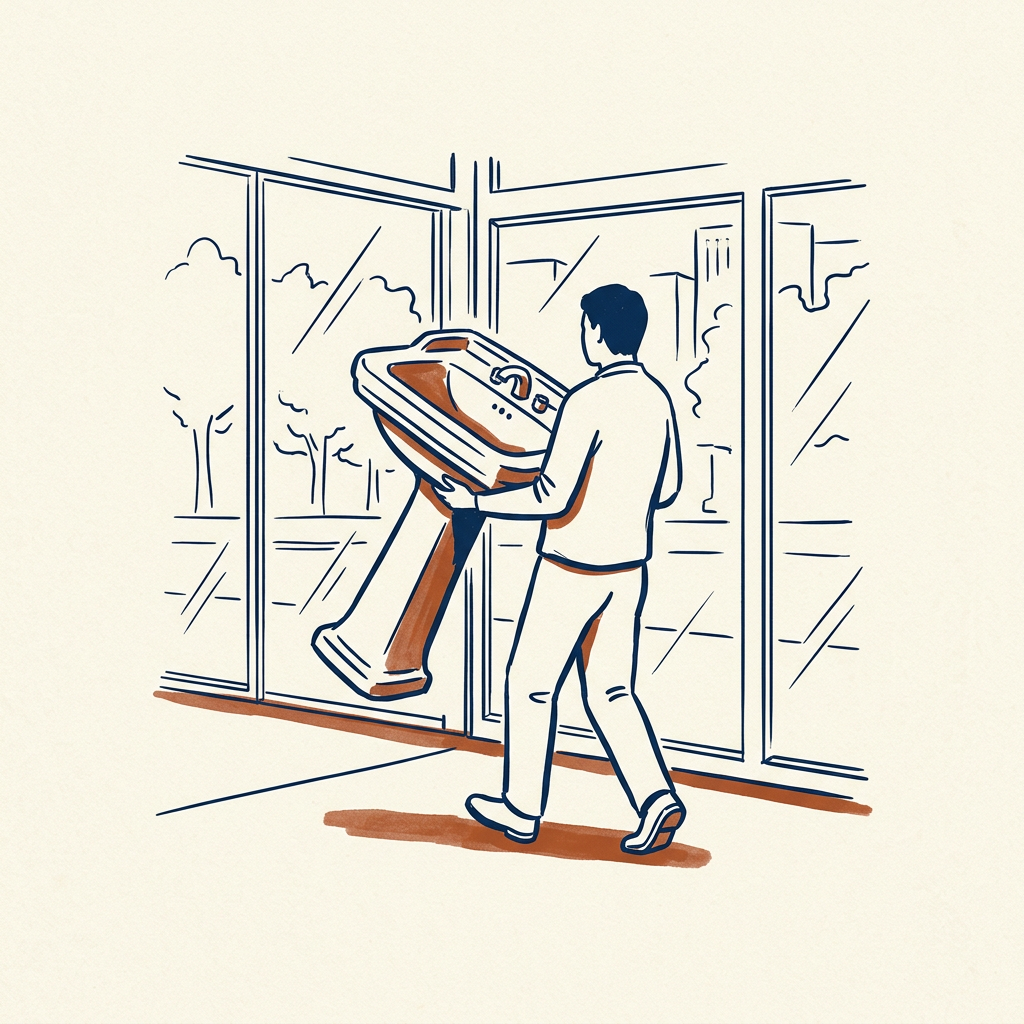
Musk closed the forty-four-billion-dollar deal in October 2022, walked in carrying a sink, and applied the algorithm within days. Requirements were questioned, process deleted, staff cut from roughly seventy-five hundred to under two thousand. Engineers printed recent code for review. Servers were pulled from a Sacramento data centre over a weekend against warnings; things broke.
Isaacson is in the room for much of it. The account is neither the triumph supporters claimed nor the collapse critics predicted. The site did not fall over. Advertisers left, revenue dropped, moderation became ongoing improvisation, and the product churned through names and features while Musk ran it from a couch.
The section tests generalisation. Rockets and cars are physics: delete the part, run the test, read the dyno. A social network is advertisers, moderators, journalists, and accumulated user trust—none of which return a verdict you can instrument the same way. The reusable booster and a chaotic year at a trust-based company share the same refusal to accept that a thing must work as it always has.
In practice: Servers were physically pulled from a Sacramento data centre over a weekend; the team warned the move would break things, and it did.
7
Mission as loyalty test
People are recruited and discarded by their measured distance from a species-scale stated purpose.
Both serious companies run on a purpose larger than the product—making life multiplanetary, ending fossil-fuel transport—and management logic follows. Engineers accept hours no ordinary employer can ask; senior hires leave better-paid jobs; the argument that ends every debate is that the schedule serves the mission.
The same frame explains why human costs are tolerated inside the building. If the mission is species-scale, one person's exhaustion reads as a rounding error, and objections register as weak commitment rather than accurate reporting. Long-serving lieutenants such as Gwynne Shotwell, who has translated Musk to customers and government for two decades, sit beside shorter arcs of people who challenged him once.
What the mission does not cover appears in an adjacent column: eleven children, several marriages, the death of his first child at ten weeks in 2002, estrangement from his daughter, the long feud with Errol. Isaacson does not moralise. He keeps what got built and what it cost the people in the room side by side and lets the reader notice that Musk himself seems to track only one column.
In practice: Gwynne Shotwell has translated Musk to customers and government for two decades while other senior people exit after a single challenge.
Key terms
- The algorithm Five steps in fixed order: question every named requirement, delete, simplify, accelerate, automate last.
- Surge A manufactured emergency—impossible deadline, floor sleeping, refusal to leave—until a number is hit.
- Demon mode A state colleagues read by flat stare and long silence; Grimes says he gets a lot done and hurts people in it.
- First principles Pricing a problem from raw commodity cost instead of industry custom, then treating the gap as the opening.
- Money as fuel Treating cash from exits as propellant for the next hard industry, not a score to protect.
- Mission test Judging loyalty by distance from a species-scale purpose; exhaustion becomes a rounding error.
- Add-back rule If you do not later restore at least ten percent of what you deleted, you did not delete enough.
What to do
- Pick one weekly team process; list every requirement and put a real person's name on each—no departments.
- Delete steps until something breaks; if nothing broke, keep deleting before you simplify or speed anything up.
- Only after deletion, shorten cycle time; consider automation last, never first.
- Price one purchase from first principles this quarter: sum the input commodity costs and compare them with the quote.
- If you manufacture urgency, write down who absorbs the loan and what it is costing them before you set the deadline.
Questions to think with
- Can the drive that produces the results be separated from the demons that produce the wreckage, or are they the same engine?
- Where have you optimised or automated a step that should simply have been deleted?
- When you accept a quoted price, have you checked the commodity cost underneath it?
- What mission, if any, would make permanent adrenaline feel like a rounding error to you—and who pays?
- Does the factory algorithm belong anywhere near a business whose main asset is other people's trust?
The other side
The reporting's strength is presence in the room; the cost is that the vocabulary and sense of what counts as achievement stay close to Musk's own frame, people who left angry appear less often than people still there, line workers get less weight than meeting engineers, and some public claims are relayed with less friction than critics wanted. The book also closes in 2023 while Twitter, Starship, and other large bets remain unsettled, so the verdicts readers most want are ones Isaacson cannot honestly give.
Who it's for
Readers who want the engineering method behind SpaceX and Tesla rather than the mythology, and anyone already weighing what extreme intensity buys and what it costs the people inside the room.