




Constant easy pleasure tips your brain into lasting pain
Anyone who reaches for a phone, snack, or drink the second boredom hits gets a clinic map of why that reflex deepens misery.
IJR · Oct 17, 2026 · 12 min read
In 60 seconds
- Modern stimuli—phones, sugar, porn, opioids—deliver dopamine spikes far beyond what human brains evolved to handle, so dissatisfaction becomes the baseline.
- Pleasure and pain share one neural scale; every high triggers an automatic compensatory pain response that typically overshoots.
- Once reward circuits are dysregulated, even small ‘moderate’ doses restart cravings; roughly four weeks of full abstinence is the clinical reset window.
- Radical honesty about actual consumption and physical friction from triggers outperform willpower.
- Mild self-imposed pain—cold, hard exercise—recalibrates the balance toward resilience through hormesis.
- Severe cases may need medication to make behavioral tools workable at all.
The big idea
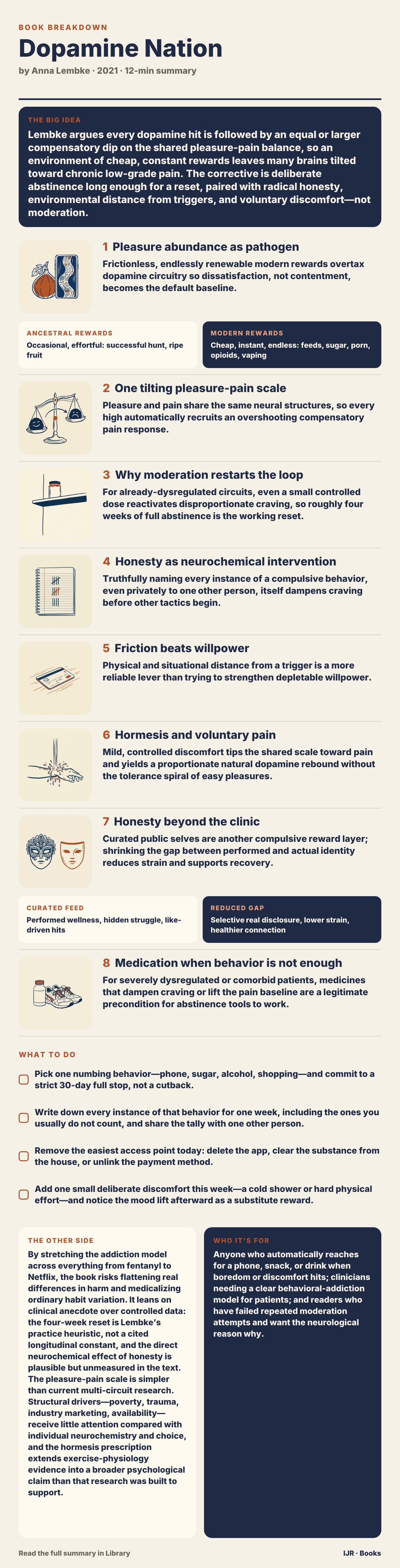
Lembke argues every dopamine hit is followed by an equal or larger compensatory dip on the shared pleasure-pain balance, so an environment of cheap, constant rewards leaves many brains tilted toward chronic low-grade pain. The corrective is deliberate abstinence long enough for a reset, paired with radical honesty, environmental distance from triggers, and voluntary discomfort—not moderation.
The book in brief
Lembke opens on a patient compulsively using internet pornography multiple times daily despite wanting to stop, then widens to the denser problem: engineered foods, streaming, social media, opioids, and vaping stack frictionless rewards into every hour. Ancestral brains met occasional effortful payoffs; modern ones face endless novelty that outruns processing capacity, producing the paradox of more pleasure access alongside more reported anxiety and depression. She treats behavioral addictions with the same seriousness as substances because the delivery mechanism itself can hijack ordinary circuitry.
The mechanism is a single pleasure-pain balance seeking homeostasis. Any pleasure tip recruits an opposing pain response that usually overshoots, leaving a comedown; repeated use trains faster, stronger compensation, shrinking pleasure (tolerance) while after-pain grows until people use only to feel normal. Romance-novel and running patients show the pattern is identical for chemical and behavioral triggers, which is why moderation often fails once circuits are sensitized—any taste reactivates the whole loop.
Abstinence for roughly four weeks functions as diagnostic and therapeutic reset. Acute withdrawal (irritability, anxiety, insomnia, cravings) typically precedes a stabler baseline, though timing varies. Getting there and staying there starts with radical honesty: writing and speaking every instance undercuts the secrecy and self-rounding that keep compulsions alive, and she claims the telling itself engages self-control circuits. A shoplifting patient saw urges drop once each incident was confessed within twenty-four hours, before any other plan.
Next comes environmental design—distance, time, and space—because willpower depletes while friction does not. Delete the app, enforce a waiting period, change the cue-laden context; Vietnam veterans whose heroin use largely stopped outside the war environment illustrate that place itself can drive relapse. One shopping patient succeeded by uninstalling apps and removing his credit card, not by resolving harder. After removal comes hormesis: controlled mild pain (cold immersion, hard training, fasting) tips the scale the other way and yields a proportionate rebound of natural dopamine and endorphins without the steep tolerance curve of drugs.
Honesty then widens to public self-presentation; curated feeds are another dopamine layer, and closing the gap between performed and actual self reduces strain while destigmatizing spectrum addiction. Finally she tempers the model: some severe or comorbid patients cannot tolerate withdrawal without medication (naltrexone, certain antidepressants) that dampens craving enough for the behavioral tools to work. The arc lands on self-control as brain chemistry plus environment design, with medication as legitimate complement rather than contradiction.
Context
Anna Lembke, a practicing psychiatrist drawing on neuroscience and two decades of clinic cases, published Dopamine Nation in 2021. The book mattered because it moved addiction discourse beyond substances into everyday behavior and technology, treating compulsive phone use, shopping, or streaming with the same mechanistic seriousness once reserved for drugs.
The key ideas
1
Pleasure abundance as pathogen
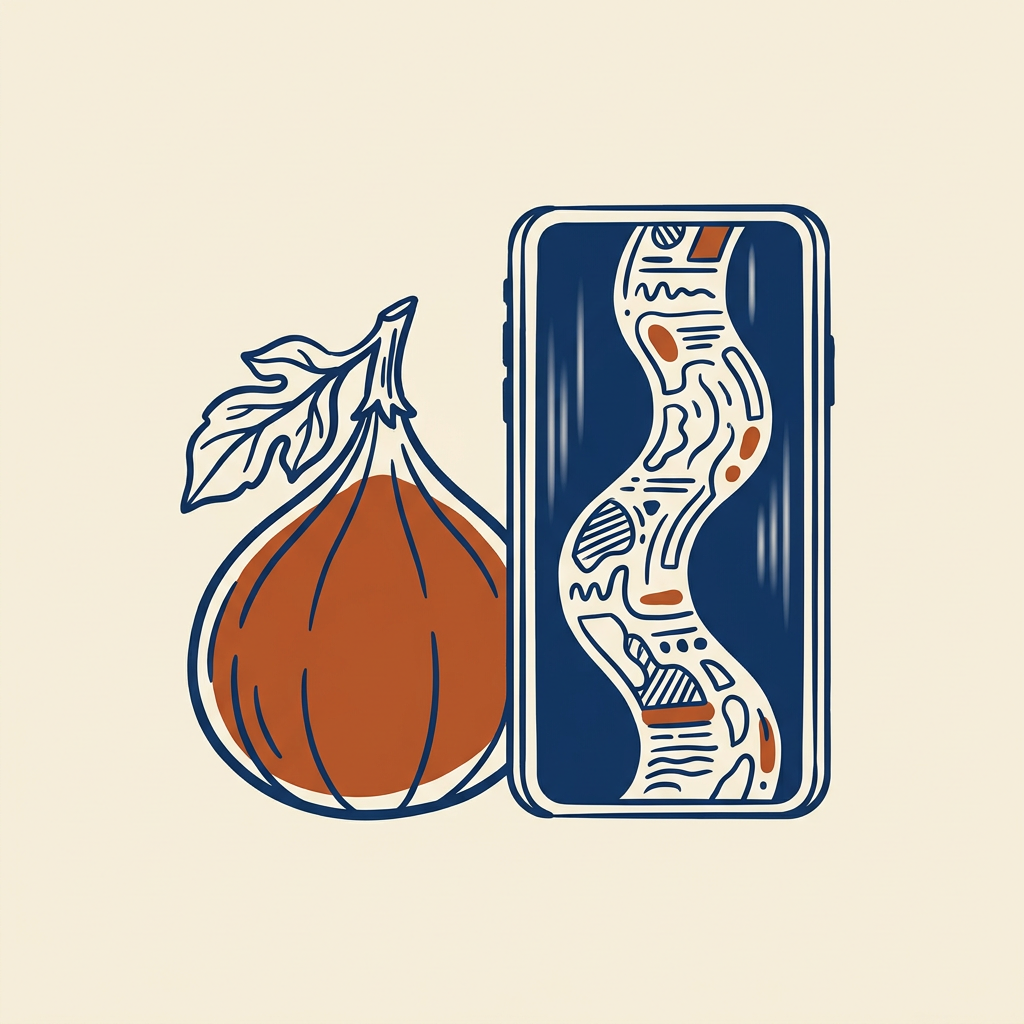
Frictionless, endlessly renewable modern rewards overtax dopamine circuitry so dissatisfaction, not contentment, becomes the default baseline.
Ancestral rewards
Occasional, effortful: successful hunt, ripe fruit
Modern rewards
Cheap, instant, endless: feeds, sugar, porn, opioids, vaping
Lembke treats dopamine less as a pure pleasure chemical than as currency measuring the gap between expected and received reward. Engineered foods, streaming video, social media, opioids, and vaping deliver spikes far beyond ancestral occasional payoffs such as a hunt or ripe fruit.
Density is the pathogen, not any single vice. Layers of accessible reward stacked into every waking hour can hijack ordinary circuitry even without genetic predisposition to classic substance addiction; a compulsive Instagram or shopping pattern needs only a frictionless delivery system.
She presents the correlation—more pleasure access, more reported anxiety and depression—as a repeated clinical pattern rather than strict proof of causation. That pattern justifies treating behavioral addictions with the seriousness once reserved for drugs, a stance still contested in mainstream psychiatry when she wrote.
The opening move strips the assumption that addiction requires a chemical and replaces it with a mechanism: any dopamine surge that outpaces what the brain can process without cost.
In practice: A patient she calls Jacob kept masturbating to internet pornography multiple times daily even though he wanted to stop, illustrating how novelty and potency alone can lock ordinary reward circuits.
2
One tilting pleasure-pain scale
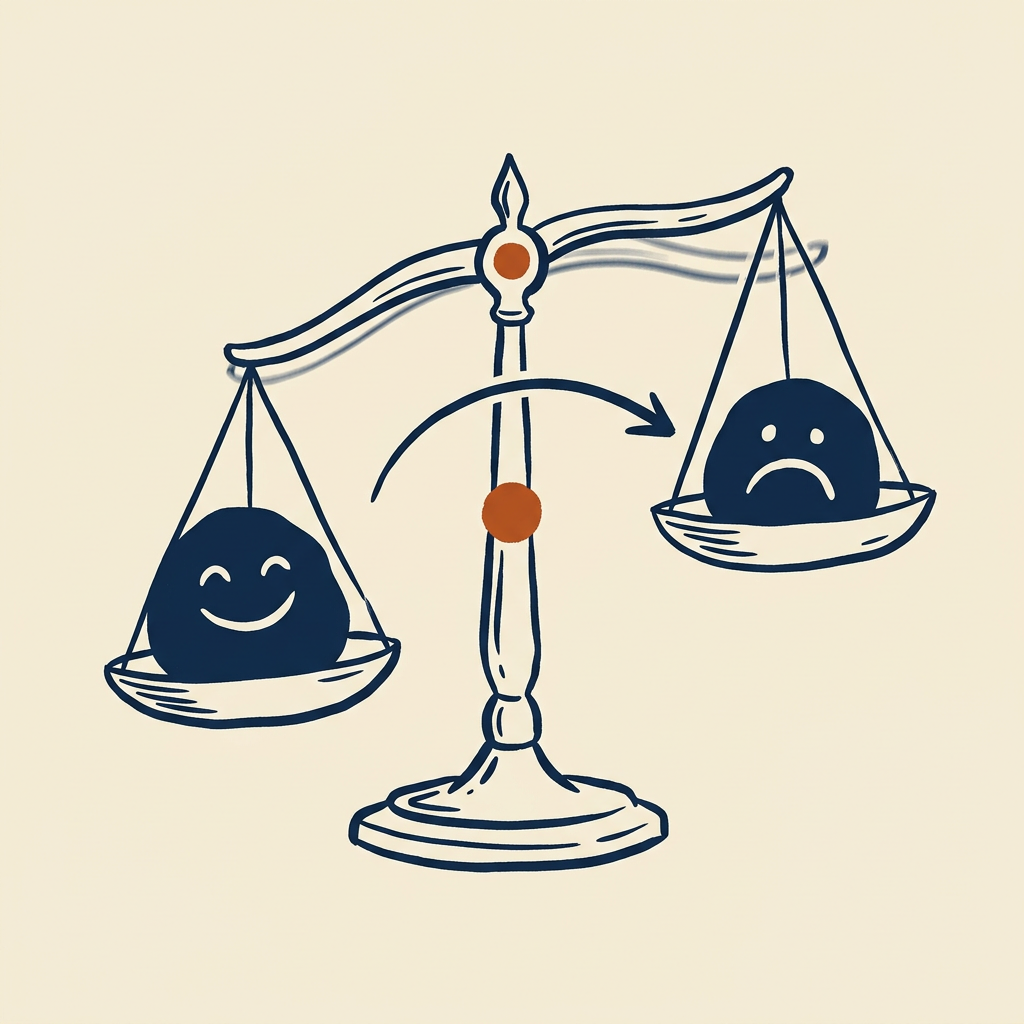
Pleasure and pain share the same neural structures, so every high automatically recruits an overshooting compensatory pain response.
The brain keeps pleasure and pain on one balance and seeks homeostasis at all times. When pleasure tips the scale, an opposing pain force is recruited to level it; that compensation typically overshoots, leaving the brain slightly on the pain side once the high fades.
That overshoot is the comedown, the hangover, the crash after sugar or doomscrolling. Repeated stimulation trains the brain to recruit the pain response faster and harder—neuroadaptation—so pleasure from the same stimulus shrinks while after-pain grows and lingers.
Long-term users therefore often consume not to feel good but to feel normal, staving off withdrawal rather than chasing euphoria. Willpower does not operate at this automatic level; the drive to equilibrium is involuntary.
The tilting-scale metaphor, rather than an on/off switch, becomes the physiological foundation for why abstinence can be neurologically cleaner than moderation once the system is sensitized.
In practice: Patients addicted to romance novels and to running displayed the identical pattern of shrinking pleasure and growing after-pain, showing the mechanism is not limited to drugs.
3
Why moderation restarts the loop
For already-dysregulated circuits, even a small controlled dose reactivates disproportionate craving, so roughly four weeks of full abstinence is the working reset.
Common ‘everything in moderation’ advice collides with sensitization. Each exposure, however tiny, tips the balance and restarts the compensatory cycle; for a brain trained by heavy prior use the craving that follows is out of proportion to the dose.
Patients who tried ‘just one drink’ or ‘just five minutes of social media’ found the boundary impossible to hold—not from moral failure but because the cue-response loop, once lit, overrides intention. Moderation remains workable only for behaviors that never crossed into compulsion for that person.
Lembke therefore offers a defined abstinence window as diagnostic and therapeutic tool rather than moral absolute. Roughly four weeks is the clinical heuristic she uses for the dopamine system to settle and the pain response to fade; it is drawn from patient patterns, not a single controlled trial, and varies by individual and substance.
Inside that window an acute withdrawal phase—irritability, anxiety, insomnia, cravings—usually precedes a more stable baseline. The practical claim is that any taste keeps the cycle alive, while a clean break lets homeostasis reassert.
In practice: Patients who planned brief, controlled checks on social media or single drinks watched the limit collapse once the neurological loop reactivated.
4
Honesty as neurochemical intervention
Truthfully naming every instance of a compulsive behavior, even privately to one other person, itself dampens craving before other tactics begin.
Compulsions thrive on secrecy and self-deception; people routinely under-count drinks, screen hours, or purchases to themselves through mental rounding and rationalization. Deliberate truthful accounting—writing every instance and speaking it aloud—breaks that pattern.
Lembke claims the act of telling is more than monitoring. On clinical observation it engages prefrontal regions tied to self-control and dampens limbic reward response, making honesty a proposed neurochemical intervention, though the causal claim rests on case impression rather than controlled measurement.
The same honesty repairs relationships degraded by concealment and, she argues, helps recalibrate reward because real social connection supplies healthier dopamine. Behavior change cannot be separated from accurate self-knowledge.
This is the bridge from mechanism to protocol: accountability is framed as neurological, not merely psychological.
In practice: A patient who compulsively shoplifted saw urges diminish once she confessed each incident to her therapist within twenty-four hours, before any behavioral plan was in place.
5
Friction beats willpower
Physical and situational distance from a trigger is a more reliable lever than trying to strengthen depletable willpower.
Willpower is finite and unreliable; environmental friction runs continuously without conscious effort. Distance means removing the object—deleting an app, keeping alcohol out of the house, blocking a site. Time means a mandatory delay between urge and action. Space means altering cue-rich contexts that can trigger craving through classical conditioning alone.
Lembke links this to long-standing addiction observations, including Vietnam veterans whose heroin use, contrary to expectation, largely did not continue once they left the drug-associated war environment. Context is causal, not incidental.
Self-control is therefore reframed as design: make the compulsive path require enough extra steps that the automatic urge loses its frictionless completion. Families and workplaces can apply the same lever even if she does not develop full policy prescriptions.
Intention still matters, but it works better when the environment no longer does the enemy’s job.
In practice: A patient cut compulsive online shopping by uninstalling shopping apps and taking the credit card out of his wallet, so the urge faced immediate extra steps.
6
Hormesis and voluntary pain
Mild, controlled discomfort tips the shared scale toward pain and yields a proportionate natural dopamine rebound without the tolerance spiral of easy pleasures.
After subtracting harmful pleasure, Lembke adds pain on purpose. Hormesis—borrowed from toxicology’s observation that large-dose toxins can benefit in tiny controlled doses—is applied to the pleasure-pain balance.
Cold exposure, hard exercise, fasting, or sustained exertion deliberately tip toward pain; the brain’s compensatory response then produces a rebound of natural dopamine and endorphins once the discomfort ends. Unlike drug pleasure, the rebound stays proportionate and lacks the same steep tolerance curve, so it can be repeated.
Patients use structured discomfort as a craving-management substitute that channels the same hunger for intense sensation toward a sustainable outlet. The drive itself is not the enemy; the stimulus that feeds it is.
Suffering is reframed as a doseable tool rather than something only to eliminate, turning the physiological model into an active practice.
In practice: Patients replaced compulsive urges with daily cold showers or demanding physical training and used the after-mood lift as the substitute reward while withdrawal ran its course.

7
Honesty beyond the clinic
Curated public selves are another compulsive reward layer; shrinking the gap between performed and actual identity reduces strain and supports recovery.
Curated feed
Performed wellness, hidden struggle, like-driven hits
Reduced gap
Selective real disclosure, lower strain, healthier connection
The same self-deception mechanisms scale to social media and public identity. Likes and validation deliver dopamine hits, while the distance between curated persona and actual life mirrors the earlier craving-satisfaction gap.
Maintaining the false front costs cognitive effort and generates its own low-grade pain, compounding digital overconsumption. Lembke extends radical honesty outward: disclose struggles rather than perform wellness, within limits that are not indiscriminate dumping.
Clinical cases showed shame dropping and support rising once addiction or mental-health struggles stopped being hidden from friends, family, and colleagues. Destigmatizing addiction as a spectrum rather than a moral failing confined to ‘addicts’ also changes willingness to seek help.
The chapter is more cultural extrapolation than the tighter neuroscience earlier; it asks readers to apply the honesty framework to identity itself.
In practice: Patients who stopped concealing addiction or mental-health struggles from their circles reported less shame and more usable social support.
8
Medication when behavior is not enough
For severely dysregulated or comorbid patients, medicines that dampen craving or lift the pain baseline are a legitimate precondition for abstinence tools to work.
Lembke owns a limit of her model: some long-entrenched addictions or psychiatric comorbidities leave the pleasure-pain balance tipped so far toward pain that patients cannot survive the withdrawal window on behavior change alone.
Naltrexone for alcohol or opioid dependence, or certain antidepressants, can directly blunt craving or raise the floor enough that honesty, distance, and hormesis become reachable. This is framed as layered clinical realism, not a contradiction of self-imposed pain.
A patient with severe opioid use disorder needed medication-assisted treatment before any of the behavioral levers had a chance. The four-week reset heuristic therefore does not apply uniformly; some people require ongoing pharmacological management.
The practicing psychiatrist resists pure ideology and keeps the framework from becoming a one-size abstinence gospel.
In practice: One severe opioid patient could only begin using honesty, environmental distance, and hormetic practices after medication-assisted treatment first stabilized the system.
Key terms
- Pleasure-pain balance Single neural scale where any pleasure tip automatically recruits an opposing, often overshooting, pain response to restore equilibrium.
- Neuroadaptation With repeated hits the brain learns to fire the compensatory pain response faster and harder, shrinking pleasure and lengthening after-pain.
- Dopamine reset Roughly four-week full abstinence window used as a clinical heuristic for the reward system to settle and withdrawal pain to fade.
- Radical honesty Writing and speaking every instance of a compulsive behavior so secrecy ends and, on her clinical reading, self-control circuits engage.
- Distance, time, and space Environmental friction—remove the trigger, delay the action, change the cue context—so willpower is not the only defense.
- Hormesis Mild controlled discomfort that tips the scale toward pain and produces a proportionate natural dopamine rebound without drug-style tolerance.
- Behavioral addiction Compulsive patterns around phones, shopping, streaming, or porn that hijack the same reward circuitry as substances when delivery is frictionless.
What to do
- Pick one numbing behavior—phone, sugar, alcohol, shopping—and commit to a strict 30-day full stop, not a cutback.
- Write down every instance of that behavior for one week, including the ones you usually do not count, and share the tally with one other person.
- Remove the easiest access point today: delete the app, clear the substance from the house, or unlink the payment method.
- Add one small deliberate discomfort this week—a cold shower or hard physical effort—and notice the mood lift afterward as a substitute reward.
Questions to think with
- Which daily reward do you reach for the moment you feel bored or uncomfortable, and what would a clean four-week break reveal?
- Where are you still practicing ‘just a little’ on a behavior that has already shown it restarts the full craving loop?
- What single environmental change would add the most friction between urge and action this week?
- If you told one trusted person the un-rounded truth about your consumption, what would become harder to continue?
- Where could a dose of voluntary discomfort replace a dose of easy stimulation?
The other side
By stretching the addiction model across everything from fentanyl to Netflix, the book risks flattening real differences in harm and medicalizing ordinary habit variation. It leans on clinical anecdote over controlled data: the four-week reset is Lembke’s practice heuristic, not a cited longitudinal constant, and the direct neurochemical effect of honesty is plausible but unmeasured in the text. The pleasure-pain scale is simpler than current multi-circuit research. Structural drivers—poverty, trauma, industry marketing, availability—receive little attention compared with individual neurochemistry and choice, and the hormesis prescription extends exercise-physiology evidence into a broader psychological claim than that research was built to support.
Who it's for
Anyone who automatically reaches for a phone, snack, or drink when boredom or discomfort hits; clinicians needing a clear behavioral-addiction model for patients; and readers who have failed repeated moderation attempts and want the neurological reason why.