




Why the underdog often holds the real edge
Gladwell contends we misread strength because size and wealth reverse past a threshold while hidden tactics decide outcomes.
IJR · Oct 16, 2026 · 12 min read
In 60 seconds
- Gladwell argues David beat Goliath by fighting as a slinger against a slow armored giant who may not have seen him clearly.
- He claims advantages follow an inverted U: more class size cuts or money help only to a point, then can harm discussion, resilience, and outcomes.
- He profiles successful people with dyslexia who built memory, listening, and failure-tolerance so strong the disability became net useful for survivors.
- Relative rank, he says, shapes confidence more than raw talent, so a top spot in a weaker pond can beat the bottom of an elite one.
- Force without perceived fairness backfires; underdogs who refuse the favorite’s rules win far more often, and remote brushes with danger can build courage instead of trauma.
The big idea
Gladwell argues we routinely misjudge strength and weakness by counting size, wealth, and credentials instead of strategy, adaptation, and legitimacy. Being outmatched on paper only settles what the weaker side must do differently—refuse the assumed rules—to control the outcome.
The book in brief
Gladwell starts by reframing the biblical duel. Goliath was a heavy infantryman built for close combat; David was a ranged shepherd with a sling whose projectile hit like a small handgun. Physicians’ speculation that Goliath’s size, slow gait, attendant, and vision complaints point to acromegaly only sharpens the point: the mismatch was category and tactics, not miracle. That template launches the book’s claim that observers trust the wrong measures of power.
He next maps advantage as an inverted U. More resources help until a peak, then flatten and reverse. A class of thirty-five is worse than eighteen, yet eight or nine can starve discussion. Abundant parental wealth can erase the friction that teaches limits, feeding entitlement and worse anxiety or substance use than moderate means. Disadvantage is not simply missing advantage; both sit on the same curve.
Chapters then track “desirable difficulties” and relative rank. Dyslexic standouts such as litigator David Boies and executive Gary Cohn, Gladwell says, built compensatory listening, memory, and early comfort with failure. Impressionist painters left the Paris Salon’s elite crush to found their own shows and become big fish in a pond they controlled. Strong STEM students at elite schools drop the major more often than peers at less selective ones because local standing, not absolute skill, drives persistence.
Power chapters apply the same logic to institutions. In 1963 Birmingham, Wyatt Walker provoked Bull Connor’s televised violence against nonviolent marchers, including children, and the overreaction stripped Connor’s legitimacy. Gladwell ties this to research that people obey when process feels fair, not merely when punishment is harsh, and criticizes stop-and-frisk and Three Strikes as past the useful threshold. Vivek Ranadive’s full-court youth team and T. E. Lawrence’s railway raids show underdogs winning by changing the game; one study of asymmetric wars since 1800 found unconventional weaker sides won roughly sixty-three percent of the time.
Later chapters turn to fear and restraint. London Blitz “remote misses” left many civilians feeling invulnerable rather than broken. Wilma Derksen’s public forgiveness after her daughter’s murder, and the Huguenot village of Le Chambon sheltering Jewish refugees, model refusal to feed the aggressor’s preferred conflict. Gladwell lands on a single pattern: the side willing to reject assumed rules often holds more real control than the side with every conventional edge.
Context
Malcolm Gladwell’s 2013 book is openly thesis-driven narrative nonfiction aimed at parents fretting over every advantage, managers watching thin teams beat favorites, and readers who like familiar stories reframed with cases and data. Critics including Steven Pinker flagged thin research attachments and survivorship bias the same year, yet the core reframe of advantage and disadvantage still travels as a way to loosen assumptions.
The key ideas
1
The mismatch was strategy
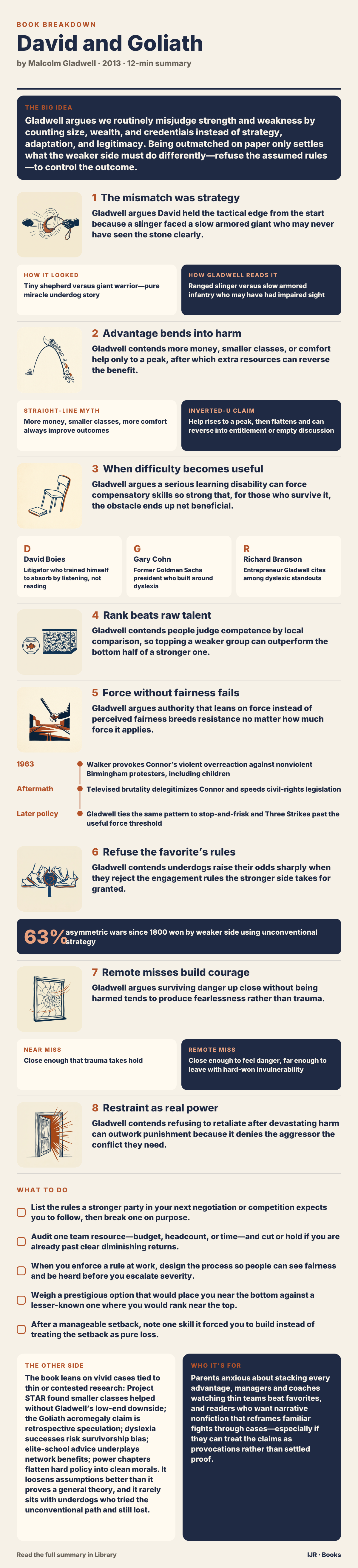
Gladwell argues David held the tactical edge from the start because a slinger faced a slow armored giant who may never have seen the stone clearly.
How it looked
Tiny shepherd versus giant warrior—pure miracle underdog story
How Gladwell reads it
Ranged slinger versus slow armored infantry who may have had impaired sight
Gladwell rereads the famous duel as a category error, not a miracle. Goliath expected hand-to-hand combat as a heavily armored infantryman. David fought as a ranged shepherd.
A trained sling, Gladwell notes, could deliver force and accuracy like a small-caliber handgun. Physicians have floated acromegaly to explain Goliath’s size, slow approach, need for a guide, and vision complaints. If so, the giant may never have locked onto the smaller figure.
The two were mismatched in strategy, and only one side understood it. Underdog wins, in this frame, are often the predictable result of refusing the favorite’s terms rather than flukes of luck.
That opening sets every later domain—classrooms, courts, battlefields, grief—against the same question: what looks like weakness, and what actually decides the fight.
In practice: David never closed for sword combat; he stayed at sling range against a target built only for close quarters.
2
Advantage bends into harm
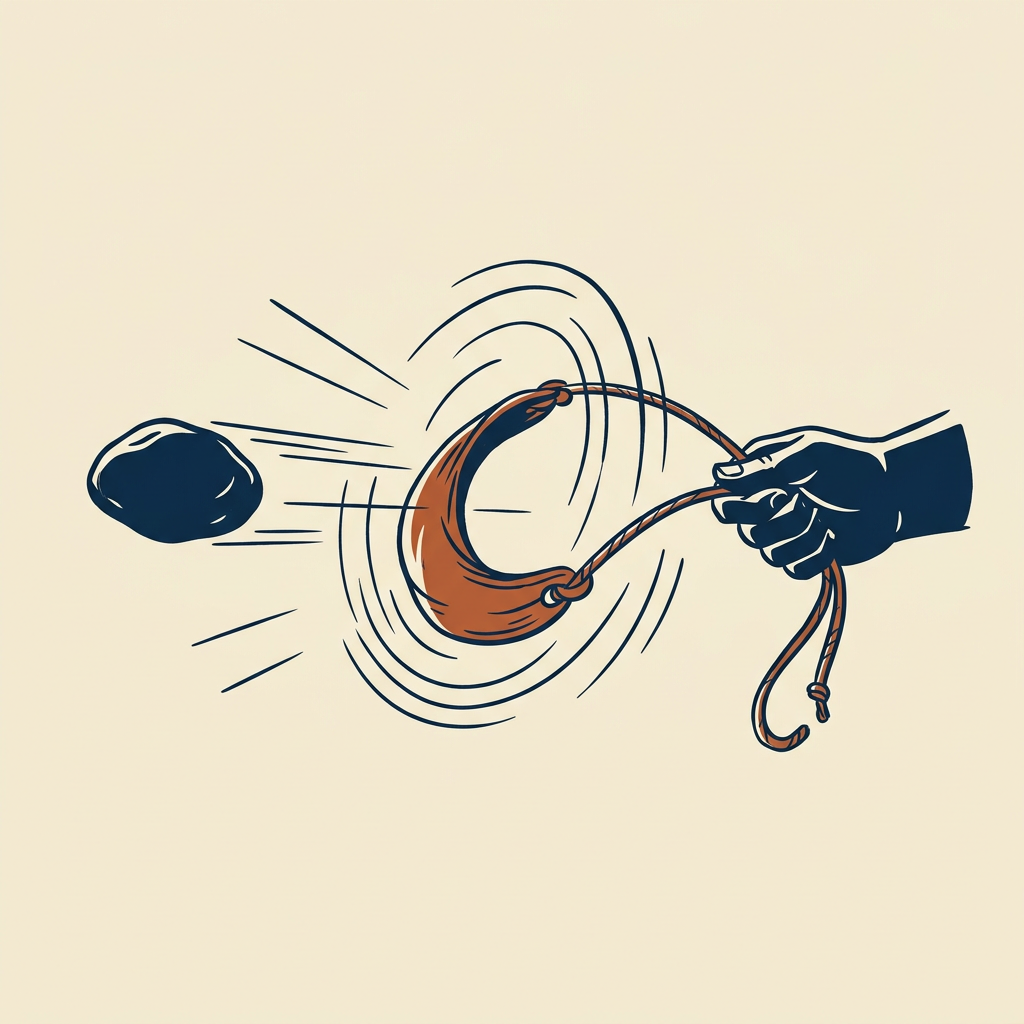
Gladwell contends more money, smaller classes, or comfort help only to a peak, after which extra resources can reverse the benefit.
Straight-line myth
More money, smaller classes, more comfort always improve outcomes
Inverted-U claim
Help rises to a peak, then flattens and can reverse into entitlement or empty discussion
He introduces an inverted-U curve for how advantages behave. Up to a threshold, more of a good thing helps. Past it, gains flatten and then turn negative.
Classroom size is his school example: thirty-five students worse than eighteen, yet eight or nine can lack enough peers for real discussion and viewpoint range. Parental wealth gets the same treatment. Children raised with abundant money can lose ordinary friction that teaches limits, producing entitlement and lower resilience.
Psychologists studying affluent families, he notes, sometimes find worse substance use and anxiety than in moderate-income homes. We treat the resource-outcome link as a straight line when it is often curved, with a sweet spot in the middle.
Institutions and parents chasing the largest possible edge may already be on the wrong side of the peak. Disadvantage is not merely missing advantage; both live on one curve.
In practice: A class cut from thirty-five to eighteen helps; pushing further to eight or nine can starve the peer mix that makes discussion work.
3
When difficulty becomes useful
Gladwell argues a serious learning disability can force compensatory skills so strong that, for those who survive it, the obstacle ends up net beneficial.
- DDavid BoiesLitigator who trained himself to absorb by listening, not reading
- GGary CohnFormer Goldman Sachs president who built around dyslexia
- RRichard BransonEntrepreneur Gladwell cites among dyslexic standouts
He profiles dyslexic successes including litigator David Boies, former Goldman Sachs president Gary Cohn, and entrepreneur Richard Branson. Blocked from fluent reading, they built exceptional memory, listening, delegation, and early ease with failure.
Gladwell borrows Robert Bjork’s term “desirable difficulty” for an obstacle that changes strategy rather than only subtracting from performance. Boies learned to absorb by ear, a skill that later let him track live courtroom testimony.
Childhood struggle that forces independence or unconventional problem-solving, he claims, can equip adults for high-pressure, ambiguous work better than a frictionless path. He is careful: this is not a brief for imposing hardship, and most people with dyslexia do not become his profiled successes.
The chapter still asks readers to treat those survivors as data that complicate a pure-subtraction story of disability—even while the sample of who talks to him remains a live tension.
In practice: Boies could not lean on reading fluency, so courtroom listening in real time became his edge.
4
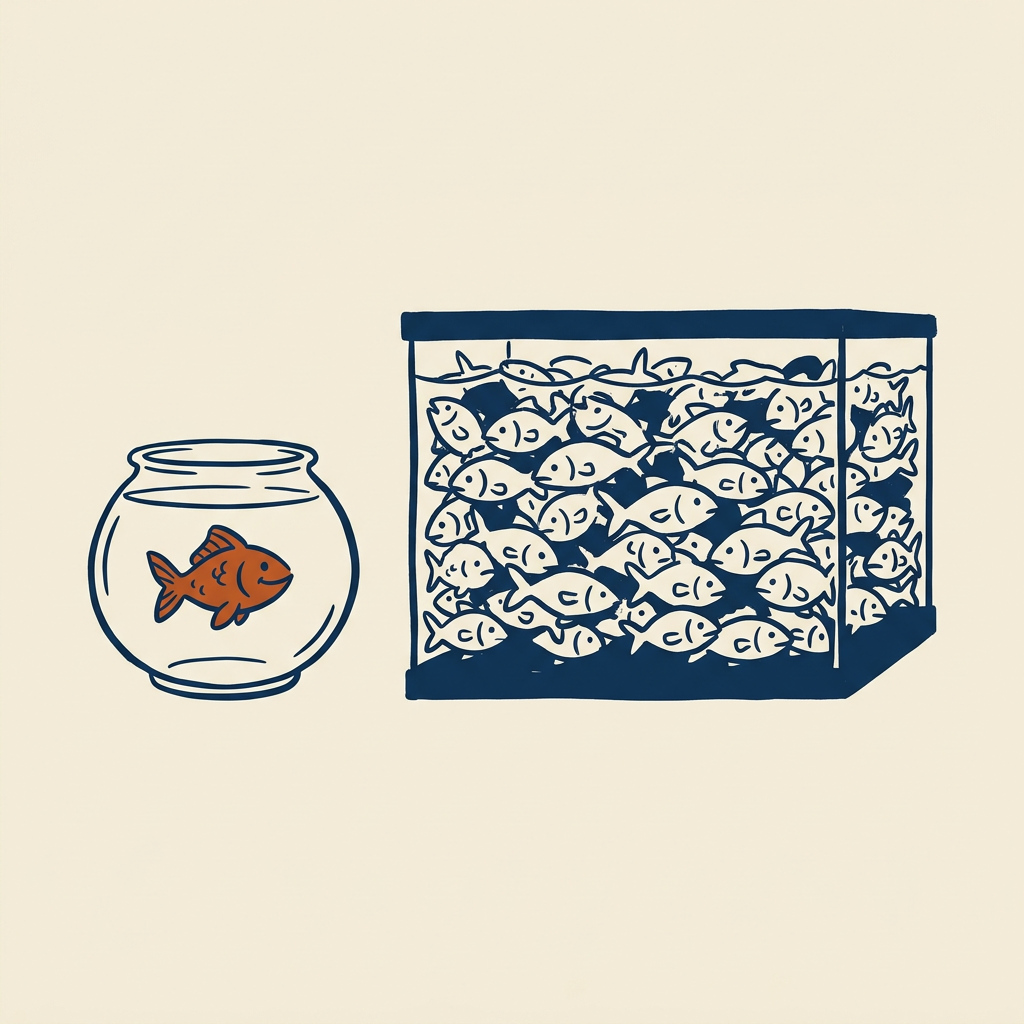
Rank beats raw talent
Gladwell contends people judge competence by local comparison, so topping a weaker group can outperform the bottom half of a stronger one.
He draws on relative deprivation: sense of ability tracks local rank more than objective skill. Impressionist painters, rejected again and again by the Paris Salon, stopped fighting for scraps inside that elite pool and founded their own exhibitions.
As big fish in a smaller pond they built confidence and reputation that later reshaped the art world. Gladwell pairs this with STEM research: strong math and science students at elite universities abandon science majors more often than similarly able students at less selective schools.
At the elite school they sit in the bottom half; absolute ability is unchanged, but relative standing discourages them. Prestige still helps sometimes, he grants. Its benefits, though, interact with a psychological mechanism admissions rarely price in.
For a subset—especially in hard technical fields—a pond where they can be among the strongest may yield more persistence than a pond stacked with even stronger peers.
In practice: Salon rejects who ran independent Impressionist shows gained the confidence the crowded elite venue would not give them.
5
Force without fairness fails
Gladwell argues authority that leans on force instead of perceived fairness breeds resistance no matter how much force it applies.
- 1963Walker provokes Connor’s violent overreaction against nonviolent Birmingham protesters, including children
- AftermathTelevised brutality delegitimizes Connor and speeds civil-rights legislation
- Later policyGladwell ties the same pattern to stop-and-frisk and Three Strikes past the useful force threshold
In 1963 Birmingham, strategist Wyatt Walker deliberately drew police commissioner Bull Connor into televised violence against nonviolent protesters, including children. The brutality did not crush the movement; it stripped Connor’s legitimacy before a national audience and sped civil-rights legislation.
Gladwell links this to Tom Tyler’s procedural-justice work: people obey less from fear of punishment than from seeing process as fair, consistent, and open to their side. He extends the point to aggressive modern tactics such as stop-and-frisk and California’s Three Strikes law.
Past a threshold, harsher enforcement stops deterring crime and starts eroding the community trust policing actually needs. This is the inverted-U applied to institutional power: force works until it makes the target population see authority as illegitimate rather than merely strict.
The claim scales from a police department and a neighborhood to any hierarchy that confuses raw pressure with durable compliance.
In practice: Connor’s televised crackdown on child marchers accelerated the very civil-rights gains he meant to block.
6
Refuse the favorite’s rules
Gladwell contends underdogs raise their odds sharply when they reject the engagement rules the stronger side takes for granted.
63%
asymmetric wars since 1800 won by weaker side using unconventional strategy
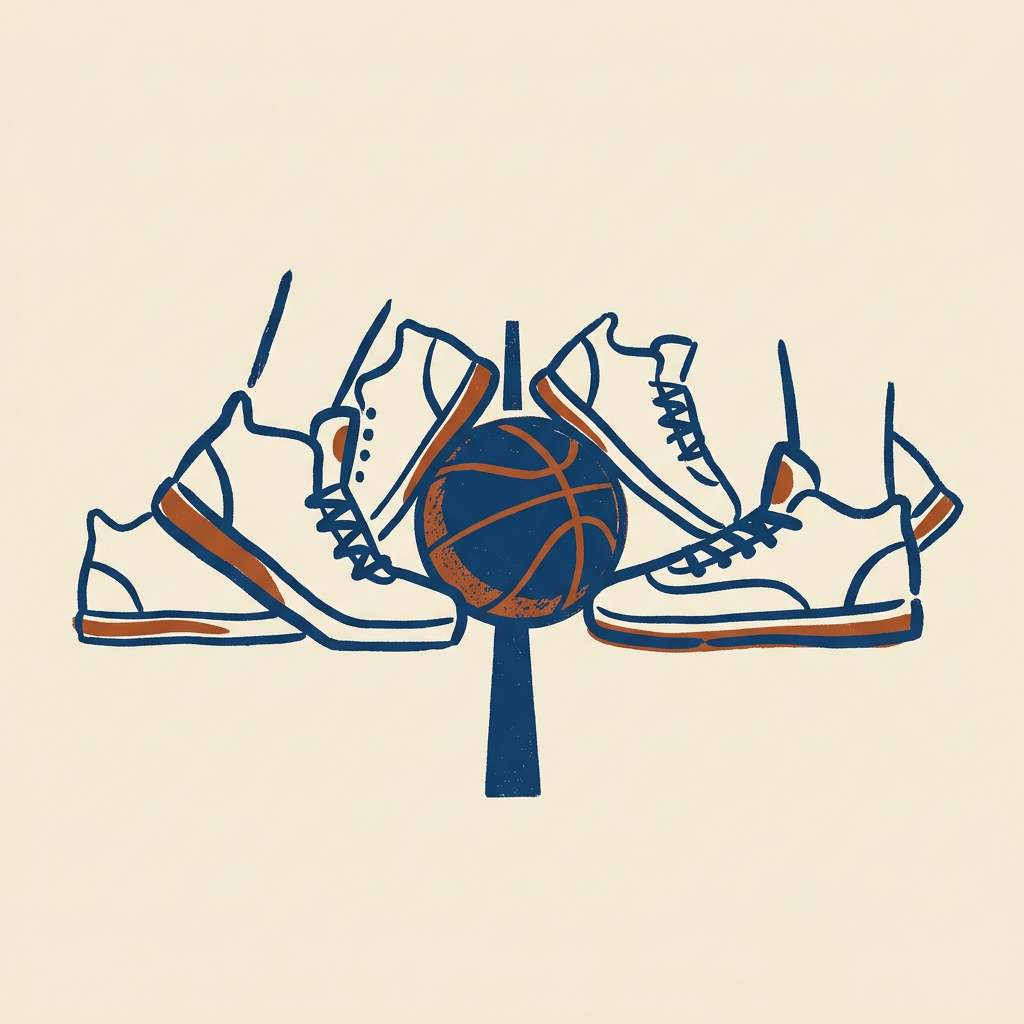
Silicon Valley executive Vivek Ranadive, with no basketball background, coached his daughter’s ordinary youth team into a national tournament by running a relentless full-court press. His players could not win a conventional half-court shooting game, so he changed the terms.
T. E. Lawrence’s Arab irregulars in World War I avoided Ottoman garrisons and hit the undefended Hejaz railway instead, outmatching conventional forces without meeting them head-on. Political scientist Ivan Arreguín-Toft’s study of asymmetric conflicts since 1800 found weaker parties using unconventional strategy won roughly sixty-three percent of the time—far higher than when they fought as the stronger side expected.
Resource mismatch is decisive only if the underdog agrees to the favorite’s preferred contest. Refusing those terms is often uncomfortable, socially punished, or exhausting, which is why most underdogs still play along.
The chapter is the practical payoff of the David opening: same logic in sport, geopolitics, and business.
In practice: Ranadive’s press turned mediocre shooters into a team that beat more talented squads unprepared for constant full-court pressure.

7
Remote misses build courage
Gladwell argues surviving danger up close without being harmed tends to produce fearlessness rather than trauma.
Near miss
Close enough that trauma takes hold
Remote miss
Close enough to feel danger, far enough to leave with hard-won invulnerability
During the London Blitz of 1940–41, British psychiatrists including J. T. MacCurdy expected mass psychiatric collapse. Morale mostly held; in some cases it improved.
MacCurdy separated “near misses” close enough to traumatize from “remote misses” close enough to feel danger yet far enough to walk away whole. The remote-miss majority, Gladwell adopts, left with a sense of invulnerability because they had met danger and survived.
Repeated exposure of that kind, he claims, builds courage safety-from-a-distance cannot, because courage needs having been afraid and come through it. He stretches the idea to childhood adversity: a manageable brush with hardship, loss, or failure—short of genuine trauma—can inoculate against later fear.
The chapter is more speculative, resting on one wartime theory pushed far beyond its setting, yet it readies the final turn toward people who answer extreme loss with composed defiance rather than paralysis.
In practice: Blitz civilians who felt the bombs yet emerged unscathed often grew steadier, not broken, contrary to psychiatric expectation.
8
Restraint as real power
Gladwell contends refusing to retaliate after devastating harm can outwork punishment because it denies the aggressor the conflict they need.
Wilma Derksen’s teenage daughter Candace was murdered in Winnipeg in 1984. Derksen publicly forgave the killer before he was identified—a choice that confused and angered people who expected fury. Gladwell frames it as strategic refusal to let grief harden into decades of vengeance that would consume her family.
He pairs her with Le Chambon-sur-Lignon, a French Protestant village of Huguenot descendants who sheltered thousands of Jewish refugees under Nazi occupation, drawing on their own memory of persecution to offer protection instead of fear. He revisits the Troubles, where British crackdowns on the IRA and Catholic communities repeatedly fueled recruitment rather than ending it—the same legitimacy trap as Birmingham and harsh policing.
Across these closings, parties who would not answer force with force, or grief with rage, often held more genuine power because sustained conflict needs both sides playing. Gladwell does not say forgiveness always works; he presents it as a hard, sometimes cruel choice, not easy virtue.
Still he ends insisting the instinct to hit back, however natural, is not always the instinct that wins.
In practice: Derksen’s early public forgiveness blocked the long family war of vengeance observers assumed must follow the murder.
Key terms
- Inverted-U curve Gladwell’s shape for advantage: help rises with more resources, peaks, then flattens and can reverse into harm.
- Desirable difficulty An obstacle that changes how someone works—building stronger backup skills—rather than only subtracting from performance.
- Relative deprivation Judging your ability by local rank among the people around you instead of by objective skill alone.
- Big fish, small pond Choosing a weaker or smaller group where you rank high so confidence and persistence rise.
- Procedural justice The finding that people comply when they see process as fair and open to their side, not mainly from fear of harsh punishment.
- Remote miss Brush with real danger that you survive unharmed, which can leave invulnerability instead of trauma.
- Unconventional strategy Refusing the stronger side’s preferred rules of engagement so the resource gap matters less.
What to do
- List the rules a stronger party in your next negotiation or competition expects you to follow, then break one on purpose.
- Audit one team resource—budget, headcount, or time—and cut or hold if you are already past clear diminishing returns.
- When you enforce a rule at work, design the process so people can see fairness and be heard before you escalate severity.
- Weigh a prestigious option that would place you near the bottom against a lesser-known one where you would rank near the top.
- After a manageable setback, note one skill it forced you to build instead of treating the setback as pure loss.
Questions to think with
- Where in your work or parenting are you still assuming more resources must equal better outcomes?
- Which rule of engagement in your field do favorites count on everyone accepting?
- Have you ever left a stronger pond and performed better—what changed in your daily rank?
- When has harsher enforcement in a group you know produced less compliance, not more?
- What would refusing retaliation cost you, and what conflict would it starve?
The other side
The book leans on vivid cases tied to thin or contested research: Project STAR found smaller classes helped without Gladwell’s low-end downside; the Goliath acromegaly claim is retrospective speculation; dyslexia successes risk survivorship bias; elite-school advice underplays network benefits; power chapters flatten hard policy into clean morals. It loosens assumptions better than it proves a general theory, and it rarely sits with underdogs who tried the unconventional path and still lost.
Who it's for
Parents anxious about stacking every advantage, managers and coaches watching thin teams beat favorites, and readers who want narrative nonfiction that reframes familiar fights through cases—especially if they can treat the claims as provocations rather than settled proof.