




True belonging starts when you stop fitting in
Anyone lonely inside their own tribe should hear Brown's claim that the deepest connection often follows rejection for refusing to change.
IJR · Oct 11, 2026 · 12 min read
In 60 seconds
- Fitting in means becoming who a group needs; belonging means being accepted as you already are, and the deepest connection often follows rejection for staying unchanged.
- True belonging is practiced in the wilderness—standing alone on your values with no guaranteed company—not behind the fence of group approval.
- Common enemy intimacy feels like belonging but depends on a shared target and dissolves once the enemy is gone, corroding real intimacy over time.
- Contempt survives at a distance through headlines and stereotypes; physical and relational proximity softens it without requiring you to abandon your values.
- Civility means naming what is false or harmful directly while refusing contempt, mockery, or writing the other person off entirely.
- Shared joy or grief with strangers rebuilds belonging weakened by isolation; the aim is a strong back for boundaries, a soft front for openness, and a wild heart that will not be tamed.
The big idea
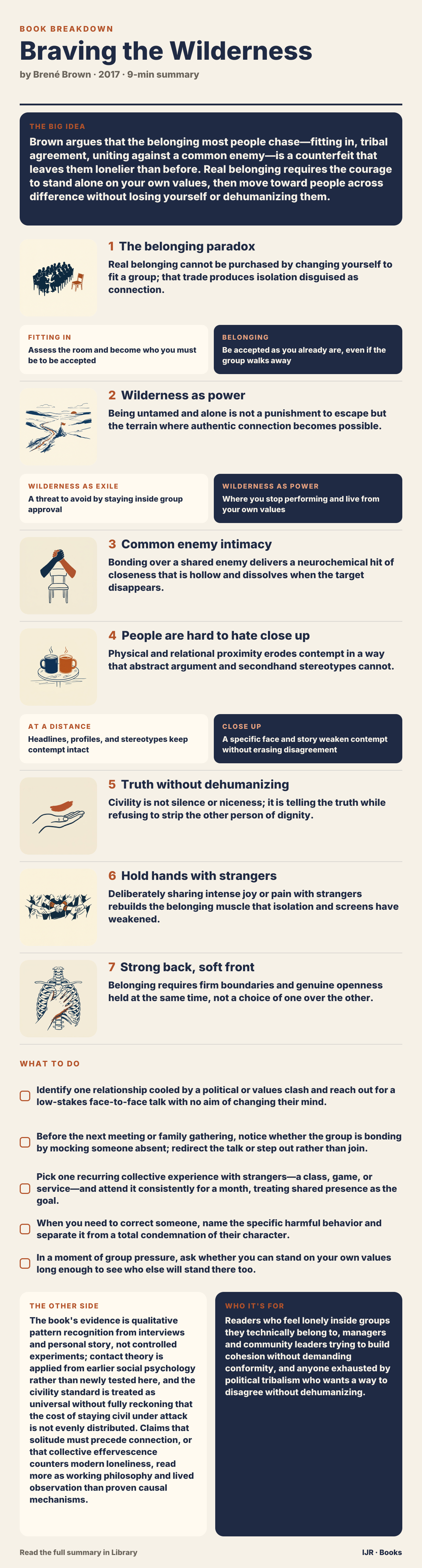
Brown argues that the belonging most people chase—fitting in, tribal agreement, uniting against a common enemy—is a counterfeit that leaves them lonelier than before. Real belonging requires the courage to stand alone on your own values, then move toward people across difference without losing yourself or dehumanizing them.
The book in brief
Brown starts from a painful everyday experience: people join groups, mirror the tribe, and still feel isolated. Drawing on years of interview patterns, she separates fitting in—reading the room and becoming acceptable—from belonging, which means being received as you already are. The people who reported the strongest connection were often those who had been rejected for refusing to reshape themselves. That inversion sets the book's problem: community bought with self-betrayal is not belonging at all.
She then reframes solitude. The wilderness is not exile to escape but the open ground where you stop performing an identity and live from your own values. Only from that untamed place, she holds, can you meet others as yourself rather than as a role. The emotional register shifts from checklist self-help to a meditation on tolerating exposure and disapproval.
From there the diagnosis turns outward to a hollow substitute she sees everywhere after sharp political sorting: bonding against a shared enemy. The rush feels like intimacy and delivers the same in-group warmth, yet it depends entirely on the target. Remove the enemy and the bond collapses because shared opposition never required shared values. Ordinary office gossip and family alliances run on the same fuel, not only partisan media.
The later chapters offer disciplines rather than a program. Move physically and relationally toward people you dislike so contempt has less room to survive. Tell the truth about harm without stripping dignity. Seek brief collective joy or grief with strangers to rebuild the muscle isolation has weakened. Hold firm boundaries and genuine openness at the same time. Belonging lands not as a group you finally join but as a practice you carry into every room, including rooms where you stand alone.
Context
Published in 2017 amid sharp political polarization, the book draws on Brown's qualitative research—thousands of stories coded through grounded theory—rather than controlled experiments. It mattered because it named a concrete failure mode: substituting shared hatred of an outgroup for genuine intimacy, and treating polarization as a belonging problem rather than only a political one.
The key ideas

1
The belonging paradox
Real belonging cannot be purchased by changing yourself to fit a group; that trade produces isolation disguised as connection.
Fitting in
Assess the room and become who you must be to be accepted
Belonging
Be accepted as you already are, even if the group walks away
Brown's interview work drew a clean line most people blur. Fitting in is a social calculation: scan the room, become who you need to be, collect acceptance. Belonging is the opposite posture—being received without the costume. Her team kept finding the same pattern across stories: the people who described the deepest sense of connection were often those a group had pushed out for refusing to bend.
The paradox follows directly. You must be willing to stand completely alone, sometimes rejected by everyone you know, in order to keep something true about yourself. Community is not the enemy; community bought with self-betrayal is. Belonging stops being a destination you reach by joining the right network and becomes a practice you carry into every room, including rooms where you are the sole dissent.
That framing inverts the usual advice to join more groups and build more ties. The wilderness image she previews is the logical next step: a place with no clear path and no guaranteed company, which she treats as the actual location of belonging rather than its opposite.
In practice: She quit the Episcopal church of her childhood, later re-entering organized religion only on terms of spiritual honesty rather than the comfort of a ready-made community.

2
Wilderness as power
Being untamed and alone is not a punishment to escape but the terrain where authentic connection becomes possible.
Wilderness as exile
A threat to avoid by staying inside group approval
Wilderness as power
Where you stop performing and live from your own values
Most people treat the wilderness as a threat: stay inside the fence of group approval or be cast out. Brown flips the valence. Drawing on Angelou's sense that freedom arrives when you belong no place and every place, she treats the wilderness as the ground where performance ends and values begin.
In that uncertain terrain you meet others as yourself rather than as a role. Solitude and self-possession, on her reading of the interview data, precede genuine connection instead of following it. The practical question changes from how to get back inside the group to whether you can stand on your own values long enough to see who else is willing to stand there too.
The chapter sets the book's emotional temperature. It is less a list of tactics than a call to tolerate exposure and the loss of approvals you once needed. Readers should hear the causal claim as a working philosophy drawn from stories, not a proven sequence.
In practice: After her TED talks went viral she lived the isolation of being famous and misunderstood at once, and had to learn to tolerate disapproval from people whose approval she used to require.

3
Common enemy intimacy
Bonding over a shared enemy delivers a neurochemical hit of closeness that is hollow and dissolves when the target disappears.
Brown names the rush that comes from uniting against a political opponent, a rival team, or the coworker everyone agrees to dislike. It feels like belonging because it produces in-group warmth. It is not belonging because the bond is organized around opposition, not shared values.
Remove the enemy and the intimacy evaporates. She points to partisan sorting and media ecosystems that reward outrage because outrage drives engagement. Dehumanizing language makes cruelty easier to justify—an analogy she draws carefully from genocide scholarship and past work with law enforcement trainers, stressing degree rather than equivalence.
The disagreeable claim is that ordinary people run the same pattern constantly: office gossip, family alliances, fandoms. Whenever the fastest route to feeling connected is finding someone to look down on together, common enemy intimacy is at work. The slower replacement she develops later is shared vulnerability and shared values that do not require a target to survive.
In practice: She treats the surge of partisan sorting in American politics after 2016, amplified by social media algorithms that reward outrage, as the central public case.

4
People are hard to hate close up
Physical and relational proximity erodes contempt in a way that abstract argument and secondhand stereotypes cannot.
At a distance
Headlines, profiles, and stereotypes keep contempt intact
Close up
A specific face and story weaken contempt without erasing disagreement
Contempt thrives at a distance—headlines, profiles, inherited caricatures. Brown's repeated personal practice is simple: people are hard to hate close up, so move in. Contact with a specific face and a specific story tends to soften anger without erasing disagreement.
She is explicit about the limits. Moving in is not capitulation on values or a demand to treat harmful positions as acceptable. It is the separation of person from position enough to stay in relationship while still opposing the stance. She leans on contact theory associated with Gordon Allport's 1954 work: structured contact under conditions of equal status, common goals, and support can reduce prejudice. She applies that established idea to interview stories of family estrangement and political rifts rather than running a new controlled test.
The harder edge is her insistence that the practice matters most with people you cannot simply avoid. Cutting off family over politics is sometimes required for safety; it also forecloses the proximity that might reduce contempt on both sides.
In practice: At a gathering with people whose politics she found alarming, her anger softened—without disappearing—once she heard them talk about families and fears rather than voting records.

5
Truth without dehumanizing
Civility is not silence or niceness; it is telling the truth while refusing to strip the other person of dignity.
Brown draws a hard line between two failures that look like opposites. Staying silent to keep the peace is self-betrayal. Speaking so bluntly that the other person is mocked or written off entirely forecloses any chance of being heard. Both abandon the relationship.
Her standard—speak truth to bullshit, be civil—demands naming what is false or harmful directly while rejecting contempt and dehumanizing language. She separates this from being 'nice,' a surface pleasantness that smooths conflict away. True civility is harder because it requires staying in the room during disagreement.
The move is to correct a specific behavior without condemning the whole character, on the theory that people can still hear you if they do not feel entirely discarded. She offers the standard as a moral commitment and practice, not as a technique validated by persuasion studies.
In practice: In workplace and family settings she practiced calling out a racist joke while explicitly separating that behavior from a wholesale condemnation of the person's character.

6
Hold hands with strangers
Deliberately sharing intense joy or pain with strangers rebuilds the belonging muscle that isolation and screens have weakened.
Brown borrows Durkheim's early-twentieth-century idea of collective effervescence: the energy that rises when strangers share a concert, a funeral, a game, or a protest. Modern life, she argues, has thinned the rituals that once delivered that energy and replaced them with isolated, screen-mediated consumption.
That loss helps explain rising loneliness alongside more digital connections than ever. Her instruction is almost literal. Seek low-stakes collective experiences with people you do not know and will probably never see again. Singing the same song or grieving the same loss for an hour rebuilds tolerance for vulnerability outside your existing circle.
If common enemy intimacy is a false substitute, collective joy and collective grief are among the few replacements that do not need an enemy to stay alive. She treats the link as lived observation applying an old sociological concept to contemporary loneliness, not as new causal data.
In practice: Shortly after a personal loss she stood in a concert crowd and found unexpected comfort in the shared emotion of strangers.

7
Strong back, soft front
Belonging requires firm boundaries and genuine openness held at the same time, not a choice of one over the other.
Brown closes with an image from Zen teacher Roshi Joan Halifax: strong back, soft front, wild heart. The strong back is boundaries, values, and self-respect firm enough that social pressure does not collapse you. The soft front is real openness—the willingness to be moved. The wild heart is the refusal to be tamed into someone else's preferred version of you.
Most people default to a single posture. A rigid back with a hardened front uses armor instead of boundaries and repels connection. An overly soft front with no back dissolves into whatever the group wants and sacrifices the self that connection requires. Neither yields belonging.
The image synthesizes the whole arc. Standing alone in the wilderness needs the strong back. Moving in on people you disagree with needs the soft front. Refusing common-enemy shortcuts needs the wild heart. She offers no step-by-step method—only the picture to return to when a moment demands more boundary or more openness.
In practice: She describes disciplining her own child while remaining emotionally present, neither purely punitive nor purely permissive, as the same posture that scales to workplaces and communities.
Key terms
- Fitting in Reading a situation and becoming who you must be in order to be accepted
- True belonging Being accepted as you already are; a practice of standing on your values even when you stand alone
- The wilderness Untamed ground where you stop performing for an audience and live from your own values
- Common enemy intimacy The rush of closeness from uniting against a shared target; it feels like belonging but collapses without the enemy
- Speak truth to bullshit, be civil Name what is false or harmful directly while refusing contempt, mockery, or dehumanizing language
- Collective effervescence The energy that rises when strangers share an intense emotional experience such as a concert, funeral, or protest
- Strong back, soft front, wild heart Firm boundaries plus genuine openness plus the refusal to be reshaped into someone else's preferred self
What to do
- Identify one relationship cooled by a political or values clash and reach out for a low-stakes face-to-face talk with no aim of changing their mind.
- Before the next meeting or family gathering, notice whether the group is bonding by mocking someone absent; redirect the talk or step out rather than join.
- Pick one recurring collective experience with strangers—a class, game, or service—and attend it consistently for a month, treating shared presence as the goal.
- When you need to correct someone, name the specific harmful behavior and separate it from a total condemnation of their character.
- In a moment of group pressure, ask whether you can stand on your own values long enough to see who else will stand there too.
Questions to think with
- Where have you traded authenticity for group acceptance, and what isolation arrived dressed as connection?
- When has shared dislike of someone felt like friendship, and what remained once the target was gone?
- Who do you hold in contempt only at a distance, and what would moving one step closer require of you?
- Is your current community organized more around shared values or shared opposition?
- In hard conversations, do you default to a hardened front, a missing back, or the harder balance of both?
The other side
The book's evidence is qualitative pattern recognition from interviews and personal story, not controlled experiments; contact theory is applied from earlier social psychology rather than newly tested here, and the civility standard is treated as universal without fully reckoning that the cost of staying civil under attack is not evenly distributed. Claims that solitude must precede connection, or that collective effervescence counters modern loneliness, read more as working philosophy and lived observation than proven causal mechanisms.
Who it's for
Readers who feel lonely inside groups they technically belong to, managers and community leaders trying to build cohesion without demanding conformity, and anyone exhausted by political tribalism who wants a way to disagree without dehumanizing.