




Attachment styles, not chemistry, run the chase-and-withdraw trap
Attachment strategies—not chemistry or character—drive the chase-and-withdraw pattern that keeps couples stuck.
IJR · Oct 13, 2026 · 12 min read
In 60 seconds
- Adult romantic bonding runs on the same biological attachment system that binds infants to caregivers, not on chemistry quizzes or willpower.
- Survey data the authors cite put roughly half of adults as secure, about a fifth anxious, roughly a quarter avoidant, plus a small fearful mix.
- Anxious systems hyperactivate and protest until reassured; avoidant systems deactivate and create distance after closeness.
- Anxious and avoidant people pair more often than chance, locking into a self-reinforcing pursuit-withdrawal loop.
- Reliable dependency on a partner frees real independence—the dependency paradox—and direct need-statements beat tests and silence.
- Attachment style shows early in dating; screen for consistency before chemistry locks you in, and some anxious-avoidant pairings are better ended than forced.
The big idea
Levine and Heller argue that adult love is an attachment system inherited from infancy, sorting people into secure, anxious, or avoidant strategies that predict how they seek closeness and handle threat. Naming the pattern lets couples interrupt destructive cycles, choose better partners, and treat need as legitimate wiring rather than weakness.
The book in brief
The book opens by reframing romantic love as the same evolved proximity-seeking system Bowlby described in infants: a partner becomes a safe haven under stress and a secure base for the rest of life. Treating delayed texts or need for notice as character flaws misses the machinery.
It then maps three adult strategies—secure, anxious, avoidant, plus a rarer fearful mix—drawn from the same categories Ainsworth saw in toddlers and that Hazan and Shaver’s 1987 love quiz found in adults. These are coping strategies for one system, not degrees of love, and they can shift with a secure partner or deliberate practice.
Chapters on each style show the anxious pattern as a hyperactivated alarm that escalates into protest behavior, the avoidant pattern as deactivation that suppresses need and catalogs flaws after intimacy, and security as the quiet baseline that lasts longer and can calm the other two.
The middle of the book names the trap: anxious and avoidant people attract each other, then lock into a vicious cycle of pursuit and withdrawal kept alive by intermittent reinforcement. Willpower and generic communication tips usually lose to the loop.
The closing arc argues for the dependency paradox—reliable reliance produces real independence—plus stating needs plainly instead of testing, and screening for attachment consistency early in dating before deep attachment forms. Some pairings that never move are better ended.
Context
Levine and Heller popularize decades of attachment research—Bowlby’s infant system, Ainsworth’s toddler patterns, and Hazan and Shaver’s 1987 adult extension—for a general audience in 2010. The book mattered because it gave ordinary readers a shared vocabulary for chase-and-withdraw dynamics that dating advice usually treated as chemistry or maturity problems.
The key ideas
1
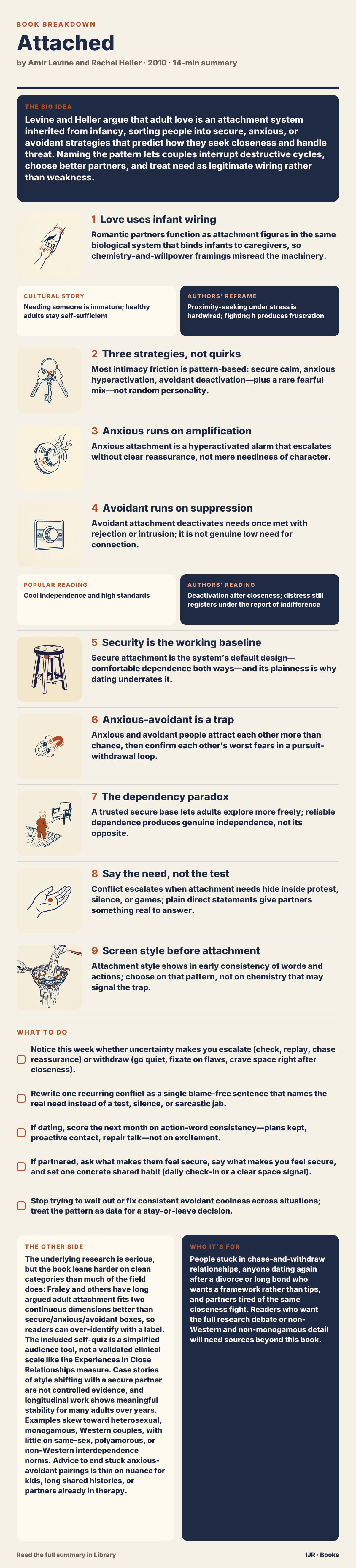
Love uses infant wiring
Romantic partners function as attachment figures in the same biological system that binds infants to caregivers, so chemistry-and-willpower framings misread the machinery.
Cultural story
Needing someone is immature; healthy adults stay self-sufficient
Authors’ reframe
Proximity-seeking under stress is hardwired; fighting it produces frustration
Bowlby observed that infants are wired to seek proximity to a caregiver who is both safe haven in distress and secure base for exploration. Levine and Heller treat adult partners as the same kind of figure, not a separate cultural invention.
Hazan and Shaver’s 1987 newspaper love quiz asked adults to describe relationships in infant-attachment language. Responses mapped onto Ainsworth’s three toddler patterns in similar proportions, which reframed adult bonding as a continuation of that system.
A slow text reply or a need for advance plans is then the visible output of a nervous system doing what it evolved to do, not a flaw to argue away. The authors push against the cultural message that needing someone is immature; they say the drive is hardwired and universal, and fighting it breeds frustration.
In practice: A partner who needs notice before making plans is running an attachment system, not displaying a character defect to be debated out of them.
2
Three strategies, not quirks
Most intimacy friction is pattern-based: secure calm, anxious hyperactivation, avoidant deactivation—plus a rare fearful mix—not random personality.
Adults sort into secure, anxious, and avoidant styles, with a smaller anxious-avoidant or fearful group. The authors cite survey work such as Mickelson, Kessler, and Shaver’s 1997 nationally representative study: roughly half secure, about a fifth anxious, roughly a quarter avoidant, small remainder fearful.
These are strategies for managing one attachment system, not scores of how much someone loves. A secure system stays relatively calm under ordinary stress; an anxious system hyperactivates and amplifies threat until reassurance arrives; an avoidant system deactivates and suppresses need signals to protect independence.
Style is not fixed by early care alone. Accumulated adult relationships can shift it, which is why choosing partners and practicing new behavior matters instead of fatalism. Treat the lens like knowing someone’s native language: it explains why the same delayed call is a shrug for one person and a five-alarm event for another.
In practice: One partner shrugs at a canceled weekend plan; the other spirals into crisis over the identical message—same event, different strategy.
3
Anxious runs on amplification
Anxious attachment is a hyperactivated alarm that escalates without clear reassurance, not mere neediness of character.
Inconsistent early care often teaches that comfort is unreliable, so the system stays on high alert for distance. Small shifts—a slower reply, a changed phone tone, an unanswered weekend question—can trigger protest behavior: the adult form of a child’s cry-and-follow strategy when separated from a parent.
Protest can look like repeated texting, replaying talks for hidden meaning, or picking a fight to force engagement. It is not cool manipulation; it is an evolved bid to restore proximity.
The pattern self-reinforces. Escalation sometimes finally pulls a response from an inconsistent partner, and intermittent reward is the hardest pattern to extinguish. Wanting closeness is normal; using rising alarm to get it often pushes partners away.
In practice: A woman reads her partner’s late-night silence as proof the relationship is ending; he was only asleep.
4
Avoidant runs on suppression
Avoidant attachment deactivates needs once met with rejection or intrusion; it is not genuine low need for connection.
Popular reading
Cool independence and high standards
Authors’ reading
Deactivation after closeness; distress still registers under the report of indifference
Where anxiety amplifies, avoidance suppresses. Early lessons that expressing need brought rejection or overwhelm lead the system to minimize closeness and prize independence.
In couples this shows up as discomfort when intimacy rises fast, a preference for leftover distance even in commitment, and deactivating moves: cataloguing a partner’s flaws, idealizing an ex, or picking a fight right after closeness. The person need not consciously decide to sabotage.
The authors reject the popular reading of this as pure independence or high standards. They note physiological and imaging work showing avoidant people still register separation distress while reporting indifference. The signal is suppressed, not absent—which means the strategy has a cost and can ease under steady, undemanding security.
In practice: A man feels suffocated and suddenly finds his partner’s minor habits unbearable right after she says she loves him.
5
Security is the working baseline
Secure attachment is the system’s default design—comfortable dependence both ways—and its plainness is why dating underrates it.
Secure people depend and are depended on without treating ordinary uncertainty as emergency. They name needs and disappointments more directly. Hazan and Shaver’s 1987 data and later literature the authors cite show their relationships lasting longer on average and rating more satisfying, with less conflict volatility.
Security can be somewhat contagious. Steady reassurance calms an anxious partner; closeness without pressure reassures an avoidant one. Clinical cases in the book describe anxious clients whose symptoms fell sharply after years with a secure partner, evidence that current context can move style.
Two practical conclusions follow: secure partners are disproportionately good long-term bets even when early dates feel less dramatic, and anxious or avoidant people can practice secure behaviors instead of waiting for the nervous system to change first.
In practice: An anxious client’s protest spirals ease over several years with a partner who answers reliably and does not punish bids for closeness.
6
Anxious-avoidant is a trap
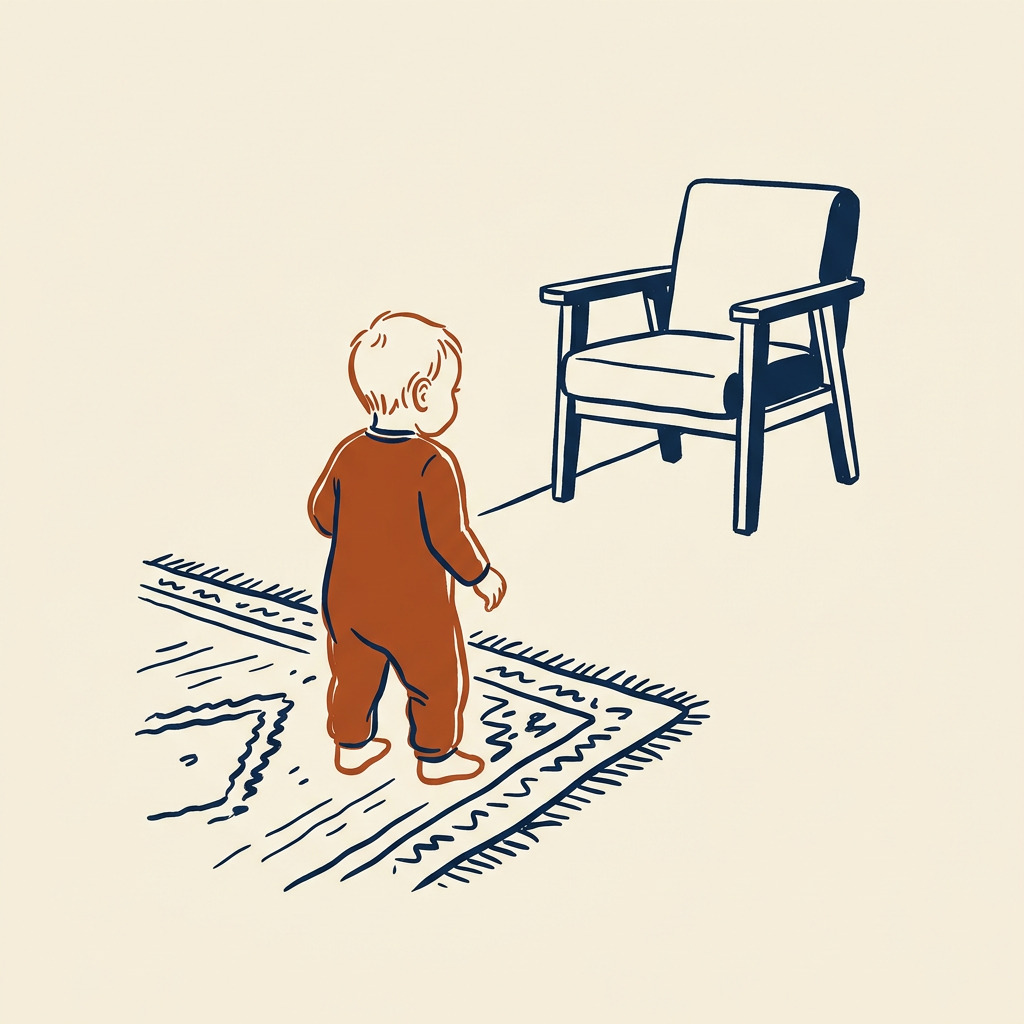
Anxious and avoidant people attract each other more than chance, then confirm each other’s worst fears in a pursuit-withdrawal loop.
Early on, anxious intensity can read as flattering validation and avoidant coolness as confidence, so each is drawn to the trait that later hurts most.
Once paired, the anxious bid for reassurance triggers avoidant deactivation—more distance, less disclosure—which spikes anxious alarm and more pursuit, which produces more withdrawal. Neither is deliberately cruel; each runs an automatic strategy that misfires with this partner.
Intermittent reinforcement hardens the loop: occasional warmth keeps the anxious partner hooked; occasional backing-off lets the avoidant partner re-enter briefly before leaving again. Technique alone usually loses because the trigger-response cycle reactivates faster than either person can apply a tip. The authors’ harder claim is that some of these pairings are better ended when the avoidant partner will not even name the pattern.
In practice: She texts more after he goes quiet; his quiet deepens; a brief warm weekend resets both just enough to start the week’s chase again.
7
The dependency paradox
A trusted secure base lets adults explore more freely; reliable dependence produces genuine independence, not its opposite.
Toddlers explore a room longer and more boldly when a trusted caregiver sits as secure base. Levine and Heller say the same mechanism runs in adult pairs: when support is available on request, people spend fewer resources monitoring the bond and take more risks elsewhere—career moves, hard talks, creative work.
That undercuts the avoidant tradeoff of independence versus closeness, and it complicates advice that anxious people should simply force self-reliance. Forced self-reliance without a base often suppresses the signal the way avoidance does; it does not calm the system.
Couples need not apologize for check-ins, reassurance, or affection that outsiders call clingy if both find the arrangement workable. The test is whether both people feel calm enough to function well outside the relationship.
In practice: With a partner who answers when asked for support, someone finally risks the career change they kept postponing while monitoring the relationship’s temperature.

8
Say the need, not the test
Conflict escalates when attachment needs hide inside protest, silence, or games; plain direct statements give partners something real to answer.
Anxious partners may fight about dishes when the real issue is emotional distance. Avoidant partners may go quiet rather than say they feel crowded. Both strategies share indirectness.
The skill the authors teach is naming the attachment need without accusation: a lunch text when daytime silence spikes anxiety, stated cleanly. They contrast that with protest and games—waiting to see who texts first, letting a call ring to look less invested, ultimatums aimed at extracting reassurance.
Those tactics can buy short-term relief but train the pair to answer manipulation instead of truth, eroding trust. Directness is harder for avoidant people who have little practice noticing need, and scarier for anxious people who fear plain asks invite rejection. The authors still hold that short-term vulnerability beats long-term corrosion because clear information is what makes reliable responsiveness possible.
In practice: Instead of sarcastic silence after a quiet morning, one partner says they get anxious without daytime contact and would like a quick midday text.
9
Screen style before attachment
Attachment style shows in early consistency of words and actions; choose on that pattern, not on chemistry that may signal the trap.
Infatuation can mask warnings because intense chemistry itself sometimes marks an anxious-avoidant pull rather than fit. The authors want attention on follow-through across weeks: plans kept, proactive contact without chase, small conflicts repaired by talk instead of withdrawal or blow-up.
A calm, even slightly boring early bond is often security, not low compatibility—the same underrating of secure partners named earlier. Consistent avoidant coolness across partners and settings predicts a durable pattern, not a phase you can wait out or fix.
Screening only pays off if you already know your own style, can spot hyperactivation and deactivation, value workable dependence over false self-sufficiency, and practice direct asks—before you are deeply attached to someone whose strategy collides with yours.
In practice: Over a month of dating, one person keeps every plan and raises a scheduling snag in the same conversation; another repeatedly cancels and reappears with intensity—the pattern is already visible.
Key terms
- Attachment system The biological wiring that makes partners safe havens in distress and secure bases for exploration—the same system infants use with caregivers.
- Secure style Default calm functioning: can depend and be depended on, names needs directly, treats ordinary uncertainty as ordinary.
- Anxious style / hyperactivation Alarm system that amplifies small signs of distance and escalates into protest until reassurance arrives.
- Avoidant style / deactivation Strategy that suppresses need signals, prizes distance, and uses mental moves that restore space after closeness.
- Protest behavior Evolved bids to restore proximity—repeated contact, fight-picking, meaning-hunting—not cool manipulation.
- Deactivating strategies Flaw-cataloguing, ex-idealizing, or post-closeness fights that create distance without a conscious sabotage plan.
- Anxious-avoidant trap The self-perpetuating pursuit-withdrawal loop fueled by intermittent reinforcement on both sides.
- Dependency paradox Reliable ability to depend on a partner is what frees real independence and risk-taking elsewhere.
- Fearful / anxious-avoidant mix The smaller pattern that combines high anxiety with high avoidance.
What to do
- Notice this week whether uncertainty makes you escalate (check, replay, chase reassurance) or withdraw (go quiet, fixate on flaws, crave space right after closeness).
- Rewrite one recurring conflict as a single blame-free sentence that names the real need instead of a test, silence, or sarcastic jab.
- If dating, score the next month on action-word consistency—plans kept, proactive contact, repair talk—not on excitement.
- If partnered, ask what makes them feel secure, say what makes you feel secure, and set one concrete shared habit (daily check-in or a clear space signal).
- Stop trying to wait out or fix consistent avoidant coolness across situations; treat the pattern as data for a stay-or-leave decision.
Questions to think with
- When a reply is slow, do you protest, deactivate, or state a need—and what did you learn that strategy would do?
- Which early-dating chemistry moments might have been anxious-avoidant pull rather than fit?
- Where do you still treat workable dependence as clinginess because of an independence ideal?
- If you are in a pursuit-withdrawal loop, has your partner ever named the pattern, or only re-entered intermittently?
- What would one week of scoring consistency over excitement change in who you answer?
The other side
The underlying research is serious, but the book leans harder on clean categories than much of the field does: Fraley and others have long argued adult attachment fits two continuous dimensions better than secure/anxious/avoidant boxes, so readers can over-identify with a label. The included self-quiz is a simplified audience tool, not a validated clinical scale like the Experiences in Close Relationships measure. Case stories of style shifting with a secure partner are not controlled evidence, and longitudinal work shows meaningful stability for many adults over years. Examples skew toward heterosexual, monogamous, Western couples, with little on same-sex, polyamorous, or non-Western interdependence norms. Advice to end stuck anxious-avoidant pairings is thin on nuance for kids, long shared histories, or partners already in therapy.
Who it's for
People stuck in chase-and-withdraw relationships, anyone dating again after a divorce or long bond who wants a framework rather than tips, and partners tired of the same closeness fight. Readers who want the full research debate or non-Western and non-monogamous detail will need sources beyond this book.