




Small habits compound when identity and systems align
Readers burned by abandoned resolutions get Clear's concrete claim that a 1% daily gain compounds to roughly 37 times better in a year—if cues, friction, and identity are redesigned.
IJR · Oct 8, 2026 · 13 min read
In 60 seconds
- A 1% daily improvement compounds to roughly 37 times better over a year; a 1% daily decline collapses toward zero, so direction and consistency beat big bursts.
- Goals set direction but shared aims do not separate winners from losers; lasting results follow from systems you repeat today.
- Identity sits at the core of change: every small action is a vote for the type of person you believe you are.
- Four laws engineer the habit loop—make cues obvious, cravings attractive, responses easy, and rewards satisfying.
- Shrink a new habit to two minutes, stack it onto an existing routine, cut friction for good behaviors, and never miss twice.
- Motivation holds when difficulty sits just beyond current skill; plateaus of latent potential make most people quit right before payoff.
The big idea
Clear argues that lasting behavior change comes from identity rebuilt through tiny repeated actions, not from willpower or ambitious goals alone. You do not rise to the level of your goals; you fall to the level of systems made obvious, attractive, easy, and satisfying enough to compound.
The book in brief
Clear opens with his high-school baseball injury—a line drive that shattered his skull, forced a medically induced coma, and left him to rebuild through small physical routines that eventually put him on a college all-conference team. From that recovery he draws the book's central model: habits compound like interest, so a 1% daily gain reaches roughly 37 times better over a year while a 1% decline slides toward zero, and people quit inside a valley of disappointment because they expect linear progress from a nonlinear process.
He then separates outcomes, processes, and identity. Goals, he claims, are shared by winners and losers, expire once hit, and postpone contentment; systems—the daily practice itself—are what actually produce results, illustrated by British Cycling's turnaround under Dave Brailsford through stacks of marginal gains rather than a louder goal statement.
Identity becomes the hinge. Clear places outcomes on the outer ring, processes in the middle, and identity at the core, arguing that habits contradicting self-image get dropped even when short-term willpower works. Each action casts a vote for who you are; enough votes make congruent behavior feel natural.
That philosophy feeds a four-law framework mapped to the cue-craving-response-reward loop. Make the cue obvious with scorecards, implementation intentions, and habit stacking. Make the craving attractive through temptation bundling and social norms. Make the response easy by cutting friction and using a two-minute start. Make the reward satisfying with immediate reinforcement, trackers, and the rule never to miss twice.
Later chapters soften the framework's universalism. Genes and temperament, Clear suggests, make some habits easier for some people, so fit matters more than forcing a popular routine; an explore-then-exploit search finds the match. He closes on the plateau of latent potential and the Goldilocks Rule: effort often looks flat until a threshold, and motivation peaks when tasks stretch just beyond current ability, which means automatic habits still need periodic reflection or they coast without improving.
Context
James Clear wrote Atomic Habits in 2018 after years of publishing on behavior change, grounded in his own recovery from a near-fatal baseball injury. The book landed with readers tired of vague willpower advice because it offered a practical system—identity, environment design, and triggers—rather than another motivational pep talk.
The key ideas
1
Habits compound nonlinearly
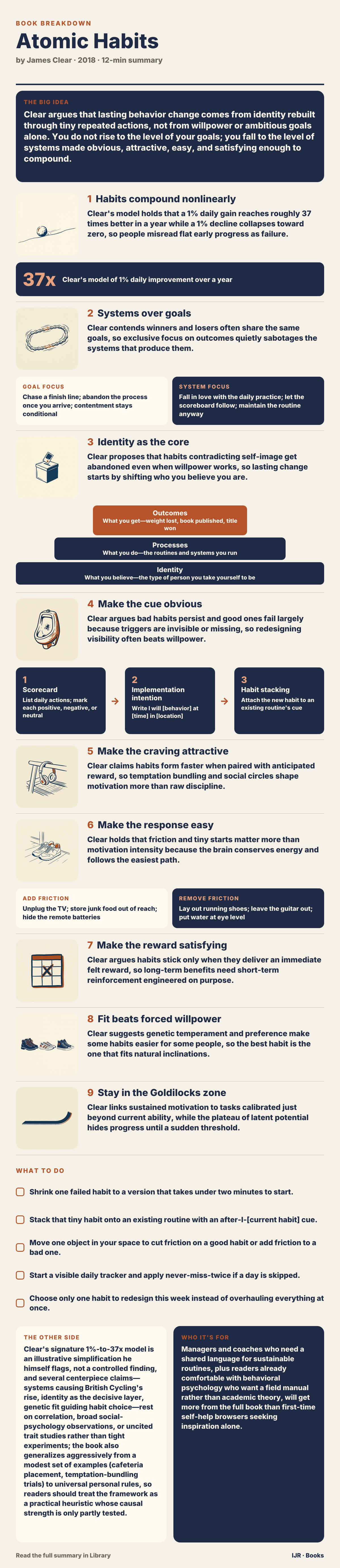
Clear's model holds that a 1% daily gain reaches roughly 37 times better in a year while a 1% decline collapses toward zero, so people misread flat early progress as failure.
37x
Clear's model of 1% daily improvement over a year
Clear begins with the line drive that shattered his skull in high school, the induced coma, and the slow rebuild through tiny physical routines that later earned him an all-conference college baseball spot. He treats that arc as proof that trajectory beats intensity: small consistent moves accumulate into outsized change.
The mathematical picture he offers is deliberate simplification, not a controlled study—habits do not grow or decay at fixed rates in real life—yet the psychology still lands. People expect a straight line of improvement; actual results often stay flat for a long stretch he names the valley of disappointment, then jump once the behavior becomes structural.
Flossing one tooth a night or writing one sentence a day looks pointless for months. The payoff arrives only after enough repetitions have reshaped the underlying system. Missing one workout, on this view, is a single data point, not a verdict; the series determines the outcome.
In practice: Someone who writes one sentence daily sees no book for months, then suddenly has a draft once the streak has compounded past the flat stretch.
2
Systems over goals
Clear contends winners and losers often share the same goals, so exclusive focus on outcomes quietly sabotages the systems that produce them.
Goal focus
Chase a finish line; abandon the process once you arrive; contentment stays conditional
System focus
Fall in love with the daily practice; let the scoreboard follow; maintain the routine anyway
He splits change into outcomes you want, processes you run, and identity you hold. Most advice fixates on the outer layer—lose twenty pounds, publish the book, win the title—which he calls backward.
Goals fail three ways on his account: everyone chasing the podium already wants gold, so the goal does not differentiate; once the target is hit the supporting system is often abandoned, which is why crash dieters and lottery winners regress; and happiness gets locked behind an if-then gate that resets the moment a new goal replaces the old one.
Falling in love with the daily practice itself, independent of any scoreboard, keeps the machine running. British Cycling under Dave Brailsford rebuilt around marginal gains in equipment, hygiene, and training rather than a louder mission statement and then dominated—correlation he admits is only partly testable, yet the reframe still points attention at today's repeatable actions.
In practice: A dieter hits a weight target, drops the meal-prep system that got them there, and regains the weight because the process was never the point.

3
Identity as the core
Clear proposes that habits contradicting self-image get abandoned even when willpower works, so lasting change starts by shifting who you believe you are.
- OutcomesWhat you get—weight lost, book published, title won
- ProcessesWhat you do—the routines and systems you run
- IdentityWhat you believe—the type of person you take yourself to be
He draws three concentric layers: outcomes outside, processes in the middle, identity at the center. Targeting only the outer rings—'I want to quit smoking' or 'I will track cigarettes in an app'—leaves the self-concept untouched.
The mechanism is a voting metaphor. Every action casts a ballot for the kind of person you take yourself to be; enough ballots accumulate into a self-image that makes matching behavior feel natural and mismatched behavior feel wrong. The claim rests on self-perception ideas rather than a named study in the book, yet it reorders the work: ask who you wish to become, then take the smallest provable action that person would take today.
Writing one paragraph is a vote for being a writer. The identity is built by the repeated act, not announced in advance. That hinge turns habit work from behavior modification into identity construction and sets up the four laws as tools for casting more consistent votes.
In practice: Offered a cigarette, one person says 'I'm trying to quit' and still frames themselves as a smoker; another says 'I'm not a smoker' and acts from a finished identity.

4
Make the cue obvious
Clear argues bad habits persist and good ones fail largely because triggers are invisible or missing, so redesigning visibility often beats willpower.
- 1ScorecardList daily actions; mark each positive, negative, or neutral
- 2Implementation intentionWrite I will [behavior] at [time] in [location]
- 3Habit stackingAttach the new habit to an existing routine's cue
The four-law frame maps onto cue, craving, response, and reward. Law one attacks the cue. Behavior that has gone automatic drops out of awareness, so people cannot change what they do not notice.
His first tool is a habit scorecard: list the day's routine actions and mark each positive, negative, or neutral until the invisible becomes visible. Once cues are seen they can be engineered—Schiphol Airport etched a fly into urinals and reportedly cut spillage by giving aim a target without a lecture.
For personal use he borrows Gollwitzer's implementation intentions—'I will [behavior] at [time] in [location]'—which in 1990s studies raised follow-through on tasks like health screenings versus vague plans. Habit stacking extends the same idea: attach the new act to an existing one so the established routine becomes the trigger and no fresh decision is required. Ambiguity, on this view, is what kills follow-through.
In practice: After I pour my morning coffee, I will meditate for one minute—coffee becomes the cue so the new habit needs no extra willpower to start.

5
Make the craving attractive
Clear claims habits form faster when paired with anticipated reward, so temptation bundling and social circles shape motivation more than raw discipline.
Dopamine, in the simplified neuroscience he presents, spikes in anticipation of reward, not only at the reward itself. Linking a needed habit to something already wanted therefore makes starting easier.
Temptation bundling, drawn from Katy Milkman's work, pairs a desired activity with an avoided one—favorite show only while on the treadmill—and raised gym attendance among participants versus unbundled access. Stacking plus bundling chains the sequence: existing routine cues the needed habit, then a small pleasure follows at once.
Social environment multiplies the effect. People imitate the close, the many, and the powerful; joining a group where the desired behavior is already normal turns it into what people like us do rather than a private grind. Habit design, he concludes, is partly the choice of company that makes the right action the path of least social resistance.
In practice: A runner who only allows a favorite podcast while training pairs anticipation of the show with the workout until the gym itself starts to feel rewarding.
6
Make the response easy
Clear holds that friction and tiny starts matter more than motivation intensity because the brain conserves energy and follows the easiest path.
Add friction
Unplug the TV; store junk food out of reach; hide the remote batteries
Remove friction
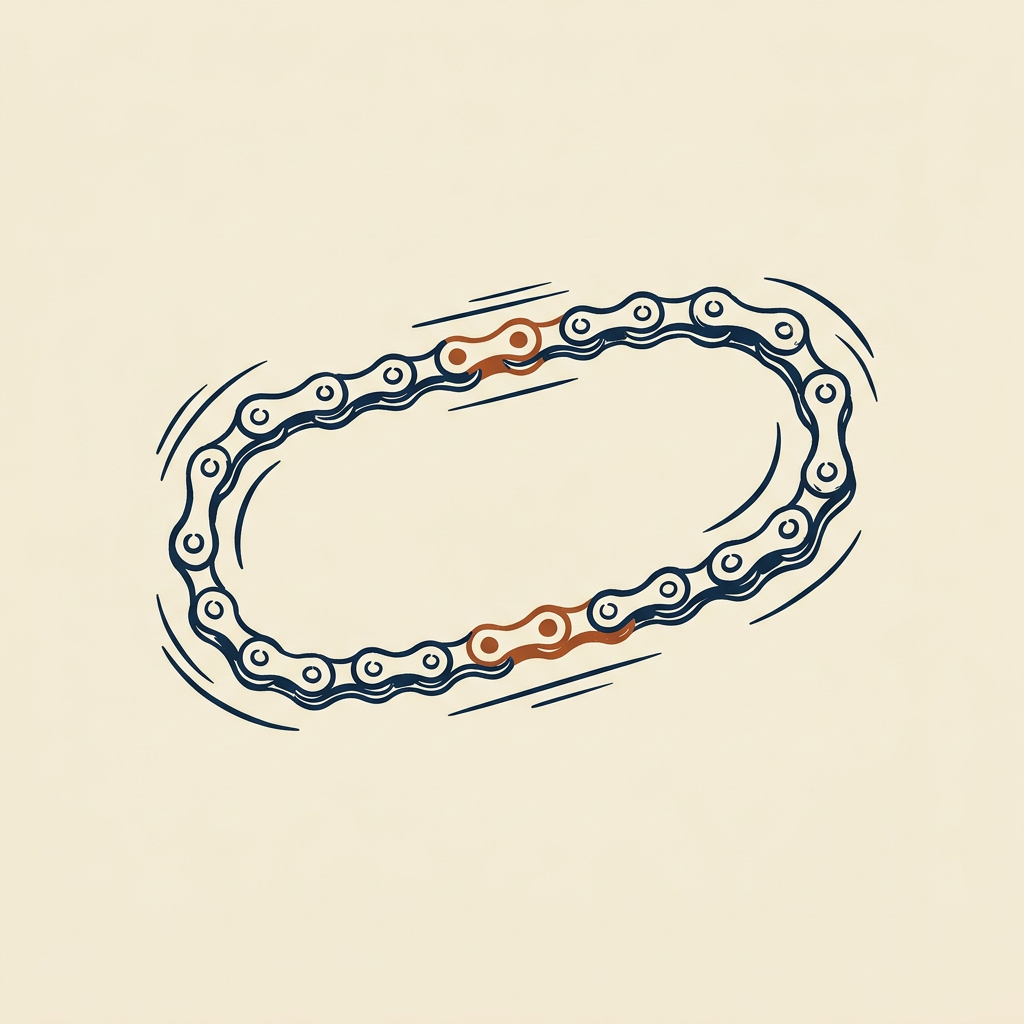
Lay out running shoes; leave the guitar out; put water at eye level
People overrate resolve and underrate convenience. A Massachusetts General Hospital cafeteria study around 2012 rearranged shelves so water was more visible and soda harder to reach; beverage sales shifted for months with no messaging campaign—environmental friction decided behavior.
The two-minute rule follows: scale any new habit to something that takes two minutes or less—'read one page' not 'read a book'—because the early goal is the pattern of showing up, not peak performance. Intensity can rise after automaticity arrives.
Priming the environment cuts steps between intention and action: shoes laid out at night, guitar left out of its case. Bad habits get the opposite treatment—unplug the TV and remove the remote batteries so the behavior is just inconvenient enough to force a second thought. A few extra seconds of friction, he generalizes, can redirect behavior at scale.
In practice: Someone who wants less TV unplugs the set and pulls the batteries after every use, turning mindless watching into a deliberate chore.

7
Make the reward satisfying
Clear argues habits stick only when they deliver an immediate felt reward, so long-term benefits need short-term reinforcement engineered on purpose.
The brain evolved to favor instant consequences over delayed ones. Good habits often cost now and pay later; bad habits pay now and cost later. That asymmetry, he says, is why junk food and smoking are easy to pick up and saving or training are hard to keep.
The fix is an artificial immediate reward until the long-term benefit can carry itself. A visual tracker—an X on each completed day—supplies a small hit of satisfaction from not breaking the streak. Commitment devices flip the script on bad behavior by attaching an immediate cost, such as sending money to a cause you dislike if you skip.
Trackers have failure modes he names openly: the unbroken chain can become the goal, people force habits on days they should rest, and one miss can spiral into total abandonment. His corrective is never miss twice—treat a single skip as data, not identity.
In practice: A reader marks an X on a wall calendar after each night of reading one page, and the growing chain itself becomes the reason to sit down again tomorrow.
8
Fit beats forced willpower
Clear suggests genetic temperament and preference make some habits easier for some people, so the best habit is the one that fits natural inclinations.
Departing from the four laws, he addresses individual variation. Body type, temperament, and cognitive strengths shape which pursuits feel rewarding enough to sustain; advice that ignores fit quietly blames discipline for what is really mismatch.
Choosing a sport aligned with body type beats forcing a popular but hated routine that delivers the same fitness at higher friction. Someone who loathes running may thrive in strength work or a team sport and still get the health outcome without daily self-battle.
He borrows an explore/exploit balance from decision theory: sample several habits or fields early, notice where aptitude and enjoyment show up, then commit deeply to the one or two that fit. The chapter is more corrective than evidence-heavy—he cites no specific genetic studies—yet it reframes repeated failure as a signal to redesign the goal around strengths rather than to push harder on the same ill-fitting path.
In practice: A person who has quit running programs three times switches to a climbing gym that matches their build and preference and finally keeps a consistent training streak.

9
Stay in the Goldilocks zone
Clear links sustained motivation to tasks calibrated just beyond current ability, while the plateau of latent potential hides progress until a sudden threshold.
Building on the valley of disappointment, he names the wider gap the plateau of latent potential: effort keeps going in while visible results stay flat, and most people quit without knowing how close a breakthrough may be.
The Goldilocks Rule, drawn from flow research, says peak motivation arrives when work is neither too easy nor too hard but sits at the edge of capability—popularly cited in some research as around a four-percent stretch past present skill. Trackers that never raise difficulty go boring; systems that escalate too fast produce discouragement from the other side.
Habits therefore need periodic review, not set-and-forget design. Once a behavior is automatic, attention often drifts and improvement stalls even while consistency continues. Clear's closing corrective is deliberate reflection—what is working, which identity the habits reinforce, where boredom has replaced growth—so automaticity handles execution while conscious review handles excellence.
In practice: A guitarist who only ever plays the same three easy songs gets bored and stops; adding slightly harder pieces at the edge of skill restores the pull to practice.
Key terms
- Valley of disappointment The long flat stretch where effort continues but visible results lag, causing most people to quit too soon.
- Habit stacking Attaching a new habit to an existing routine so the established act becomes the automatic cue.
- Temptation bundling Pairing a behavior you need with a pleasure you already want so anticipation pulls you into the hard thing.
- Two-minute rule Scaling any new habit down to something that takes two minutes or less so showing up becomes automatic first.
- Implementation intention A specific plan in the form I will [behavior] at [time] in [location] that removes ambiguity about when and where.
- Plateau of latent potential The hidden gap between invested effort and delayed visible payoff where breakthroughs quietly build.
- Goldilocks Rule Motivation peaks when a task is neither too easy nor too hard but sits just beyond current ability.
- Never miss twice After one skipped day, resume immediately so a single lapse stays an outlier instead of a new pattern.
What to do
- Shrink one failed habit to a version that takes under two minutes to start.
- Stack that tiny habit onto an existing routine with an after-I-[current habit] cue.
- Move one object in your space to cut friction on a good habit or add friction to a bad one.
- Start a visible daily tracker and apply never-miss-twice if a day is skipped.
- Choose only one habit to redesign this week instead of overhauling everything at once.
Questions to think with
- Which identity am I actually voting for with the small actions I repeat most days?
- Where does my environment make the wrong behavior easier than the right one?
- What habit have I labeled a discipline failure that might instead be a poor fit for my temperament?
- Am I still inside a valley of disappointment on a practice I am about to abandon?
- Which of my routines has become automatic but stopped improving because I no longer review it?
The other side
Clear's signature 1%-to-37x model is an illustrative simplification he himself flags, not a controlled finding, and several centerpiece claims—systems causing British Cycling's rise, identity as the decisive layer, genetic fit guiding habit choice—rest on correlation, broad social-psychology observations, or uncited trait studies rather than tight experiments; the book also generalizes aggressively from a modest set of examples (cafeteria placement, temptation-bundling trials) to universal personal rules, so readers should treat the framework as a practical heuristic whose causal strength is only partly tested.
Who it's for
Managers and coaches who need a shared language for sustainable routines, plus readers already comfortable with behavioral psychology who want a field manual rather than academic theory, will get more from the full book than first-time self-help browsers seeking inspiration alone.