




Computer science already solved your hardest everyday choices
Anyone buried in searches, to-do lists, or clutter gets principled rules for when to stop, what to keep, and what to do first.
IJR · Oct 17, 2026 · 14 min read

In 60 seconds
- Reject roughly the first 37 percent of options to set a bar, then take the next one that beats them, for a 37 percent shot at the best.
- Explore new options when a long horizon remains; exploit known favorites when little runway is left.
- Full sorting only pays if you search often enough to recoup the cost; comparison sorts cannot beat roughly n log n.
- Keep what you used most recently and purge what has sat untouched longest, treating clutter as a cache.
- Order tasks by shortest duration or earliest deadline, not dread, and batch work to avoid thrashing.
- Extra criteria and endless deliberation often fit noise; early stopping and simpler models can decide better.
The big idea
In Algorithms to Live By, Brian Christian and Tom Griffiths show that everyday dilemmas—when to stop searching, what to keep, how to schedule a day—are versions of problems computer scientists have already solved. Indecision is often not a personal failing but a hard computational problem, and formal methods can tell you when good enough really is.
The book in brief
Christian and Griffiths start from a familiar frustration: irreversible searches, messy desks, overloaded days, and the nagging sense that you never have quite enough information. They treat each as a known computer-science problem rather than a character flaw.
They begin with optimal stopping and the look-then-leap rule, then move to the explore-exploit tension that should shift as your remaining time shrinks. Sorting and caching chapters reframe organization as a cost-benefit tradeoff driven by how often you actually search and how recently you used each item. Scheduling supplies explicit ordering rules and warns that constant switching can thrash a day the way it thrashes a machine.
Prediction chapters insist that the right forecast depends on whether a process is power-law, normal, or exponential, then caution that adding factors and fitting past data ever more closely can make future judgments worse. When problems are intractable, relaxation—dropping a constraint, solving the easier version, then adapting—beats paralysis. Randomness and mechanism design finish the arc: a little deliberate chance escapes ruts, and redesigning incentives beats trying to out-recurse other people.
The book lands on a reassurance. Clutter, procrastination, and endless searching are symptoms of genuinely hard problems; the same families of algorithms that manage them in machines can be borrowed, imperfectly but usefully, for the mess of daily life.
Context
Brian Christian and Tom Griffiths published Algorithms to Live By in 2016 as a plain-language translation of results from optimal stopping, statistics, and game theory. Contemporary coverage in the New York Times and the Atlantic praised its cleverness while noting it functions more as an idea book connecting fields than as a tested how-to.
The key ideas

1
Look then leap
Reject roughly the first 37 percent of options purely as a benchmark, then commit to the next one that beats everything seen so far.
37%
chance of picking the true best under look-then-leap
Christian and Griffiths open with the secretary problem: you must hire the best candidate from a fixed pool, deciding immediately after each interview with no going back. The math says interview and reject the first roughly 37 percent only to learn the quality bar, then hire the very next candidate who tops that group. That look-then-leap rule yields a 37 percent chance of the actual best—better than any rival strategy—even though it still fails most of the time.
They extend the pattern to apartments, dating, and parking. If you can roughly estimate how many options you will see, spend the first third of the window purely gathering information. After that threshold, take the first option that outperforms everything already observed.
The model needs a known pool size, random order, and no callbacks. Real searches rarely meet those conditions. Its lasting gift is the mental model: endless searching costs the option you already passed, stopping too early has a cost too, and the 37 percent rule anchors the vague feeling that it might be time to decide.
In practice: In a three-month apartment hunt, spend the first month only viewing places, then take the next one better than all of those early options.

2
Horizon sets the mix
Whether to try something new or stick with a known favorite should rise and fall with how much time remains to use what you learn.
Long horizon
Explore more: new places and roles carry high information value you still have time to use
Short horizon
Exploit more: return to known favorites whose payoff is already clear
The multi-armed bandit problem casts a gambler facing several slot machines with unknown payouts who must choose, each pull, whether to keep playing a machine that has paid or try one that might be better. Christian and Griffiths find the same tension in restaurants, careers, and partners.
The optimal solution, the Gittins index, gives each option one number balancing known average payoff against the value of new information. Trying something untried scores higher when a long horizon remains to exploit the discovery. The math validates a comforting pattern: a young person sampling widely is not reckless, and an older person returning to favorites is not merely set in their ways.
Simpler heuristics approximate the heavy index. Upper Confidence Bound methods used in A/B testing favor high-uncertainty options because uncertainty itself carries upside. A choice is never only about immediate expected payoff; runway left changes what the right move even is.
In practice: A newcomer to a city should keep trying unfamiliar restaurants; someone with only a short stay left should default to the known favorite.

3
Sort only what you search
Full organization pays only when you search often enough to recoup the cost; comparison sorting cannot beat roughly n log n operations.
Sort fully
Pays when the collection is searched constantly, as in a busy library
Leave loose
Smarter when searched rarely, as with a home shelf checked twice a year
Computer scientists have hard limits: comparison-based sorting cannot beat roughly n log n operations for n items, while a method like bubble sort runs on the order of n-squared and becomes impossible as collections grow. Christian and Griffiths reframe alphabetizing shelves, filing papers, and clearing closets through that limit.
The sorting-versus-searching tradeoff decides whether the effort is worth it. A library searched constantly justifies rigorous cataloging. A personal shelf searched twice a year probably does not; time spent alphabetizing could go elsewhere.
Arrival order also matters. Partly ordered data sorts far faster than random data, which is why real-world algorithms like Timsort detect and exploit existing order. Leaving mail, receipts, or email in loose piles and relying on selective retrieval is often smarter than imposing a full system on everything that arrives. Organization level should follow actual use, not virtue.
In practice: A busy office library warrants a full catalog; a home bookshelf touched a few times a year can stay loose without real loss.

4
Evict by recency
What you keep close should follow how recently you used it, not attachment or fear you might need it someday.
- Top of pileMost recently touched items kept closest for fast reuse
- Middle layersModerately recent items still worth keeping nearby
- Bottom to archiveLongest-untouched items, first to discard or store cold
Computers manage fast small memory versus slow large storage with a cache of items likely to be needed soon. The dominant rule for what to drop when space fills is Least Recently Used: discard whatever has gone longest untouched, on the theory that recent use predicts near-future use.
Christian and Griffiths cite cognitive scientist Steve Whittaker’s work on messy desks. So-called disorganized stacking often functions as an efficient LRU cache: recent papers rise, untouched ones sink, and the pile self-organizes by recency without conscious filing. Clutter can be functional rather than lazy.
The same logic reaches closets, kitchens, and memory. Keeping an item because you might need it someday ignores the real cost of space and attention—the mistake LRU avoids. Caching works when future use resembles recent use, but fails for rare-yet-predictable items such as annual tax documents. Naming the pattern lets you purge, deliberately, whatever has sat untouched longest.
In practice: Whittaker’s desk studies found stacked papers already surface recent work and bury the untouched, mimicking a cache without a formal system.
5
Order by an explicit rule
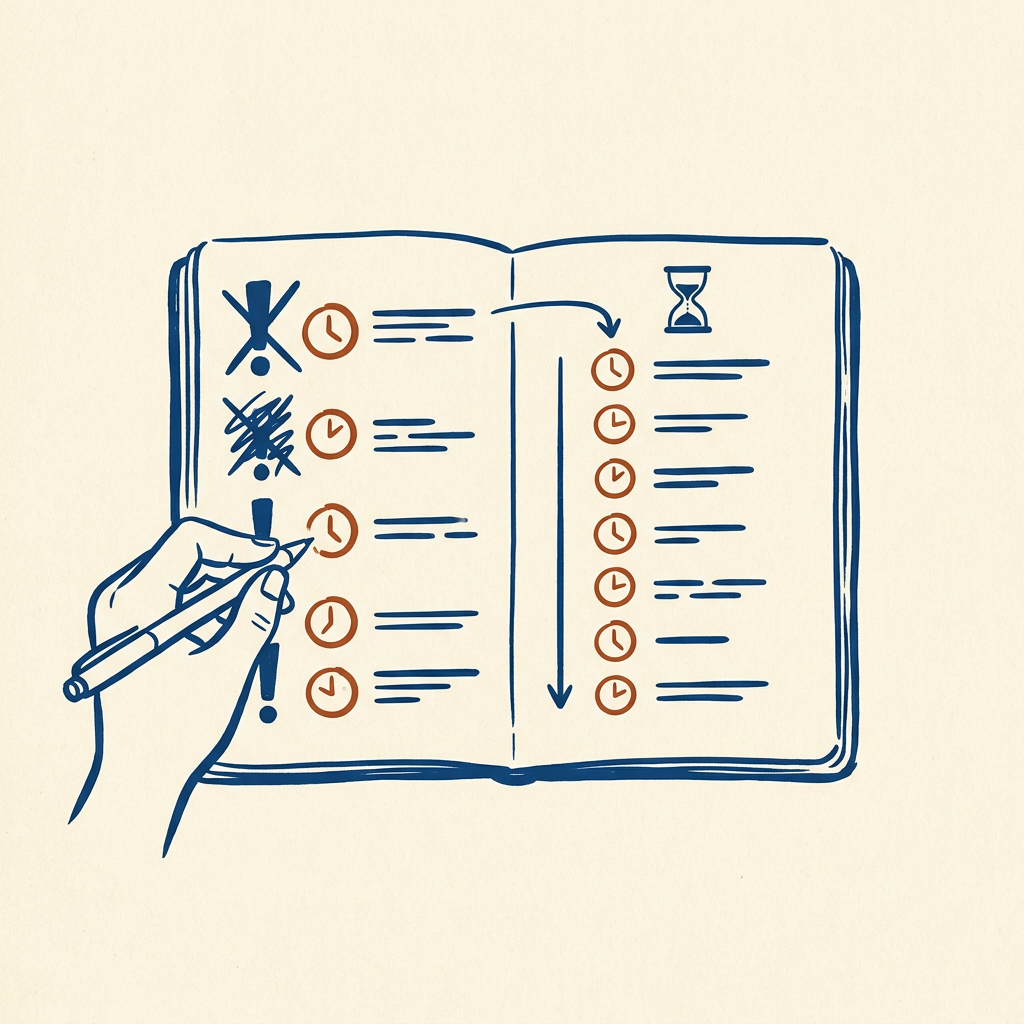
Sequence work by shortest processing time or earliest due date rather than by whatever feels most urgent or dreaded.
- 1Name the goalMinimize total wait, worst lateness, or number of missed deadlines
- 2Apply the matching ruleShortest Processing Time, Earliest Due Date, or Moore-Hodgson
- 3Batch and protectGroup like tasks and cut thrashing from constant switches
Scheduling theory offers provable rules tied to the goal. To minimize total waiting time, do the shortest task first—Shortest Processing Time clears the most items fastest. To minimize the worst lateness, Earliest Due Date is optimal. When some deadlines are unreachable and the aim is fewer misses overall, the Moore-Hodgson algorithm drops the single hardest task to save the rest.
Christian and Griffiths highlight switching cost. Machines thrash when so much effort goes into choosing the next task that little time remains to run any of them. Constant hopping among email, messages, and deep work produces the same waste: overhead can eat more of the day than the tasks. Batching similar work and cutting interruptions is a grounded fix, not a fad.
The pure rules assume known lengths and deadlines and underplay the cost of stopping midway. Still, they beat anxiety-sorting, which can be provably worse than ordering by due date or length.
In practice: A mixed day of messages and deep work improves when similar tasks are batched and the list follows due date rather than dread.
6
Match prior to process
Forecasts of remaining length or size must follow whether the underlying pattern is power-law, normal, or exponential.
Power-law
No typical size; scale expected remaining life from elapsed time at a random point
Normal
Clustered around a mean; predict the actuarial remainder, not a random fraction
Bayes’s rule combines prior knowledge with new evidence, and prior shape matters enormously. Christian and Griffiths illustrate with astrophysicist J. Richard Gott’s Copernican-style reasoning on the Berlin Wall: assume you are seeing it at a random point in its life. That method fits power-law phenomena with no natural typical size—movie runs, technology lifespans, Broadway shows.
For normal distributions clustered around a mean, such as human lifespan, use the average and add a fixed remainder. Knowing someone is 40 points you toward the actuarial rest of a normal life, not a random fraction of an unknown total. Exponential cases teach a third lesson: elapsed time tells you nothing. A light bulb still burning is no more or less likely to last another hour just because it already has.
Good prediction is not one formula. It is choosing the correct family of prior from real knowledge of the process, then updating with evidence. Blind extrapolation without that pattern yields systematically bad guesses.
In practice: Gott treated the Berlin Wall as a random point in a power-law span; human age instead calls for a normal-distribution remainder around the known average.

7
Stop before the noise
Extra factors, precision, or effort can worsen the outcome; deliberate simplicity and early stopping often beat full optimization.
Overfit
Many noisy criteria or endless deliberation that memorizes past quirks
Early stop
Few strong factors and a deliberate halt before noise looks like signal
In machine learning, a model that fits training data too tightly captures noise as signal and then fails on new cases. Standard defenses are cross-validation against unseen data and regularization that penalizes complexity. Christian and Griffiths see the same failure in ordinary decisions.
A hiring process with twenty weighted criteria can lose to one with three, because the extras mostly encode noise from a small sample of past hires. A hedge-filled recommendation letter can help less than a short confident one; excess detail without confidence looks like fitting to irrelevancies. Athletic recruiting and stock strategies backtested on history often shine on past data and flop forward.
Early stopping—deliberately not optimizing all the way—is often superior. A network trained to full convergence typically generalizes worse than one halted partway. Past a point, more research mostly adds noise dressed as insight. Choosing to stop analyzing is a skill, not a failure of thoroughness.
In practice: A three-criterion hiring score can beat a twenty-factor rubric that mostly fits quirks from a handful of earlier hires.
8
Relax then adapt
When exact solution is intractable, drop a real constraint, solve the easier version, then bend that answer back to reality.
- 1Name the blockerIdentify the constraint that makes the real problem feel impossible
- 2Drop it temporarilySolve as if budget, time, or convention were gone
- 3Adapt the idealBend the unconstrained answer back toward the real limit
Large instances of problems like the traveling salesman route are computationally hopeless to solve exactly. Computer scientists relax them: strip a constraint that makes the problem hard, solve the easier version, and use the result as a bound or starting guide. Lagrangian relaxation turns a hard constraint into a penalty, producing an approximation never worse than a known bound on the true optimum.
Christian and Griffiths apply the move to decisions hemmed by budget, time, or convention. First solve as if the binding constraint did not exist. See the ideal. Only then adapt it to the real limit. Reasoning under every constraint at once is often what creates paralysis.
An everyday case is the apology. The relaxed form of a long justified excuse is simply “I’m sorry I’m late,” dropping the demand to narrate every link. That shorter version is often more useful to the listener. Intractable exactness is frequently the wrong standard; a good approximate answer reached quickly beats a perfect one reached too late or never.
In practice: Instead of a full defensive story for lateness, the relaxed move is a plain apology that drops the need to justify every detail.
9
Randomness and redesign
Limited randomness escapes local dead ends, and redesigning incentives beats trying to out-recurse other people’s strategies.
Outthink everyone
Infinite recursive modeling of others’ models—provably intractable
Redesign the game
Mechanism design, as in a Vickrey auction, makes honest play dominant
Some landscapes are full of traps. Randomized methods such as simulated annealing occasionally accept a worse move on purpose, with that willingness falling over time, the way metal cools into a strong rather than brittle structure. Christian and Griffiths treat small randomness in ordinary choices—random tie-breaks, trying an option you would otherwise skip—as a documented escape from ruts, not a cop-out.
Game theory adds another hardness. Modeling what others will do, including their model of you, spirals into infinite recursion that is provably intractable; complexity results on Nash equilibria make the point precise. Strong players and mechanism designers do not out-recurse opponents. They shape the situation so good behavior is the easy dominant choice no matter what others do.
The Vickrey second-price auction is classic: bidding your true value is always optimal regardless of other bidders. Braess’s paradox shows the societal version—adding a road can slow everyone’s commute as self-interested drivers reroute in ways that hurt the whole. The fix is better incentives, not harder individual reasoning.
In practice: In a Vickrey auction, bidding your true value is dominant no matter what others bid, removing the need to model them.
Key terms
- look-then-leap Reject a fixed opening fraction of options to set a bar, then take the next one that beats it.
- Gittins index A single score per option that balances known payoff against the value of trying something uncertain.
- Least Recently Used Cache rule that discards whatever has gone longest without being touched.
- Shortest Processing Time Do the quickest task first to minimize total waiting across the list.
- Earliest Due Date Order by soonest deadline to minimize the worst lateness.
- thrashing When switching and managing tasks consumes more effort than doing them.
- overfitting Fitting past data so tightly that noise is treated as signal and new cases go worse.
- relaxation Drop a hard constraint, solve the easier problem, then adapt that answer to reality.
- Vickrey auction Second-price auction in which bidding your true value is always the best strategy.
- Braess’s paradox Adding capacity can slow everyone when self-interested routing hurts the whole network.
What to do
- Before your next apartment, hire, or vendor search, fix roughly how many options you will consider, spend the first third only gathering information, then take the next one that beats all of them.
- Reorganize one desk or inbox by strict recency: archive or remove whatever has gone longest untouched first.
- Rewrite tomorrow’s to-do list by deadline or task length instead of dread, and batch similar tasks to cut switching cost.
- When a choice feels frozen by constraints, first solve it as if the hardest limit were gone, then adapt that ideal answer.
- Before adding another hiring or purchase criterion, ask whether it mostly captures noise from a small past sample.
Questions to think with
- Where are you still searching past the point where the next better option should simply win?
- Which piles or inboxes of yours already behave like a recency cache, and which fight it?
- When did extra research last make a personal decision worse rather than better?
- What single constraint could you temporarily drop to see the ideal version of a stuck choice?
- Does your current mix of exploring and exploiting match how much time you actually have left?
The other side
The analogy shines on clean, quantifiable decisions and weakens on messier ones. The 37 percent rule needs a known pool and no callbacks—conditions real apartment and hiring searches almost never meet—and economics reviewers flagged the risk of over-applying the tidy headline. The Gittins index is elegant yet too heavy to compute in ordinary settings, leaving a gap the simpler heuristics only partly close. The book is popular explanation, not original research or a tested intervention; no study shows that people who consciously apply these rules make better life choices or feel more satisfied. It also has little to say about unequal power or information in hiring, negotiation, or household scheduling, since the models generally assume similarly positioned optimizers. Reviewers in the New York Times and the Atlantic called it a clever idea book more than a direct guide, leaving readers to finish the translation work themselves.
Who it's for
Professionals drowning in to-do lists who want a principled order of attack, readers curious how computer-science ideas travel outside the lab, and anyone facing a big irreversible choice—hiring, dating, or apartment hunting—who wants a clearer rule for how long to keep looking.