



France-Switzerland Lake Dries Amid Record Heat
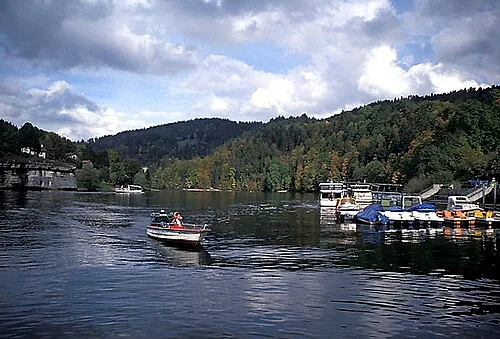
At the northern end of Lac des Brenets, Yvan Durig records the water level by hand. Every day he measures what is left of the basin as it contracts into the deepest part of the lake. The automatic gauge that once tracked the level now sits so far from the water that it is useless; the monitoring station has been left behind as the shoreline pulled back. Durig is owner and captain of the Société de Navigation des Brenets, the Lac des Brenets navigation company, and the daily reading falls to him alone.
“Normally, we have 25 or 30 metres of depth here,” he said. About nine metres are left. The water that remains is brown Fish pack into it with nowhere else to swim. “The fish are really chock-a-block,” Durig said. A couple of swans still paddle across the surface.
He finishes the day’s reading at the edge of all that is left. Beyond the basin the lakebed lies exposed where metres of water used to stand, open ground in place of a lake. Dozens of boats and pontoons sit stranded high and dry on the cracked bed. Jumbo rests among them, a vessel from Durig’s fleet now fixed on open mud. The Société de Navigation des Brenets normally carries 200 to 300 people a day. Those passengers are gone. The company is idle.
“We had to halt boat operations on 20 July,” Durig said. The date fell in the middle of the working season, when the boats should still have been running. “Just imagine: having to stop right in the middle of the season like that. It’s unbearable for a company like ours.”

Maxime Fallet works at a Doubs riverboat excursion company, another operator left without the water his trade requires. Along this stretch of the Doubs the summer traffic has stopped.
David Favre lives in Les Brenets. At 76 he is an amateur local historian, and the bare ground no longer matches the summers he knew. “As children, we used to spend all our summers swimming at the beach, having fun by the water, diving, jumping in and sometimes even fishing,” he said. A tourist has been photographed staring at the parched bed of Lac des Brenets, looking out over the same dry floor.
“It’s absolutely heartbreaking. It really is emotionally devastating, because it’s utter despair: no more lake,” Favre said. “Since the last drought in 2018, it’s been a disaster. Unfortunately, the lake empties out every couple of years, or soon, perhaps every year,” he said. He feels the authorities have “completely abandoned” the lake. Pleasure-boat tourism is already ruined, and some now question whether the water will ever return to lasting full health.
Lac des Brenets is four kilometres long and two hundred metres wide. It formed where landslide debris dammed the Doubs, holding the river into a narrow winding lake. The Doubs rises in the French Jura mountains near Mouthe at 946 metres elevation. At Les Brenets it normally gathers into this basin before it begins to mark the border between France’s Franche-Comté region and Switzerland’s Neuchâtel canton. Geological fissures open through the bed and drain water underground.

Rainfall has run at about half of normal levels since April, MeteoSwiss reports. June, July and August 2026 were each the hottest months on record in Switzerland since measurements began in 1864. The drought ranks with those of 1976, 2003 and 2018. The water line is dropping 20 to 22 centimetres a day. On 1 October the surface sat at 735.34 metres above sea level, 14.66 metres below normal. The 1906 record low was a 15.35-metre drop. That mark is about to be surpassed.
The lake ends at the Saut du Doubs. The twenty-seven-metre waterfall has stopped flowing.
Martial Beyeler is 69 and lives here. “It’s so beautiful when there’s water, when it’s flowing,” he said. “It’s an idyllic, wonderful place. It makes me sad to see the place like this.” France’s Franche-Comté holds one bank; Switzerland’s Neuchâtel holds the other. The Doubs has long marked that border as it left the basin and dropped through the fall.
Fallet fears the lake is “destined to disappear” for lack of a plan to save it. A Franco-Swiss task force set up in 2022 to limit the water draining into the fissures has taken no decisive action. No sealing of the lakebed has begun. The fissures remain open. Durig sees the wait as finished. “We must take action – indeed, be proactive – and seal the lakebed,” he said. “But this can no longer take years. That is simply not an option anymore.” The seal he calls for has not been placed.
Weeds now flourish on the exposed bed. A tiny stream trickles through them, the last surface water still crossing the floor of Lac des Brenets. HELP and SOS have been scratched into those weeds.