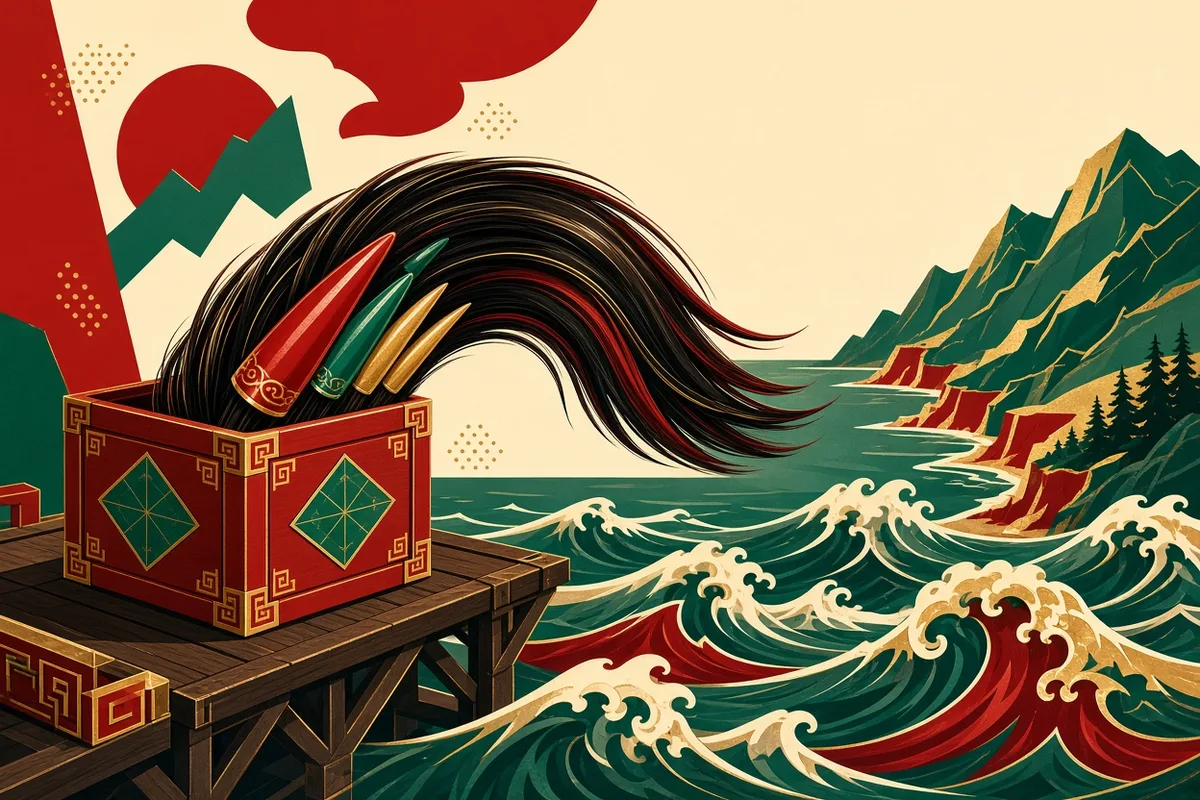



Burberry reworks signature check with Birtwell florals for 2027 show

Central Cee walked the Chelsea College of Arts runway with his hood up and his jeans slung extremely low. A shoelace secured the trousers. The British rapper was making his first-ever runway appearance in Burberry’s Spring/Summer 2027 show, and he made no attempt to become a classic Burberry man. He wore the clothes as Central Cee.
Models moved between unregimented wooden seating inside the bright white surroundings of the University of the Arts London college. A soundtrack spanning four decades of David Bowie filled the space as the cast passed. On 21 September 2026 the presentation closed London Fashion Week. Rather than imposing one cleaned-up look, the casting left each person with a personal outline intact. The rapper’s appearance made that choice concrete without a speech: Burberry worn as the wearer already was.
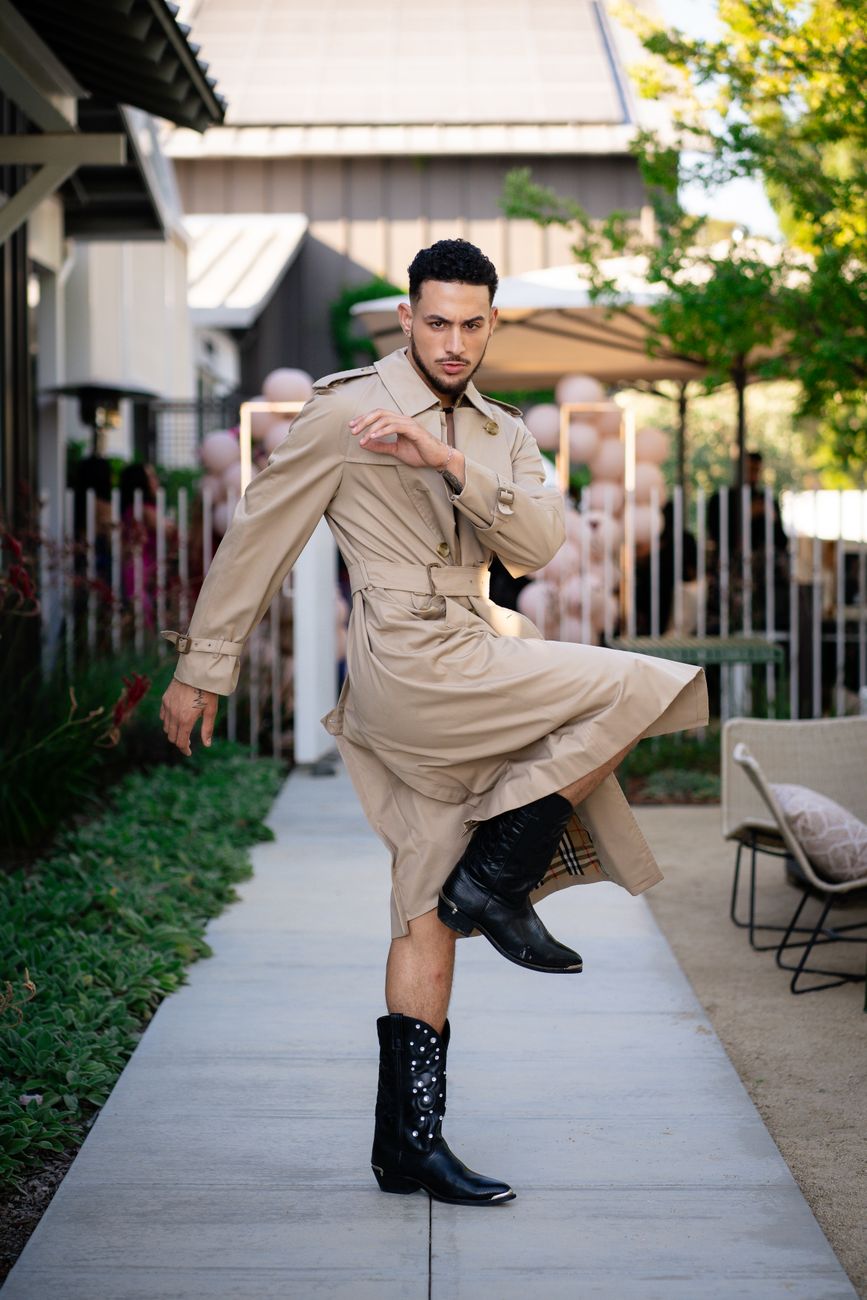
From that opening the garments themselves took up the same refusal of the pristine. Sixty-one looks moved through the space. Trenches came in silk-faille and taffeta, shown deliberately creased and wrinkled, some with puffed hems and others with braided epaulettes flattened against the shoulders. The surfaces held the soft folds of clothes already worn rather than newly pressed. Washed silk and cotton carried the same lived-in quality across the rest of the collection.

Celia Birtwell’s floral and face motifs ran through nearly everything. Mimosas, blueberries, violets, rosebuds and climbing vines were embroidered onto pencil skirts, scattered over trenches and worked into coats. Her “Halloween” smiling faces appeared on knits, then turned into tiny medallions dangling from coats and kitten heels.
“Nothing is overly pressed or pristine,” Daniel Lee said. “There’s an intentional imperfection: the idea of owning a piece, living in it.” The same hand that left the creases also began to loosen the house’s most protected geometry.
The House Check was next. Birtwell reworked the signature into gingham, then reduced it further into a stripe. The geometry resolved in stages, each one simpler than the last, until the protected pattern had loosened into something freer. She redrew it entirely by hand. The lines came out chunkier and less obedient. Sometimes the grid was treated like a garden trellis for flowers. Those hand-drawn checks landed on coats, bags and skirts, still recognizably Burberry yet no longer an exercise in reminding anyone the house owned a check. The pattern kept its identity while surrendering its neatness. What had been locked geometry became something a person had clearly drawn.
“You can really feel the human hand in it,” Daniel Lee said. “In the check, in the lines.” That hand belonged to the collaborator he had never asked onto a show before.
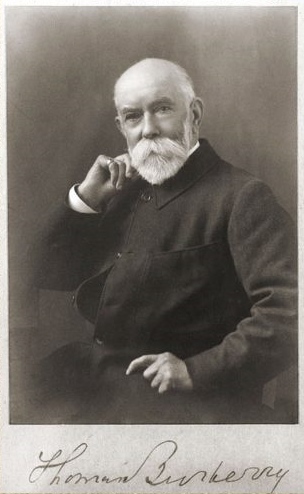
He asked Celia Birtwell. She was 85. The commission marked Burberry’s 170th anniversary, the house Thomas Burberry had founded in 1856, and Lee wanted something special for the milestone. Once he met her, he knew she was the one. The venue already held her name: she had once taught at Chelsea College of Arts.
“I’ve never really collaborated with someone on a show before — I think it’s a difficult thing. But everybody loves Celia. She’s the epitome of British fashion. Her prints feel timeless, and she was also really inspired by Burberry’s check. She wanted to interpret it, take it into her world,” Lee said.
Birtwell took the invitation as work for the mind as much as the hand. “Very thrilled that Daniel asked me, because it’s very good for my brain to do different things. It was fun to work with them, and a challenge for me in a very different way,” she said.
Jess Cartner-Morley framed the pairing as two British national treasures meeting. Burberry was the grand luxury house; Celia Birtwell was the textile designer who, with Ossie Clark, helped define the look of late-1960s and early-1970s London, and who has long been David Hockney’s muse, appearing repeatedly in his portraits.
Of Clark she has been blunt. “He was a genius, better than Yves Saint Laurent. His cut – although he lifted it from the 1930s, he had his own take on it – even plump women felt pretty in. He didn’t dress just the slimmest, which is always easier. I thought his garments were wonderful. I used to see [their] construction and the way he’d get excited about how he’d put a new sleeve in. He was a real artist.”
That standard of cut sat under Lee’s brief for the season. He called the collection “a return to the basis of things,” and described the silhouettes as reaching for “something instinctive… something felt…something true.” Print and cut had already proved the point once, in Clark’s sleeves and Birtwell’s cloth. What that approach would look like inside Burberry became visible on the runway itself.
Celia Birtwell sat front row at the show watching her designs move down the catwalk. The prints were hers. She had a busy stretch ahead once the show ended. The exhibition “Ossie Clark + Celia Birtwell” is set for London’s Design Museum. It opens on 2 October and runs into the following April, the gap after the Burberry presentation of 21 September 2026 carrying the same hand forward through autumn, winter and into spring.
“It’s an emotional thing,” Daniel Lee said. “The imperfections ultimately make things feel more human.”