





British Arms Brokers Jailed 16 Years Over Warzone Deals
David Greenhalgh stood alone in the dock at Southwark Crown Court while Judge Sally-Ann Hales KC delivered her sentencing remarks. His co-defendant was not there. Christos Farmakis, the Greek national who had worked the same enterprise beside him, had been granted bail, fled the United Kingdom, and been tried in his absence. On Wednesday 23 September 2026 the hearing that would fix both their penalties went ahead with only Greenhalgh still available.
“Their offending was deliberate, sophisticated, financially motivated and persisted over many years,” Judge Hales said. “The evidence established a long-standing and mutually beneficial criminal enterprise.”
Greenhalgh, 68, from Croydon, had been convicted in June of ten counts of being knowingly concerned in the unlicensed supply of controlled goods to embargoed destinations. Farmakis, 48, had been convicted of nine counts of the same offence. Between 2009 and 2016 the pair ran an illegal arms-dealing enterprise worth tens of millions of pounds.
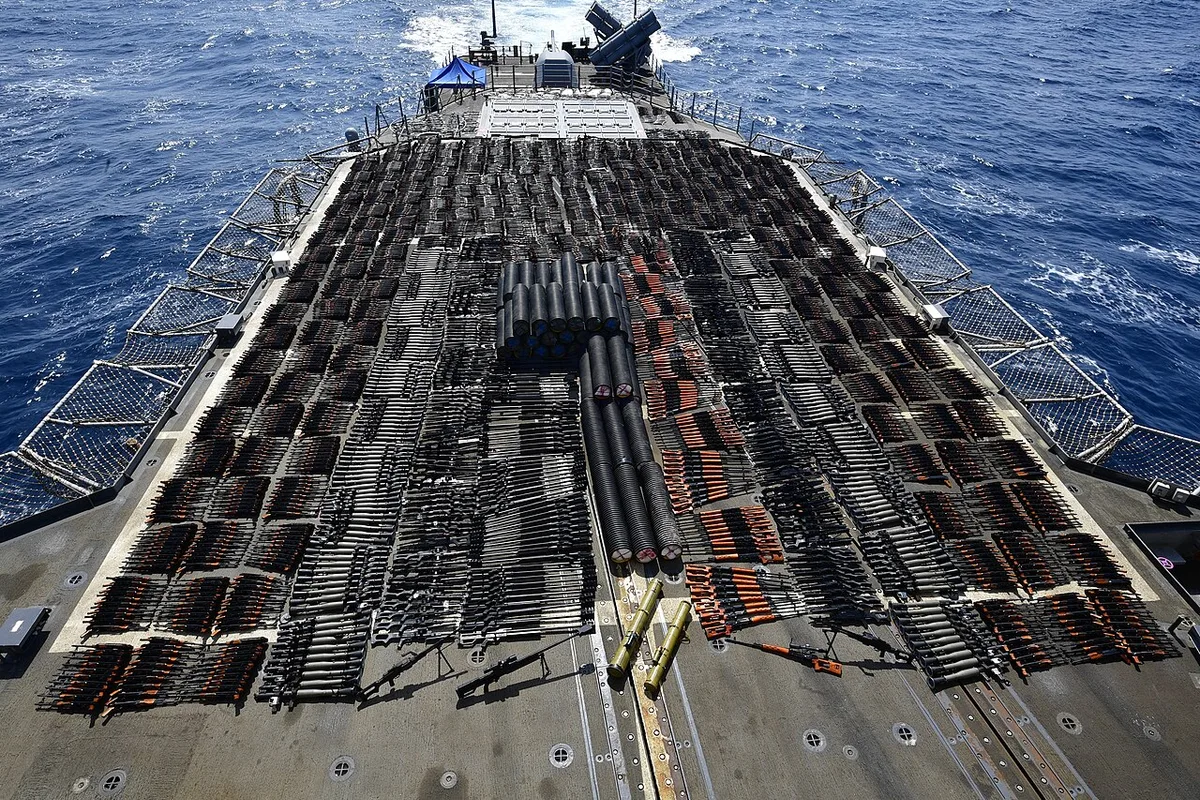
The catalogue they moved and offered took in former Soviet MiG29, Su25 and Su27 fighter jets, Mil Mi-24V attack helicopters, surface-to-air and anti-tank missile systems, AK-47 assault rifles, battle tanks, bombs, rocket-propelled grenades and hundreds of thousands of rounds of ammunition. The destinations sat under British embargo: Sudan, South Sudan, Libya, Iran, Iraq and Syria.
In one email Greenhalgh offered to deliver 100,000 weapons to South Sudan plus 50 million rounds of ammunition, valued at more than $14 million.
The rest of the enterprise reached for the same hardware across the remaining embargoed states, each deal dependent on paperwork that could hide where the goods were truly headed. Jurors were shown the emails that passed between Greenhalgh and Farmakis on how to route that paperwork and how to keep the true end destinations of arms shipments to Iraq from view. Forged end-user certificates presented the goods as bound for countries free of sanctions. Greenhalgh struck the deals through his Airservices companies, registered across the United Kingdom, Greece, North Macedonia and South Sudan, and in the correspondence he called them “sensitive projects.”
Farmakis used his post as an adviser to Greater London Enterprise, a body with local and government funding, as a facade for the same work. He also deployed fake credentials from UK Trade & Investment to lend himself credibility with customers and suppliers. Concealment of the true destinations was “routinely achieved,” Judge Hales said, through corrupt payments to public officials. “I am also satisfied that both of you knowingly participated in or facilitated such payments which you regarded as a necessary cost of doing business,” she said. “The fact you were not charged with offences of bribery does not prevent me from regarding this as a significant aggravating factor.” Prosecutor Edmund Burge KC set the same conduct before the court as “large-scale bribery and corruption.”

Of the charges that grew from those methods, only one concerned weaponry that actually changed hands: the sale of a former Ukrainian S-125 Pechora missile system to South Sudan. The Pechora is a surface-to-air missile system. Prosecutors said Greenhalgh and Farmakis had very close connections to senior figures there. South Sudan was still formally part of Sudan until it achieved independence in 2011, so the British arms embargo covering Sudan applied to the territory as well. Edmund Burge told jurors the semi-autonomous region remained subject to that ban.
Beyond the single completed delivery, arranged supplies and plans reached Iran, Iraq and Syria. After the 2011 Arab Spring the pair also offered fighter jets and other arms to Libya, and discussed how the aircraft might be inspected and delivered without drawing the attention of the authorities.
The enterprise came apart on a forward Farmakis never intended. He had used his work email at Greater London Enterprise to arrange the arms deals in private. That account inadvertently sent incriminating correspondence on to his boss. The documents that arrived exposed plans to sell fighter jets and other arms to Libya after the 2011 Arab Spring, The multi-year probe became one of the most significant weapon-sales cases to reach a British court.
Both men kept going after explicit warnings. In January 2012 Greenhalgh was told at a meeting with HMRC that he must obtain UK licences because of his British nationality; he continued the trade. Farmakis remained involved after a colleague told him he needed a UK licence. Prosecutor Edmund Burge KC placed Farmakis’s abuse of his role within GLE before the court as an aggravating factor.
James Hines KC, defending Greenhalgh, cited his client’s age and lack of previous convictions. Of the January 2012 meeting, Hines said Greenhalgh had believed the same licensing duty did not bind his Greek co-defendant. Judge Hales described Greenhalgh at trial as “someone who is something of a wheeler and dealer,” a man whose experience had already taken him through the export of second-hand clothing to Africa, a sugar refinery, a copper mine and a theme park. “Those achievements make your conscious decision to engage in serious criminal conduct all the more disappointing,” she said.
Judge Sally-Ann Hales KC sentenced both men to 16 years in prison. Greenhalgh received his term in court. Farmakis was given the same 16-year sentence without appearing; the penalty was fixed in his absence. Efforts were made to bring him back to the United Kingdom for the sentencing hearing from Greece, where he was believed to be living. Those efforts failed. His current whereabouts were unknown.
Edwige Hill, deputy director of HMRC’s Fraud Investigation Service, said: “Strict export licensing controls exist to protect the UK and to ensure that military equipment does not fall into the wrong hands. Greenhalgh knowingly and repeatedly circumvented those controls, forging documents and routing deals through overseas companies to evade detection.”