



Bogong Moth Swarms Signal Rebound Across Australia
Reina Hill stepped out of her Batemans Bay home and into a living swarm. The bogong moths had been there since Friday.
“I walked out my door and was hit in the face by thousands of them,” she said.
They layered under the deck, under the eaves, and all around the windows.
“I swear there was millions of them layered on various areas under my deck, under my eaves and all around the windows,” Hill said.
Along Australia’s east coast the same brown bodies were pressing into backyards and houses, including in Sydney. In Penrith a listener opened a boot and found it lined with moths. About 800 sightings had already been logged on iNaturalist since Friday, more than 200 of them in the previous twenty-four hours. Each insect carries a wingspan of up to five centimetres. The migration season runs from September to November, and the moths were simply following it.

“They’re not trying to get into your house, they’re just trying to migrate,” said Eleanor Drinkwater. “For some of these little individuals that people might see, they’re going to be travelling hundreds, if not thousands, of kilometres.”
In a good year, four billion moths or more migrate to the alpine caves. The journey can span up to 3,000 kilometres.
Linnea Emneby said the decade’s scarcity had altered what people now expected a migration to look like. The moths, she added, hitch rides on north-westerly winds, small bodies carried great distances when the air moves their way.
The decline began in the 1980s. After 2016 and 2017 it accelerated under drought, insecticides, agricultural intensification and habitat loss. During the 2017–18 droughts the population collapsed by an estimated 99.5 percent. In December 2021 the moths were listed as Endangered on the IUCN Red List.
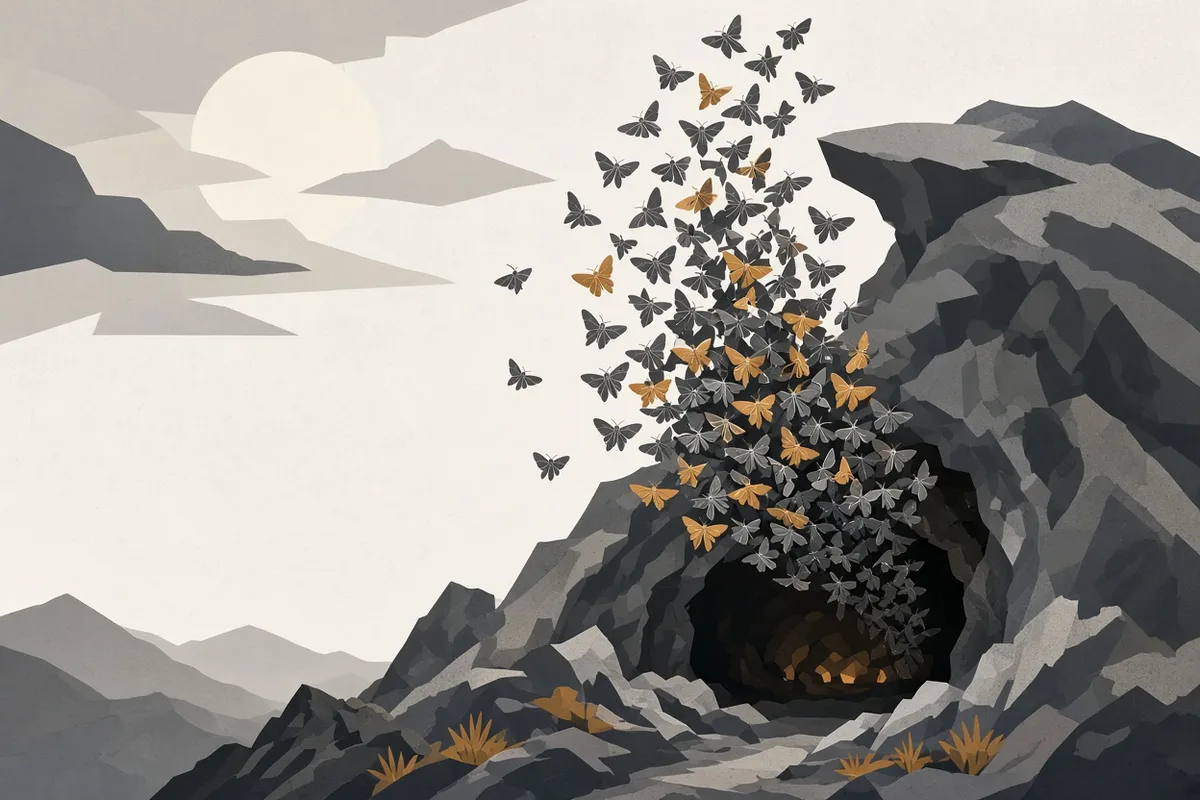
The alpine caves where bogong moths wait out the summer heat went quiet. Scientists were aghast at how few were making the journey. “People described going into the caves and finding barely any moths, and just kind of being in shock,” Drinkwater said. The migration continued after the crash, yet so few completed the long flight south that the gatherings once filling those spaces vanished from the walls. Photographs showed moths clustered so densely on cave walls that the rock beneath was invisible.
Since early September 2026 the tracker had logged about 4,000 reports. Roughly half had been analysed. From those came 1,600 verified bogong sightings. The previous best year, 2024, recorded 1,950 reports. This season had already left that mark behind.
Scientists in Zoos Victoria’s office met the season’s counts with happy tears.
“There have been happy tears in my office because this is what nature should be,” Parrott said. “People are noticing those big swarms again. They can celebrate what I think is one of nature’s great spectacles.”
James Todd, Victoria’s Chief Biodiversity Officer, called the jump in numbers a positive sign for biodiversity. Steve Whan, who represents the alpine Monaro in the New South Wales parliament, said it was exciting to see the recovering population coming their way; the moths, he added, support native wildlife such as the pygmy-possum and pollinate eucalyptus. One working theory held that more rainfall in northern New South Wales had produced extra food for the larvae, while cooler, wetter conditions aided the rebound.
“They get up into the mountains and into these caves, where they make this beautiful tiling pattern,” Drinkwater said. “They cover the walls in this very dense mat of moths.” They remain through the heat. “They hang out there until the weather starts getting cooler, and they come back down to their breeding grounds,” she said.

Each moth makes the trip only once. In 2025 researchers tethered captive moths and projected stars onto a wall; the insects oriented by the Milky Way. Bogong moths became the first invertebrates shown to use celestial navigation for long-distance travel.
The same dense gatherings are a key food source for the critically endangered mountain pygmy-possum. Drawn to stadium floodlights, swarms once registered on weather radar as rain during the closing ceremony of the 2000 Sydney Olympics. University of Sydney biologist Dieter Hochuli said the moths hide in crevices by day. “There’s a lot of birds and mammals and everything that’s going to want to eat them,” he said. “So, basically, they’re just finding a good spot to spend the day.” The species, he added, moves through massive population fluctuations and cycles.
The moths remain under pressure from climate-linked threats, with a severe El Niño forecast raising summer temperature fears. They are harmless to humans and legally protected. Researchers are urging continued photo logs to iNaturalist and Moth Tracker to map the rest of the season.
“It’s great they’re back, and we’re really excited they’re back,” Drinkwater said. “But we’re still worried about them.” “This is a brilliant opportunity for us to learn more about what they’re doing,” she said. “They still need a lot of help and they still face some serious battles,” Parrott said.
The small brown bodies are still pressing south and east on the wind toward cool alpine caves where, if the weather holds, the walls will again take a dense living mat.