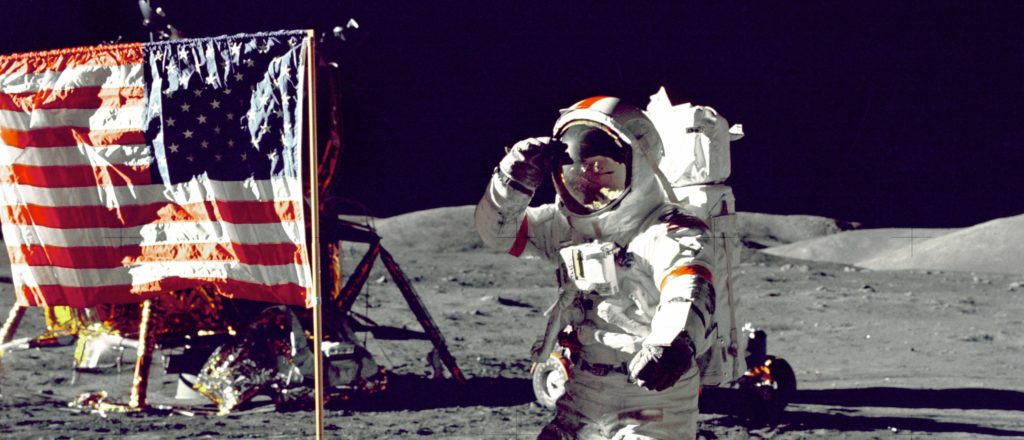
America Plans To Conquer The Moon Again. Here’s What It Will Take To Stay
President Donald Trump's ambition to establish a permanent American presence on the moon faces a costly challenge: figuring out how to keep astronauts alive, powered and supplied hundreds of thousands of miles from Earth.
Francis Kapper·Oct 10, 2026·9 min read
Sponsored
President Donald Trump’s ambition to establish a permanent American presence on the moon faces a costly challenge: figuring out how to keep astronauts alive, powered and supplied hundreds of thousands of miles from Earth.
Building a lunar base will require reliable electricity, radiation-protected shelters, communications networks and systems to deliver food, water and equipment, according to NASA. While the agency aims to return Americans to the lunar surface in 2028, construction of a permanent outpost capable of supporting extended stays is not expected to begin until 2032 or later, according to NASA.
“When I look at what NASA is trying to do now, is really much more complex than the Apollo program, which was designed to put people on the Moon and bring them back safely,” Jeffrey A. Hoffman, a former NASA astronaut and professor of aeronautics and astronautics at the Massachusetts Institute of Technology, told the DCNF. “But they only stayed there three days at the most, and they took everything with them. And now we want to have a permanently staffed science base on the Moon, sort of like we have on the South Pole; that’s a big order, and yet NASA has only a fraction of what they had during the Apollo budget.”
“Returning American astronauts to the lunar surface and establishing a Moon Base requires NASA and its partners to develop and deploy the systems and infrastructure that will enable an enduring presence on the lunar surface,” a NASA spokesperson told the Daily Caller News Foundation. “This includes dependable power, communications and navigation, crew and cargo transportation, habitation and life support, surface mobility, and logistics systems that can operate safely in an environment shaped by radiation, extreme temperatures, abrasive lunar dust, difficult terrain, and long lunar nights. NASA will build these capabilities incrementally through robotic missions, technology demonstrations, cargo deliveries, and increasingly complex crewed missions.”
The announcement reinforces a December 2025 executive order directing NASA to return Americans to the Moon by 2028 and establish the initial elements of a permanent lunar outpost by 2030, according to the
“NASA continues to target 2028 for the Artemis IV mission that will land American astronauts near the Moon’s South Pole. Next year, NASA will launch Artemis III, its most complicated crewed mission to date, that will test the Space Launch System rocket, Orion spacecraft, commercial human landing systems, and other systems needed to land astronauts safely and return them to Earth,” a NASA spokesperson told the DCNF.
“If we could land Americans on the Moon in 1969, we can do it now,” Michelle L.D. Hanlon, executive director of the Center for Air and Space Law at the University of Mississippi School of Law, told the DCNF. “Establishing a permanent presence is a greater undertaking, but we possess capabilities that the Apollo generation could scarcely have imagined. What we need is the passion and shared sense of purpose that President Kennedy helped inspire.”
American ambitions also face international competition. China continues developing rockets, spacecraft and lunar landing equipment as it pursues its goal of placing astronauts on the Moon by 2030, according to theChinese Ministry of National Defense.
Although the United States and China are competing to establish a presence on the moon, experts disagree on whether the two countries should cooperate or compete for dominance.
“China is working to get astronauts to the Moon. NASA is working to get astronauts to the Moon,” the former astronaut, Hoffman, told the DCNF. “I lived through the space race with the Soviet Union, and that was a space race in a much more serious sense … There is definitely enough room for both countries to establish bases and and operate. I think it’s a shame, to be honest, that Congress up till now has prohibited NASA from any form of cooperation with the Chinese. We were able to do that with the Soviet Union, with Apollo-Soyuz at the height of the Cold War, and just in terms of compatibility, setting up potential rescue operations. I mean, all sorts of things, as well as exchanging a lot of scientific information. The Chinese are doing great work, and you know it’s a shame we can’t cooperate a bit more.”
“In this new space race, the Moon is the starting line, not the finish line,” Hanlon told the DCNF. “The countries that establish reliable operations will help shape the practices and expectations governing access to lunar resources, coordination between operators and the development of a space economy. Neither the United States nor China can legally claim lunar territory, but the infrastructure they build and the ways they operate can create significant practical advantages and influence how existing legal obligations are interpreted and implemented.”
Landing on the moon carries risks beyond the spacecraft itself, as rocket exhaust can blast lunar dust and rocks into nearby equipment, potentially damaging other missions, according to NASA. To prevent such conflicts, the U.S.-led Artemis Accords provide for temporary safety zones around lunar operations, requiring countries to coordinate their activities without granting ownership of the surrounding territory, according to NASA.
“Once you have set up a base, you sort of control a fair amount of territory around you,” Hoffman told the DCNF. “Nobody can land 100 meters away from where your base is because they’ll mess you up with their landing plumes , and so that’s going to be an interesting issue in international law and possession of loyal property and so on. But there’s no question; whoever gets there first is going to have a big advantage.”
NASA’s upcoming Artemis III mission, scheduled for 2027, will test spacecraft docking procedures in Earth orbit rather than land astronauts on the Moon. The exercise is intended to demonstrate critical systems before Artemis IV attempts the first crewed lunar landing in 2028, according toNASA.
“Americans need to understand what we are building toward: scientific discovery, commercial opportunity and a future in which people live and work throughout space,” Hanlon told the DCNF. “That public support must translate into a bipartisan commitment that survives elections and provides the continuity NASA, its commercial partners and our international allies need to turn ambition into enduring capability.”
SpaceX and Blue Origin are developing competing lunar landers for NASA, but both have experienced technical difficulties and schedule delays. NASA’s Office of Inspector General also warned that the agency currently lacks the ability to rescue astronauts stranded on the lunar surface following a catastrophic emergency, according to the watchdog.
SpaceX and Blue Origin did not immediately respond to a request for comment.
“America will establish a permanent presence on the moon,” theWhite House declared Thursday in a post on X.
The new push toward the Moon could create a new “lunar economy” in the coming decades.
“If the American government is committed to long-term presence on the Moon, then we can easily do it,” Philip Metzger, a planetary science research professor at the University of Central Florida and director of the Stephen W. Hawking Center for Microgravity Research and Education, told the DCNF. “The current NASA budget is only about 1/3 of a penny per dollar of the federal budget, so we could easily afford to do more, including a lunar base. However, the most sustainable way to do this would be to bootstrap commercial businesses on the Moon. The business cases right now are shaky, but as transportation costs come down and as technologies mature, there are many commercial business cases for the Moon, and I’m sure they will be successful. The government is in a great position to make that happen.”
“There may be a lot of valuable elements on the Moon,” Hoffman told the DCNF. “I mean, asteroids have been crashing into the Moon for billions of years, and a small percentage of those contain metals. You know, platinum, gold, silver, plus a lot of rare earth elements. It could be that someday the Moon will be truly a valuable mining site. And again, we have no current laws that really establish that. Whoever … gets there first … will have certain rights for mineral extraction.”
The Artemis IV mission would send four astronauts toward the Moon, with two descending to the lunar south pole for approximately one week. NASA intends to conduct scientific experiments and collect lunar samples before returning the astronauts to Earth, according to theagency.
“The Moon Base will be built in phases: robotic exploration and technology demonstrations continue through 2029; foundational power, communications, transportation, mobility, and logistics infrastructure is planned from 2029 to 2032; and beginning in 2032, habitats and other critical systems will be integrated to enable progressively longer stays and, ultimately, an enduring human presence near the lunar South Pole,” a NASA spokesperson told the DCNF.
NASA and the Department of Energy signed an agreement Thursday to develop nuclear technologies capable of powering a lunar base during extended periods of darkness, with the administration targeting 2030 to launch a lunar surface reactor, according to NASA.
Funding presents another major question. The Trump administration requested $8.5 billion for Artemis and related Mars exploration capabilities in fiscal year 2027, although that proposal does not itself constitute congressional appropriations, according toNASA’s budget request.
The Moon could also play a big part in the push for more computing power and data centers as some visionaries propose moving data centers into space.
“The space economy is going to grow extraordinarily fast over the next couple of decades due to artificial intelligence computing being placed into space,” Metzger told the DCNF. “This will create demand for other parts of the in-space economy. I expect the space economy will exceed the entire terrestrial economy sometime this century, maybe in just 40 years, depending how fast AI grows.”
NASA has already committed nearly $7 billion to developing lunar landing systems and expects to spend more than $18 billion on those systems through fiscal year 2030, according to a March report from theNASA Office of Inspector General.
“The United States should lead through a presence that demonstrates how exploration and commerce can advance while respecting freedom of access and avoiding harmful interference,” Hanlon told the DCNF. “We have an opportunity to build a future that reflects our commitment to openness, enterprise and international cooperation, and we need the public conviction and political continuity to see it through.”
All content created by the Daily Caller News Foundation, an independent and nonpartisan newswire service, is available without charge to any legitimate news publisher that can provide a large audience. All republished articles must include our logo, our reporter’s byline and their DCNF affiliation. For any questions about our guidelines or partnering with us, please contact licensing@dailycallernewsfoundation.org.
America Plans To Conquer The Moon Again. Here’s What It Will Take To Stay — IJR